Vienna: 9 spots in the 9th district
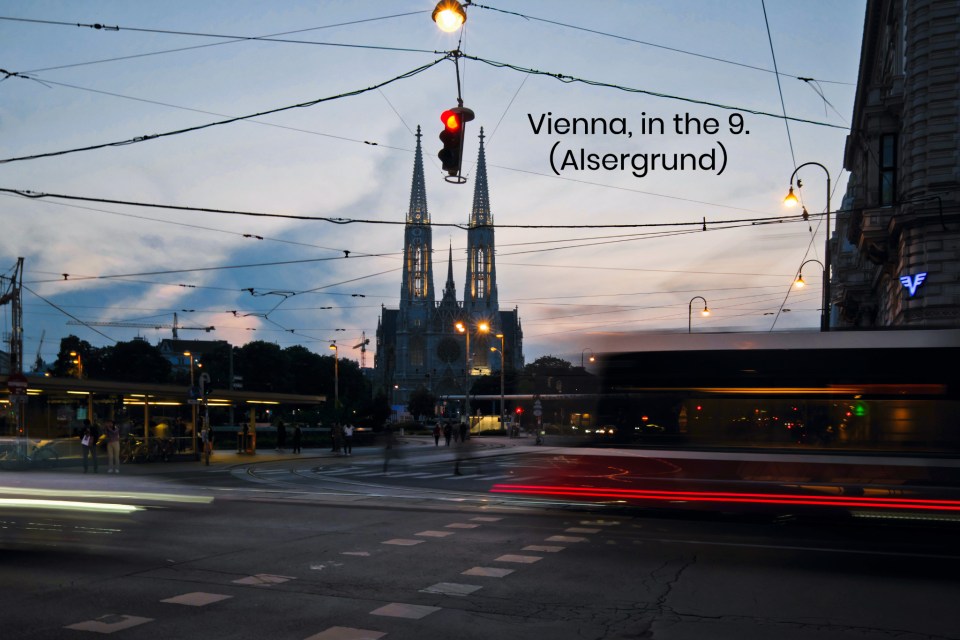
Above/featured: Votivkirche (Votive church) from Schottentor. Photo, 20 May 2023.
Two visits: two months spread over two years.
A thousand kilometres of walking.
Hundreds of historical spots and locations tracked, spotted, and photographed.
It makes sense that out of Vienna’s 23 city districts, I’ll frequent some more than others. The 1st district, or the Innere Stadt, is unavoidable, because that’s where most visitors to the city will congregate. The 2nd (Leopoldstadt) and the 6th (Mariahilf) are districts where I had separate month-long stays. But it’s the 9th district (Alsergrund) into which I wandered through countless times, including tracking my way to the 18th and 19th districts.
Out of many interesting little spots in Alsergrund, I’ve highlighted nine examples from a historical “mélange” of architecture, Jewish culture, medicine, music, and physics. If you’re wondering about the Votivkirche (Votive Church) in the image above, I’ll have more about the church in future posts about Ringstrasse (Ring Road) architecture as well as the architectural works by Heinrich Ferstel.
9 in the 9.
- Dr. Ignaz Semmelweis statue
- Incineration plant at Spittelau
- Jewish cemetery Rossau
- Physics institute (2nd)
- St. John of Nepomuk Chapel
- Shoah Holocaust Wall of Names
- Sigmund Freud memorial stele
- Strudlhof steps
- Vivaldi memorial
Dr. Ignaz Semmelweis Denkmal
Ignaz Semmelweis memorial, Medical University of Vienna
Located in the sprawling university campus is a memorial statue to Hungarian-Austrian medical doctor Ignaz Semmelweis (1818–1865). In mid-19th century Vienna, the rate at which women died from “childbed fever” after giving birth was at an alarming 20 to 25 per cent. Working in the city’s first Obstetrical Clinic, Semmelweis instituted the hygienic procedure of hand-washing. The subsequent death rate from postpartum infections in 1847 plunged to 2 per cent, as proof of the evidence-based life-saving practice, long before the establishment of germ theory of disease. Semmelweis was called “Saviour of Mothers” (Retter der Mütter) for insistence and foresight. In recognition of Semmelweis, the university commissioned Hungarian artist Péter Párkányi Raab to create the memorial which was unveiled in an official ceremony in 2019.
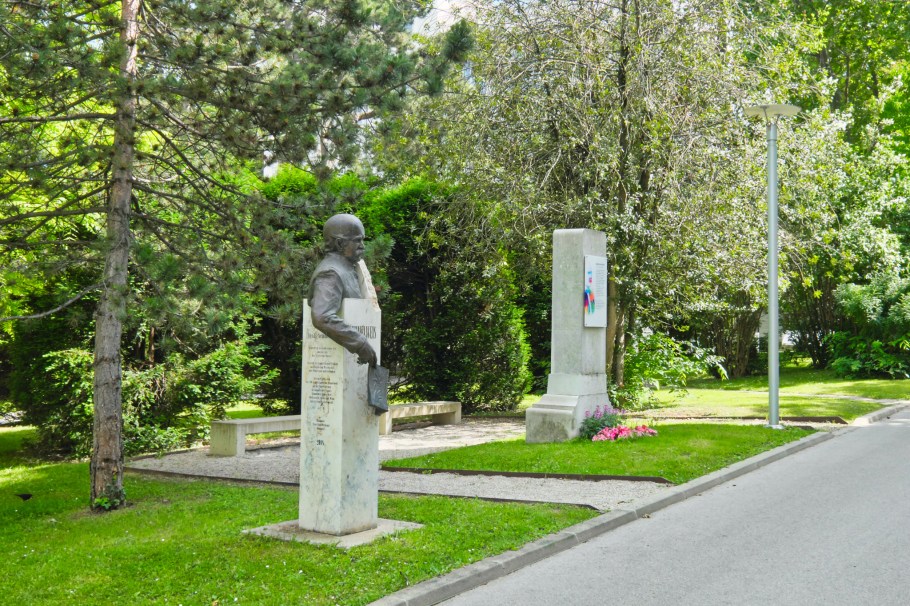
Descriptions around the memorial are provided in three languages: German, English, and Hungarian. Photo, 30 May 2022.
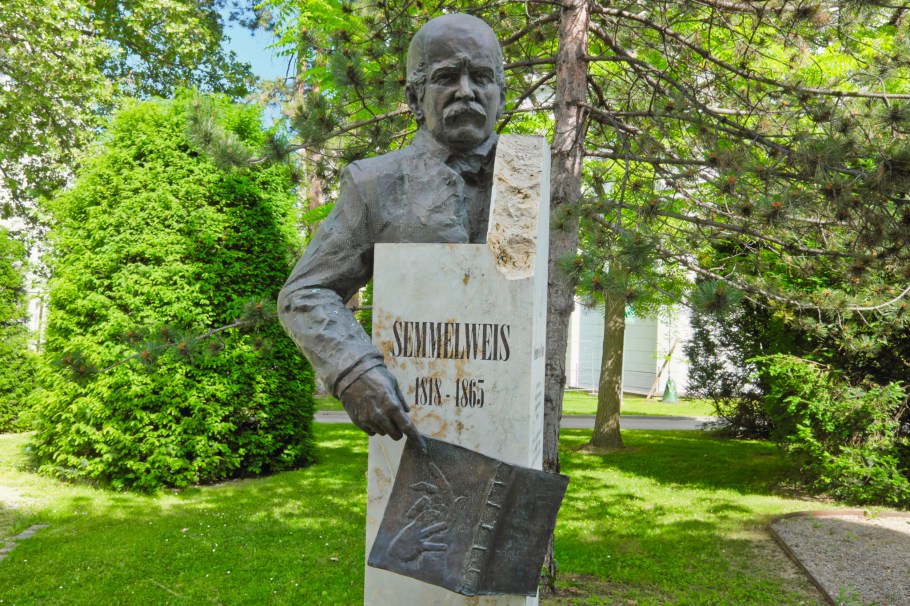
Semmelweis points to a pair of hands in the washing/rinsing gesture. Photo, 30 May 2022.
Müllverbrennungsanlage Spittelau
Incineration plant at Spittelau
Friedensreich Hundertwasser’s distinctive colour and design is all over a landmark that’s visible from around the city (e.g., Leopoldsberg). The city constructed a district heating facility in Spittelau in 1969. After fire destroyed much of the facility in 1987, Austrian artist and environmentalist Hundertwasser undertook the design of the new facility with colour splashes, rounded shapes, hanging plants, and a large shiny golden globe to the top of the incineration stack. The entire facility is operated today by city utility Wien Energie.
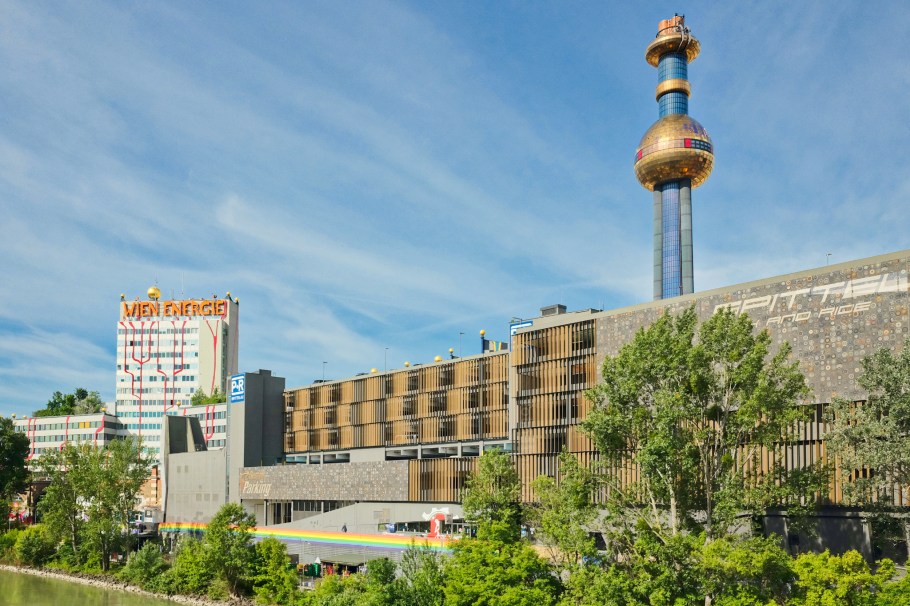
Müllverbrennungsanlage Spittelau, from Spittalauer Steg. Photo, 31 May 2022.
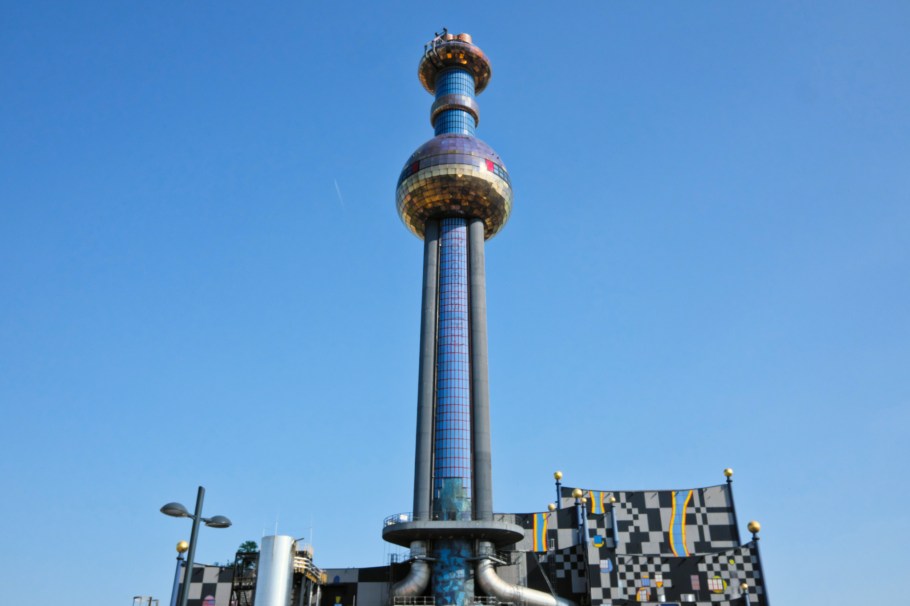
Müllverbrennungsanlage Spittelau, from Bahnhof Spittelau. Photo, 3 Jun 2023.
Jüdischer Friedhof Rossau
Jewish cemetery Rossau
The oldest preserved Jewish cemetery in Vienna and Austria is located in the courtyard of a senior citizens’ residence in the Rossau neighbourhood. First opened in the 14th to 15th-century, the 2000-m2 (0.5-acre) cemetery served the city’s Jewish community until 1783, when burial functions were moved to the cemetery in Währing. About 300 of the 900 graves have been restored in the cemetery, which is now managed by IKG Wien. With construction and renovation activity, the grounds of the cemetery are closed to the public (2023). However, public access is available free of charge with the observation platform in the courtyard of the Haus Rossau retirement home.
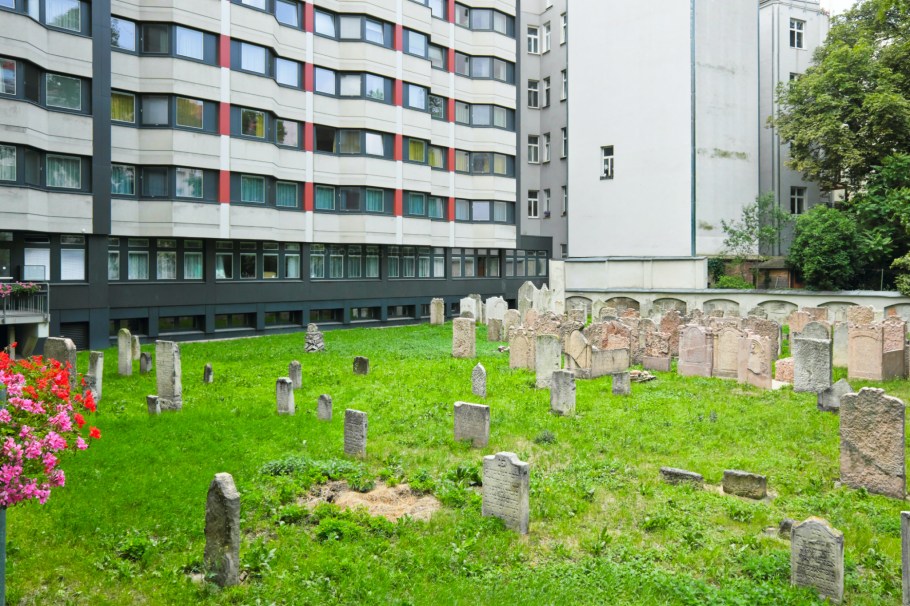
Jewish gravestones, Haus Rossau seniors’ home. Photo, 8 Jun 2022.
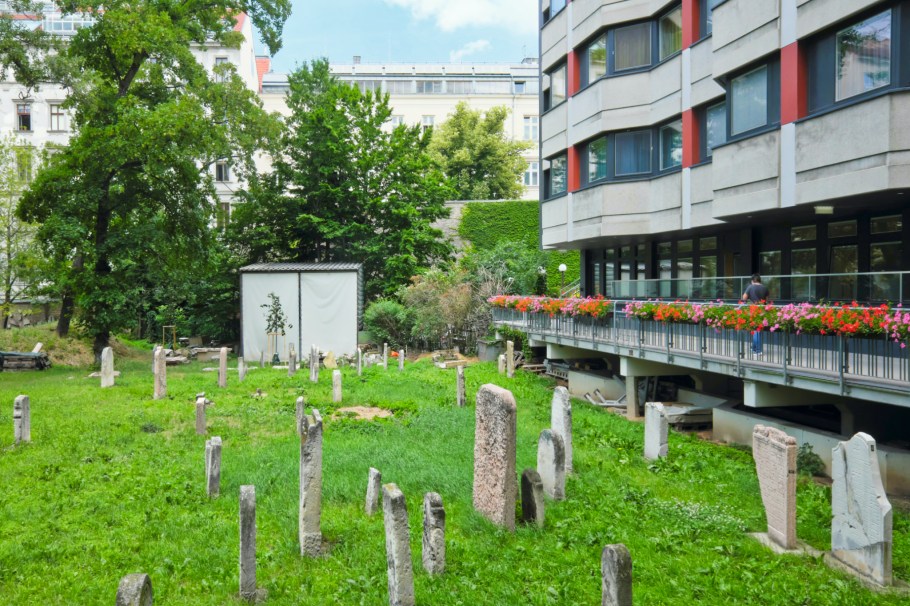
Jewish gravestones, Haus Rossau retirement home. Photo, 8 Jun 2022.
Physikalisches Institut
Physics Institute (2nd)
This is a nod to my background and training in physics. From 1875 to 1913, the building at Türkenstrasse 3 was the location of the University of Vienna’s second Institute of Physics, serving as home to many physicists, including Ludwig Boltzmann, Victor Hess, Lise Meitner, Stefan Meyer, Erwin Schrödinger, and Josef Stefan. With a new larger building about 800 metres north at Strudlhofgasse, the third institute of physics opened in 1913. The renovated building on Türkenstrasse is now home to a student dormitory, Café Afro, and space administered by the Archdiocese of Vienna. A large memorial plaque is mounted on the exterior wall facing Türkenstrasse.
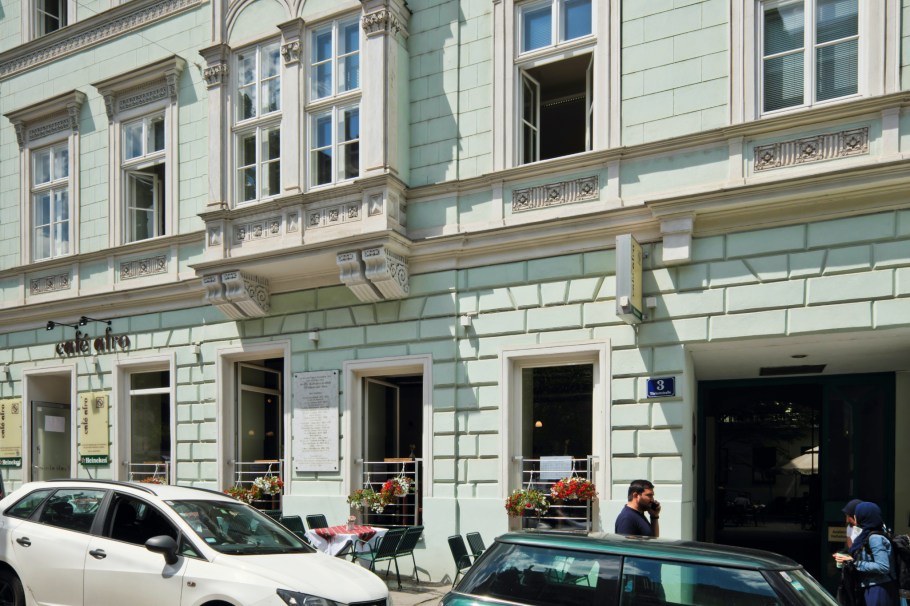
At Türkenstrasse 3, a large plaque is mounted on the outside wall of Café Afro, which offers weekday lunch specials including vegetarian and vegan options. Photo, 30 May 2022.

This location was home to many world-renowned physicists. Photo, 30 May 2022.
Sankt-Johannes-Nepomuk-Kapelle
St. John of Nepomuk chapel
Hidden in plain sight a mere 200 metres south from U-Bahn station Währinger Strasse is a modest church on one side of Währinger Gürtel (Währing Belt Road). Designed by Otto Wagner, the 1895 St. John Nepomuk chapel in the Secession style opened in conjunction with the new metropolitan railway Gürtellinie (belt line); Währinger Strasse station first went into operation in 1895. The chapel served as direct model and predecessor to the grand St. Leopold church at Steinhof, which he completed in 1907. Not surprisingly, the Steinhof church resembles the earlier Nepomuk chapel, especially the rounded dome.
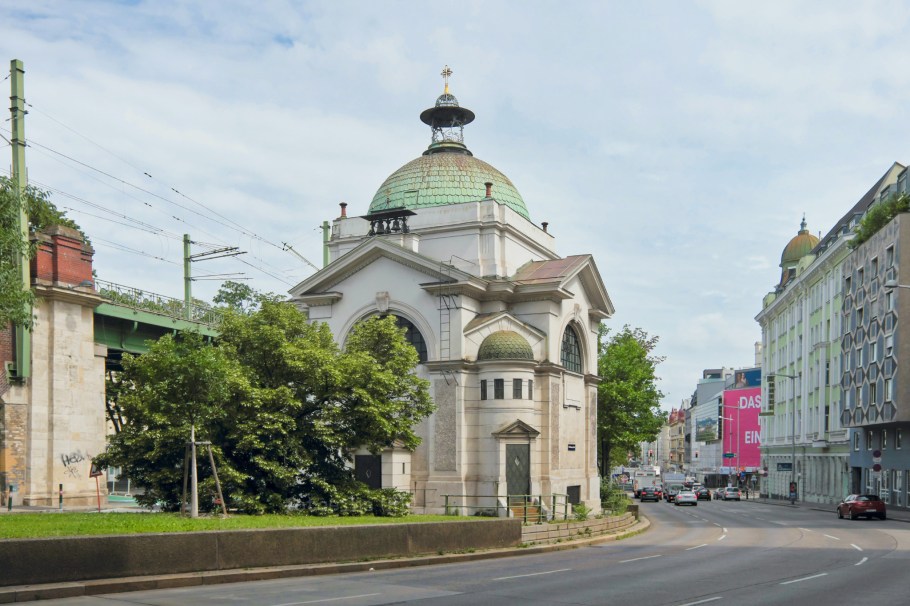
North along Währinger Gürtel. Photo, 8 Jun 2022.

Northwest, from Klammergasse. Photo, 8 Jun 2022.
Shoah Namensmauern Gedenkstätte
Holocaust Wall of Names memorial site
In Ostarrichi Park, the Shoah Namensmauern Gedenkstätte (Holocaust Wall of Names Memorial) is dedicated to Austrian Jews murdered and disappeared by the Nazi regime. The names of over 64-thousand children, women, and men are engraved onto 160 granite slabs arranged in the park as an oval ring. The names include Egon Friedell, Elise Richter, Alma Rosé, and Benjamin & Ester Tutter. The memorial opened in an official ceremony on 9 November 2021 on the 83rd anniversary of the 1938 Pogrom.

Memorial entrance. Photo, 25 May 2022.

Surnames “N” and “O”. Photo, 25 May 2022.
Sigmund-Freud-Denkmal
Sigmund Freud memorial, Sigmund Freud Park
One of the many traces to Sigmund Freud (1856–1939) is located in the park named after him. The Freud stele (stone memorial) is inscribed with Greek letters psi (Ψ) and alpha (Α) to represent Freud’s abbreviation for psychoanalysis, and a sentence from his 1927 essay “Die Zukunft einer Illusion” (The Future of an Illusion): “Die Stimme des Intellekts ist leise.” (The voice of intellect is soft.) This memorial was inaugurated in 1985 on the 100th anniversary of his appointment as “Privatdozent” (lecturer) at the University of Vienna, which is immediately opposite the park.
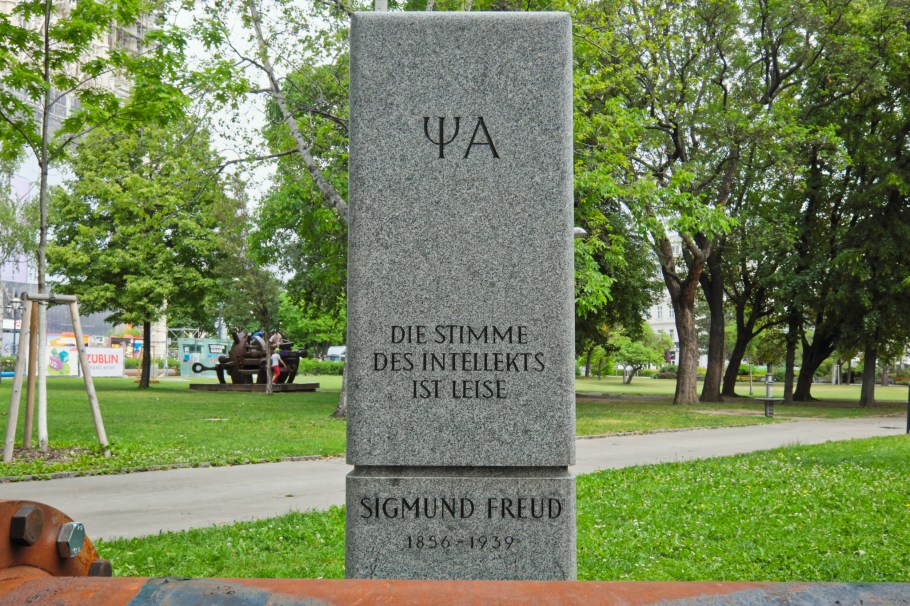
Sigmund Freud memorial stone in Sigmund Freud Park. The large pipe in the lower foreground is temporary for construction of the new U5 U-Bahn line. Photo, 25 May 2022.
Strudlhofstiege
Strudlhof steps
Designed by Theodor Johann Jaeger and completed in 1910, the Studlhofstiege (Strudlhof Steps) connected a patch of high ground with the former Alserbach creek flowing down and east to the Danube River. The Art Nouveau style staircase became the backdrop for Heimito Doderer’s abstract and experiential novel, “Die Strudlhofstiege” (1951), describing how the Viennese experienced and reacted to change in the early 20th-century. The structure honours Imperial painter Peter Strudel (1660–1714) who established in Vienna the Akademie der bildenden Künste (Academy of Fine Arts), one of the oldest arts academies in Europe.

Strudlhof steps, from the base at Pasteurgasse. Photo, 24 May 2023.
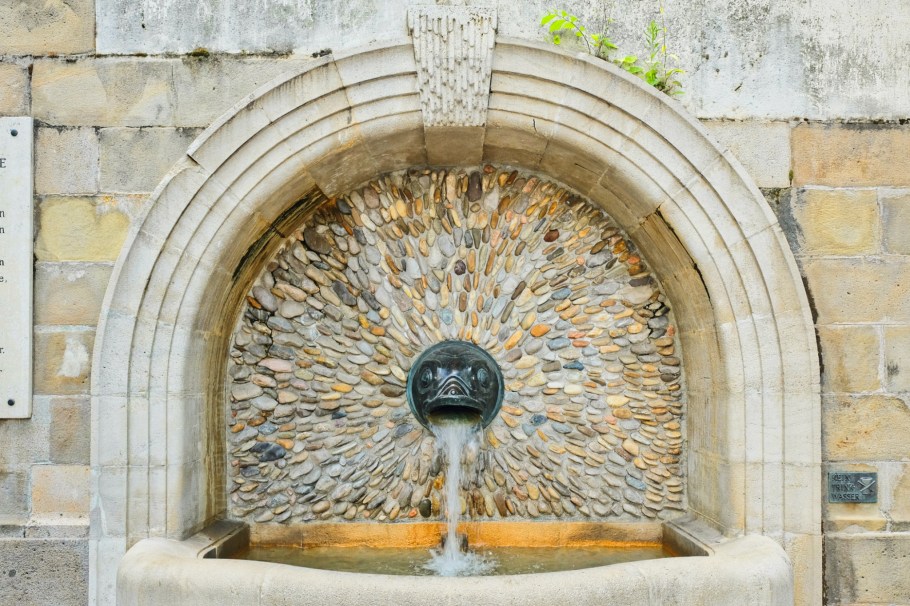
Fish-head fountain, at mid-level. Photo, 30 May 2022.

Next to the fish-head is a panel with the first few lines from Doderer’s novel “Die Strudlhofstiege”. Photo, 24 May 2023.
When the leaves upon the steps are lying,
from the old stairs is heard an autumn sighing
of all that’s gone across them in the past.
A moon in which a couple, holding fast,
embraces, lightweight shoes and heavy footfall,
the mossed urn in the middle, by the wall,
outlasts the years between the wars and dying.
So much is past and gone, to our dismay,
And beauty shows the frailest power to stay.( 2021 English translation by Vincent Kling, as provided by the Doderer Gesellschaft. )
Vivaldidenkmal
Memorial to Antonio Vivaldi, Votivpark
The name “Vivaldi” is best known for “The Four Seasons” violin concertos, completed around 1720 in Mantua. However, the Italian composer Antonio Vivaldi would spend the final year of his life in Vienna. At the north end of Votivpark behind the church is a Vivaldi memorial, created by Italian sculptor Gianni Aricò and unveiled in 2001. Additional markers to Vivaldi in Vienna’s inner city include (the approximate position of) Vivaldi’s grave in a former church cemetery and his apartment next to the former Kärntnertor Theater.
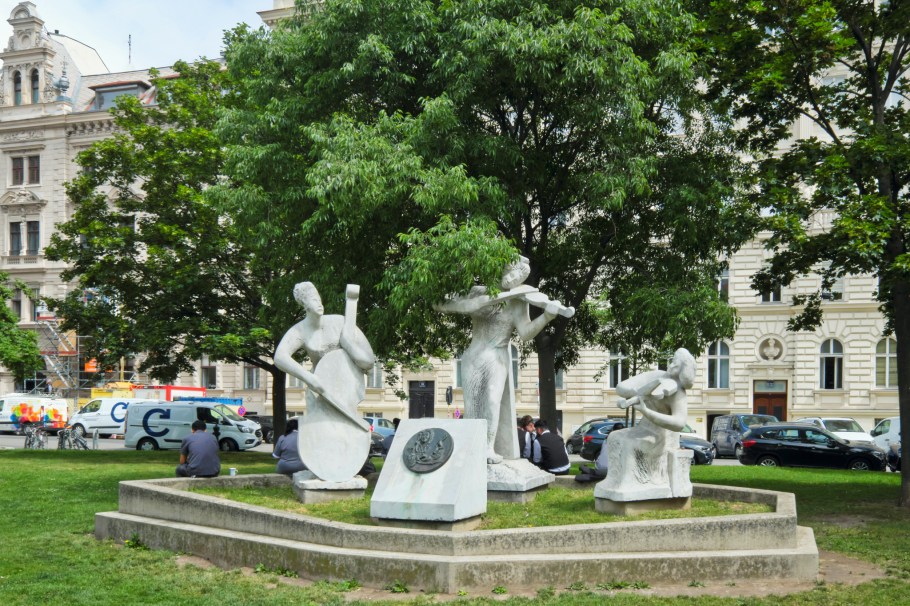
North end of Votivpark, “behind” the church. Photo, 25 May 2022.
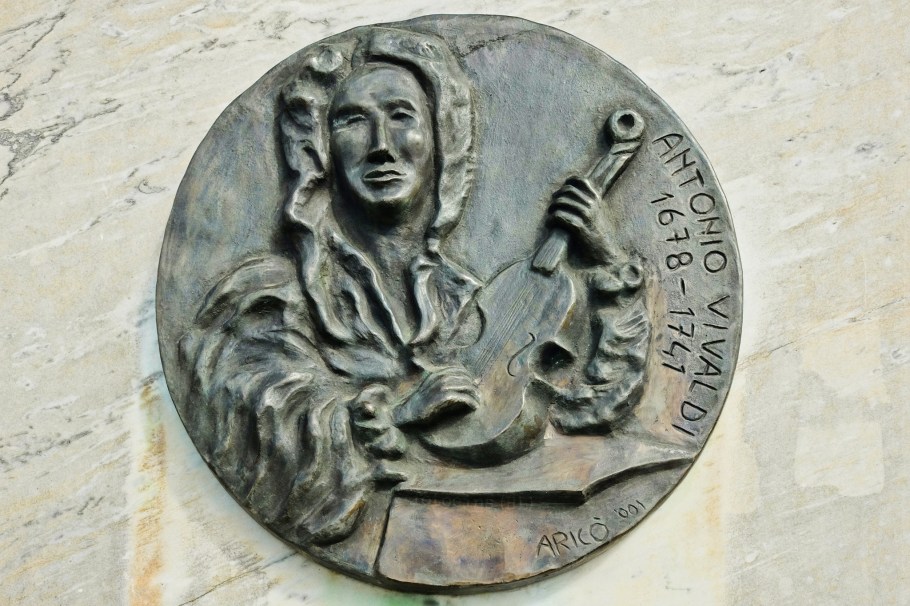
Front: “Antonio Vivaldi, 1678–1741. Aricò `001”. Photo, 25 May 2022.
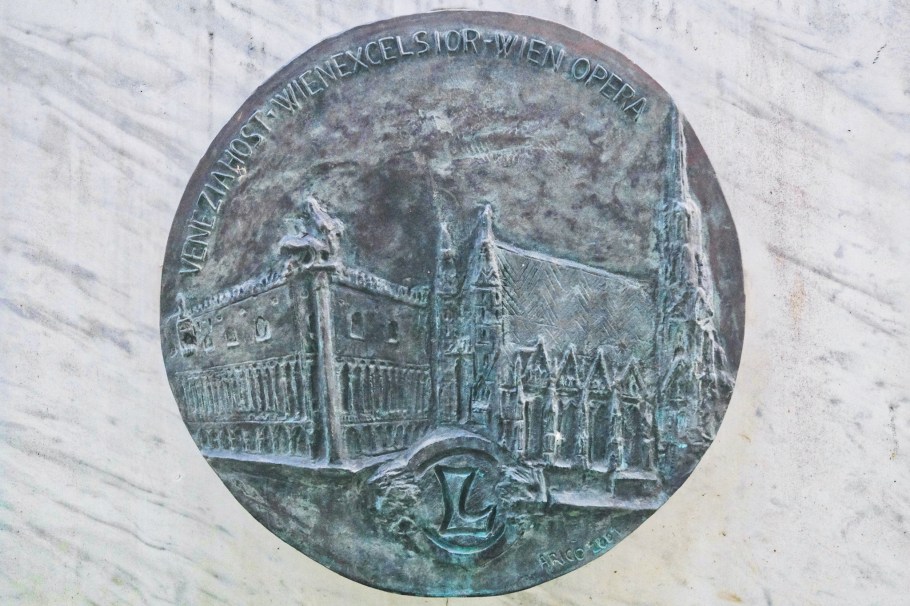
Back: “Venezia Host – Wien Excelsior – Wien Opera. Aricò 2001”. Photo, 15 May 2023.
I made all images above in the summers of 2022 and 2023 with a Fujifilm X70 fixed-lens prime. This post appears on Fotoeins Fotografie at fotoeins DOT com as https://wp.me/p1BIdT-nro.
 Fotoeins Fotografie
One Response to “Vienna: 9 spots in the 9th district”
[…] 1966. • Austrian writer; his novel “Die Strudlhofstiege” named after the outdoor staircase in the 9th district. • Dr. phil. Franz Karl Heimito Doderer: group 10, row 2, number […]
LikeLike