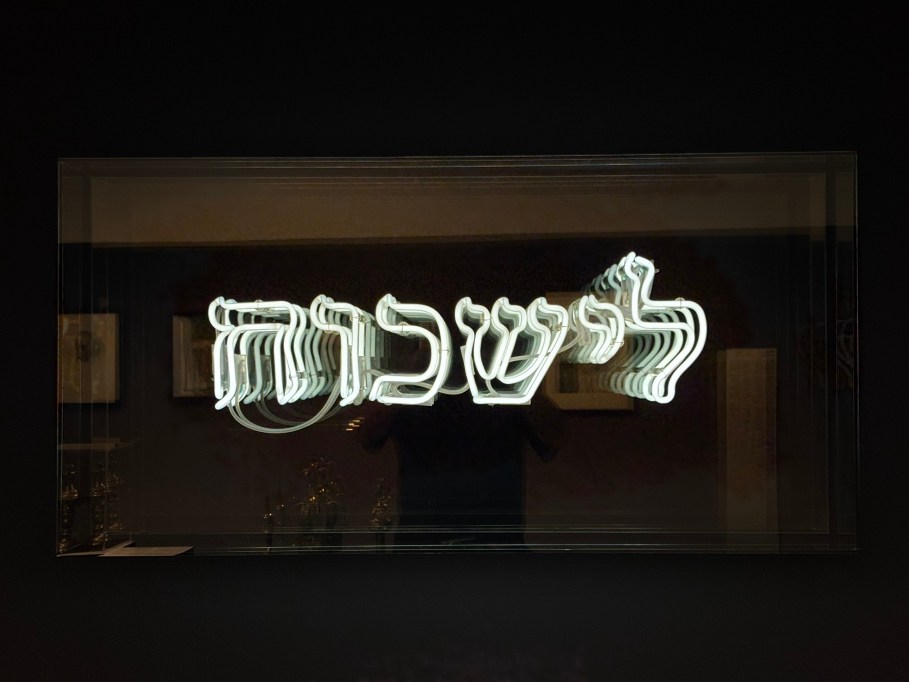
By definition, a “votive” is an object offered in fulfillment of a solemn promise.
Having survived an assassination attempt in 1853, Austria’s Emperor Franz Joseph promised to construct a church in gratitude. That’s how Vienna’s Votive Church came to be in 1879 with the design by first-time architect Heinrich Ferstel.
Suspended Infinity
In mid-December 2025, Austrian artist Billi Thanner unveiled her light sculpture, “Unendlichkeit des Lichtes” (Infinity of Light), placed between the two towers of the Votive Church. The art work is a 28- by 6-metre aluminum loop weighing 800 kilograms, and includes almost 5000 lights. The sculpture wraps around both towers in a figure-eight; but sitting on its side, the visual is also the mathematical symbol for infinity (∞).
The significance for the number 8 is its representation of the time taken by light to travel from the Sun to the Earth. As for “infinity”, Thanner explains:
Licht ist für mich das Leben. Und irgendwann kam der Impuls: die Unendlichkeit im Licht sichtbar machen. Nicht abstrakt, sondern real im Stadtraum — zwischen den beiden Türmen dieser Kirche
Light is life itself. The impulse came to me at some point: to make infinity visible in the light. Not in its abstract nature, but something real in the urban space — between the two towers of this church.)
What’s a little unusual is that this sculpture and its installation have been financed entirely through private sources: no public money and no church donations. Thanner also waived her commission fee, essentially making this years-long project one out of total independence and personal dedication.
While the sculpture’s attachment to a church building makes a direct association with religion or spirituality, I feel there’s something simpler and more fundamental. Billi Thanner’s sculpture reminds us to do better for and to be better with each other as people. That’s in part a promise I made after accompanying my parents to the end. I’m inspired by Thanner’s light to try a little more with every passing day, despite spectacular failure and disappointment.
The light sculpture will remain in place until May 2027.
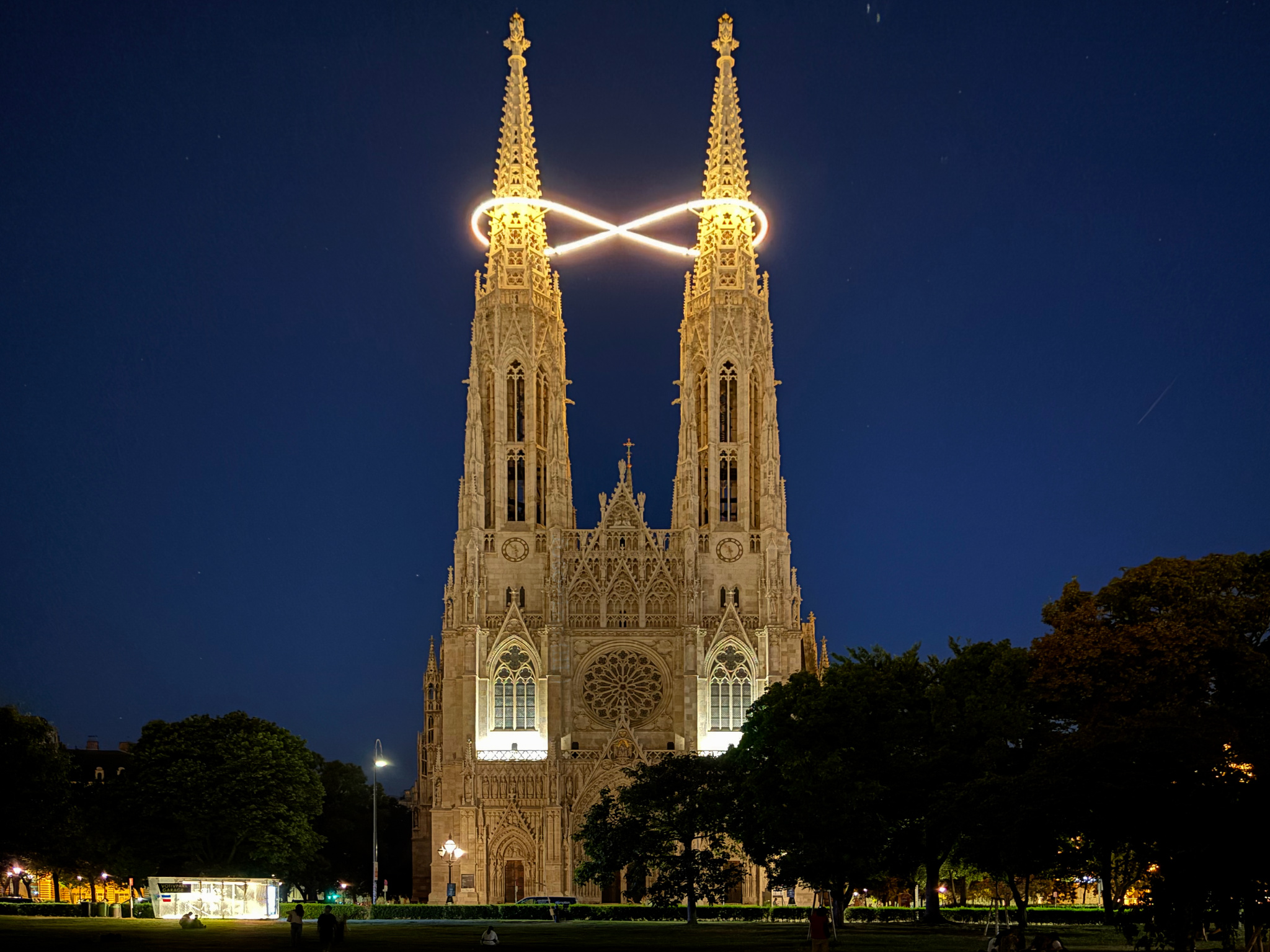
Votive Church from Sigmund-Freud-Park, 28 Jun 2026; image corrected for geometric distortion.
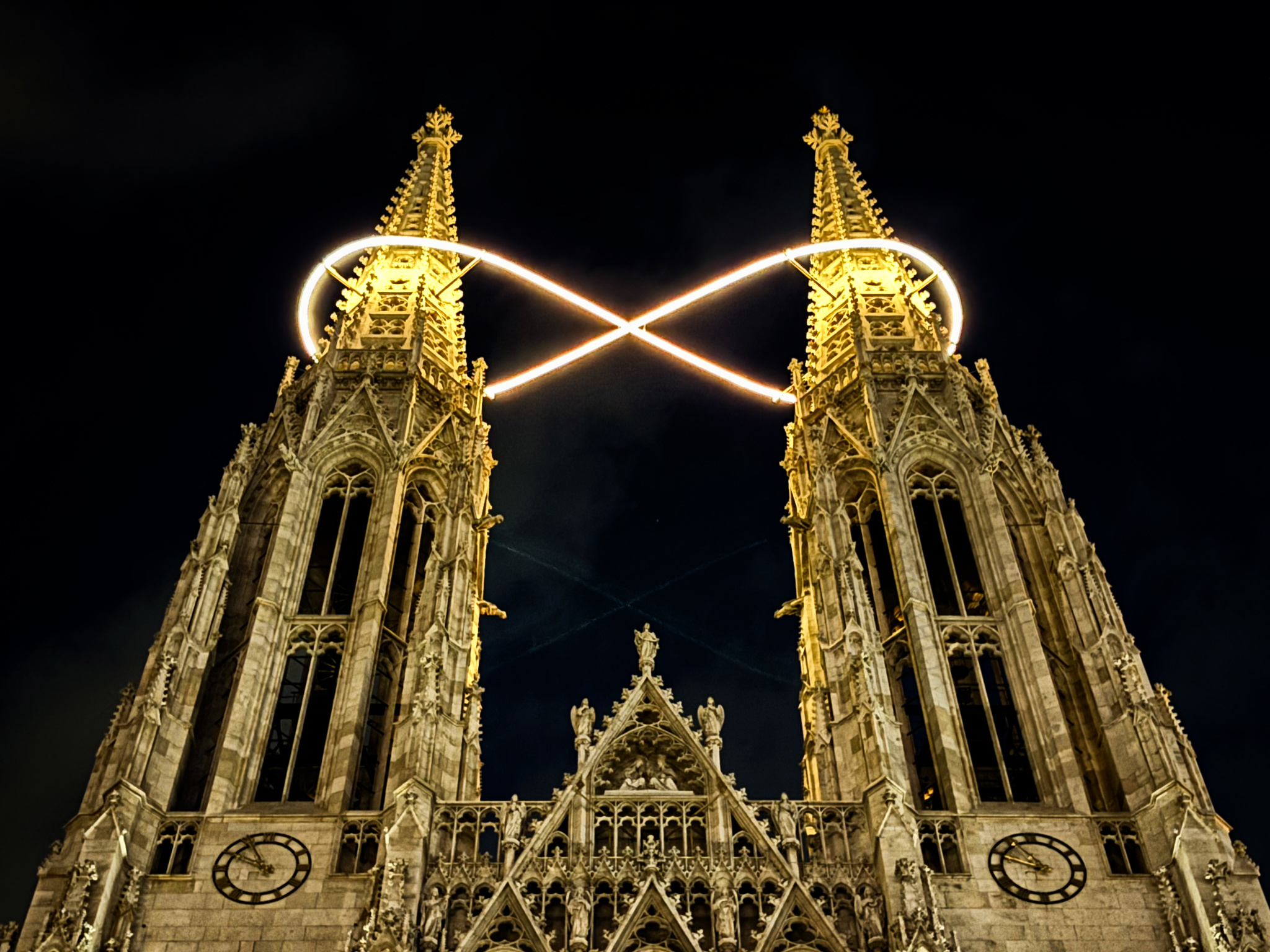
Votive Church from Sigmund-Freud-Park, 18 Jul 2026.
7.5 minutes: light-display recorded 18 Jul 2026. The dynamic display appears to occur at the top of every hour at night, but I didn’t go out to check past midnight (heh).
Für mich war diese Skulptur nie nur eine Lichtinstallation. Sie ist eine Möglichkeit, Menschen für einen Moment an Hoffnung, Freude und ihre Verbundenheit zu erinnern. Gerade in einer Zeit, in der vieles trennt, kann Kunst Räume öffnen, die Menschen wieder miteinander in Verbindung bringen.
For me, this sculpture was never just a light installation. It’s a way to remind people, if only for a moment, of hope, joy, and their close connections. In these divisive times, art can open spaces that bring people together again.
– Billi Thanner.
I received neither pre-visit support nor post-visit compensation fot this entry. I made all media above on 28 June and 18 July 2026 with an iPhone15. This post appears on Fotoeins Fotografie at fotoeins DOT com as https://wp.me/p1BIdT-z2V.
48.215401
16.359082