19 Feb 2020 0401 GMT+0000
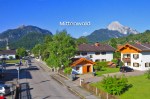
Above/featured: From the regional train: facing southwest over Schöttlkarstrasse and the eastern end of the Wettersteinwand at right.
In 1786, the German writer Johann Wolfgang von Goethe described the alpine town of Mittenwald as “lebendes Bilderbuch” – a living picture-book. Images and descriptions in print and provided by visitors became a real draw and lure. Funny thing is I’d stayed in nearby Garmisch-Partenkirchen several times, and I hadn’t taken the easy 20-minute train hop to Mittenwald.
I took care of that with two visits within a span of 15 months: with snow and without snow.
Wandering through Mittenwald is pure delight because of abundant fresh mountain air, picturesque surroundings, and the compact nature of the town. The description becomes a common refrain for alpine towns.
Mid-winter is special with the combination of seeing mountains freshly frosted with snow, people of all ages wearing masks and costumes during carnival season, houses painted in colourful “Lüftlmalerei”, and the town’s special place in music history. When the warm sun dominates in spring and summer, it seems like an endless vista of blue skies along with green meadows and mountains to accompany your time outside on walks and hikes in the area.
With about 7400 residents, Mittenwald is about 100 kilometres (60 miles) south from Munich, located in what’s locally called “Werdenfelser Land” within Landkreis (county) Garmisch-Partenkirchen. The town lies conveniently between the town of Garmisch-Partenkirchen and the city of Innsbruck (Austria); the Mittenwald railway provides a vital connection to all three places. The nearby towns of Klais, Krün, and Wallgau also provide easy access to Mittenwald.
I describe the following in Mittenwald:

“Welcome to the Upper Isar Valley“, Mittenwald train station – 30 May 2018.
The “Buckelwiesen” can be translated as “hummocky meadows” or a wide stretch of alpine grassy fields with mounds or small rounded hills. The Buckelwiesen are under legal environmental protection, because they are the largest remaining area of relatively pristine alpine meadows which were at one time commonly widespread throughout the Alps and their surrounding foothills. Strict preservation rules apply to human activity. Farmers must use traditional methods: grass is cut manually (e.g., with scythe), fertilizer use is forbidden, and sheep and goats are allowed to graze on the meadows. The unique landscape and its ongoing treatment have been submitted by Germany to UNESCO for consideration as World Heritage Site. While keeping to clearly marked walking trails, these meadows are easily accessible from Mittenwald (info, in German).

Facing northeast, on train from Mittenwald to Garmisch-Partenkirchen – 30 May 2018.

Facing north-northeast, on train from Mittenwald to Garmisch-Partenkirchen – 30 May 2018.
The Geigenbaum is a giant violin created by Mittenwald brothers Bernhard and Stefan Adam. Symbolizing the history of violin-making, the wood sculpture has stood as landmark in the town’s oldest neighbourhood Im Gries since 2009. But time and weather have taken its toll on the sculpture, as a stormy evening in November 2019 tore the sculpture into two pieces. Although expensive, the town’s residents were more than willing to come up with funds for the replacement sculpture, recognizing the history of wood-carving and violin-making in this neighbourhood, town, and region. A new violin sculpture was unveiled to the public in June 2020.

Wood violin sculpture – 3 Mar 2017.
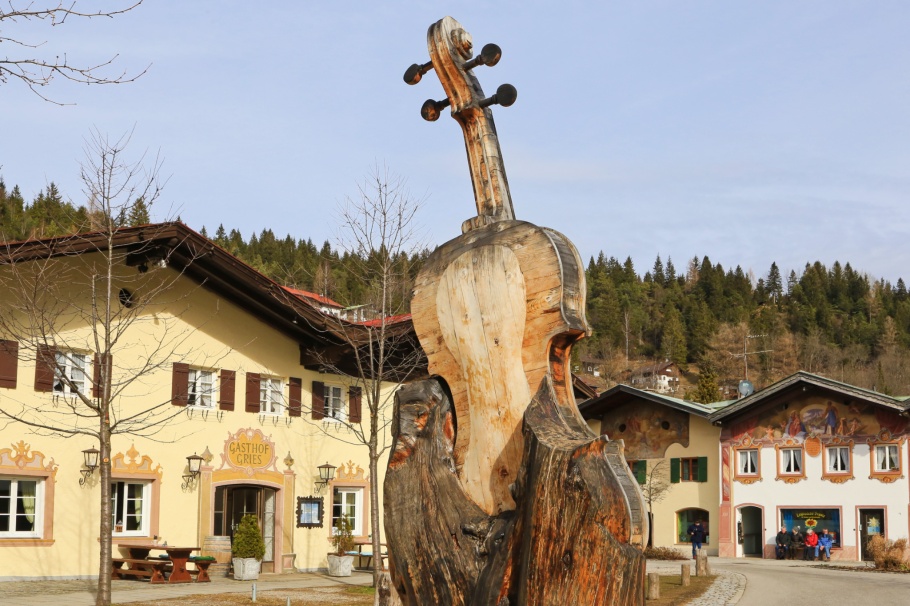
Wood violin sculpture – 3 Mar 2017.
There’s something special about the region’s spruce and maple trees (e.g., Alpentonholz) and the subsequent tonewood grain and colour are selected specifically to create a unique sound to the specifications of the violin maker and demands of the violinist. As one of the European centres for violin-making, the Mittenwald scene took advantage of the local forests and existing trade routes between northern and southern Europe with a dominant role played by the Klotz family from the late-17th and well into the 18th-century. Founded in 1930, the Geigenbaumuseum or violin-making museum has been housed inside the Hollbeck House at address Ballenhausgasse 3 since 1960. The father of violin-making, Matthias Klotz, is honoured with a memorial statue at the northern end of Obermarkt.

Renovated Hollbeck-Haus, with 1764 wall fresco by Franz Karner – 28 Feb 2017.

This building at Ballenhausgasse 3 has been inscribed by the Bavarian State Office for Monument Protection (Bayerisches Landesamt für Denkmalpflege, BLfD) as heritage property D-1-80-123-4. Photo on 2 Mar 2017.

Pre-lacquered pre-finished “white” violins – 28 Feb 2017.

Path of a violin, from upper left to lower right – 28 Feb 2017.
One of the great traditions in this part of southern Bavaria is the history of wood carving. Similar to what’s happening in nearby towns (e.g., Oberammergau), the struggle in Mittenwald has been about maintaining the quality and number of hand-crafted objects against the overwhelming surge of globalized industrialization and the increasing popularity of 3D-printing machines. Perhaps, being made to wait and being made to pay more invites a personal touch to the carving; then and only in that case, all may not be completely lost.
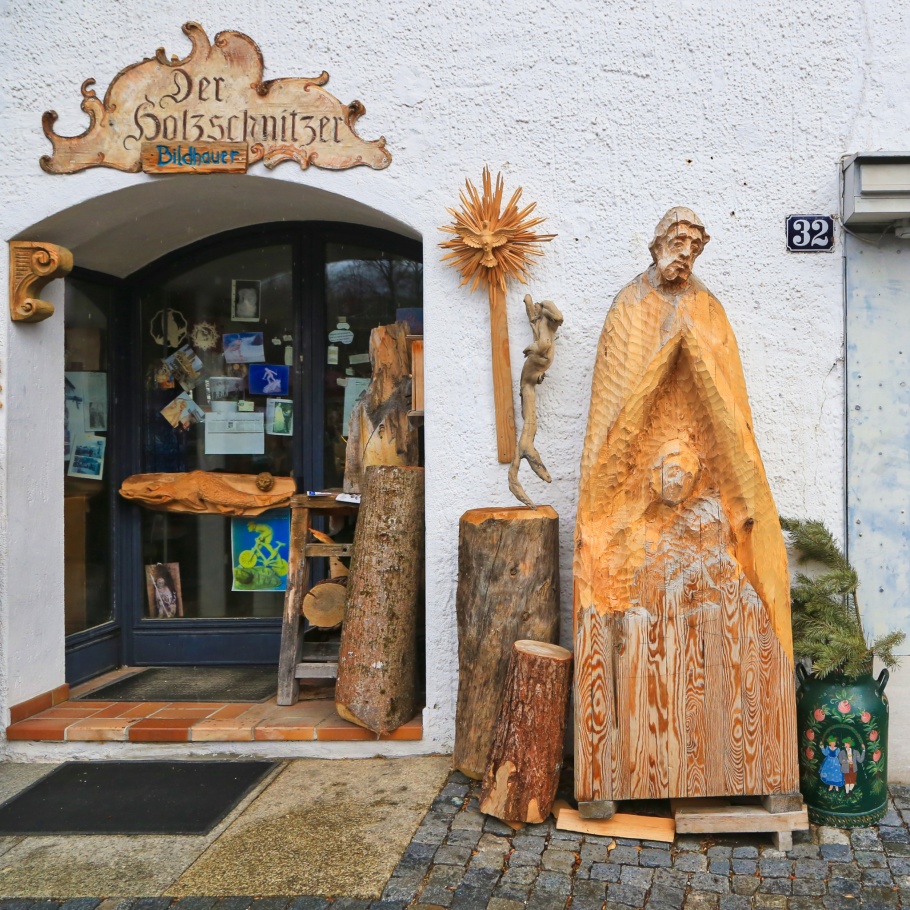
Im Gries 32: “Der Holzschnitzer (Bildhauer)” // The wood carver (statuary) – 2 Mar 2017.

Dove-like.

Christ-like.

Skier-like.
In southern Germany, an entertaining aspect of the Fasching carnival season is the wearing of “Holzlarven” masks which are individually hand-crafted from wood. A common festival costume is the “Flecker-Gwand” made with colourful patches or flecks which are custom-sized for children or adults. This all happens before Catholic Lent; the festival honours the pagan ritual by chasing away the evil spirits of winter and inviting spring’s arrival as quickly as possible.

Larve für Erwachsene (masks for adults): Mittenwalder Handarbeitsstüberl – 28 Feb 2017.

Right: Fleckerl-Gwand costume “for sale”, all sizes (available) for children and adults”. Mittenwalder Handarbeitsstüberl – 28 Feb 2017.

Scary enough to ward off winter’s evil spirits? Photo on 28 Feb 2017.

Young Mittenwalders on the drums – 28 Feb 2017.
The oldest part of Mittenwald is called “Im Gries” whose buildings are beautifully painted with the “Lüftlmalerei” and includes the locations of the violin tree (Geigenbaum), wood carver (Holzbildhauer), and the home of famous violin-maker Anton Sprenger. Im Gries is part of the town ensemble under heritage protection provided by the Bavarian State Office for Monument Protection (Bayerisches Landesamt für Denkmalpflege, BLfD) as ensemble property E-1-80-123-2.

Im Gries: a cold wet winter day, but the colours are like a warm glow here – 2 Mar 2017.
Mittenwald is about 15 km from the headwaters or source of the Isar river in Austria’s Hinterautal valley below the Karwendel Alps. The word “Isar” has Roman-Celtic origins with “Isaria“, meaning “rapids” or “torrent”. Many in Munich will be familiar with the Isar river which flanks the Englischer Garten city park and with the river’s offshoot into Eisbachwelle creek where year-round urban surfing takes place. No water-surfing in Mittenwald, though.

Facing southwest, local-access bridge over the Isar – 30 May 2018.
Every 30 minutes, the Karwendel cable car whisks visitors from the valley station (Talstation) at 933 metres (3061 feet) up to the mountain station (Bergstation) at an elevation of 2244 metres (7362 feet) with the trip lasting about 10 minutes. Upon arrival, visitors can walk the 450-metre tunnel under the rock face to the Dammkar or head up to the Karwendelgrube (Karwendel bowl) to enjoy views of the German and Austrian Alps.

WINTER: east end of the Dammkartunnel, and down into the steep Dammkar ski run – 27 Feb 2017.

SPRING: Dammkartunnel down onto Mittenwald (lower centre), Isar river valley from lower-left to upper-right – 30 May 2018.

SPRING: from top of Mittlere Karwendelgrube, straddling the AT-DE international border, facing east to Austrian Alps – 30 May 2018.
Matthias Klotz (1653-1743) is considered the father of violin-making in Mittenwald. From a humble workshop starting around 1689, he and his apprentice turned successors pushed the town to the forefront and heights of producing violins of the highest quality, the traditions for which continue today in town with active workshops and an instrument-making school. In front of the Peter and Paul church is the Matthias Klotz monument constructed by Ferdinand von Miller in 1890.

Next to Peter and Paul church is the memorial statue of Klotz which has been inscribed by the Bavarian State Office for Monument Protection (Bayerisches Landesamt für Denkmalpflege, BLfD) as heritage property D-1-80-123-89. Photo on 28 Feb 2017.
Paths in open fields north of town are included in the network of European pilgrim roads called Jakobsweg (St. James’ Way) running north-south through Mittenwald. On a clear day, I’m alone in the fields, far from clusters of other visitors. From the ground, the unobstructed view of the Karwendel mountains is unmatched.

View northeast from Lainbacher Felder – 2 Mar 2017.

View southeast from Lainbacher Felder: the mountain station for the Karwendelbahn is near the centre of the upper ridge. Photo on 2 Mar 2017.
In the southern reaches of town near the location where the Leutasch river merges with the larger Isar, a path through a series of meadows leads to the Leutasch gorge and waterfall, both open only during summer season. It’s another part of town that’s quietly mine and far from the usual visitors. These paths are also a part of the network of European pilgrim roads called Jakobsweg (St. James’ Way) through Mittenwald.

Facing south at Leutascher Ache: at centre is the Arntalköpfle (elevation 1529 metres / 5016 feet) sloping gently down and to the left towards the unseen border town of Scharnitz in the distance. Photo on 3 Mar 2017.

Next to the Leutasch canal is this vacation house Ferienwohnung Johanna with the Karwendel behind – 3 Mar 2017.
When Martin Luther was called to meet with papal authorities in 1510-1511 on behalf of a number of Augustinian monasteries, he walked from Wittenberg to Rome and back; many have suggested he stopped in Mittenwald and stayed for at least one night in 1511. This 1983 stone commemorating his (possible) stay in Mittenwald appears at the entrance to the town’s evangelical (Protestant) church.
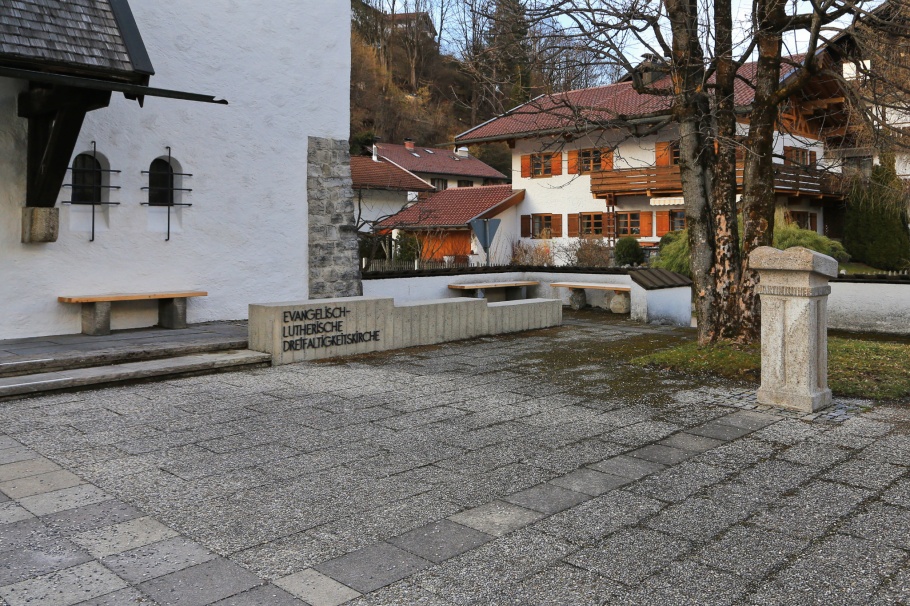
Near the entrance to the evangelical church is the Luther memorial stone, seen here at right – 2 Mar 2017.
Obermarkt is a quarter-kilometre pedestrian north-south road through the heart of the Old Town with cafes, hotels, shops, and restaurants on both sides of the street. With vehicular traffic strictly controlled, many sit outside in the sun to sip their beverages and watch people and the world go by. At the north end of Obermarkt is the Peter and Paul Church (visible at centre in the image below) where the memorial statue to Matthias Klotz also resides.

North to Peter and Paul church, on a warm winter morning – 27 Feb 2017.
A wooden raft installed at Platzl (“little plaza”) highlights the medieval history of wooden rafts and their construction (Flösser, Flossbau), and how river rafts on the Isar were critical to north-south trade and the local economy. Mittenwald was once a stage for transporting goods between Venice/Italy in the south and Munich/Bavaria to the north (via Brenner Pass and Innsbruck). With trade shifting over time to a different mountain pass, Mittenwald lost its importance until railways entered the picture. The word “Floss” is the preterite tense for “fliessen” which is the German verb “to flow”, and is similar to “Fluss”, the German word for “river”.

Replica river raft at Platzl: rafts on the Isar once carried goods from Mittenwald to Munich and Landshut. Photo on 2 Mar 2017.

Mahlzeit! High-noon decisions for the next meal – 27 May 2018.
Possible lunch options at Zum alten Rathaus (At the old town hall): listed on the little chalk boards at the “Metzger Imbiss” (Meat shop / snack stand) are daily specials and typical meals for the region.
For public transport to Oberammergau from Mittenwald, the routing is typically: Deutsche Bahn train from Mittenwald to Garmisch-Partenkirchen station, and at the latter station, RVO bus 9606 to Oberammergau. If returning to Mittenwald at the end of the day, check or ask about the last trips of the day by train or bus.
• “Mittenwald in Bayern: Die Gassen voller Geigen” – Deutschlandfunk, 30 Apr 2015.
• “Die Geige: die Stradivaris aus Mittenwald (so klingt eine Klotz)” – BR, 2 Apr 2012.
I made all photos above with a Canon 6D mark1 in winter (February) 2017 and spring (May) 2018. This post appears on Fotoeins Fotografie at fotoeins DOT com as https://wp.me/p1BIdT-fBN.
Posted by HL fotoeins
Categories: Arts, Culture, Europe, Germany, Industrial History, Mountains, Photography, Seasons, Spring, Travel, Winter
Tags: Alps, Bavaria, Bayern, Bergwelt Karwendel, Deutschland, fotoeins, Geigen, Geigenbau, Geigenbaumuseum Mittenwald, Holzlarven, Karwendel, Karwendelbahn, Landkreis Garmisch-Partenkirchen, Larven, Maschkera, mask, Mittenwald, Mittenwald Railway, Mittenwaldbahn, Noerdliche Kalkalpen, Northern Limestone Alps, Oberbayern, Upper Bavaria, Via Raetia, violin, violin making, violin museum, Werdenfelser Land
Mobile Site | Full Site
Get a free blog at WordPress.com Theme: WordPress Mobile Edition by Alex King.
Wonderful post, Henry. I love the wood carving tradition and the violin sculpture. Fabulous! The picture of the woman sweeping with the mask is great!
LikeLiked by 1 person
By pattimoed on 19 Feb 2020 at 1227 GMT+0000
Thanks, Patti. There are some real concerns in both Mittenwald and the region about the future of wood-carving and the future of hand-crafted violins.
LikeLiked by 1 person
By fotoeins on 20 Feb 2020 at 1234 GMT+0000
Understandably. Deforestation must be a real concern.
LikeLiked by 1 person
By pattimoed on 20 Feb 2020 at 1319 GMT+0000
Compared to other demands for wood, the effects of deforestation by wood-carving and violin-making are small, given how wood is very carefully selected, the locations of special spruce and maple trees are a local secret, and the long time-scales required for exquisite craftsmanship (e.g., months or more to dry, weeks to months to carve and complete a single piece.) What worries most is that fewer people are entering the trade because there are better paying jobs elsewhere and/or in big cities, and the threat imposed by speed and reproducibility by 3d-printing machines.
LikeLike
By fotoeins on 21 Feb 2020 at 0131 GMT+0000
Such a beautiful post, Henry, I really enjoyed it, thank you for sharing such beauty
LikeLiked by 1 person
By www.corneliaweber-photography.com on 20 Feb 2020 at 0323 GMT+0000
Thanks, Cornelia. I’m glad there were some picturesque reminders of great memories for you.
LikeLike
By fotoeins on 20 Feb 2020 at 1235 GMT+0000
Indeed, there were a lot, Henry. Tank you so much for your kind reply.
LikeLiked by 1 person
By www.corneliaweber-photography.com on 21 Feb 2020 at 0429 GMT+0000
[…] Mittenwald is a town best known for its history of violin-making, but it’s not surprising people apt at shaping wood would also create masks for the season. It’s the time of year for residents to dig out the Holzlarven (wooden masks). Some masks and costumes are available in local shops, but the tradition is carried out by residents with inherited masks and costumes some of which have been passed down over generations. The masks are supposed to hide the true identity of festival participants who might also change their speaking voice and regular gait to enhance their disguise. Whatever mischief occurs and whatever happens during Maschkera stays inside Maschkera. Letting loose also means making fun of authority, which makes the disguise an important part of past tradition to mock without threat or penalty. […]
LikeLike
By Fasching, Maschkera, Oimrausch: pre-Lent shenanigans in southern Germany on 20 Feb 2020 at 0423 GMT+0000
[…] light from the regional train between Garmisch-Partenkirchen and Mittenwald. At centre is the Karwendelbahn cable car from the town of Mittenwald up to the Karwendel mountains. There are many easy hiking trails in the […]
LikeLike
By Seasons: spring (LAPC) | Fotoeins Fotografie on 4 Jul 2020 at 1302 GMT+0000
Henry, this is such a wonderful, comprehensive look at Mittenwald. Since it’s rather close to Oberammergau, we’ve been there a few times, though usually in the cold-weather months. We thoroughly enjoyed the Geigenbaumuseum. Next time, I’d like to step into the violinmakers’ workshops — perhaps even do some hiking or hop onto the Karwendelbahn.
LikeLiked by 1 person
By Tricia A. Mitchell on 15 Sep 2020 at 1404 GMT+0000
Grüss Gott: joa und dankschee, Tricia! 😉
I really enjoyed the Geigenbaummuseum, too. In addition to the workshops, I wonder if it’s possible to have a look at the Geigenbauschule/Musikinstrumentenbauschule Mittenwald.
As you know very well, late-spring is beautiful; I can imagine what mid-summer must be like, hiking mountains and valleys during those long alpine days. I’d really like to walk more through Werdenfelser Land, wandering around the Buckelwiesen and the path between Klais and Mittenwald. Spectacular are the views from the top of the Karwendelbahn, or for the more adventurous, the actual Westliche Karwendelspitze summit. Naturally, getting around up top is easier in summer than in winter; definitely recommend going up when the snow is gone. When I was up top in May (2018), I underestimated the sun exposure, and I suffered some heat exhaustion. I stumbled back to my accommodations, cancelled my plans for the afternoon/early-evening, and stayed cool-moist. Fortunately, I was better the following morning to be on the road again, but I still felt effects for a couple of days. It was a “fascinating” experience I’ll not repeat again.
I hope this message finds you and your family happy and healthy.
LikeLike
By fotoeins on 16 Sep 2020 at 0047 GMT+0000
It sounds like you’ve been working on your Bairisch. 😉
Summer is indeed a magical time to explore that part of Germany. We were last in Oberbayern last summer. In fact, we did a pleasant hike to the top of Oberammergau’s Laber last year. Having bought some trekking poles a few months ago, Shawn and I are eager to do more hiking in Germany and beyond — many more Gipfels to reach!
Your mention of having experienced heat exhaustion is a good reminder to take it easy when at higher altitudes. I’m glad that experience didn’t disrupt too much of your trip.
Speaking of hiking, we’ve done a bit of it here in Croatia when the weather allows. For the most part, however, the temperatures have been sweltering these past few months and we haven’t been able to get out during the day very much. We’ve been in Croatia during the entire pandemic. Due to travel restrictions, we cannot get into Germany as we’d originally planned pre-pandemic. We’re not eager to travel at this time, but we were originally hoping to visit my parents this past spring.
Hope you and those you care about are also well, Henry.
LikeLiked by 1 person
By Tricia A. Mitchell on 16 Sep 2020 at 1014 GMT+0000
Hi. I enjoyed the information and loved the pictures. I came across the page, because I am always searching for information on four German wood carved chairs that I have. They are very unique I believe, as I have never seen any others exactly like them in my searches. Someone from Germany suggested this area due to the intricate wood carvings. If there’s a way I could share my pictures with you, perhaps you could get some insight. Thankyou
LikeLiked by 1 person
By Cindy Cady on 25 Aug 2023 at 0802 GMT+0000
Hi, Cindy. Thank you for your kind comment and for stopping by. I’m not a wood carver by trade, nor am I an expert in chairs (furnishings). However, it’s fairly easy for any visitor to Bavaria to see how there is an enormous wood-carving culture that’s extended to furniture, sculptures, and violin-making. I would be happy to look at your pictures, but I can’t offer any additional insight that will lead you closer to the information you seek.
LikeLike
By HL fotoeins on 25 Aug 2023 at 2145 GMT+0000