On the train southwest from central Berlin to Potsdam, there are many reasons to stop in Wannsee on a bright summer day, including the many nice big (richly decorated) villas in the city district, a memorial to Heinrich Kleist, a small cemetery where Hermann Helmholtz and Emil Fischer are buried, as well as boating clubs and the Strandbad beach next to Wannsee lake.
But I’m here for the lakeside villa purchased by German Impressionist painter Max Liebermann and his wife Martha, and another villa just down the street whose importance lies in total infamy.
Liebermann-Villa
Max Liebermann was an important late 19th-century artist, contributing to the German Impressionism movement of the time. Liebermann had by 1910 a villa constructed by Wannsee lake for their family summer getaway from Berlin. By the 1930s, he like many suffered discrimination and persecution by the National Socialists because of his Jewish heritage. He died in 1935, and in 1940, the National Socialists forced the rest of the family to sell the villa. Since 2006, the refurbished villa reopened as a museum, thanks to the Max Liebermann Society.
Mounted on the fence is a Berlin memorial plaque dedicated to Max Liebermann. The 1909-1910 building was by architect Paul O.A. Baumgarten.
Front of the villa at centre-background, garden shed at left is now the museum’s entrance portal, and the “front garden” is in the foreground.
Renovated upstairs with barrelled ceiling; this used to be Max Liebermann’s work space and now it’s exhibition space.
Facing west to the back, which is now patio seating for the museum’s café. Wannsee lake is behind me.
2025 eastward view of the back garden, towards Wannsee lake. The villa is behind me.
1921 painting by Max Liebermann: “View of the garden at Wannsee, looking east”, oil on canvas.
Haus der Wannsee-Konferenz
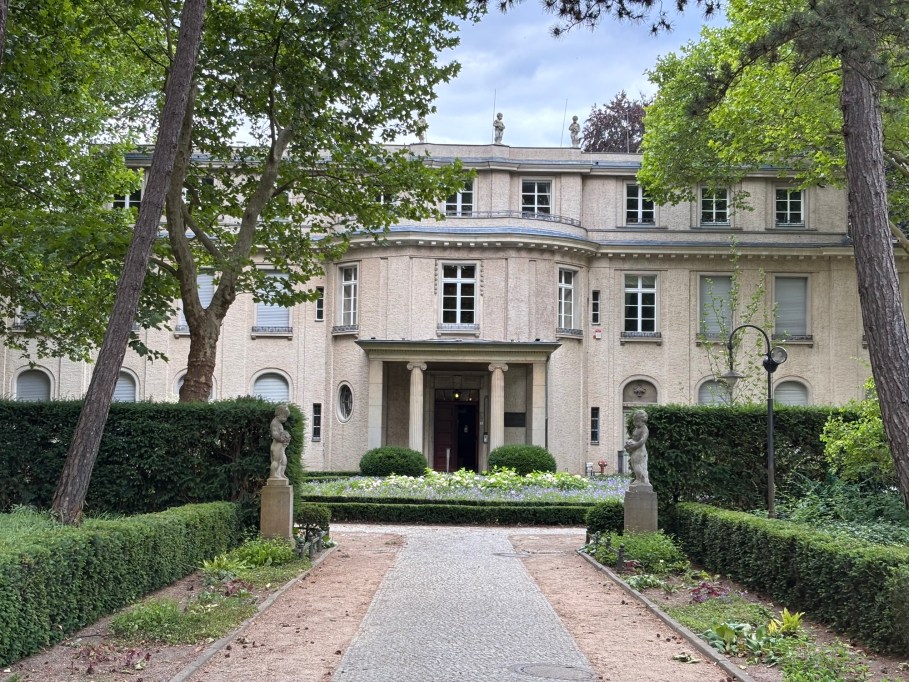
On 20 January 1942, 15 high-ranked SS-officers in various aspects of Nazi governance met in another lakeside villa just down the road from the Liebermann summer house. In a lunch meeting lasting about 90 minutes, the 15 decided the fate of millions, organizing pre-existing extrajudicial-killing groups into the logistics and industrialization of mass murder of European Jewish men, women, and children. Since 1992, the renovated building is both memorial and education site, with an active archive and library on the upper floor.
Sign in front of entrance to “Memorial site: House of the Wannsee Conference”.
The villa at Am Großen Wannsee 56-58. Architect Paul O.A. Baumgarten had this villa built in 1915 for businessman Ernst Marlier.
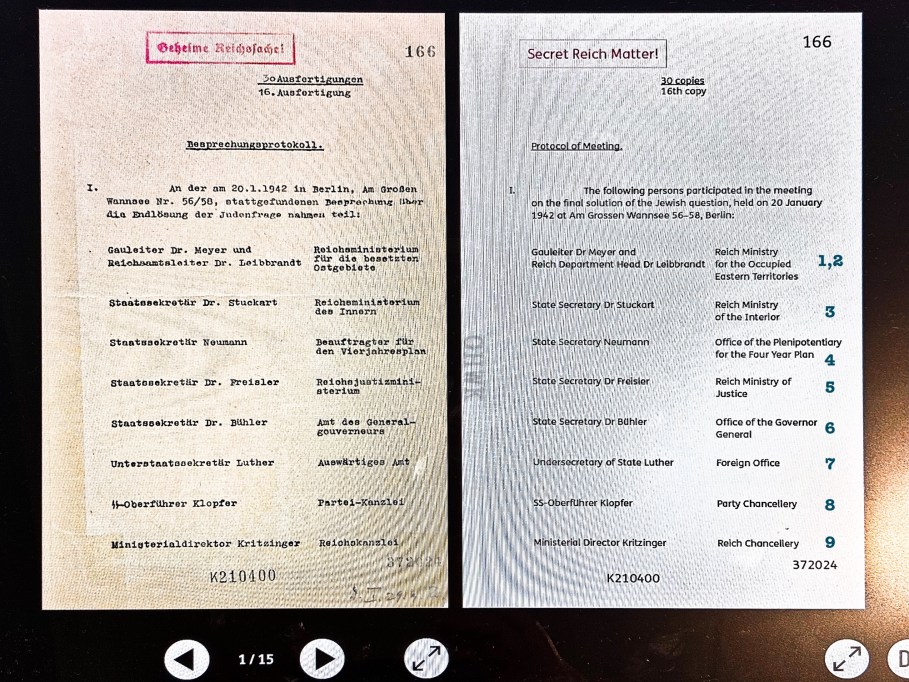
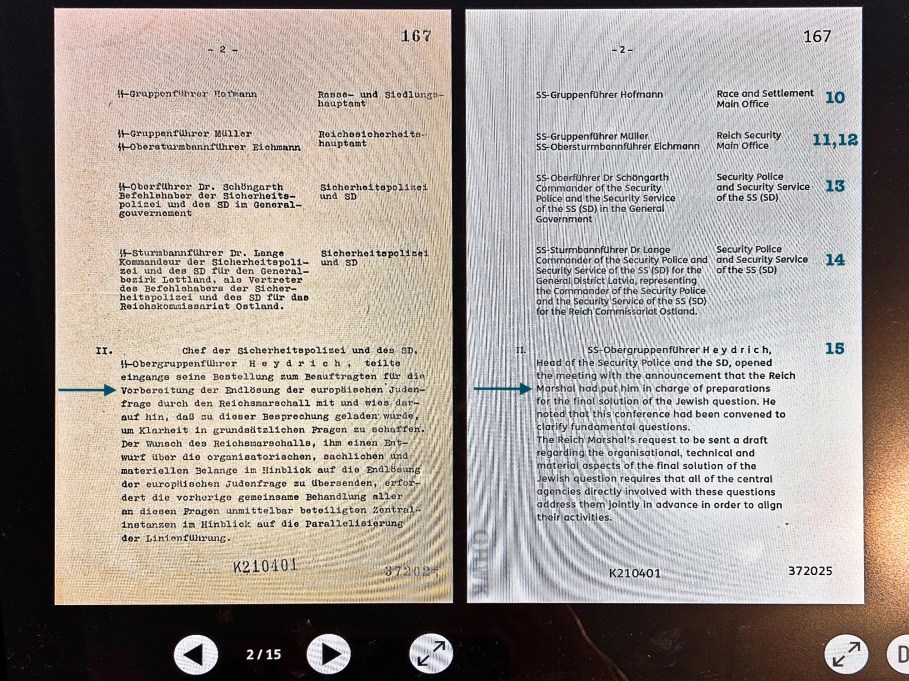
This is the former dining room where the 1942 meeting took place. Today, the memorial site has displays of the meeting, its participants, and a complete display of “The Protocol”, or minutes of the meeting.
Page 1 of “The Protocol” (minutes of the meeting): German at left, English translation at right. Numbers in dark blue correspond to participants. The Moiré pattern is caused by direct imaging of an illuminated display.
Page 2 of “The Protocol” (minutes of the meeting): German at left, English translation at right. Numbers in dark blue correspond to participants. The arrow points to wording with the word/phrase “Endlösung” or “final solution”; the euphemisms fly fast and thick. The Moiré pattern is caused by direct imaging of an illuminated display.
The idyllic view out back onto Wannsee lake.
I made all images above with an iPhone15 on 28 June 2025. This post composed within Jetpack for iOS appears on Fotoeins Fotografie at fotoeins DOT com.




 Fotoeins Fotografie
Please leave your comments below