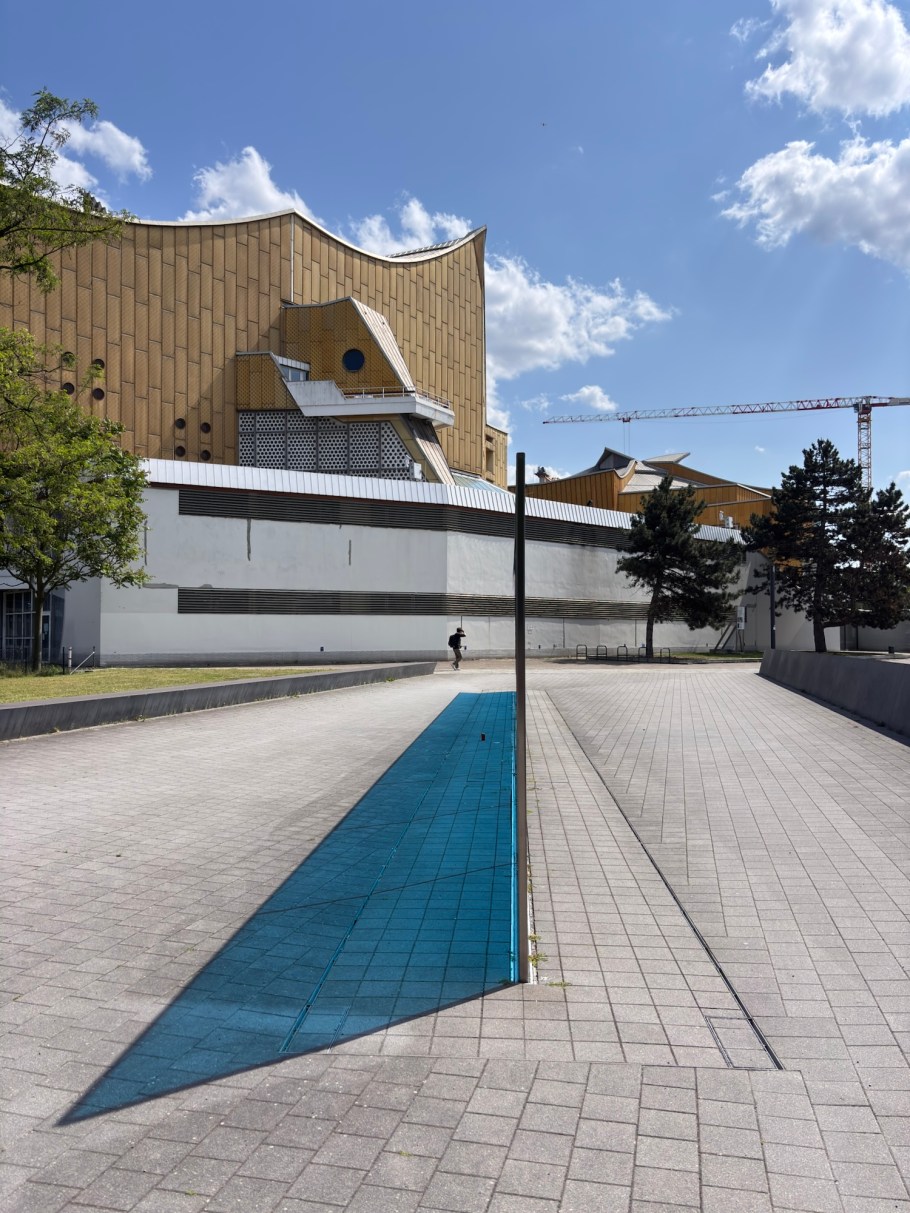
To the northwest of the yellow-roofed and very modern Philharmonie (Philharmonic Hall) is the 2014 “T4 memorial”, dedicated to patients in hospitals, elder-care homes, and mental health facilities who were murdered because they were deemed “financial burdens” and “socially, physically, and/or mentally unfit for any use in society”.
The Nazi “forced euthanasia” program saw the murder of hundreds of thousands across Europe, and became the first stage of systematic mass extermination, whose initial practices led directly to the much wider-scale organized and industrialized process of the Holocaust. In 1940, a department called “Zentraldienststelle T4” (T4 central office) put together the coordination of leadership, medical staff, methods of killing, assembly of victims, and the facilities required. The department was named after its Berlin address: Tiergartenstrasse 4. The “Aktion T4” (Operation T4) continued secretly until 1944, accelerating to gas chambers and the establishment of killing centres.
This is a part of the playbook with similar language being used again. Not even a century has passed, and to the shameless of some, all those people entrapped by T4 all apparently died for nothing.
I’m standing today at Tiergartenstrasse 4.
24-meter long blue-wall (left, east); information display (right, west).
“Goodbye, blue sky …”
Anna Lehnkering, 1915-1940. Growing up in the Ruhr region, Anna was a sweet mild-mannered child with a learning disability. As she was discovered to have a “hereditary disease”, she was forcibly sterilized in 1935, and admitted to Bedburg-Hau hospital in 1936. She became increasingly restless and difficult; officials declared her “incapable of work”. In March 1940, the T4 doctors’ commission selected her for murder by gas asphyxiation at the Grafeneck killing centre.
Ilsze Lekschas, 1895-1940. Ilsze, her husband, and their two children lived in East Prussia’s Memel, which in 1923 was occupied by Lithuania. She underwent treatment in 1925 because of religious delusions. In 1939, the Memel region was incorporated into greater Germany by which time she was moved to a facility in Tapiau. In May 1940, she was transferred to the Soldau transit camp, where she was murdered by the SS-Sondercommando Lange unit which had developed the use of “gas vans” or mobile gas chambers.
Wilhelm Werner, 1898-1940. Born into a penniless family, Werner sometimes lived in housing for the needy in Franconia’s Nordheim am Main. In 1919, he was admitted to the sanatorium in Werneck with the diagnosis of “idiocy.” He was subsequently and forcibly sterilized in 1933 under Nazi law. He tried to come to terms with the “Triumph of Sterelation” with over 40 of his drawings. In 1940, “Aktion T4” selected him for murder by asphyxiation with carbon dioxide at the Pirna-Sonnenstein killing centre
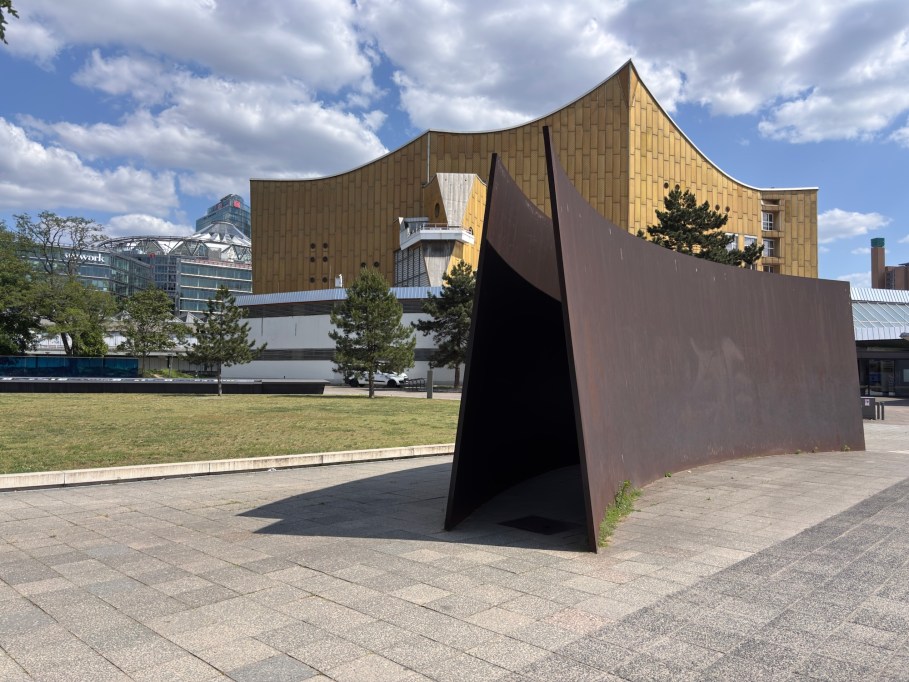
At right is “Berlin Junction” by Richard Serra (1987).
Despite the bright afternoon sun, walking inside and between the two tall curved metal pieces was an unsettling experience.
I made all images above with an iPhone15 on 3 June 2025. This post composed within Jetpack for iOS appears on Fotoeins Fotografie at fotoeins DOT com.





 Fotoeins Fotografie
Please leave your comments below