Fotoeins Fotografie

location bifurcation, place vs. home

Posts tagged ‘Deutschland’

Dachau: nie wieder, never again

Where: KZ-Dachau, 20 km northwest from Munich, Germany.
What: The blueprint by which murder became a methodical industrialized process.

I once thought I wasn’t prepared emotionally; perhaps I never would. But I couldn’t go further in my long-term examination of Germany and Jewish-German history without a visit.

It’s an overcast morning in early June, and a couple of rain showers accompany me along with a handful of other people, waiting for the site to open at 9am. A dark heavy cloak descends the moment I step through the main gate and into the site. There is dread, waiting. I promise myself to be open as much as possible, to really look and listen.

This is KZ-Gedenkstätte Dachau, the Dachau Concentration Camp Memorial Site. The abbreviation KZ is “Konzentrationslager fĂĽr Zivilpersonen” or concentration camp for civilians, although the initial terminology used by the Nazi Schutzstaffel (SS) was KL for “Konzentrationslager.”

There’s a lot to absorb. And maybe, it’s best not to.

Systematic torture and unrestrained cruelty. Forced medical experiments. Arbitrary execution by hanging or gunfire. The destruction of human dignity. The annihilation of hope. This camp as a “model” to broaden the scope and scale of industrial mass-murder. The first commandant of Auschwitz in 1940, Rudolf Höss, honed a career in brutality as SS support staff and block leader at the Dachau camp in late-1934.

I had planned to stay for a few hours at most and leave around noon. I didn’t notice the time. When I finally noticed clear skies and the change in sun-angle, I check my watch. It’s almost 5pm, closing time. Eight hours have flown by outside my bubble, which begins to dissolve.

( Click here for images and more )

My Mittenwald: mountains, masks, music, Mahlzeit!

Above/featured: From the regional train: facing southwest over Schöttlkarstrasse and the eastern end of the Wettersteinwand at right.

In 1786, the German writer Johann Wolfgang von Goethe described the alpine town of Mittenwald as “lebendes Bilderbuch” – a living picture-book. Images and descriptions in print and provided by visitors became a real draw and lure. Funny thing is I’d stayed in nearby Garmisch-Partenkirchen several times, and I hadn’t taken the easy 20-minute train hop to Mittenwald.

I took care of that with two visits within a span of 15 months: with snow and without snow.

Wandering through Mittenwald is pure delight because of abundant fresh mountain air, picturesque surroundings, and the compact nature of the town. The description becomes a common refrain for alpine towns.

Mid-winter is special with the combination of seeing mountains freshly frosted with snow, people of all ages wearing masks and costumes during carnival season, houses painted in colourful “LĂĽftlmalerei”, and the town’s special place in music history. When the warm sun dominates in spring and summer, it seems like an endless vista of blue skies along with green meadows and mountains to accompany your time outside on walks and hikes in the area.


( Click here for images and more )

WĂĽrzburg: Röntgen, X-rays, & 1st Nobel Prize in Physics

On my list and map, I placed the museum’s location as a “possible” to visit in the city. If I had time, I’d swing by and have a look, appealing to my fondness for science and the history of science.

Many arrive in Würzburg to visit the Residenz UNESCO world heritage site. On a daytrip from Frankfurt am Main, I duly visited the Residenz, and easily completed my initial visit requirements, as I knew I would. That’s when my inner voice (a.k.a., the spirit of B.Sc. ’90) reminded me insistently the museum was “simply and conveniently” on the return walk to the city’s central train station to fully complete my visit requirements.

I walked north from the Residenz, and followed the signs into the building for the Röntgen-Gedächtnisstätte (Röntgen Memorial) where X-rays were discovered. Standing inside the former laboratory space, I’m surrounded by artifacts, books, papers, tubes, equipment, and photographs.

I also feel a part of my undergraduate physics education has come full circle.

( Click here for images and more )

Before Bauhaus: Alfeld Fagus Factory, UNESCO WHS

Before Bauhaus found its first footing in Weimar, there was in the town of Alfeld in central Germany the Fagus-Werk factory building.

The Fagus factory building is looked upon as the first building in the world for the modern architectural age, and is the predecessor to the elegant 1926 Bauhaus headquarters building in Dessau. Fagus company founder Karl Benscheidt commissioned architect and future Bauhaus founder, Walter Gropius, to create and build a shoe-making factory as an artistic project. Gropius and his collaborator Adolf Meyer stuck with working floor-plans by architect Eduard Werner, and set their sights on new exterior and interior designs. Completed in 1911, the factory’s office building set a new standard for 20th-century industrial architecture with steel and glass construction and tall unsupported windows at the corners of the building.

“Fagus” is Latin for “beech tree”, and shoemaking began with shoe lasts or moulds constructed from beech wood, which were sold and distributed around the world to other companies for the productions of shoes. In the 1920s, Benscheidt developed the turning precision-lathe speeding up production, prompting growth and expansion and elevating the company to world’s top producer of shoe lasts. Today, the building is still a working factory: Fagus creates plastic lasts milled by automated machinery to precise specifications for specific designs by shoe companies. Also on-site is GreCon which produces systems for fire-detection and fire-extinguishing in industrial settings. The Fagus factory building was recognized as “unique living monument” and inscribed by UNESCO as World Heritage Site (Welterbe) in 2011.

With a population of over 20-thousand people, Alfeld is located in the German federal state of Lower Saxony. The town’s reach by train is 30-minutes from Hannover or 40-minutes from Göttingen, after which is a short 5- to 10-minute walk from Alfeld(Leine)1 train station to the entrance of the Fagus/GreCon complex. Visitors can walk around the working factory site, stop at the World Heritage Site Visitor Centre, sit in the neighbouring café for coffee or tea, and visit the museum dedicated to the building’s origins, the building’s century-long history of shoe-making, and a general history of footwear.

Walter Gropius and others would move to Weimar to establish a centre of art, design, thought, and attitude for Bauhaus in 1919, eight years after inauguration of the Fagus-Werk.

Die Baukunst soll ein Spiegel des Lebens und der Zeit sein.
(Architecture should be a mirror to life and its time.)

– Walter Gropius.

( Click here for images and more )

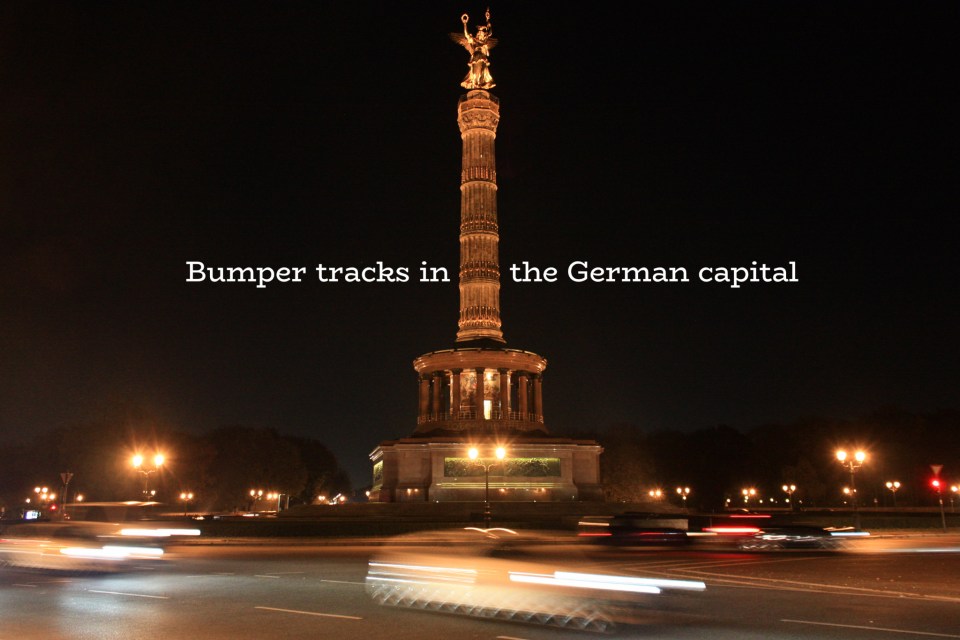
Siegessäule, Grosse Stern, Tiergarten, Berlin, Germany, fotoeins.com

My Berlin: 30 tracks for the German capital

Above/featured: Siegessäule & Grosse Stern, at night – 13 Nov 2012 (HL).

I compiled a list of songs accompanying my travel, a soundtrack that’s full of meaning and memories. This is another set, a listing of tracks I associate with Germany’s capital city. Music is always about personal selection, and every track fires a specific memory of time and place within Berlin. For example, watching “Lola rennt” (Run Lola Run) in a movie theatre in Toronto in the fall of 1998 planted the seeds for a move to Germany three years later. My first visit to Berlin soon after marked the beginning of a deep love affair with the “grand lady of BAER’leen.”


( Click here for more )