Fotoeins Fotografie

location bifurcation, place vs. home

Posts tagged ‘Deutschland’

Berlin Hauptbahnhof, B Hbf, Berlin, Germany, Deutschland, fotoeins.com

Germany: 30 years of ICE on the rails (2021)

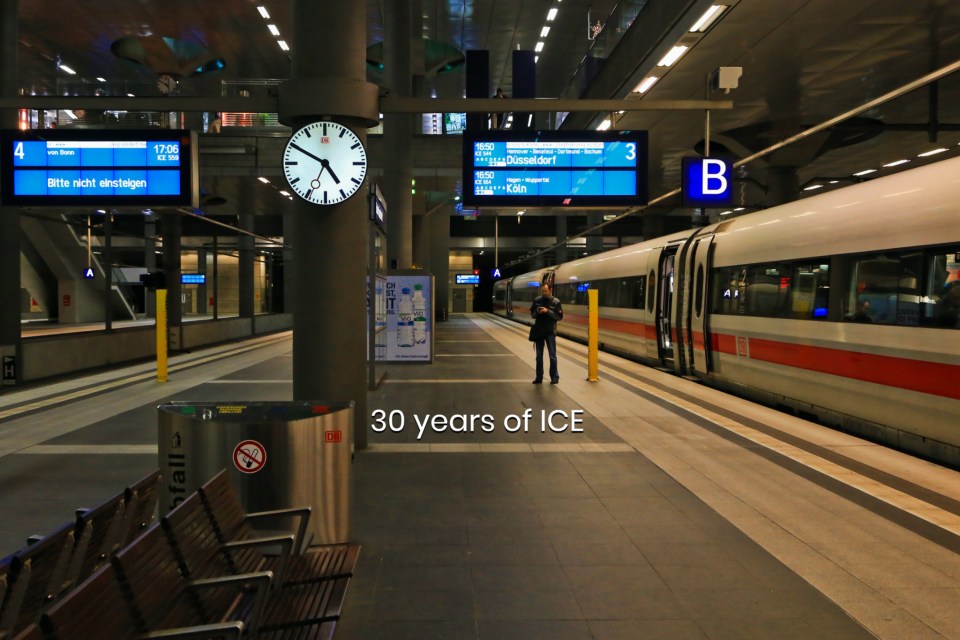
Above/featured: Berlin Hauptbahnhof – 9 Dec 2015 (6D1). Departing from track 3 is ICE 554 to Köln (front-half) and ICE 544 to Düsseldorf (back-half); trains split in the town of Hamm.

June 2021 marks the 30th anniversary of high-speed Intercity Express (ICE) service on German rail.

In the 1991 vs. 2021 comparison graphic provided by Deutsche Bahn, I’ve marked in green the ICE routes upon which I’ve made dozens of trips since late-2001 (when I moved to Heidelberg). Even after leaving in 2003, frequent annual trips back to Germany meant spending a lot of time planted on express trains across the country. Arriving in Europe mostly meant flying into Frankfurt am Main airport, from which I’d travel:

  • Frankfurt to Berlin, via Kassel
  • Frankfurt to Heidelberg, via Mannheim
  • Frankfurt to Köln
  • Frankfurt to Munich, via Stuttgart
  • Berlin to Frankfurt, via Kassel
  • Berlin to Köln, via Hannover
  • Köln to Berlin, via Hannover
  • Köln to Frankfurt
  • Munich to Frankfurt, via Stuttgart

Over the last few years, the express stretch between Erfurt and Halle/Leipzig has vastly improved the Berlin-Frankfurt and Berlin-Munich routes, cutting the one-way travel time for each route by about one hour. Except for the Erfurt-Halle/Leipzig stretch, I’ve travelled on every “Stundentakt” ICE route (thick red/green in the graphic below).

Intercity Express, Deutsche Bahn, German Rail, Germany, Deutschland

ICE coverage, including recent work on the Erfurt-Halle/Leipzig stretch; graphic courtesy of Deutsche Bahn. My “dozens on ICE” are marked in green; red filled circles indicate cities I frequented the most (B, F, HD, K, M).

Intercity Express, train fleet, Deutsche Bahn, German Rail, Germany, Deutschland

The ICE fleet of trains include vehicles with maximum speeds of over 300 km/h; graphic courtesy of Deutsche Bahn.

Frankfurt am Main Hauptbahnhof, F Hbf, Frankfurt am Main, Hesse, Hessen, Germany, Deutschland, fotoeins.com

Morning ICE 5 service from Frankfurt am Main to Basel; how to read this train station signage – 20 May 2016 (6D1).

HackerbrĂĽcke, MĂĽnchen, Munich, Bavaria, Bayern, Germany, Deutschland.

Morning light at Munich’s HackerbrĂĽcke station. Foreground: westbound metallic-white ICE train just departing the city’s central station, traveling right to left. Background: red DB regional train approaching central station, from left to right. Photo on 23 Feb 2017 (6D1).

I made three images above with a Canon EOS6D mark1 (6D1). This post appears on Fotoeins Fotografie at fotoeins DOT com as https://wp.me/p1BIdT-l60.
herakut, Museum of Urban and Contemporary Art, MUCA, Munich, Muenchen, Bayern, Bavaria, Germany, Deutschland, fotoeins.com

Herakut: big wall art around Germany

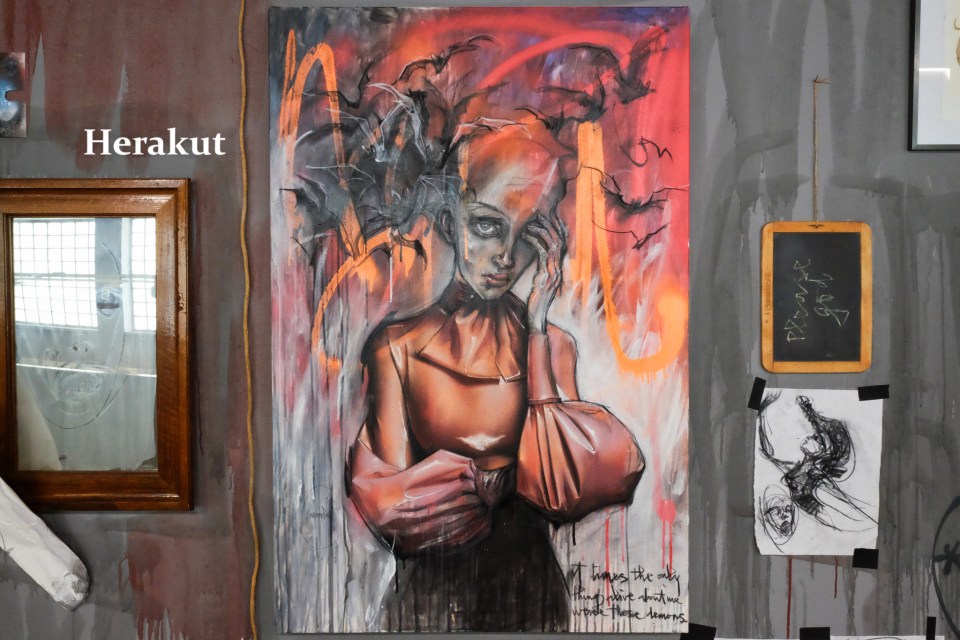
Above/featured: “At times the only thing alive about me were those demons.” MUCA Munich – 31 May 2018 (X70).

One of my favourite artists is Herakut, a German duo whose street murals have appeared in Europe and around the world since 2004. Hera (Jasmin Siddiqui) and Akut (Falk Lehmann) use walls and big spaces for their big art with a signature look that includes expressive faces and big eyes, lots of photo-like details, and sharp typography. Their work explores issues such as physical and emotional isolation, maternal relationships, gender and racial equality, and all the things we think and feel lurking inside. But I think their compositions also include long notes and pauses which allow and incorporate vivid fantasy and playful whimsy.

Examples shown below include Wittenberg 2016, Heidelberg 2017, Berlin 2017, Munich 2018, Berlin 2021, Frankfurt am Main 2024.

( Click here for more )

My Cologne: wandering the streets in Ehrenfeld

For many, the German city of Cologne brings to mind the Cathedral, Karneval, and perfumed water.

For me, Cologne brings to mind great friends, tasty Turkish nibbles, football side 1. FC Köln, and Ehrenfeld.

My friend Y wanted to test her new camera on the streets, and when she suggested the Ehrenfeld neighbourhood, I readily agreed. My many visits to this city on the Rhine have frequently ended up in Ehrenfeld that’s largely Turkish and working class, an immigrant blue-collar area with which I readily identify and it’s why Ehrenfeld is my K-‘hood.


( Click here for images and more )

Munich: Ghost station “Olympic Stadium”

In the vicinity of Munich’s Olympic Stadium is a train station overgrown with brush and weeds. The tracks stretch north and south, but go nowhere.

Munich played host to the Summer Olympics in 1972; physical reminders include the Olympiadorf (Olympic Village), Olympiapark, and the Olympiastadion (Olympic Stadium). In 1988, the train station “MĂĽnchen Olympiastadion” closed to train service for the final time. Rail tracks which connected the station with the North Ring freight tracks were cut, isolating the station and leaving it to decay.

Since 2001, the Olympic Village has been listed as part of the heritage Olympiapark ensemble which includes the abandoned station. But will the station be left to decay? Or will the station be refurbished in some way to become a living memorial?

Historical maps of the MVV U- and S-Bahn system show how train service from central Munich to Olympic Stadium was utilized. S-Bahn train service carried passengers along the central trunk to Olympic Stadium via Hauptbahnhof, Laim, and Moosach; check out the system maps for June 1972 and June 1988.


( Click here for images and more )

My Konstanz: Jan Hus’ last stand

Above/featured: Old Town from the Bodensee (Lake Constance): visible from left-to-right are respectively the broad-roofed Konzilgebäude (Council Building), Münster (tall Cathedral spire behind sailboat), and the Dominikanerinsel (Dominicans Island). Photo on 23 Sep 2017.

6 July is a national holiday in the Czech Republic; the formal name is “the day Jan Hus was burned at the stake” (Den upálenĂ­ mistra Jana Husa).

I wrote previously about medieval Bohemian theologian and reformer Jan Hus (John Huss) whose teachings in the relatively novelty of the Czech language and criticisms about abuse and injustice within the Catholic Church predated Martin Luther’s own revolution for change by almost 100 years. Hus’ place within Czech history is fixed onto the nation with a giant memorial sculpture at the centre of Old Town Square in the capital city of Prague. His place is also assured in the European Reformation as seen in full display at the world’s largest Reformation Monument in the German city of Worms. Hus’ conviction and execution and the resulting armed conflicts would give rise not only to the concept of European unity (see also the prominent Czech historical figure George of PodÄ›brady), but would also give way to the European continental wars of religion.

As key historical aspects for creating unique Bohemian and subsequent Czech identity, Hus’ life, final days, and death are also a part of the historical record in the southern German city of Konstanz (Constance in English, Kostnice in Czech).


How Hus got here

The backdrop was the one of the largest conferences in the Middle Age. The Council of Constance met from 1414 to 1418, during which one key directive of the synod was to decide once and for all a single pope from three candidates. With the Council’s election of Pope Martin V in 1417, the Papal Schism which began in 1378 effectively came to an end; this would also be the one and only time a pope was elected on German soil. As the only meeting of its kind held north of the Alps, this massive medieval assembly gathered tens of thousands of people, including religious, political, civic, and social leaders; scholars and other civic officials; as well as traders and merchants from around the continent.

Constance had become a free Imperial city in the late 12th-century, allowing the city to prosper by trade of many goods around the European continent and onto the Mediterranean to destinations in Africa and the Middle East. The city was chosen to host the 15th-century conference, because the city as bishopric had sufficient space and resources to host, house, and feed a very large number of conference guests. Constance has the nickname “Stadt des Konzils” or the “Council City”, and has been included as part of the Hussite Cultural Route (Hussitische Kulturroute), which traces Hus’ final journey from Prague to Konstanz.

As follower of English philosopher John Wycliffe, Hus spoke out on flagrant abuse and corruption, especially on the sale of indulgences with the act of forgiveness for sin being used as a tool to increase church income. At a time when the church claimed complete spiritual, moral, and civic authority, Hus was an obvious troublemaker, and the central church authority punished him with censure and excommunication. Hus was called to travel from Prague to Konstanz and answer charges of heresy at the Council of Constance. He ignored the pleas of friends and colleagues to stay put (“it’s a trap!”), and armed with an apparent imperial promise of safe passage and conduct, he set off on his journey to Konstanz. Upon arrival in November 1414, the promise was naught and the betrayal complete; Hus was promptly arrested, imprisoned, and tortured in various places throughout the area for several months. In refusing to recant over his criticisms against the church, he was never given a fair trial. The Council convicted him of heresy inside the city’s cathedral on 6 July 1415. Hus was immediately handed over to the civil authority, who condemned him to death by burning at the stake on the same day. Jan Hus is revered as a key historical figure for Czechs and the Bohemian Reformation, just as Martin Luther would be for his role to kick off the German Reformation almost 100 years later.


( Click here for images and more )