Fotoeins Fotografie

location bifurcation, place vs. home

Posts tagged ‘Deutschland’

Göttingen: a circle of Nobel Prize winning scientists

What: Circular feature celebrating Nobel Prize winners, all of whom worked at the city’s university.
Where: Stadtfriedhof (city cemetery) in Göttingen.

Göttingen is a university town in central Germany. Not only will I find a memorial to Nobel Prizes, I’m here also to acknowledge my academic training. I spent many years studying physics and astronomy, and while I’m no longer active in science research, I enjoy the search and discovery of the final resting spots for scientists whose work formed a significant part of my education. Visiting their graves provides direct historical connection to “academic predecessors”; to go beyond the abstraction of simply learning their names and contributions to science, the gravestones belong to real people with keen minds, family lives, and all too human imperfections.

45 Nobel Prize laureates have been or are connected with the Georg-August-Universität Göttingen as of posting (2018). That’s a phenomenal number, as this single institution accounts for 8 per cent of all Nobel Prizes (585 as of 2017).


( Click here for images and more )

Freistaat Bayern, The Free State of Bavaria

Bavaria: 100 years of statehood (2018)

Featured image: The blue and white diamonds (fusils) are a familiar Bavarian symbol, adopted in the late 13th-century by the Wittelsbach family who ruled Bavaria from 1180 to 1918.

As a product of the coastal and mountainous Canadian Southwest, I always feel the pull exerted by the Bavarian Alps regardless of where I am in Germany; it’s been this way over the past 18 years. But there’s more to Bavaria than fairytale castles, Oktoberfest, and BMW, although they’re spot on for the Wurst (sausage). And frankly, there’s a ton more to Germany than Bavaria, but that’s one of many reasons for this entire blogsite after all.

Located in southeast Germany, Bavaria includes more than a half-dozen World Heritage Sites, the pre-Easter Fasching/Fastnacht festival, the sight of Audis on the Autobahn, over one thousand years of wine-making in Franconia, and violin-making since the late 17th-century, among many things to explore, eat, and experience.
( Click here for more )

17 for 17, Fotoeins Fotograms of 2017, fotoeins.com

17 for 17: Fotoeins Fotograms of 2017 (IG)

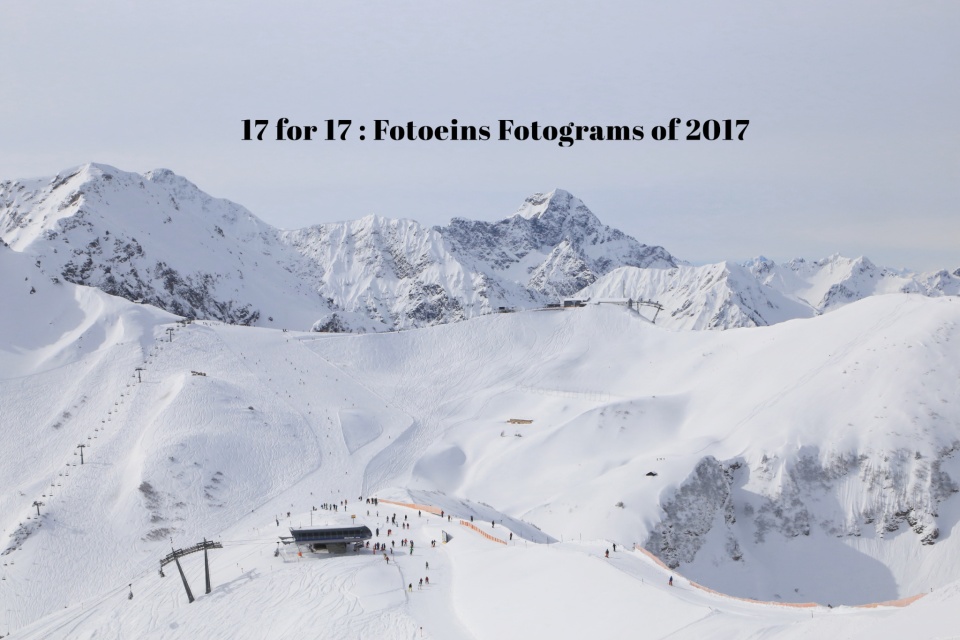
Featured: At the Germany-Austria border, from Fellhorn mountain near Oberstdorf: 8 March.

Another year gone, another 34-thousand images made*

As the image above shows, I also spent a lot of time this year at the Austrian-German frontier, much of it at altitude.

Below I look back at the year 2017 with a selection of 17 images. Each picture is a direct clickable link to the corresponding post on Instagram.

( Click here for more )

Mengenlehreuhr, set theory clock, Berliner Uhr, Berlin Clock, Sixt, Europa-Center, Budapester Strasse, Charlottenburg, Berlin, Hauptstadt, Germany, fotoeins.com

My Berlin: An Unusual (Set Theory) Clock

I had read about this unusual clock years ago; the unusual mathematics connection was an additional “plus”.

I leave the crowds at Gedächtniskirche and Breitscheidplatz and head on over to the SixT car rental outlet on Budapester Strasse. What’s standing in front is most certainly a curiosity, even as passers-by look at me curiously.

The Berlin Clock is known in German as “Berliner Uhr”. The alternate name is “set theory clock” or “Mengenlehreuhr”, a German compound word consisting of “Menge” for quantities (sets), “Lehre” for theory, and “Uhr” for clock. The Guinness Book of Records claimed “the Berlin Clock was the first clock in the world operating according to the principles of set theory1“.

Created by inventor Dieter Binninger, the clock first stood at the corner of Kurfürstendamm and Uhlandstrasse in West Berlin from 1975 to 1995. Local business arrangements were made with Binninger’s widow for a long-term loan including maintenance costs, and the clock was moved in 1996 to its present location at the Europa-Center.

Here is how one reads the Berlin Clock:

  • Top circle: light flashes every 2 seconds; ‘on’ 1-second, ‘off’ 1-second
  • 1st row: hour of day in 5-hour increments, up to 20
  • 2nd row: hour of day in 1-hour increments, up to 4
  • 3rd row: minutes in 5-minute increments, up to 55
  • 4th row: minutes in 1-minute increments, up to 4

Time shown in the above featured image is 1310 hours or 110pm, which breaks down as (2 x 5) + (3 x 1) hours and (2 x 5) + (0 x 1) minutes.

( Click here for more )

Koblenz: 1st and 2nd Deutsches Eck (German Corner)

Above: West view to Deutsches Eck from Ehrenbreitstein. 2015 photo by Taxiarchos228 (Wladyslaw Sojka). I’ve added the following labels: (1) Seilbahn/Gondola, (2) St. Kastor Basilica, (3) Deutschherrenhaus, (4) first Deutsches Eck, (5) Memorial to German Unity (Kaiser Wilhelm Memorial), (6) reclamation in the late 19th-century, (7) second Deutsches Eck.

Many will know, have seen, or have read about the Deutsches Eck (German Corner) in the German city of Koblenz. The river city has plenty to provide: visitors wander into the vineyards to sip on crisp white wine from local grapes, vacation on long cabin-boats to enjoy the river scenery, or explore the surrounding Upper Rhine River Valley.

But Koblenz is also well known by virtue of its name after the junction where the rivers Moselle and Rhine meet. By the first-century AD/CE, the Romans had built for strategic protection a fort1 called “Castellum apud Confluentes“, Latin for “the castle at the confluence”. What most commonly acknowledge as the Deutsches Eck (German corner) is not the original location. Half concealed among the trees some 200 metres back near the Deutschherrenhaus is the first location of the Deutsches Eck.

What follows:

  • a map to the area and my photos from the present-day,
  • a short history of the “Deutsches Eck,” and
  • archival images from the mid-16th century to early 20th century.

( Click here for images and more )