Fotoeins Fotografie

location bifurcation, place vs. home

Posts from the ‘Urban Photography’ category

My Vienna: Othmar Schimkowitz, 5 sculptural examples

Above/featured: Musenhaus (Muse House), Linke Wienzeile in Vienna – 18 May 2018.

Early 20th-century European artist Othmar Schimkowitz was one of many key figures in Vienna Modernism, an art movement which celebrated its centennial in 2018 in the Austrian capital city. Schimkowitz was born in Hungary and became well-known in Vienna for his architectural sculptures. In 1898, he joined the (Vienna) Secession, a group of artists which included Josef Hoffmann, Gustav Klimt, Max Kurzweil, Carl Moll, Koloman Moser, and Joseph Maria Olbrich.

Sculptures by Schimkowitz are often seen in a variety of architectural creations by Otto Wagner. Here below are four Schimkowitz examples in Vienna; all are accessible with public transit from Wiener Linien (WL) transport authority.


( Click here for images and more )

Fagus-Werk, Fagus Factory Building, Fagus, Walter Gropius, Karl Benscheidt, Alfeld, Lower Saxony, Niedersachsen, Germany, UNESCO, World Heritage, Bauhaus, fotoeins.com

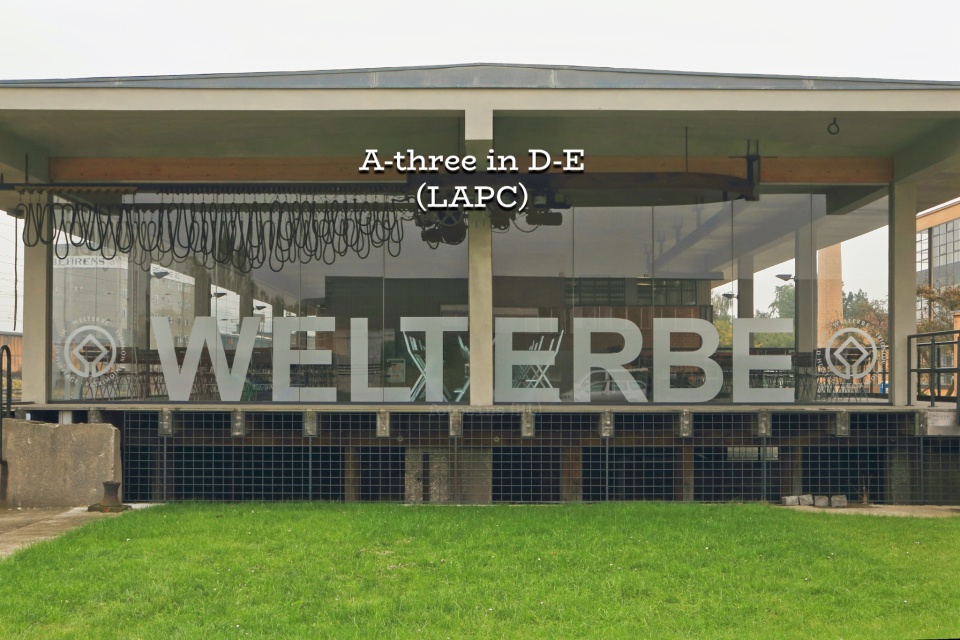
A-3 in D-E

Above/featured: “Welterbe” (World heritage): GreCon/Fagus, Alfeld – 28 Sep 2017.

For LAPC’s first alphabet challenge, I present three German locations whose names begin with ‘A’; all three are in the list of the nation’s UNESCO World Heritage Sites (WHS).

•   Aachen, in North Rhine Westphalia (Nordrhein-Westfalen, NW),
•   Alfeld, in Lower Saxony (Niedersachsen, NI), and
•   Augsburg, in Bavaria (Bayern, BY).

(I also created an A-3 post for Aotearoa/New Zealand.)


( Click here for images and more )

Seattle Ballard: Sunday Farmers Market

In Seattle, a friend in Ballard recommends a visit to their neighbourhood’s weekly farmers’ market. Despite the forecast for intermittent morning showers, I’m lured by any stroll through a market for bright harvest colours and freshly prepared food.

A slow meander through the stalls, letting curiosity be the guide. Fresh apples and pears here; ripe plump tomatoes there. From an assortment of red and yellow peppers; to an array of yellow and green gourds. Quickly, the appetite is on high alert. Quesadillas prepared fresh from the grill. Hot from the fryer, little donuts sprinkled with cinnamon sugar. Happy dogs walking their humans; couples strolling with children; others sitting on the curb for a chat, nosh, and sip.


( Click here for images and more )

Vienna: Otto Wagner’s architectural legacy

Above/featured: On the Linke Wienzeile, opposite the Naschmarkt at right. Photo, 18 May 2018 (6D1).

What: Among many are 2 key structures: Post Savings Bank, Steinhof church.
Why: Some of the most important architectural examples of 20th-century modernism.
Where: Many examples found throughout the city of Vienna.
“Wagner School” included Josef Hoffmann, Joseph Maria Olbrich, Jože Plečnik.

To visit Vienna is to know Otto Wagner. A first-time visitor to the city will be forgiven for not knowing about Wagner or his creations, but throughout their time spent in the Austrian capital, they’ll encounter Wagner’s early 20th-century “Modern Architecture”.

Vienna is for many the city of Beethoven, Mozart, and Strauss; the city of historic and stylish cafés with coffee and Sacher Torte; the city whose pride is revealed in the combined World Heritage Site that are the classic period architecture within the Old Town and the beautiful palace and gardens at Schönbrunn. Flowing through the city is the Danube river, memorialized in Johann Strauss II’s “An der schönen blauen Donau” (The Blue Danube).

The evolution of architectural style is plainly evident throughout the city. Around the Ringstrasse (inner ring road) is architecture in the Historicism style, with big nods to Neoclassicism in the Parliament, Neo-Gothic in City Hall and the Votivkirche, and a lot of Neo-Renaissance represented by the City Theatre, Art History Museum, Natural History Museum, Opera House, and the University.

But as calendars flipped from 1899 to 1900, the fin-du-siècle heralded a move to bold thinking, different style, and a change in the way and reasons why buildings were put together. Consequently, Vienna is a city of 20th-century modernism whose traces are found in art, architecture, and urban planning. Even with post-war reconstruction in the mid-20th century and a mindful push for environmental rigour in the 21st-century, Vienna still remains in many ways Otto Wagner’s city.

Modern Architecture began with (Charles Rennie) Mackintosh in Scotland, Otto Wagner in Vienna, and Louis Sullivan in Chicago.

– Rudolph Schindler, who studied architecture under Otto Wagner (Sarnitz 2005).

( Click here for images and more )

My Cologne: wandering the streets in Ehrenfeld

For many, the German city of Cologne brings to mind the Cathedral, Karneval, and perfumed water.

For me, Cologne brings to mind great friends, tasty Turkish nibbles, football side 1. FC Köln, and Ehrenfeld.

My friend Y wanted to test her new camera on the streets, and when she suggested the Ehrenfeld neighbourhood, I readily agreed. My many visits to this city on the Rhine have frequently ended up in Ehrenfeld that’s largely Turkish and working class, an immigrant blue-collar area with which I readily identify and it’s why Ehrenfeld is my K-‘hood.


( Click here for images and more )