Fotoeins Fotografie

location bifurcation, place vs. home

Posts from the ‘Photography’ category

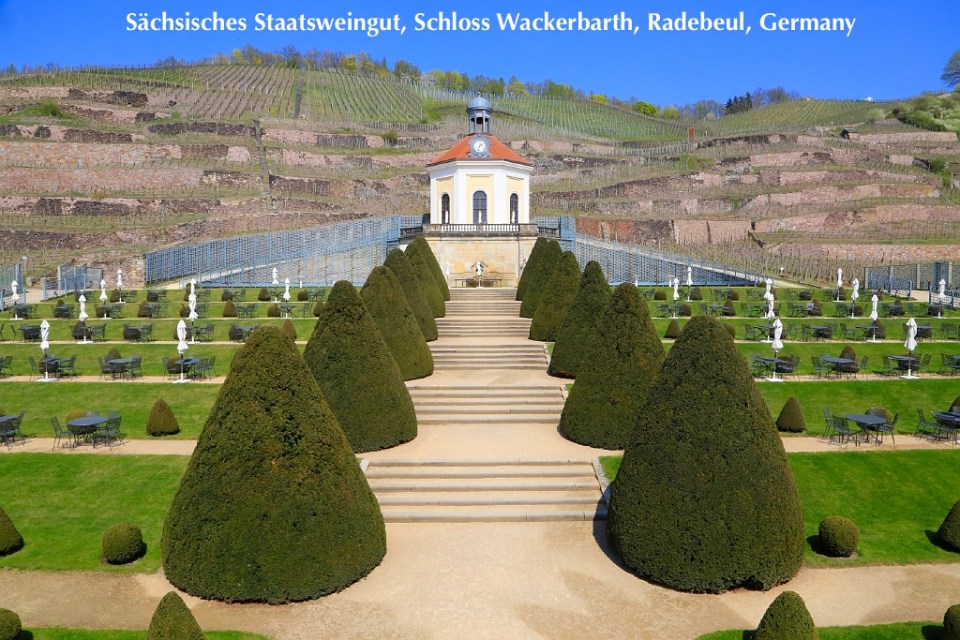
Sächsisches Staatsweingut, Schloss Wackerbarth, Radebeul, Saxony, Germany, fotoeins.com

Celebrating Saxon wine tradition at Schloss Wackerbarth

I have a confession.

Red wines and I have rarely gotten along.

With the exception of the Chilean Carménère, reds generally feel I’ve been pouring scarlet poison down my gullet, burning and tearing the esophageal lining on the way down to my stomach, into a slow boil, scalding and churning with fury.

Dear crimson nectar, you’re all hot and alluring dressed in your tannins, but I cannot have you any more. The subsequent days of post-red churning-gut syndrome are over. I’ve left you for the clean, smooth, sharp, sexy blondes, because frankly, I’m having a lot more fun with the whites. I admit I’ll occasionally stray to the familiar Carménère, but I will always bring white wine back home.

( Click here for images and more )

Weimar: Duchess Anna Amalia Library, UNESCO WHS

As one of over ten buildings, residences, and properties making up what is called “Classic Weimar”, the Duchess Anna Amalia Library (Herzogin Anna Amalia Bibliothek) has been a UNESCO World Heritage Site since 1998.

To consolidate her love of books into a larger holding space, Duchess Anna Amalia commissioned in 1761 the State Architect to rebuild and convert the Renaissance-style French (Green) Castle into a library, which opened in 1766. Becoming one of the most important libraries in the country, the collections included some of the finest written and produced in German literature, art and culture, history, and architecture. Johann Wolfgang von Goethe himself was Library Director between 1797 and 1832.

The library has had its fair share of names: initially called the Ducal Library (Herzogliche Bibliothek); in 1815 renamed as the Grand Ducal Library (Großherzoglichen Bibliothek); in 1918 renamed as the Thuringia State Library (Thüringische Landesbibliothek); in 1969 renamed as the Central Library of German Classics (Zentralbibliothek der deutschen Klassik); and in 1991, renamed as Duchess Anna Amalia Library (Herzogin Anna Amalia Bibliothek) in honour of the library’s founder.

An electrical short from aging damaged wiring sparked a fire on 2 September 2004; the fire held on for over two days before the final hotspot was put out. Over 100 thousand books were damaged or destroyed by fire, water, and smoke. The fire was the largest to strike a German library in post-war history. Subsequent donations and volunteers poured into Weimar from throughout Germany and Europe to help with rescue and preservation efforts. After conclusion of extensive restoration work to the building, the interior Rococo Hall, and to thousands of rescued books, the library was reopened on 24 October 2007, the birthday of the library’s namesake (Anna Amalia born 24 October 1739).

( Click here for more )

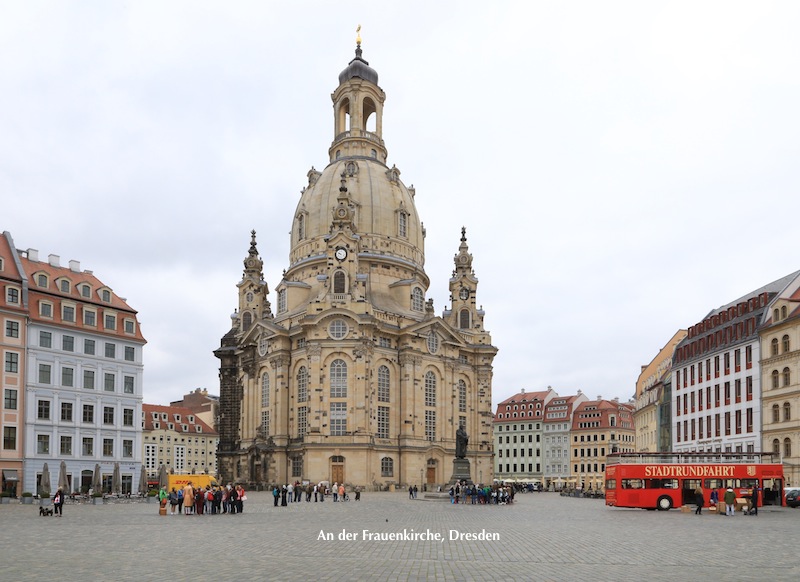
An der Frauenkirche, Dresden, Germany, fotoeins.com

The bright side of Dresden (2015)

It’s 6am in southeast Germany, and I’d like to know how this city will look on a spring morning. Unfortunately, there’s mid-level cloud and there won’t be any direct sun this morning. I’m no longer in a rush, and by 7am, I’m on the Carolabrücke over the Elbe river for the following view of the Dresden skyline.


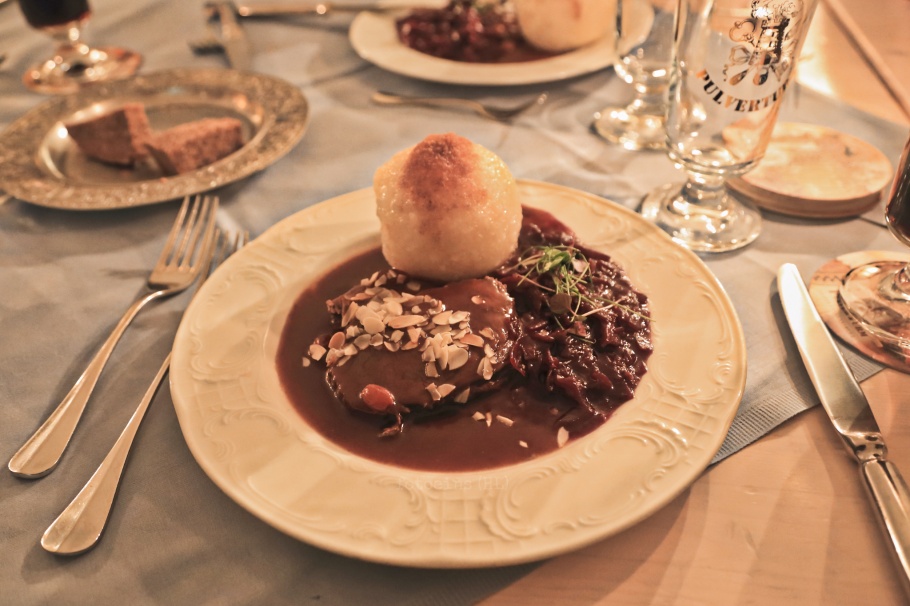
Later that evening I’m in Pulverturm Restaurant near the Frauenkirche, and I’m among about two dozen other travel-trade and -press representatives from around the world. I have a Saxon version of the Sauerbraten, accompanied by red sauerkraut and a big potato dumpling: the right combination of sweet, savory, and sour, representing Saxony.

Pulverturm, Frauenkirche, Dresden, Saxony, Sachsen, Germany, Deutschland, fotoeins.com

At Pulverturm: Saxon Sauerbraten with apple red-cabbage slaw with raisins and a King-size potato dumpling. Photo on 22 Apr 2015.


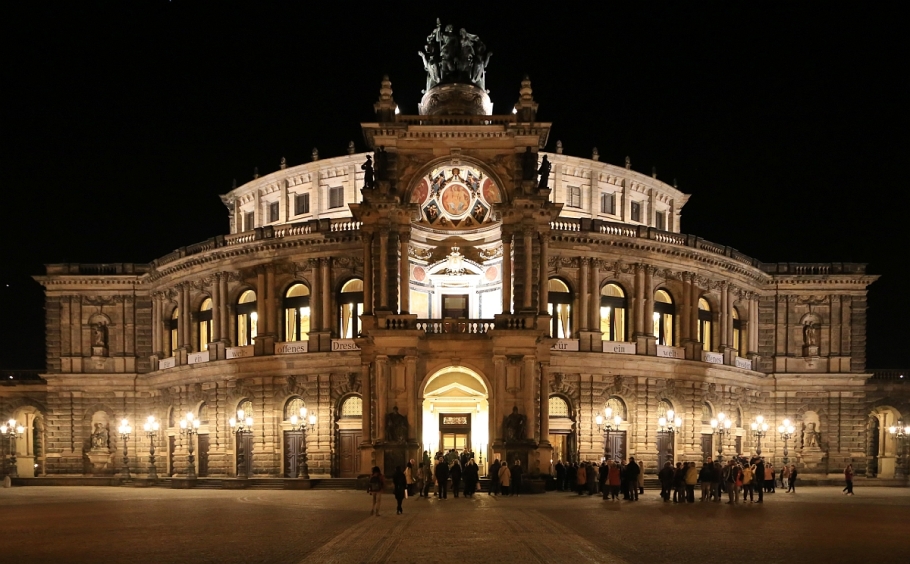
The evening ends with a guided-tour of the interior to the city’s famous Semperoper opera house. Other groups outside are waiting to enter the opera house to have a look inside; we’re fortunate to leap ahead and have a look inside.

Semper Oper, Theaterplatz, Dresden, Sachsen, Germany, fotoeins.com

Classic night shot of the Semperoper – 22 Apr 2015.


I made all of the photos above on 22 April 2015 with a Canon EOS6D mark1. I’m grateful to Germany Tourism and Dresden Marketing for supporting and providing the activities. This post appears on Fotoeins Fotografie at fotoeins DOT com as http://wp.me/p1BIdT-6L3.

Canberra: Remembering Gallipoli at the Atatürk Memorial Garden

In Canada, places like Ypres, Vimy Ridge, Passchendaele, and Flanders Field resonate in the collective national history.

For Australia and New Zealand, it is Gallipoli, known in modern Turkish history as the battle of Çanakkale.

On 25 April 1915, Australian and New Zealand (ANZAC) troops stormed the Turkish Gallipoli peninsula in support of the British Empire’s efforts to secure the high ground over the narrow Dardanelles strait and approach from the eastern Mediterranean into the Sea of Marmara and beyond to the Black Sea. The Turks repelled the advance and the British retreated from the region eight months later after suffering great losses. In total on all sides, there were up to 400-thousand casualties.


( Click here for images and more )

UNESCO World Heritage Sites (WHS) Worldwide

Since 1995, I’ve been fortunate to experience significant travel: first as green graduate student on my first (of many) trips to Chile; followed by the opportunity to live and work in 3 countries on 3 continents inside a span of 10 years. I didn’t give much thought about their relative importance at the time, but I’m lucky to have visited a number of UNESCO World Heritage Sites (WHS).


( Click here for images and more )