Fotoeins Fotografie

location bifurcation, place vs. home

Posts from the ‘Europe’ category

My Cologne: wandering the streets in Ehrenfeld

For many, the German city of Cologne brings to mind the Cathedral, Karneval, and perfumed water.

For me, Cologne brings to mind great friends, tasty Turkish nibbles, football side 1. FC Köln, and Ehrenfeld.

My friend Y wanted to test her new camera on the streets, and when she suggested the Ehrenfeld neighbourhood, I readily agreed. My many visits to this city on the Rhine have frequently ended up in Ehrenfeld that’s largely Turkish and working class, an immigrant blue-collar area with which I readily identify and it’s why Ehrenfeld is my K-‘hood.


( Click here for images and more )

Munich: Ghost station “Olympic Stadium”

In the vicinity of Munich’s Olympic Stadium is a train station overgrown with brush and weeds. The tracks stretch north and south, but go nowhere.

Munich played host to the Summer Olympics in 1972; physical reminders include the Olympiadorf (Olympic Village), Olympiapark, and the Olympiastadion (Olympic Stadium). In 1988, the train station “MĂĽnchen Olympiastadion” closed to train service for the final time. Rail tracks which connected the station with the North Ring freight tracks were cut, isolating the station and leaving it to decay.

Since 2001, the Olympic Village has been listed as part of the heritage Olympiapark ensemble which includes the abandoned station. But will the station be left to decay? Or will the station be refurbished in some way to become a living memorial?

Historical maps of the MVV U- and S-Bahn system show how train service from central Munich to Olympic Stadium was utilized. S-Bahn train service carried passengers along the central trunk to Olympic Stadium via Hauptbahnhof, Laim, and Moosach; check out the system maps for June 1972 and June 1988.


( Click here for images and more )

Vienna Hietzing Cemetery: F.Grillparzer, G.Klimt, K.Moser, O.Wagner

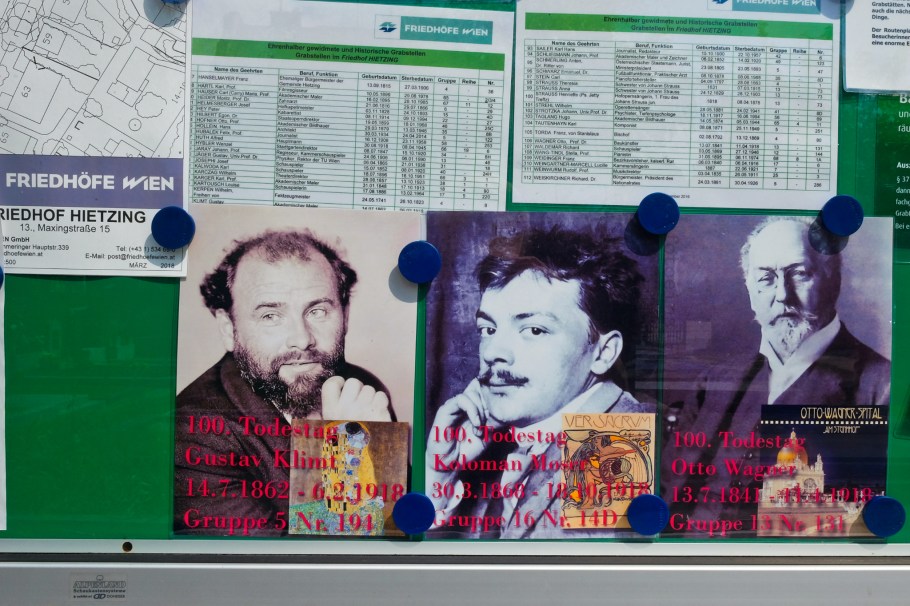
Previously, I provided short biographies for artist Gustav Klimt, artist and designer Koloman Moser, and architect Otto Wagner, and why they are important figures to the arts and culture scene in early 20th-century Vienna. These three figures are buried in Hietzing Cemetery in the 13th district of Hietzing at the city’s western periphery.

Located to the southwest of the former imperial summer residence Schönbrunner Schlosspark, Hietzing Cemetery is modest in size with an area of over 10 hectares (25 acres) and containing over 11-thousand graves. With the present site inaugurated in 1787, the cemetery has seen several expansion phases and survived damage from the Second World War.

I highlight the final resting places for Alban Berg, the Fröhlich sisters, Franz Grillparzer, Hans Hollein, Gustav Klimt, Koloman Moser, Strauss women, and Otto Wagner.

Friedhof Hietzing, Hietzing Cemetery, Friedhoefe Wien, Hietzing, Wien, Vienna, Austria, Oesterreich, fotoeins.com

2018 was the 100th anniversary of the deaths of Gustav Klimt (1862–1918), Koloman Moser (1868–1918), and Otto Wagner (1841–1918). Photo, 16 May 2018.

13. Bezirk, Hietzing, Friedhof Hietzing, Hietzing Cemetery, Friedhoefe Wien, Hietzing, Wien, Vienna, Austria, Oesterreich, fotoeins.com

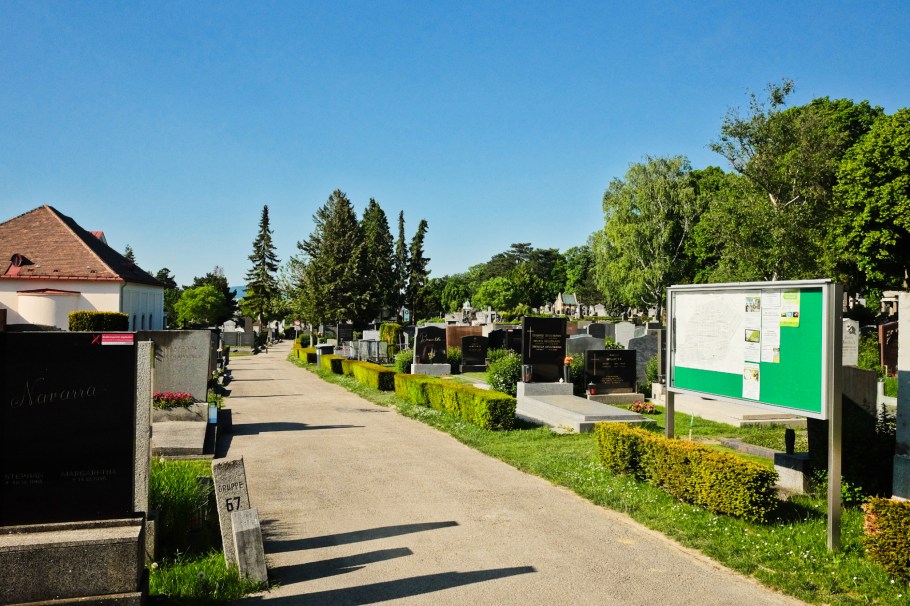
Inside the front entrance – 15 May 2022.

Friedhof Hietzing, Hietzing Cemetery, Friedhoefe Wien, Hietzing, Wien, Vienna, Austria, Oesterreich, fotoeins.com

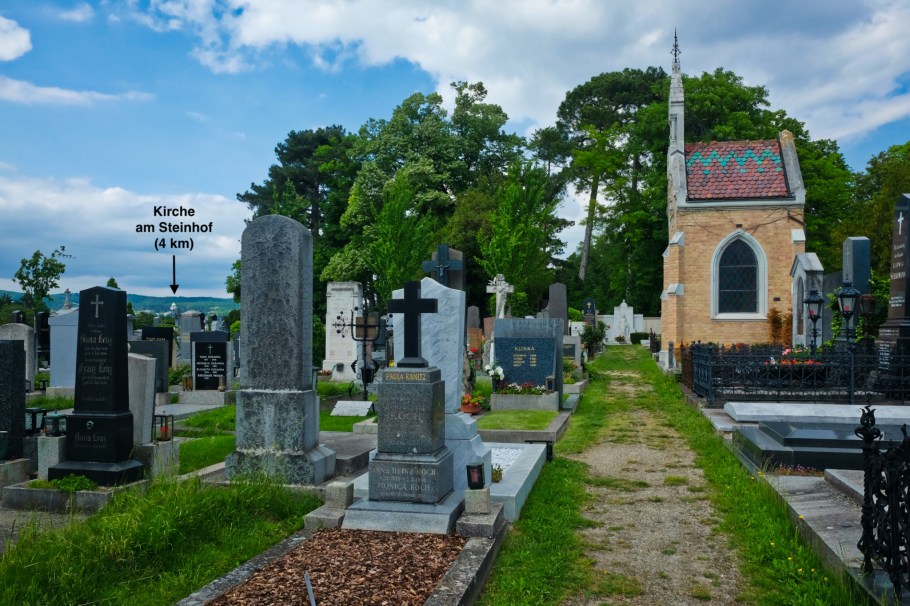
Visitors to the cemetery can look northwest to see the glowing golden dome of Otto Wagner’s Steinhof Church at a distance of 4 km (2.5 mi). Photo, 16 May 2018.


( Click here for images and more )

Strassenbetrieb, Müllkübel, Müllsprüche, Mistkübel, Abfallkörbe, Abfalleimer, Innsbruck, Tirol, Tyrol, Austria, Oesterreich, fotoeins.com

My Innsbruck: I do not refuse the humour

It’s not really low humour, and besides, I’m not one to reject humour.

As an encouragement for everyone to keep the environment clean (aside from personal and collective responsibility), the ubiquitous red garbage or waste bins throughout the city of Innsbruck are all tagged with a succinct sentence that’s amusing and punny. I don’t abide by the stereotype that the German language can’t be funny; instead, the stereotype persists because of lazy ignorant thinking.

Many small red waste-bins or garbage cans are located throughout the Tirolean capital. With a real chance to causing double takes, the different sayings on the bins is a mix of Austrian German and English, encouraging residents and visitors to use them as intended. The bins are emptied when city staff open them from underneath. This “attraction to waste” is not a unique phenomenon, as various other cities employ a similar trick; for example, in Hamburg and Berlin. But when a waste-bin urges people to feed it, I find it hard to look away.

From over 1200 submissions for a public city-wide competition for the best slogans, 20 were selected and unveiled in autumn 2010 (Innsbruck informiert, 2010: 15 Sept and 6 Oct). Theses mottos are on hundreds of bins in the city. Below are 17 out of 20 for a 85% completion rate, which is pretty good for a few days in and out of town.


( Click here for more )

My Konstanz: Jan Hus’ last stand

Above/featured: Old Town from the Bodensee (Lake Constance): visible from left-to-right are respectively the broad-roofed Konzilgebäude (Council Building), Münster (tall Cathedral spire behind sailboat), and the Dominikanerinsel (Dominicans Island). Photo on 23 Sep 2017.

6 July is a national holiday in the Czech Republic; the formal name is “the day Jan Hus was burned at the stake” (Den upálenĂ­ mistra Jana Husa).

I wrote previously about medieval Bohemian theologian and reformer Jan Hus (John Huss) whose teachings in the relatively novelty of the Czech language and criticisms about abuse and injustice within the Catholic Church predated Martin Luther’s own revolution for change by almost 100 years. Hus’ place within Czech history is fixed onto the nation with a giant memorial sculpture at the centre of Old Town Square in the capital city of Prague. His place is also assured in the European Reformation as seen in full display at the world’s largest Reformation Monument in the German city of Worms. Hus’ conviction and execution and the resulting armed conflicts would give rise not only to the concept of European unity (see also the prominent Czech historical figure George of PodÄ›brady), but would also give way to the European continental wars of religion.

As key historical aspects for creating unique Bohemian and subsequent Czech identity, Hus’ life, final days, and death are also a part of the historical record in the southern German city of Konstanz (Constance in English, Kostnice in Czech).


How Hus got here

The backdrop was the one of the largest conferences in the Middle Age. The Council of Constance met from 1414 to 1418, during which one key directive of the synod was to decide once and for all a single pope from three candidates. With the Council’s election of Pope Martin V in 1417, the Papal Schism which began in 1378 effectively came to an end; this would also be the one and only time a pope was elected on German soil. As the only meeting of its kind held north of the Alps, this massive medieval assembly gathered tens of thousands of people, including religious, political, civic, and social leaders; scholars and other civic officials; as well as traders and merchants from around the continent.

Constance had become a free Imperial city in the late 12th-century, allowing the city to prosper by trade of many goods around the European continent and onto the Mediterranean to destinations in Africa and the Middle East. The city was chosen to host the 15th-century conference, because the city as bishopric had sufficient space and resources to host, house, and feed a very large number of conference guests. Constance has the nickname “Stadt des Konzils” or the “Council City”, and has been included as part of the Hussite Cultural Route (Hussitische Kulturroute), which traces Hus’ final journey from Prague to Konstanz.

As follower of English philosopher John Wycliffe, Hus spoke out on flagrant abuse and corruption, especially on the sale of indulgences with the act of forgiveness for sin being used as a tool to increase church income. At a time when the church claimed complete spiritual, moral, and civic authority, Hus was an obvious troublemaker, and the central church authority punished him with censure and excommunication. Hus was called to travel from Prague to Konstanz and answer charges of heresy at the Council of Constance. He ignored the pleas of friends and colleagues to stay put (“it’s a trap!”), and armed with an apparent imperial promise of safe passage and conduct, he set off on his journey to Konstanz. Upon arrival in November 1414, the promise was naught and the betrayal complete; Hus was promptly arrested, imprisoned, and tortured in various places throughout the area for several months. In refusing to recant over his criticisms against the church, he was never given a fair trial. The Council convicted him of heresy inside the city’s cathedral on 6 July 1415. Hus was immediately handed over to the civil authority, who condemned him to death by burning at the stake on the same day. Jan Hus is revered as a key historical figure for Czechs and the Bohemian Reformation, just as Martin Luther would be for his role to kick off the German Reformation almost 100 years later.


( Click here for images and more )