Fotoeins Fotografie

location bifurcation, place vs. home

Posts from the ‘Germany’ category

WĂĽrzburg: Röntgen, X-rays, & 1st Nobel Prize in Physics

On my list and map, I placed the museum’s location as a “possible” to visit in the city. If I had time, I’d swing by and have a look, appealing to my fondness for science and the history of science.

Many arrive in Würzburg to visit the Residenz UNESCO world heritage site. On a daytrip from Frankfurt am Main, I duly visited the Residenz, and easily completed my initial visit requirements, as I knew I would. That’s when my inner voice (a.k.a., the spirit of B.Sc. ’90) reminded me insistently the museum was “simply and conveniently” on the return walk to the city’s central train station to fully complete my visit requirements.

I walked north from the Residenz, and followed the signs into the building for the Röntgen-Gedächtnisstätte (Röntgen Memorial) where X-rays were discovered. Standing inside the former laboratory space, I’m surrounded by artifacts, books, papers, tubes, equipment, and photographs.

I also feel a part of my undergraduate physics education has come full circle.

( Click here for images and more )

My Heidelberg: 40+ Highlights from Home

Above/featured: From Philosophenweg: across the Neckar, over the Altstadt, and up to Königstuhl – 21 May 2016 (HL).

Heidelberg is “eine adoptierte Heimatstadt” (an adopted hometown). Some have called this place “scenic, natural, and spectacular”; some call it “boring, provincial, and extortionate”. I could be referring to Vancouver, but that’s a subject for another time.

I’ve long struggled with questions of place: what defines “home”? Can those definitions and qualities change with time? Do people have choice(s) and do they apply their choices in their search? Can people find meaning with “home”? Must “home” be restricted to only one place, or can different needs be met from different places?

Images can provide access to memories of having lived in a new country, experiencing the shock of the new, and settling into the mundane. I remember advice someone once gave me which became constant companion and reminder: that I was inhabiting a place at the same latitude as my birthplace, 8000 km in distance and 9 time zones apart on the other side of the planet, a place that’s seen its compact share of activity with flair and impact.

Most recall is naturally connected to sight. Occasionally, it’s a rush of the senses: the quick breeze on the skin, the ankle-spraining undulations of the cobblestone, how fog clings like a cold clammy cloak, the sing-song of birds among tall trees in the forest on the hill, the smell of grilled sausages in town by day, and the satisfying late-night noms of a spicy Dürüm Döner with a cool Ayran. And other times, human history leaps out and buries its claws, when the unthinkable must be acknowledged and understood in a synapsis of memory and senses.

In the autumn of 2001, I moved to Germany and Heidelberg: both sight unseen and without having learned any of the language. I stayed in town for a little under two years. What’s astonishing is I have no pictorial record of my time in Heidelberg, Germany, and Europe: I had no camera before the dawn of the smart-phone.

I have some great memories, even if time is casting long shadows. What I lost (no, gave away) was some part of me that actually has little to do with the “Schlager” hit song “Ich hab mein Herz in Heidelberg verloren“. It might be a piece of the heart, a part of the soul, or simply a scrap of good sense; but what it is precisely still remains undefined and shapeless. Finding solid answers about what I’ve surrendered might take years. And so, for the sake of clarity, I’ve returned many times since leaving town in 2003. A sharper focus comes through the post-departure blur whenever I step off the train in town.

I couldn’t have possibly known the experience of moving to and living in Heidelberg would be life-changing. Time so far has been kind, because it didn’t take long for me to adopt Heidelberg as “home”.

( Click here for images and much more )

Before Bauhaus: Alfeld Fagus Factory, UNESCO WHS

Before Bauhaus found its first footing in Weimar, there was in the town of Alfeld in central Germany the Fagus-Werk factory building.

The Fagus factory building is looked upon as the first building in the world for the modern architectural age, and is the predecessor to the elegant 1926 Bauhaus headquarters building in Dessau. Fagus company founder Karl Benscheidt commissioned architect and future Bauhaus founder, Walter Gropius, to create and build a shoe-making factory as an artistic project. Gropius and his collaborator Adolf Meyer stuck with working floor-plans by architect Eduard Werner, and set their sights on new exterior and interior designs. Completed in 1911, the factory’s office building set a new standard for 20th-century industrial architecture with steel and glass construction and tall unsupported windows at the corners of the building.

“Fagus” is Latin for “beech tree”, and shoemaking began with shoe lasts or moulds constructed from beech wood, which were sold and distributed around the world to other companies for the productions of shoes. In the 1920s, Benscheidt developed the turning precision-lathe speeding up production, prompting growth and expansion and elevating the company to world’s top producer of shoe lasts. Today, the building is still a working factory: Fagus creates plastic lasts milled by automated machinery to precise specifications for specific designs by shoe companies. Also on-site is GreCon which produces systems for fire-detection and fire-extinguishing in industrial settings. The Fagus factory building was recognized as “unique living monument” and inscribed by UNESCO as World Heritage Site (Welterbe) in 2011.

With a population of over 20-thousand people, Alfeld is located in the German federal state of Lower Saxony. The town’s reach by train is 30-minutes from Hannover or 40-minutes from Göttingen, after which is a short 5- to 10-minute walk from Alfeld(Leine)1 train station to the entrance of the Fagus/GreCon complex. Visitors can walk around the working factory site, stop at the World Heritage Site Visitor Centre, sit in the neighbouring café for coffee or tea, and visit the museum dedicated to the building’s origins, the building’s century-long history of shoe-making, and a general history of footwear.

Walter Gropius and others would move to Weimar to establish a centre of art, design, thought, and attitude for Bauhaus in 1919, eight years after inauguration of the Fagus-Werk.

Die Baukunst soll ein Spiegel des Lebens und der Zeit sein.
(Architecture should be a mirror to life and its time.)

– Walter Gropius.

( Click here for images and more )

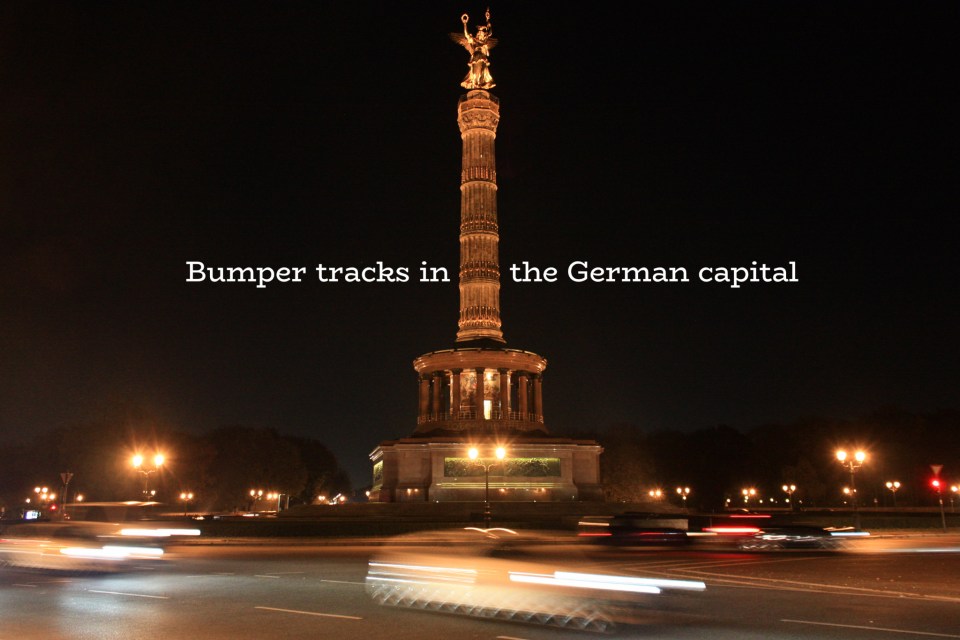
Siegessäule, Grosse Stern, Tiergarten, Berlin, Germany, fotoeins.com

My Berlin: 30 tracks for the German capital

Above/featured: Siegessäule & Grosse Stern, at night – 13 Nov 2012 (HL).

I compiled a list of songs accompanying my travel, a soundtrack that’s full of meaning and memories. This is another set, a listing of tracks I associate with Germany’s capital city. Music is always about personal selection, and every track fires a specific memory of time and place within Berlin. For example, watching “Lola rennt” (Run Lola Run) in a movie theatre in Toronto in the fall of 1998 planted the seeds for a move to Germany three years later. My first visit to Berlin soon after marked the beginning of a deep love affair with the “grand lady of BAER’leen.”


( Click here for more )

Munich: Memorials to the 1972 Olympics Massacre

Above/featured: Munich’s Olympic Park: Olympic Tower and the tent roof structure.

In my hockey-mad nation of birth, September 1972 is defined by the epic hockey Summit Series between Canada and the Soviet Union; the games and individual stories are stuff of legends. But high on my mind since childhood have been the tragic events that same month in Munich: the worst terrorist act in modern Olympics history.

The 20th Summer Olympics were under way in Munich, Germany, and “Die heiteren Spiele” (The serene Games) as they were called were the first summer games held in post-war Germany since the 1936 Berlin Olympics. Both Munich and Germany wanted to show a different peaceful and prosperous side to the world with the generation born after the Second World War.

However, the 1972 Games will also carry the stain of the “Munich Massacre” on 5-6 September. By crisis’ end, the 17 dead included eleven members of the Israeli Olympic team, one German police officer, and five Palestinian kidnappers. Many questions remained about pre-Game preparations and warnings about a possible attack, security measures, crisis management, and the failed attempt to liberate the hostages. Complete details of events remain murky even after 40 years. The disaster would damage the reputations of city, state, and country as well as international relations for years to come.


( Click here for images and more )