Fotoeins Fotografie

location bifurcation, place vs. home

Posts by HL fotoeins

My Kicks on NM State-68: Classical Gas Museum

I’ve always been mesmerized by highway signs and fascinated by the history of big highways. There’s also big nostalgia, because Dad loved highway driving and road trips. He was the sole driver on the Trans-Canada highway between Vancouver and Calgary or on US Interstate-5 to Bellingham and Seattle. How obvious is it then, that a deep yearning for open roads comes directly from my father.

The following is a part of day 8 (of 17) in our drive through the American Southwest.

We set out on a day trip from Santa Fe to Taos and Taos Pueblo, with a scenic drive on New Mexico highway NM-68, the “low road” or “river road” along the Rio Grande river between Española and Taos. With low light in the morning hour, we didn’t see it when we drove north to Taos. But on our mid-afternoon return on the low road, we found the Classical Gas Museum in the small town of Embudo. We pulled into an open sandy rocky patch, marvelling at the collection in front of rusting gas pumps and a wooden building resembling a historic gas station.

The Classical Car Museum is owned and run by Johnnie Meier who is a retired scientist and former employee at the nearby Los Alamos National Laboratory. His interest and collection grew to the point where he needed more space. Reading about the museum is one thing, but it’s no match for seeing in person his extensive collection of memorabilia, including whole and partial gas pumps, highway signage, oil cans, gas company signage, license plates, a miniature-model gas station, a working vintage Coca-Cola cooler, a classic car or two parked on the premises, an entire pre-fabricated diner building, and a mascot for a once thriving restaurant-chain. From within the building, it’s the glow which provides further fuel for interest, and once inside, the neon and warm illumination of symbols and signs combine for the inevitable “wow!” Altogether, it’s a broad mix of elements from mid 20th-century American history which is all about highway-driving and open-road nostalgia. There’s a saying about how someone’s junk is somebody else’s treasure, but the entire collection deserves careful cataloguing and a larger permanent building. A new museum would be fitting somewhere along the old US-66 highway. Santa Rosa, NM is a leading candidate, but other cities in the state are also possible.

For now, the museum is located next to highway NM-68 in Embudo; the coordinates are 36.209102 degrees North, 105.951658 degrees West. The museum sits on 0.81 hectare (2 acres) of Meier’s land, and the museum building is 93 square metres (1000 square feet) in size. There is no admission charge, though donations are most welcome, especially for the local animal shelter. You might want to call ahead (505-852-2995) to see if Meier is around in case the building is closed.

( Click here for images and more )

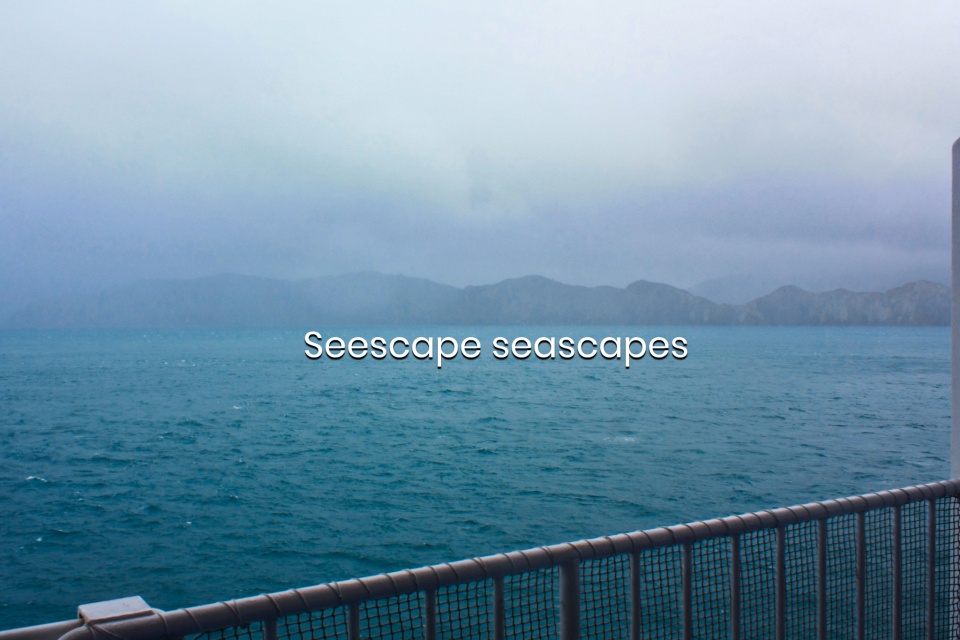
Interislander ferry, Kaitaki, Cook Strait, Raukawa Moana, New Zealand, Aotearoa, fotoeins.com

Seescape seascapes

Above/featured: Crossing Cook Strait in winter mist and fog, catching first sight of New Zealand’s South Island – 14 July 2012 (450D).

Some time ago, the challenge was people’s take on cityscapes. The present challenge looks out to the water, and while lakes are nice, I like the opportunities afforded by the ocean or the sea. The word “seascape” is a noun whose definition is “a view of an expanse of sea.” I’m pleased to present the following “seescapes” with the allure of open waters in mind:

  1. Australia: HMAS Sydney I memorial, Sydney
  2. Australia: Port Arthur, Sydney
  3. Canada: Strait of Georgia, Salish Sea
  4. England: Dover Cliffs from English Channel
  5. Germany: Bodensee (Lake Constance)
  6. Germany: Wadden Sea mud flats
  7. Hong Kong: outlying islands in South China Sea
  8. Italy: Ligurian Sea from Cinque Terre
  9. New Zealand: Akaroa Harbour and the Pacific
  10. New Zealand: Milford Sound and the Pacific
  11. South Africa: where the Indian and Atlantic Oceans meet
  12. Sweden: Stockholm archipelago, Baltic Sea
  13. USA: Puget Sound, Salish Sea

Meere Seen – mehre Seen – mehr sehen1.

( Click here for images and more )

Georgengarten, Dessau-Wörlitz Garden Realm, Gartenreich, UNESCO World Heritage Site, Dessau, Saxony-Anhalt, Sachsen-Anhalt, Germany, fotoeins.com

Dessau: George Gardens, Garden Kingdom UNESCO WHS

Above/featured: Guided Bauhaus tour stopping momentarily in the Georgengarten.

How times have changed: I wouldn’t have given Dessau a second thought a time ago. But after speaking with representatives from Saxony-Anhalt and after spending a few days in the city, I’ve better understood the historical and cultural significance, and those who feel strongly about culture and history should give Dessau a chance.

Dessau is a German city of about 80-thousand people in the federal state of Saxony-Anhalt, and is known as the second capital of Bauhaus in the early 20th-century movement of modernism for design and architecture which has been given inscription as World Heritage Site.

If you’re in town to check out various Bauhaus sites, there’s a 2nd heritage setting over a vast green space. East of the Bauhaus Masters’ Houses are a set of Roman ruins marking the edge of Georgengarten (George Gardens); further in the park is the Schloss Georgium (Georgium Palace). Since 2000, both Georgengarten and Schloss Georgium are part of the UNESCO World Heritage Site that’s shared with the neighbouring city of Wörlitz.

( Click here for more )

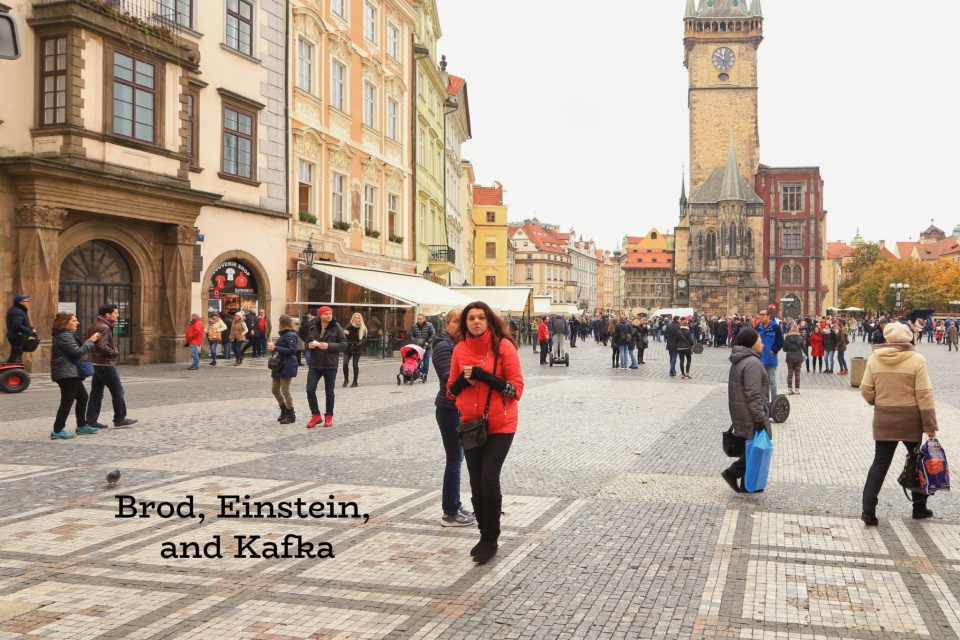
Albert Einstein, Franz Kafka, Max Brod, Dům U Kamenného beránka, At the stone lamb, Staromestske namesti, Old Town Square, Prague, Prag, Praha, Czech Republic, fotoeins.com

My Prague: Brod, Einstein, & Kafka at Fanta Salon

Above/featured: it’s as if I just pointed out a famous meeting place to her right (left for the reader).

Prague’s Old Town Square is one of the most visited landmarks, dominated by the two tall spires of the Church of our Lady before Týn, Old Town Hall, and a prominent sculpture dedicated to Czech icon Jan Hus at the centre of the square.

At the southeast corner of the square is a building called (Dům) U Kamenného beránka or “At the Stone Lamb” at address StaromÄ›stské námesti 551/17 #. To the right of the building’s main entrance is a memorial plaque with an inscription in both Czech and English. The memorial plaque was created by Czech sculptor ZdenÄ•k Kolářský and unveiled in 1998. Looking closer, you’ll recognize Albert Einstein’s face and his famous physics equation stating mass-energy equivalence and written in cursive script: E = mc2.

Over a 16-month period from 1911 to 1912, Albert Einstein lived in Prague with his family and was full professor of theoretical physics at the German Charles-Ferdinand University. Einstein enjoyed hanging out at a number of cafes for conversations, exchanges, and music, and he was a frequent visitor to this building where Czech liberal and intellectual Berta Fanta operated a literary-philosophical salon or lounge. The salon saw visits by many intellectuals, both domestic and international. “Domestic” writers Franz Kafka and Max Brod would have come here for the discourse as well, but it turns out little is actually known about whether all three arranged to meet or would have met here at the same time.

( Click here for images and more )

My Prague: Jan Hus, Bohemian reformer and Czech icon

Above/featured: Jan Hus Monument, Old Town Square – 4 Jul 2008 (HL, 450D).

Most visitors to the Czech capital city of Prague will pass by and overlook the large sculpture near the middle of Old Town Square. The central figure in the monument is one of the most important historical figures for capital and country.

Although he may not be as well known outside of the European continent, Jan Hus is a massive historical figure within central Europe. Jan Hus was declared the greatest hero of the Czech nation in a 2015 survey by Czech Radio. In Konstanz on 6 July 1415, Jan Hus was sentenced to death on the charge of heresy. I’ve described locations in Konstanz during Hus’ final days.

In recognition of his attempts to reform the Catholic Church and to foster and encourage Bohemian identity, July 6 is commemorated annually as a national holiday in the Czech Republic: the holiday is known as “Den upálení Mistra Jana Husa,” which translates to “day of the burning of Jan Hus.”

( Click here for images and more )