Fotoeins Fotografie

location bifurcation, place vs. home

Posts by HL fotoeins

1-day drive, US: Cliff Dwellers to South Rim

October 2018.

The following takes place entirely on travel day 11 in the American Southwest. The previous day was a long one on the road: from Flagstaff, we drove north on US-89 and US-89A next to Echo Cliffs and Vermilion Cliffs, and ending up at North Rim for our first-ever visit to the Grand Canyon.

After overnighting at Cliff Dwellers Lodge, a new day began with a stop at the Rock Houses nearby, then retracing the previous day’s drive back to Cameron, before turning west to spend the rest of the day at the Desert View section of the Grand Canyon’s South Rim. That began our first-time visit to the South Rim which we visited over a period of two days.

Total distance from Cliff Dwellers to Flagstaff (via South Rim): 217 mi (349 km).


( Click here for images and more )

Vancouver: summer cricket at Stanley Park

Above/featured: Grouse Mountain looms over a cricket match at Upper Brockton, with the bowler delivering from the mountain end to the pavilion end.

It’s not typical 21st-century sport in North America, but it is Canada’s first summer sport. Many of cricket’s practitioners in Vancouver’s picturesque Stanley Park have roots from India and Pakistan; among them the shouts of “shabash” are heard often during play.

In childhood, I was enamored with baseball. With its similar origins, I discovered cricket with time spent in Australia, New Zealand, the Bahamas, and South Africa. The natural connection is the former British Empire. I began with T20, the shortest format of the game; with curiosity and time, my hunger encompassed the 50-over one-day format (ODI). It’s my start with the short white-ball format that I’ve developed an appreciation for the long format of the game with red-ball Test cricket.

But is the cricket ground at Vancouver’s Stanley Park “the most beautiful cricket ground in the world”? (With Table Mountain as the backdrop, some might proclaim Newlands Cricket Ground in Cape Town, South Africa as the most beautiful/scenic.)


( Click here for images and more )

Munich: Ghost station “Olympic Stadium”

In the vicinity of Munich’s Olympic Stadium is a train station overgrown with brush and weeds. The tracks stretch north and south, but go nowhere.

Munich played host to the Summer Olympics in 1972; physical reminders include the Olympiadorf (Olympic Village), Olympiapark, and the Olympiastadion (Olympic Stadium). In 1988, the train station “München Olympiastadion” closed to train service for the final time. Rail tracks which connected the station with the North Ring freight tracks were cut, isolating the station and leaving it to decay.

Since 2001, the Olympic Village has been listed as part of the heritage Olympiapark ensemble which includes the abandoned station. But will the station be left to decay? Or will the station be refurbished in some way to become a living memorial?

Historical maps of the MVV U- and S-Bahn system show how train service from central Munich to Olympic Stadium was utilized. S-Bahn train service carried passengers along the central trunk to Olympic Stadium via Hauptbahnhof, Laim, and Moosach; check out the system maps for June 1972 and June 1988.


( Click here for images and more )

Vienna Hietzing Cemetery: F.Grillparzer, G.Klimt, K.Moser, O.Wagner

Previously, I provided short biographies for artist Gustav Klimt, artist and designer Koloman Moser, and architect Otto Wagner, and why they are important figures to the arts and culture scene in early 20th-century Vienna. These three figures are buried in Hietzing Cemetery in the 13th district of Hietzing at the city’s western periphery.

Located to the southwest of the former imperial summer residence Schönbrunner Schlosspark, Hietzing Cemetery is modest in size with an area of over 10 hectares (25 acres) and containing over 11-thousand graves. With the present site inaugurated in 1787, the cemetery has seen several expansion phases and survived damage from the Second World War.

I highlight the final resting places for Alban Berg, the Fröhlich sisters, Franz Grillparzer, Hans Hollein, Gustav Klimt, Koloman Moser, Strauss women, and Otto Wagner.
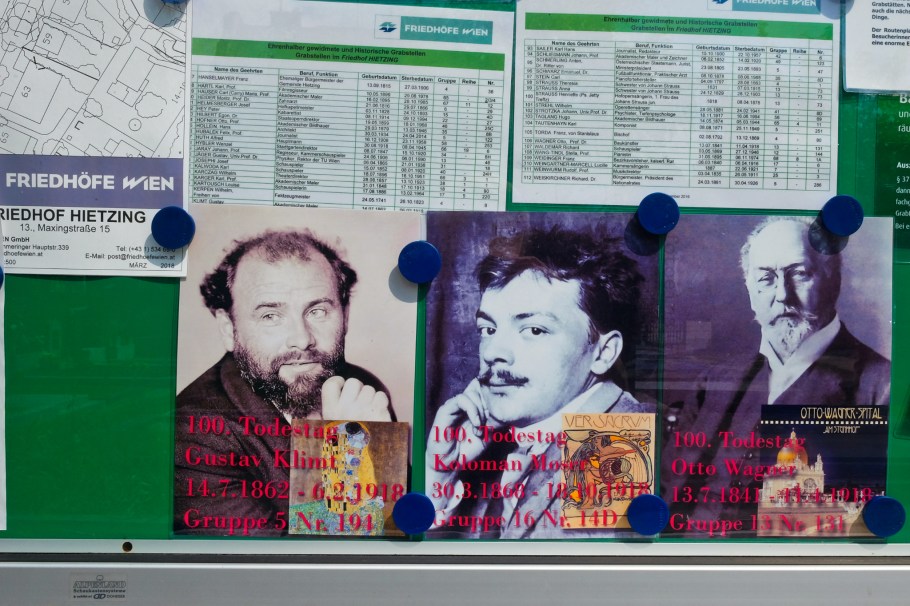
Friedhof Hietzing, Hietzing Cemetery, Friedhoefe Wien, Hietzing, Wien, Vienna, Austria, Oesterreich, fotoeins.com

2018 was the 100th anniversary of the deaths of Gustav Klimt (1862–1918), Koloman Moser (1868–1918), and Otto Wagner (1841–1918). Photo, 16 May 2018.
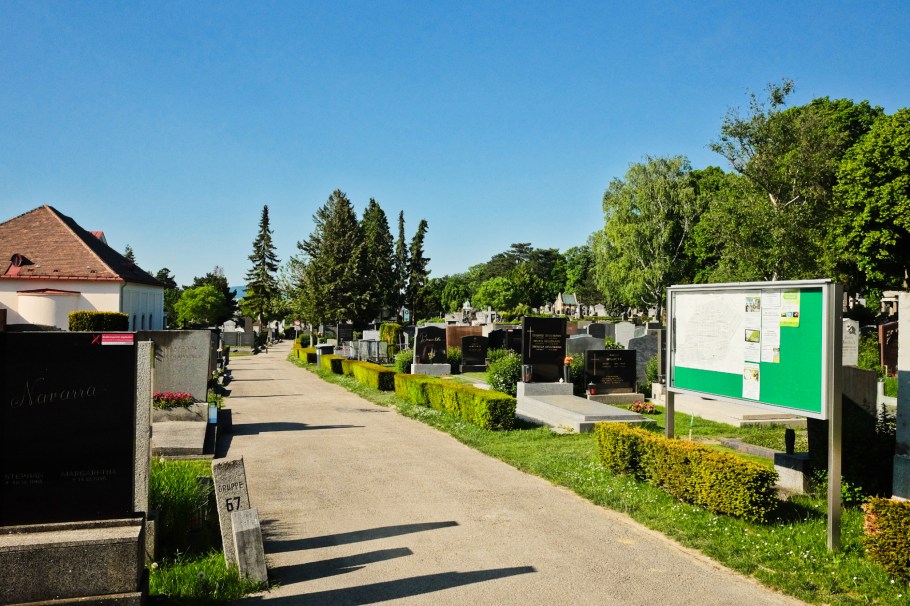
13. Bezirk, Hietzing, Friedhof Hietzing, Hietzing Cemetery, Friedhoefe Wien, Hietzing, Wien, Vienna, Austria, Oesterreich, fotoeins.com

Inside the front entrance – 15 May 2022.
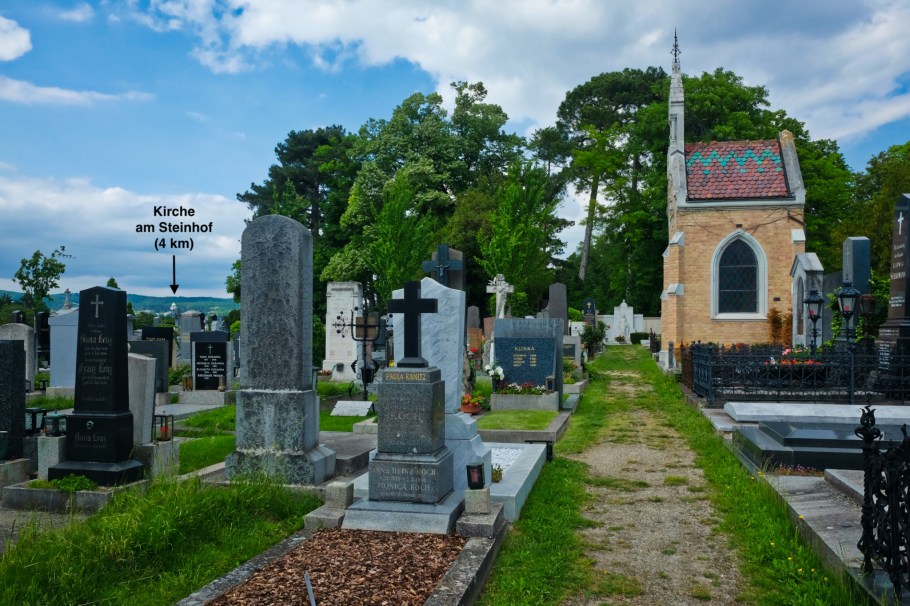
Friedhof Hietzing, Hietzing Cemetery, Friedhoefe Wien, Hietzing, Wien, Vienna, Austria, Oesterreich, fotoeins.com

Visitors to the cemetery can look northwest to see the glowing golden dome of Otto Wagner’s Steinhof Church at a distance of 4 km (2.5 mi). Photo, 16 May 2018.


( Click here for images and more )

Ruta 5, Carretera Panamericana, Panamerican Highway, Region de Antofagasta, Chile, fotoeins.com

Under the desert sun

Above/featured: Ruta 5 (highway 5), a ribbon-like cut through the desert in Región de Atacama, Chile – 24 Nov 2009 (450D).

It’s an interesting question: how does one consider, view, or photograph what’s under the sun? There’s a lot of room for interpretation. Modifying the theme for the desert sun, I examine the “quality of sunlight” within the Atacama Desert in northern and north-central Chile, and within the Sonoran Desert in southwest United States.


( Click here for images and more )