4 Sep 2018 0001 GMT+0000
Above/featured: Munich’s Olympic Park: Olympic Tower and the tent roof structure.
In my hockey-mad nation of birth, September 1972 is defined by the epic hockey Summit Series between Canada and the Soviet Union; the games and individual stories are stuff of legends. But high on my mind since childhood have been the tragic events that same month in Munich: the worst terrorist act in modern Olympics history.
The 20th Summer Olympics were under way in Munich, Germany, and “Die heiteren Spiele” (The serene Games) as they were called were the first summer games held in post-war Germany since the 1936 Berlin Olympics. Both Munich and Germany wanted to show a different peaceful and prosperous side to the world with the generation born after the Second World War.
However, the 1972 Games will also carry the stain of the “Munich Massacre” on 5-6 September. By crisis’ end, the 17 dead included eleven members of the Israeli Olympic team, one German police officer, and five Palestinian kidnappers. Many questions remained about pre-Game preparations and warnings about a possible attack, security measures, crisis management, and the failed attempt to liberate the hostages. Complete details of events remain murky even after 40 years. The disaster would damage the reputations of city, state, and country as well as international relations for years to come.
Below is a short pictorial description of sites in Munich’s Olympic Park and Olympic Village, memorializing those killed during the events of 5-6 September 1972.
At street level, there are blue information panels located near the U-Bahn station’s north entrance. A panel describes each of the following three locations in German, English, French, and Hebrew.
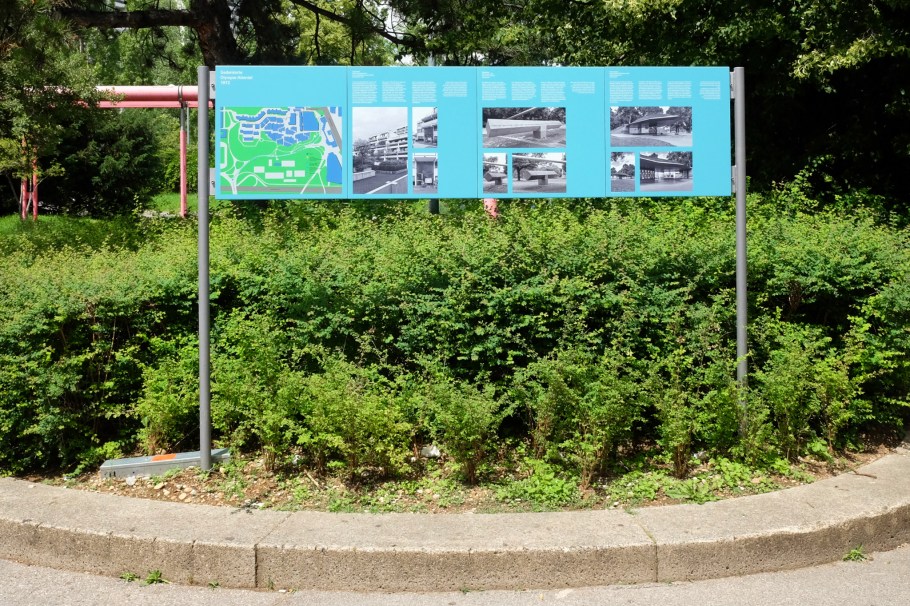
Description panels at street level at the northern exit/entrance to the U-Bahn station.
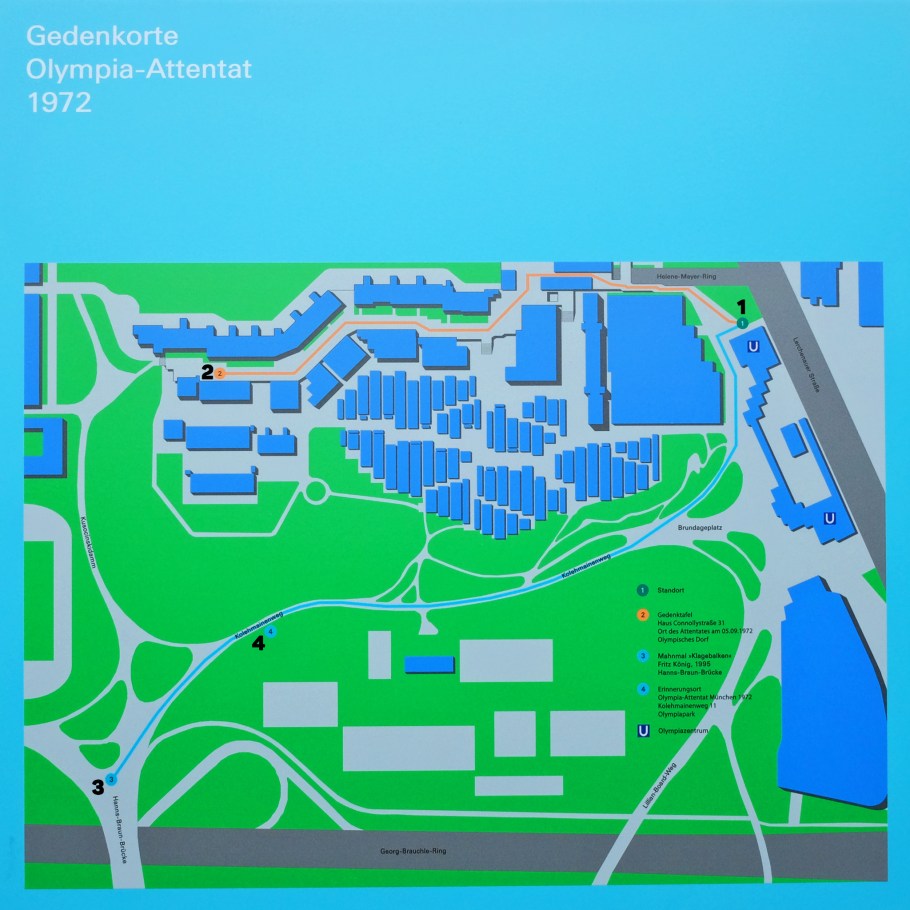
Memorial locations: 1972 Olympics Attack (Gedenkorte Olympia-Attentat).
On 5 September 1972, members of the Palestinian terrorist organization “Black September” entered the Olympic Village and stormed the residence of the Israel Olympic Team at Connollystrasse 31. In the process of taking eleven people hostage, two were killed. The following day, authorities tried to free the hostages at Fürstenfeldbruck air field. The attempt failed; killed were the nine remaining hostages, one German police officer, and five abductors. Next to the entrance at Connollystrasse 31 today is a Gedenktafel (memorial plaque) with the names of 6 athletes and 5 coaches from Israel.
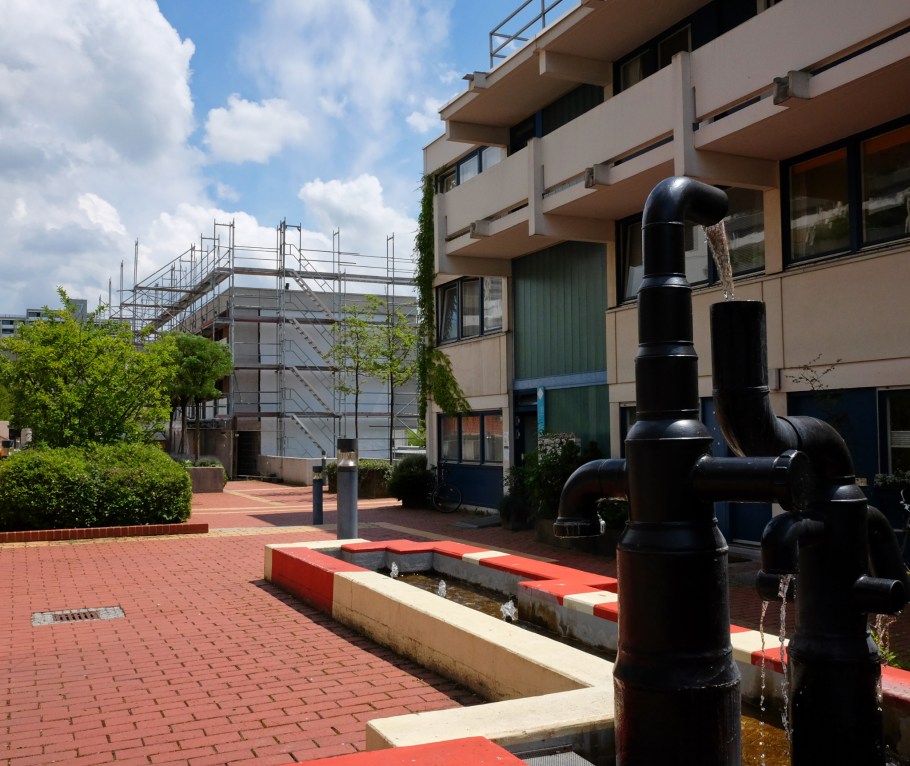
Approaching the building at Connollystrasse 31 (centre-right).
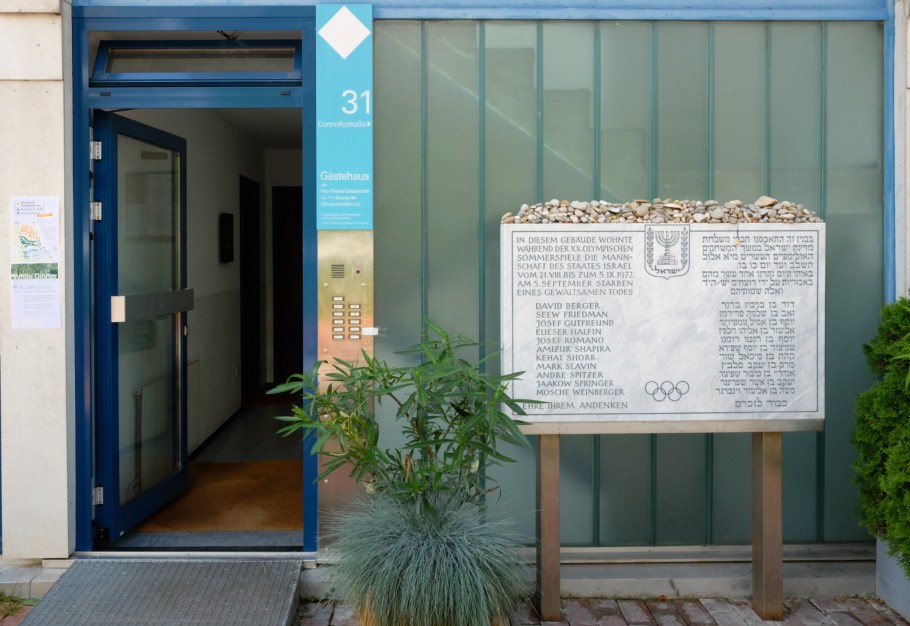
Entrance to Connollystrasse 31.

Commemorative plaque to the murdered Israeli athletes: In diesem Gebäude wohnte während der XX. Olympischen Sommerspiele die Mannschaft des Staates Israel vom 21. August bis zum 5. September 1972. Am 5. September starben eines gewaltsames Todes: David Berger, Seew Friedman, Josef Gutfreund, Elieser Halfin, Josef Romano, Amizur Shapira, Kehat Shorr, Mark Slavin, Andre Spitzer, Jaakow Springer, Mosche Weinberger. Ehre Ihrem Andenken. (The Israel national team stayed at this location for the 20th Olympic Summer Games from 21 August to 5 September 1972. Killed on 5 September were: David Berger, Seew Friedman, Josef Gutfreund, Elieser Halfin, Josef Romano, Amizur Shapira, Kehat Shorr, Mark Slavin, Andre Spitzer, Jaakow Springer, Mosche Weinberger. In honour of their memory.)
At the north end of Hanns-Braun-Brücke bridge is Fritz Koenig’s 1995 sculpture “Klagebalken” (Wailing Beam), serving as reminder and warning against terrorism. The large rectangular ten-metre long slab of granite comes from the rock quarry at Flossenbürg, near the Nazi concentration camp which bears the same place name. Inscribed onto the stone are the names of the eleven Israeli athletes (in Hebrew) and the name of one German police officer (in Latin). The memorial sculpture is called “Denkmal für die Opfer des Olympiaattentats 1972” (Memorial to the victims of the 1972 Olympics massacre), and is complementary to the memorial plaque at Connollystrasse 31. On the pavement in front of the sculpture is a small plaque; see also below.

“Klagebalken”, by Fritz Koenig, 1995. The diagonal carrier rope anchors the tent roof structure further in the park; see below.

“Grenzstein des Lebens, Nicht der Idee. Während der Spiele der XX Olympiade in München erlitten elf israelische Sportler und ein deutscher Polizeibeamter am 5. September 1972 durch einen terroristischen Anschlag einen gewaltsamen Tod.” (Border stone of life, and not the idea. During the 20th Summer Olympics in Munich, eleven Israeli athletes and one German police were killed during a terrorist attack on the 5th of September 1972.)
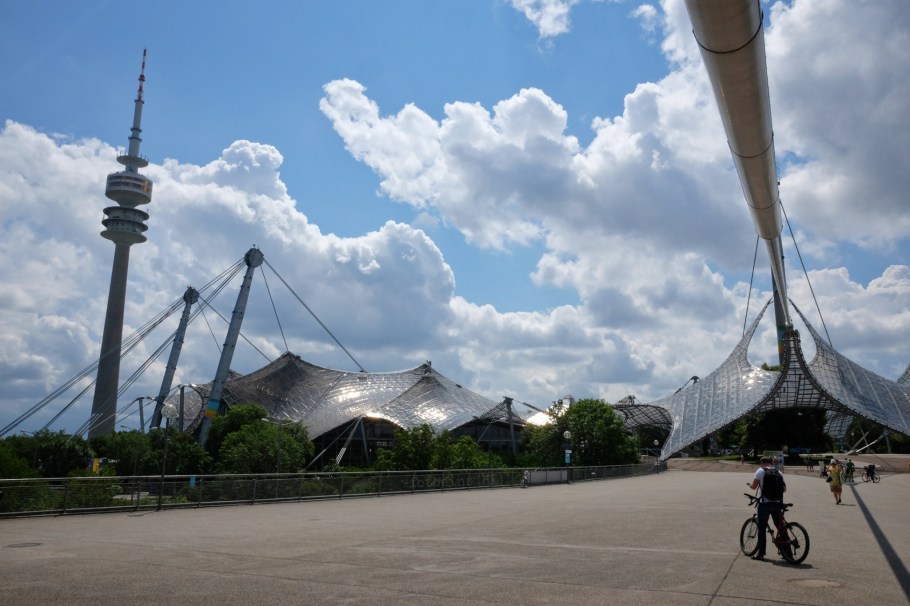
From sculpture, to Hanns-Braun-Brücke bridge, and south to Olympic Tower and the rest of Olympic park. Note the carrier rope for the tent roof beyond.
The place of remembrance “Erinnerungsort Olympia-Attentat München 1972” was inaugurated in 2017. Panels provide short histories for each of the Israeli athletes killed, and a video display with collected television footage shows the timeline of events. The memorial also illuminates the politics of the time, the significance of Germany’s first Olympics after the Second World War, and long-standing friction in the Middle East. From this place of remembrance, the view north-northeast faces the former Olympic Village (Olympiadorf) which is a part of the overall Olympic Park heritage ensemble (Olympiapark Denkmal-Ensemble) since 1998.

Erinnerungsort Olympia-Attentat München 1972.

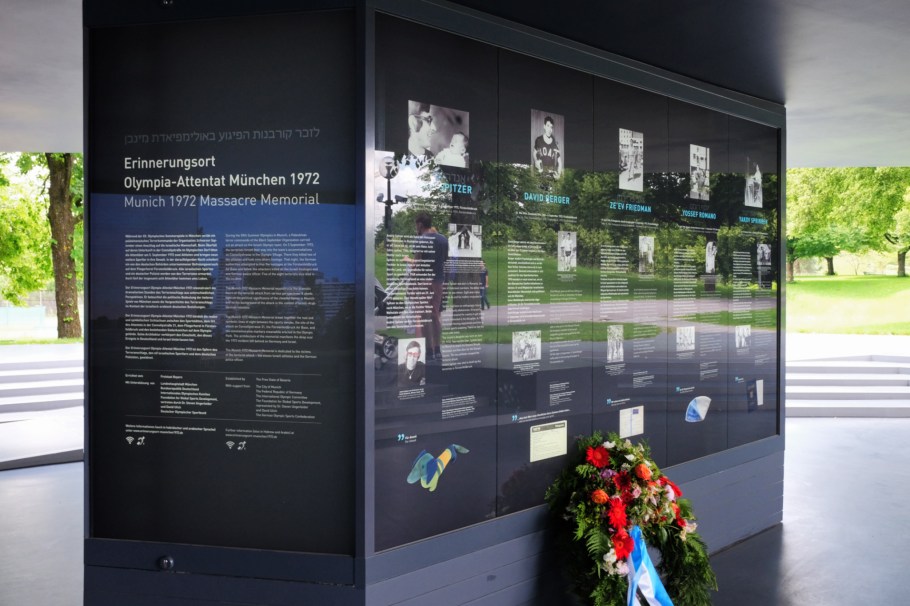


Memorial location with the Olympic Tower behind.

Northeast to Olympiadorf (Olympic Village).
• Olympia 1972: Heitere Spiele und tödlicher Terror, Deutschlandfunk, 25 Aug 2022.
• Victims’ families & German govt. compensation agreement, DW News, 31 Aug 2022.
• Summary of the 20th Summer Olympics in Munich, CBC Sports (Canada).
• How Canadian athletes were unwittingly tied to the tragedy, CBC News (Canada) in 2012.
• Could the massacre have been prevented?, from Deutsche Welle Germany (in English).
• 1972 report and 2012 series: here, here, and here: from Germany’s “Der Spiegel”, in English.
With public transport, take Munich’s U-Bahn U3 or U8 to station Olympiazentrum. From there, you can follow the suggested path to the memorial plaque at Connollystrasse 31, the “Klagebalken” memorial sculpture, and finally to the Place of Remembrance. The path is about 1.3 kilometres (0.8 mile) one-way. Click on the arrow-window icon at the upper-left corner of the map below for the legend.
I made all pictures above on 2 June 2018 with a Fujifilm X70 fixed-lens prime. Alle Fotoaufnahmen sind mit Wasserzeichen versehen worden. This post appears on Fotoeins Fotografie at fotoeins DOT com as https://wp.me/p1BIdT-cn4.
Posted by HL fotoeins
Categories: Culture, Europe, Germany, Jewish-Euro History, Photography, Seasons, Sports, Spring, Travel
Tags: 1972 Summer Olympics, Bavaria, Bayern, Connollystrasse 31, Denkmal fuer die Opfer des Olympiaattentats 1972, Deutschland, Erinnerungsort Olympia-Attentat Muenchen 1972, fotoeins, Gedenktafel fuer die ermordeten israelischen Sportler, Klagebalken, Muenchen, Munich, Munich Massacre, My Munich, Olympiapark, Olympic Park, Wailing Beam
Mobile Site | Full Site
Get a free blog at WordPress.com Theme: WordPress Mobile Edition by Alex King.
Thank you for this post. I was there back than when I lived in Germany. I will never ever forget that day, I was working at the Olympic shopping mall , just a few feet away from the happening, being there we were all so terrified, what was going. Immediatley every thing was shut down, waiting for the moment being safe again.
LikeLiked by 1 person
By www.corneliaweber-photography.com on 6 Sep 2018 at 0156 GMT+0000
Hi and you’re very welcome, Cornelia. That’s amazing you were working at the OEZ at that time, and terrifying you happened to be around when the “events” began unfolding. The next time you’re back in Munich and you feel up to it, visiting the memorials is a moving experience. Thanks for stopping by and for your comment!
LikeLiked by 1 person
By fotoeins on 15 Oct 2019 at 0111 GMT+0000
Thank you Lee, yes it was terrifying. I will visit the memorial next time.
LikeLiked by 1 person
By www.corneliaweber-photography.com on 16 Oct 2019 at 0037 GMT+0000
[…] Erinnerungsort Olympia-Attentat München 1972 – 2 June 2018 with X70 (more here). […]
LikeLike
By Global Architectonics (LAPC) on 4 Mar 2019 at 0302 GMT+0000
[…] Take the U1 or U7 U-Bahn to Georg-Brauchle-Ring station; enjoy the station interior before heading up to street-level. Walk east on the pedestrian path along Georg-Brauchle-Ring in the direction of the O2 Telefónica tower. Go past the tower towards the overpass (road B304). Staying on the path, the road turns gently left/north at the overpass; walk up the sloped ramp to the ghost station. After safely navigating around and walking about the ruins, the pedestrian bridge directly across from the station takes you over the busy road Bundesstrasse 304, and east into Olympic Park, Olympic Stadium, and memorials marking the 1972 Massacre. […]
LikeLike
By My Munich: Ghost station Olympiastadion | Fotoeins Fotografie on 24 Aug 2020 at 0001 GMT+0000
[…] The above is a shot of the weekday morning 7am commute at Georg-Brauchle-Ring station which serves U-Bahn lines U1 and U7. I used this station to visit the ruins of the Olympiastadion ghost station and memorials to the massacre at the 1972 Summer Olympics. […]
LikeLike
By Fotoeins Friday in the Munich Metro: Georg-Brauchle-Ring | Fotoeins Fotografie on 6 Nov 2020 at 0002 GMT+0000