Fotoeins Fotografie

location bifurcation, place vs. home

Posts tagged ‘Via Regia’

My Cologne: wandering the streets in Ehrenfeld

For many, the German city of Cologne brings to mind the Cathedral, Karneval, and perfumed water.

For me, Cologne brings to mind great friends, tasty Turkish nibbles, football side 1. FC Köln, and Ehrenfeld.

My friend Y wanted to test her new camera on the streets, and when she suggested the Ehrenfeld neighbourhood, I readily agreed. My many visits to this city on the Rhine have frequently ended up in Ehrenfeld that’s largely Turkish and working class, an immigrant blue-collar area with which I readily identify and it’s why Ehrenfeld is my K-‘hood.


( Click here for images and more )

Augustinerkloster, Augustinian Monastery, Erfurt, Thüringen, Thuringia, Germany, fotoeins.com

Erfurt: Martin Luther’s start at the Augustine Monastery

You can almost imagine a 16th-century monk walking these halls, contemplating various aspects of spirituality, and reconciling them with the hardships of everyday living.

In the federal state of Thuringia in central Germany, the Augustinerkloster (Augustine monastery) in Erfurt is a notable place for the history of Martin Luther and the Reformation.

Martin Luther arrived in 1501 and began studies in liberal arts, law, and theology at Erfurt University. In 1505, Luther experienced a big personal event (the scare of his life, as legend goes), and decided to leave his studies by entering the Augustine Monastery to become a monk, much to his father’s displeasure and objections. Built originally around 1300, the Augustine Monastery was home for Martin Luther until 1511, and it’s here where he was ordained as a priest. The site underwent extensive post-war reconstruction after suffering heavy bombing damage in the Second World War. The monastery is now a seminary and a modest hotel: guided tours of the monastery provide a glimpse to Luther’s early years as a monk, and visitors can now reserve rooms for overnight stays in a no-frills technology-free setting and a peaceful comfortable environment.

Erfurt’s Augustinian monastery is listed as one of many additional candidate sites for inclusion into a single UNESCO World Heritage Site under the title Luther memorials in Saxony-Anhalt, Saxony, Bavaria, and Thuringia.

( Click here for images and more )

Spinnerei, Leipzig, Sachsen, Saxony, Germany, fotoeins.com

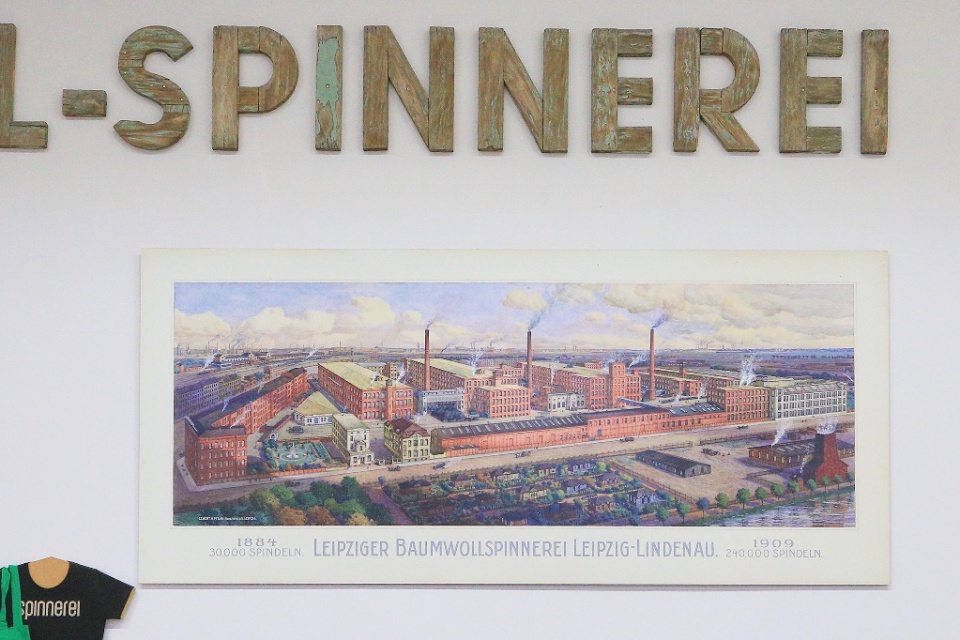
Leipzig Spinnerei: from cotton mill to arts centre

The Leipzig Spinnerei is a former cotton mill (Baumwollspinnerei) in the western industrial suburb of Plagwitz. The massive site at an area of 10 hectares (over 1 million square feet) with rows of factory buildings began operation in 1884 and eventually became the largest cotton mill in Europe with thousands working and living on-site. After the site ceased to produce spools of cotton thread shortly after reunification, artists took advantage of the cheap empty space, and transformed the area into studios, galleries, and exhibition halls. Much has been written about the impact and examples of art and space on Leipzig as the “new Berlin” as well as the “New Leipzig School.” The site as art and culture space opened its doors in 2005.

( Click here for images and more )

ShUM, SchUM, medieval Jewish cities, Speyer, Shpira, Worms, Warmaisa, Mainz, Magenza, Germany, Ashkenaz, Rheinland-Pfalz, Rhineland-Palatinate, fotoeins.com

ShUM, Jerusalem on the Rhine: Speyer, Worms, Mainz

When threats of destruction to property and life follow and linger over a group of people through no fault of their own over centuries, there’s something to be said about an eternal need to keep a watchful eye. Words like Verfolgung, Vernichtung, and Vertreibung1 have been etched into memory. I have all this in mind as I explore Jewish history in Germany as part of my need to answer the following question:

How did a nation of people which fostered composers Bach, Beethoven, Handel, Mendelssohn-Bartholdy, Strauss; and writers Goethe, the Brothers Grimm, Heine, Hesse, Heinrich and Thomas Mann, and Schiller sink to the worst depths of human atrocity and depravity in the first half of the 20th-century?

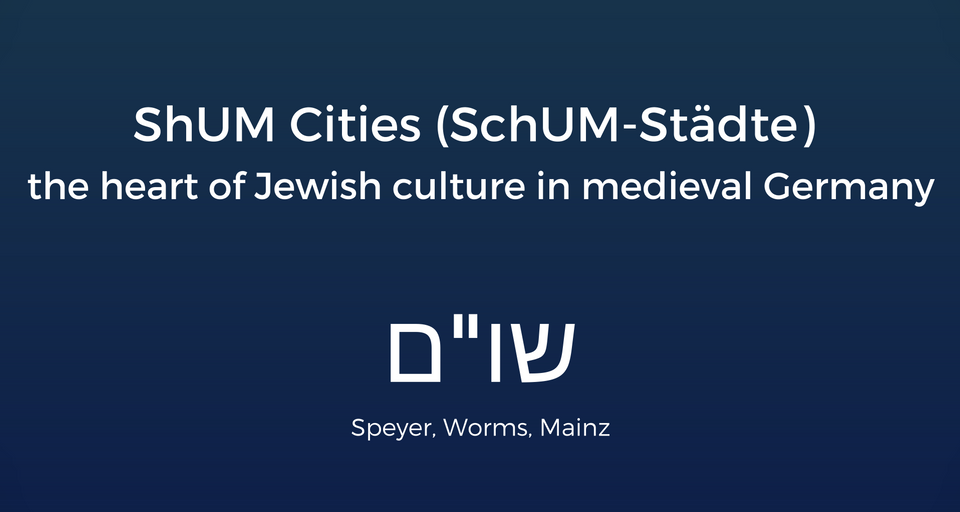
It’s easy to forget Jewish people have lived in what is now Italy and southern Europe since the middle of the 2nd-century BCE and inhabited southern Germany from the late 10th-century AD/CE2. During the High Middle Ages, three important bishopric (and cathedral) cities of Speyer, Worms, and Mainz along the Rhine river formed an important league or federation of Jewish communities (Kehillot) from the end of the 10-century to about the mid-to-late 14th-century. The word שו”ם or ShUM (SchUM in German)4 is an acronym consisting of the first letters of the Hebrew names for the three cities:

•   Shin (ש), Sh for Shpira (שפירא) → present-day Speyer;
•   Waw or Vav (ו), U for Warmaisa (וורמש) → present-day Worms;
•   Mem (ם), M for Magenza (מגנצא) → present-day Mainz.

The ShUM cities became centres for learning, training, religion, culture, and trade within medieval Germany (Ashkenaz3) and throughout Europe. Today, the three ShUM cities establish key destinations for historical travel, provide rich examples for continuing research on medieval Jewish life, and add up to a comprehensive project in recognizing an important chapter of the history of Jews in Germany.

The ShUM/SchUM was inscribed as World Heritage Site by UNESCO at the 44th meeting of the World Heritage Committee in July 2021. ShUM is Germany’s 1st all-Jewish world heritage site, a big acknowledgement to the centuries-long presence of the Jewish community along the Rhine river.


( Click here for more )

My Cologne: there’s a lighthouse that never goes out

Above/featured: Mural of the Helios structure, Köln Ehrenfeld, 9 Jan 2013 (450D).

Why is there a lighthouse located in the middle of the city? That makes no sense!

Did the Rhine river once flow here? Is that why there’s a lighthouse?

Is the structure some kind of forgotten remnant of the past?

Maybe that’s not a lighthouse, but rather a beacon that lets people know about a fire somewhere in the neighbourhood.

These are some of the questions and statements posed by Cologne residents when asked if they know anything about the lighthouse in their midst.

Located in the Ehrenfeld1 borough of Cologne is a red brick 44-metre (144-foot) high lighthouse. But why is there a lighthouse at all in the “middle” of Cologne? The Rhine river flows through the city, but the river is hardly visible from the lighthouse at a distance of about 3 kilometres (2 miles). The structure is not an actual operating lighthouse; it’s a symbol of early 20th-century enterprise from what was once one of the most important companies in Europe and marking the location of a big factory that once manufactured electrical equipment including maritime lights.

Founded in 1882, Helios2 established their presence in the town of Ehrenfeld before the latter was incorporated into the greater city of Cologne in 1888. The company once boasted a staff complement of over 2000 people, with products sold in Germany and Europe ranging from electrical generators and transformers, light bulbs, light fixtures in public spaces, and electrical streetcars. Helios also built light towers for the North and Baltic Sea coastlines, including ones at Roter Sand (Weser river estuary), Borkum and Wangerooge (East Frisian Islands), and Sylt. The onsite lighthouse in Ehrenfeld was constructed as a testing facility and never used as a navigational aid or marker. The company overextended its financial reach until Berlin’s AEG3 purchased Helios in 1905. Manufacturing operations in Ehrenfeld ceased in 1930, bringing a final end to Helios’ business presence in Cologne.

The present-day buildings which remain are used as office- and art-space. As historical landmark, the “Helios Leuchtturm” remains as part of the urban heritage in Ehrenfeld and Cologne. If the people in both borough and city have any final say in the matter, the lighthouse will never have to go out.4

( Click here for images and more )