Fotoeins Fotografie

location bifurcation, place vs. home

Posts tagged ‘UNESCO’

Kölner Dom, Hohenzollernbrücke, Köln, Cologne, Germany, fotoeins.com

Cologne’s two grand landmarks

Give them any excuse, the people in Köln (Cologne) love to party at any time. It’s a wonder but no surprise this is where I find some of the happiest people in the country. As the calendar flips to a new year, the time heralds the annual shenanigans of the Kölner Karneval. For residents and visitors, two of the best-known landmarks in the city are the Kölner Dom (Cologne Cathedral) and the Hohenzollernbrücke (Hohenzollern Bridge).

( Click here for more )

Weimar: City Church at Herderplatz, UNESCO WHS

Weimar is a compact town with a large number of buildings as a part of two UNESCO World Heritage Sites. As part of the “Classic Weimar” World Heritage listing, Herderplatz (Herder Plaza) in the northern part of the city’s old town is known most for the church with two spires and a dark grey roof. This is the Stadtkirche (City Church), known also the Church of Saint Peter and Paul.

The church dates to the middle of the 13th-century AD (CE) when town and charter were first established, although a settlement in the area goes further back to the beginning of the 10th-century AD. Built initially as late-Gothic and redesigned as Baroque, and what fires and war bombing couldn’t destroy, several phases of rebuilding and renovations were completed in 1953, 1977, and 2000.

Johannes Gottfried Herder (1744-1803) was German philosopher, writer, and theologian. From 1776 until his death, he lived and worked in Weimar as General Superintendent for the Saxon-Weimar Duchy, Court Chaplain, member of the church advisory council, and President of the Supreme Consistory. For his service to the city’s people and contributions to German philosophy and literature, and as the site of his burial, the church is also known as Herderkirche (Herder Church).

Cranach Altar

The Cranach Altar is an important testament to the history of the Reformation in the state of Thuringia. The triptych was started by Lucas Cranach the Elder in 1552, and continued by his son, Lucas Cranach the Younger, in 1554. Completed in 1555, the entire piece was installed over the main church altar by 1557. The paintings include portraits of Lucas Cranach the Elder and Martin Luther, and centre around “Christus am Kreuz” (Christ’s crucifixion). Christ’s blood streams out and touches Cranach the Elder’s forehead, symbolizing a direct relationship between God and people without the need for or the intercession of priests; more here.

Contemporaries

Lucas Cranach the Elder, 1472-1553.
Martin Luther, 1483-1546.
Lucas Cranach the Younger, 1515-1586.

Johannes Gottfried Herder, 1744-1803.
Johann Wolfgang von Goethe, 1749-1832.
Friedrich Schiller, 1759-1805.

( Click here for images and more )

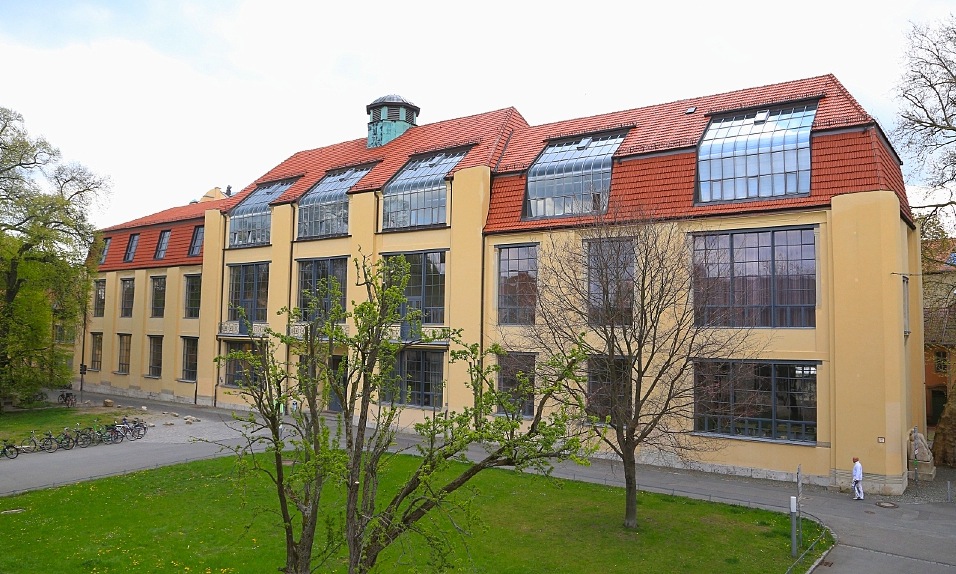
Uni-Hauptgebäude, Bauhaus Universität, Weimar, Thüringen, Germany, UNESCO World Heritage, Weltkulturerbe, fotoeins.com

Weimar Bauhaus Old & New, UNESCO WHS

There’s a clear transition in time where architecture and design took a step from behind closed doors for the sole purview of the rich and royal and out into the open for public and general consumption. It’s no surprise the years from the end of the 19th-century into the 20th-century marked big changes, with Art Nouveau at the time as part of the Secession movement. Throughout Europe, rebellion and revolution were in the air, economically, politically, and culturally.

The Bauhaus movement also helped initiate a conversation, creating and fostering a relationship between industry’s machinery and artistic or cultural creativity. Bauhaus opened in Weimar in 1919, before moving to Dessau and Berlin. The rise of the National Socialists deemed Bauhaus “degenerate” and did all they could to eliminate a movement and her people deemed counter to National Socialist policy. With Bauhaus’ forced closure in 1933 by the Nazis, a number of practitioners escaped Germany to other parts of the world, including the United States and Argentina.

For their deep and wide-ranging influence on 20th-century art, architecture, and design, an incomplete list of names includes Martin Gropius, Lyonel Feininger, Gerhard Marcks, Paul Klee, Wassily Kandinsky, Oskar Schlemmer, Herbert Bayer, Irene Bayer (née Hecht), Karla Grosch, Hannes Meyer, Ludwig Mies van der Rohe, etc. In particular, László Moholy-Nagy would move to Chicago in the United States and established in 1937 the New Bauhaus which became the Institute of Design in 1944.

Tucked away on a university campus a few minutes south of the Weimar city centre, two important building lie across from each other: the Saxony Academy of Art1 building and the Grand Ducal Saxony School of Arts and Crafts (College of Applied Arts)2. The former is now the main building for the present-day Bauhaus University, and the latter now houses Bauhaus University’s Faculty of Design. In 1996, these two buildings formed a part of the UNESCO World Heritage Site (WHS) listing and designation for Bauhaus sites in Weimar and Dessau.


( Click here for images and more )

Weimar: Duchess Anna Amalia Library, UNESCO WHS

As one of over ten buildings, residences, and properties making up what is called “Classic Weimar”, the Duchess Anna Amalia Library (Herzogin Anna Amalia Bibliothek) has been a UNESCO World Heritage Site since 1998.

To consolidate her love of books into a larger holding space, Duchess Anna Amalia commissioned in 1761 the State Architect to rebuild and convert the Renaissance-style French (Green) Castle into a library, which opened in 1766. Becoming one of the most important libraries in the country, the collections included some of the finest written and produced in German literature, art and culture, history, and architecture. Johann Wolfgang von Goethe himself was Library Director between 1797 and 1832.

The library has had its fair share of names: initially called the Ducal Library (Herzogliche Bibliothek); in 1815 renamed as the Grand Ducal Library (Großherzoglichen Bibliothek); in 1918 renamed as the Thuringia State Library (Thüringische Landesbibliothek); in 1969 renamed as the Central Library of German Classics (Zentralbibliothek der deutschen Klassik); and in 1991, renamed as Duchess Anna Amalia Library (Herzogin Anna Amalia Bibliothek) in honour of the library’s founder.

An electrical short from aging damaged wiring sparked a fire on 2 September 2004; the fire held on for over two days before the final hotspot was put out. Over 100 thousand books were damaged or destroyed by fire, water, and smoke. The fire was the largest to strike a German library in post-war history. Subsequent donations and volunteers poured into Weimar from throughout Germany and Europe to help with rescue and preservation efforts. After conclusion of extensive restoration work to the building, the interior Rococo Hall, and to thousands of rescued books, the library was reopened on 24 October 2007, the birthday of the library’s namesake (Anna Amalia born 24 October 1739).

( Click here for more )