Fotoeins Fotografie

location bifurcation, place vs. home

Posts tagged ‘sculpture’

25T69 Vienna: Schottentor station has eyes

E68, V16.

Vienna’s Schottentor station serves the city’s U-Bahn U2 line, located close to the University of Vienna’s main building and the Votive Church. Next to the escalators from the University side of the station down to the train platforms are two “eyes” staring and blinking at each other.

Austrian artist Hofstetter Kurt installed “Einen Augenblick Zeit” (Just A Moment) in Vienna’s old Südbahnhof from 1994 to 2009. Towards the end of 2024, the sculpture got its new home in Schottentor station.

It’s a little unnerving to see a couple of metal eyes to and from the U2, but I’ve come to anticipate seeing at least 1 eye at Schottentor.


11-seconds on the up: 1258pm, 15 Jul 2025.
11-seconds on the down: 131pm, 15 Jul 2025.

I made the stationary image on 7 July 2025 and videos on 15 July 2025. This post composed within Jetpack for iOS appears on Fotoeins Fotografie at fotoeins DOT com.

25T35 Vostell’s concrete sculptural commentary

E34, B29.

At a traffic circle in Berlin stands a concrete sculpture whose meaning is a criticism of excessive consumer culture and the glorification of cars. In 1987, this might not have been out of place in staunchly anti-capitalist East Berlin. Instead, German artist Wolf Vostell (1932-1998) approved the sculpture’s installation in West Berlin at Rathenauplatz, near the border between “Ortsteil” Halensee and Grunewald. The occasion was Berlin’s 750th founding anniversary as a city, as part of an extended street with sculptures for the grand anniversary.

Vostell took two full-sized Cadillacs and encased them in concrete. The title is “Two Concrete Cadillacs in the Form of the Naked Maja”, an allusion to Goya’s painting “The Naked Maja”. Vostell explained the placement of the sculpture in the traffic circle as “a dance of car drivers around the golden calf.” At the time, the artwork proved to some controversial at best and objectionable at worst, but the sculpture has stuck around to 2025, while the objections slowly aged out and died. Some folks who loved their cars apparently didn’t like to be criticized or excoriated.

Welp, I’m now a fan, and I’ll look for his 1970 cement sculpture in Cologne when I’m back there in a few weeks.


Facing northwest. The sprayed-on sentiment is recent, but absolutely agreeable.
Facing southwest.
Facing northeast.
Facing southeast. The sentiment is repeated on the other side, which makes it doubly agreeable.

I made all images above with an iPhone15 on 7 June 2025. This post composed within Jetpack for iOS appears on Fotoeins Fotografie at fotoeins DOT com.

25T28 Biedermann in Berlin Mitte: 2 sculptural examples

E27, B22.

Born in East Berlin in 1947, Karl Biedermann is a German artist, best known for his sculptures. I highlight here two of his works as memorials, both located in Berlin Mitte. The two locations are separated by a short 1-km walk.

A bronze kneeling torso appears on the west side of Zionskirche (Zion Church). The 1997 sculpture by Karl Biedermann is a memorial to Dietrich Bonhoeffer: theologian, pastor at Zionskirche, and vocal dissident who opposed Nazi programs of forced sterilization and euthanasia. He was arrested at his parents’ house in 1943, and executed for conspiracy at Flössenburg on 9 April 1945, mere weeks before the Nazis’ unconditional surrender.

At the north end of Koppenplatz (Koppen plaza) is what appears to be an open room with a table and two chairs; one of the chairs has fallen over. It’s as if the people who once lived here had to leave quickly and are now gone. This is “Der verlassene Raum”: Denkmal für die deportierten Juden, or “The deserted room”: a memorial for the deported Jews. It’s a reference to the nearby Scheunenviertel, once a thriving hub for Berlin’s Jewish community. Biedermann and landscape architect Eva Butzmann created the sculptural piece for Koppenplatz in 1996.

It’s my 2nd time at the latter sculpture, and the empty eerie feeling has never left me.


Memorial to Dietrich Bonhoeffer, by Karl Biedermann (1997), next to the Zionskirche.
On the granite base of the sculpture is the sculpture’s title and inscription: “Für Dietrich Bonhoeffer” (For Dietrich Bonhoeffer).
“Der verlassene Raum”: Denkmal für die deportierten Juden.
“The deserted room”, memorial for the deported Jews.

I made the images with an iPhone15 on 21 May (first two) and 4 June 2025 (last two). This post composed within Jetpack for iOS appears on Fotoeins Fotografie at fotoeins DOT com.

Vienna Judenplatz: centuries & memories of the Jewish community

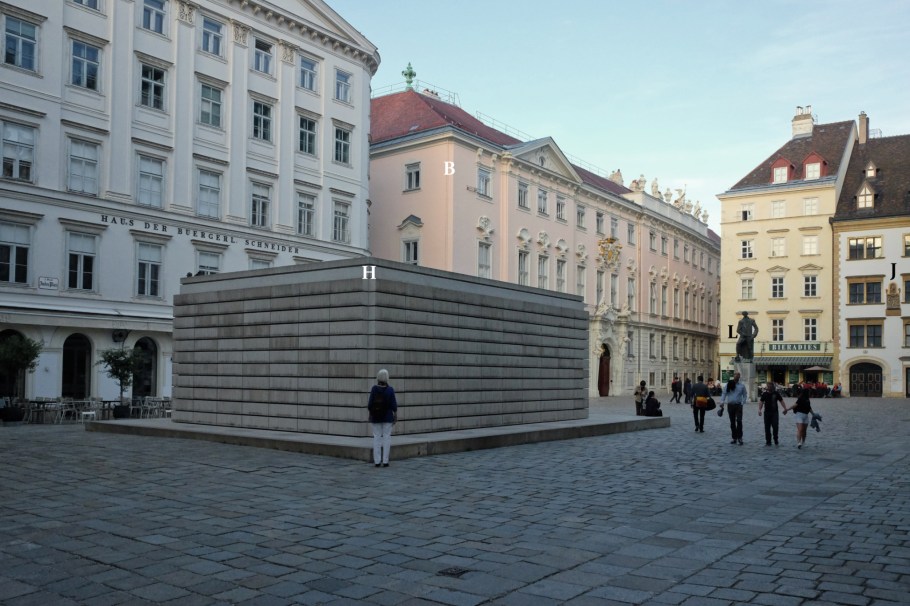
Above/featured: Judenplatz at night. The Holocaust memorial is in the foreground at centre. In the background are “To the little trinity” at centre and Misrachi House (Museum Judenplatz) at right. Photo, 10 Jun 2022.

At Judenplatz are clear visual reminders of the city’s first Jewish community in medieval times.

The first Jewish community in Vienna settled around present-day Judenplatz in the Middle Ages with mention in written documents dated mid- to late-13th century AD/CE. Daily Jewish life thrived around the Or-Sarua Synagogue, the Jewish School, and the Mikveh ritual bath. The community along with the surrounding Jewish neighbourhood came to an end with the Pogrom of 1421. Catholic Habsburg Duke Albrecht II rolled out a decree (Wiener Geserah, Vienna Gesera) which legitimatized the expulsion, incarceration, torture, and murder of some 800 Jewish residents; accompanied by destruction and forced takeover of buildings and property.

Below I highlight remnants and traces to the medieval Jewish community at this square in central Vienna.

Judenplatz, Vienna, Wien, Oesterreich, Austria, fotoeins.com

Facing northwest: B, Bohemian Chancellery; H, Holocaust Memorial; L, Lessing monument; M, Misrachi House; T, To the little Trinity. Photo, 20 May 2018.

Judenplatz, Vienna, Wien, Oesterreich, Austria, fotoeins.com

Facing southeast: B, Bohemian Chancellery; J, Jordan House; H, Holocaust memorial; L, Lessing monument. Photo, 20 May 2018.


( Click here for images and more )

My Berlin: Alicja Kwade, bridging art and science

Above/featured: Alicja Kwade exhibition, at the Berlinische Galerie. HL:X70.

In mid-2021, the world slowly climbs out of the worst of the pandemic. Later that autumn, I watch DW Culture’s Arts.21 feature on Polish-German artist Alicja Kwade whose work strikes a personal resonance. I have to go see her work and exhibition in person, but would it even be possible? My answer arrives six weeks later with a quick jump home to Berlin.

All of Kwade’s sculptural pieces in her exhibition, “In Abwesenheit” (In Absence)”, are “self-portraits.” But none of them show her face; the pieces aren’t necessarily simple, nor are they “selfies” characterized by the present vernacular. She is not physically present, and yet, every piece provides the visitor a glimpse into her mindset including questions she raises about the volatility of the human condition and about where we fit within a very large universe.

As former scientist, I love and recognize the influences on her art. She is clearly very interested in mathematics, physics, astrophysics, biology, genetics; but she’d be the first to admit she’d need multiple lives to completely fulfill all of her interests. The deconstruction of “self” into precise scientific elements is another way of expressing those (dreaded) “selfies” or self-portraits. I admire the clever play: it’s the breakdown into those elements that tell us what she is, and it’s the measured synthesis of those elements into the broad strokes of her sculptures that tell us who she is.

We’re all playing this game. Everyday things seem so important. But then you zoom out and realize that you’re standing with another billion [people] on a spinning sphere. With that perspective, you’re reminded to just be glad you’re here at all.

– Alicia Kwade about her rooftop commission at New York City’s Metropolitan Museum of Art: Artnet News, 16 April 2019.


( Click here for images and more )