Fotoeins Fotografie

location bifurcation, place vs. home

Posts tagged ‘river’

Worms: Holy Sand, Europe’s oldest surviving Jewish cemetery

I’m looking for a “thousand-year history” in the city of Worms located in southwest Germany. This has nothing to do helminthology or nematology, as the town’s name is derived from “Warmaisa”, the former Jewish name of the city. This is about an important part of Jewish-German history and peaceful coexistence of the Judeo-Christian communities within Europe. The town’s fame and reputation is also partly derived from Martin Luther; I’ve already visited the site where Luther was on trial to answer charges of heresy, as well as the world’s largest Reformation monument.

This part of the Rhein river area is considered the “cradle of European Jewry”, known also as “little Jerusalem on the Rhine.” In medieval times, flourishing Jewish communities in the cathedral cities of Speyer, Worms, and Mainz facilitated the creation of a common Jewish league with the name ShUM (SchUM), spelled out by the first letters of the Hebrew names for the three cities. As emphasis on the influence of Jewish heritage in Europe and the ongoing process of preservation and education, the Holy Sand cemetery is one of four constituents in the newly inscribed UNESCO World Heritage Site (2021).

On a breezy late-autumn afternoon, light fades quick, casting solemn shadows on this ground. In the town’s old Jewish cemetery, I’m the only person present, and I’ve placed a small stone on top of a number of gravestones. I’m surrounded by apparitions over an millennium’s age and by the remaining physical traces in various shapes, stones, and size.

( Click here for images and more )

My Heidelberg: 43 Highlights from Home

Above/featured: From Philosophenweg: across the Neckar, over the Altstadt, and up to Königstuhl – 21 May 2016 (HL).

Heidelberg is “eine adoptierte Heimatstadt” (an adopted hometown). Some have called this place “scenic, natural, and spectacular”; some call it “boring, provincial, and extortionate”. I could be referring to Vancouver, but that’s a subject for another time.

I’ve long struggled with questions of place: what defines “home”? Can those definitions and qualities change with time? Do people have choice(s) and do they apply their choices in their search? Can people find meaning with “home”? Must “home” be restricted to only one place, or can different needs be met from different places?

Images can provide access to memories of having lived in a new country, experiencing the shock of the new, and settling into the mundane. I remember advice someone once gave me which became constant companion and reminder: that I was inhabiting a place at the same latitude as my birthplace, 8000 km in distance and 9 time zones apart on the other side of the planet, a place that’s seen its compact share of activity with flair and impact.

Most recall is naturally connected to sight. Occasionally, it’s a rush of the senses: the quick breeze on the skin, the ankle-spraining undulations of the cobblestone, how fog clings like a cold clammy cloak, the sing-song of birds among tall trees in the forest on the hill, the smell of grilled sausages in town by day, and the satisfying late-night noms of a spicy Dürüm Döner with a cool Ayran. And other times, human history leaps out and buries its claws, when the unthinkable must be acknowledged and understood in a synapsis of memory and senses.

In the autumn of 2001, I moved to Germany and Heidelberg: both sight unseen and without having learned any of the language. I stayed in town for a little under two years. What’s astonishing is I have no pictorial record of my time in Heidelberg, Germany, and Europe: I had no camera before the dawn of the smart-phone.

I have some great memories, even if time is casting long shadows. What I lost (no, gave away) was some part of me that actually has little to do with the “Schlager” hit song “Ich hab mein Herz in Heidelberg verloren“. It might be a piece of the heart, a part of the soul, or simply a scrap of good sense; but what it is precisely still remains undefined and shapeless. Finding solid answers about what I’ve surrendered might take years. And so, for the sake of clarity, I’ve returned many times since leaving town in 2003. A sharper focus comes through the post-departure blur whenever I step off the train in town.

I couldn’t have possibly known the experience of moving to and living in Heidelberg would be life-changing. Time so far has been kind, because it didn’t take long for me to adopt Heidelberg as “home”.

( Click here for images and much more )

Grand Canyon National Park: The North & South Rim

Above/featured: West-northwest from Mohave Point – 15 October 2018.

The Grand Canyon National Park has very different timescales: over 100 years of human inscription as a national park, but almost 2 billion years of geologic history.

European colonizers and settlers recognized protection was required for the big dramatic landscape. On 26 February 1919, U.S. Congress passed legislation “An Act to Establish the Grand Canyon National Park in the State of Arizona” which was signed by President Woodrow Wilson. With its official designation, the country’s 15th National Park encompasses over 1-million acres (almost 405-thousand hectares) in surface area and several thousand years of history of human habitation by indigenous peoples, including the Havasupai, Hualapai, Hopi, Navajo, Paiute, and the Zuni, who consider the Grand Canyon as their ancestral birthplace. UNESCO inscribed the Grand Canyon National Park as World Heritage Site in 1979.

The park also includes over a billion years of geologic history. By geologic standards, the Grand Canyon itself is relatively “young” with the Colorado River carving into the rock about 5 to 6 million years ago. However, the Vishnu basement rock in the Grand Canyon is over 1.7 billion years old, even though that age is only 38 percent as old as the Earth’s oldest rocks at 4.5 billion years.

Over three days in October 2018, we explored parts inside Grand Canyon National Park. After our drive from Flagstaff to Vermilion Cliffs, we pushed forward to the North Rim and the winding scenic drive through the Kaibab National Forest took us to Point Imperial and Cape Royal in time for the day’s final illumination.

With a night spent at the beautifully serene Cliff Dwellers Lodge, we retraced our drive back to Cameron, then heading west to Desert View to the eastern section of the South Rim. After establishing our new ‘base’ in Flagstaff, we drove the following day to the main entrance of the Grand Canyon National Park (via Valle and Tusayan), and we spent the day in the western and central sections of the South Rim. The 1126 km (700 mi) we covered over the three days made up 22 percent of the entire 5049 km (3138 mi) driving distance accumulated in New Mexico and Arizona.


( Click here for images and more )

Koblenz: 1st and 2nd Deutsches Eck (German Corner)

Above: West view to Deutsches Eck from Ehrenbreitstein. 2015 photo by Taxiarchos228 (Wladyslaw Sojka). I’ve added the following labels: (1) Seilbahn/Gondola, (2) St. Kastor Basilica, (3) Deutschherrenhaus, (4) first Deutsches Eck, (5) Memorial to German Unity (Kaiser Wilhelm Memorial), (6) reclamation in the late 19th-century, (7) second Deutsches Eck.

Many will know, have seen, or have read about the Deutsches Eck (German Corner) in the German city of Koblenz. The river city has plenty to provide: visitors wander into the vineyards to sip on crisp white wine from local grapes, vacation on long cabin-boats to enjoy the river scenery, or explore the surrounding Upper Rhine River Valley.

But Koblenz is also well known by virtue of its name after the junction where the rivers Moselle and Rhine meet. By the first-century AD/CE, the Romans had built for strategic protection a fort1 called “Castellum apud Confluentes“, Latin for “the castle at the confluence”. What most commonly acknowledge as the Deutsches Eck (German corner) is not the original location. Half concealed among the trees some 200 metres back near the Deutschherrenhaus is the first location of the Deutsches Eck.

What follows:

  • a map to the area and my photos from the present-day,
  • a short history of the “Deutsches Eck,” and
  • archival images from the mid-16th century to early 20th century.

( Click here for images and more )

Halle an der Saale, Halle, Saale river, Saale, Sachsen-Anhalt, Saxony-Anhalt, Cultural Heart of Germany, Germany, fotoeins.com

My Halle (Saale): 12 highlights in the Händelstadt

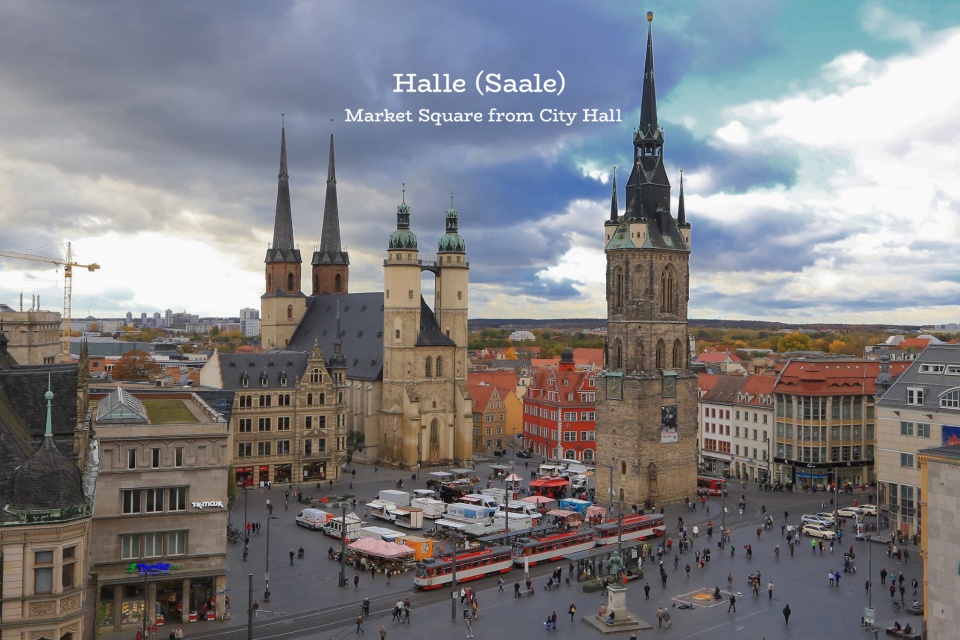
Featured: “5 towers” with 4 (spires) from St. Mary’s Church (left-centre) and 1 from the Red Tower (right-centre). Händel monument is at lower centre.

You’re visiting Halle to learn and discover:

  • why salt also known as “white gold” was critical to the city’s development;
  • how Martin Luther and the Reformation left their mark in the city;
  • composer Händel’s birth house, his upbringing, and how he learned the organ;
  • the oldest German chocolate factory continues producing “Halloren Kugeln”; and
  • how the Museum of Prehistory houses the world’s oldest depiction of the night sky.

Located in the present German federal state of Saxony-Anhalt, the city of Halle along the Saale river is one of the larger cities in east-central Germany. Making salt was of great historic and economic importance that the name of the city “Halle” is derived from the old Celtic/Brythonic word hal, meaning “salt”. The name of the river “Saale” is derived from the old German word for “salt”1. With salt bringing wealth to the city through trade, Halle became a trade city or “Handelsstadt.” With the birth and upbringing of composer Händel in the city, Halle also became a cultural city or “Händelstadt.”

Halle’s present-day population at 240-thousand people is neck and neck with the 241-thousand people in the the state capital city of Magdeburg, 75 kilometres to the north. But proximity means Halle is also connected with Leipzig, only 31 kilometres to the southeast in the state of Saxony. Halle and Leipzig are connected with the S-Bahn Mitteldeutschland train service, and the two cities share an airport located about halfway in-between.

1 The Welsh word for salt is “halen”, and the German word for salt is “Salz”. See also “Celtic culture: a historical encyclopedia,” Volume IV (M—S), pg. 1555. Editor J. T. Koch (ABC-CLIO, 2006).

( Click here for images and more )