Fotoeins Fotografie

location bifurcation, place vs. home

Posts tagged ‘Historic Highlights of Germany’

Martin Luther, Museum Lutherstiege, St.-Anna-Kirche, Augsburg, Bayern, Bavaria, Germany, fotoeins.com

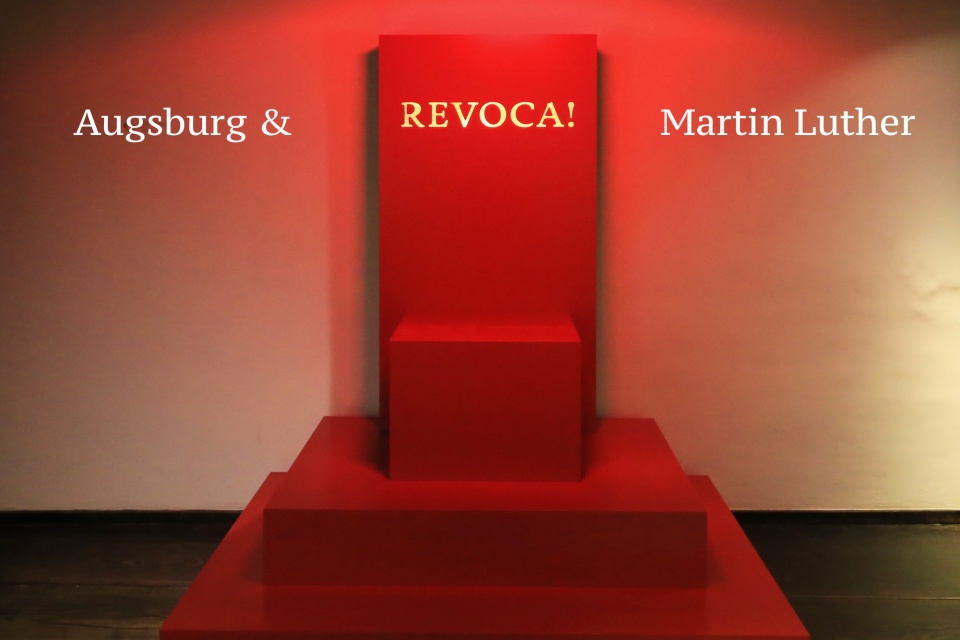
Augsburg: Luther vs. Cajetan (1518), Confessions (1530)

Above/featured: REVOCA! (Cajetan to Luther, 1518), Museum Lutherstiege.

With its founding date as “Augusta Vindelicorum” by the Roman Empire in 15 BC/BCE, Augsburg is one of the oldest cities in Germany, and has ties with Martin Luther and the Reformation which marks its 500th anniversary in 2017.

Months after making his 95 Theses known to church authorities and the public, Martin Luther was called to the free imperial city of Augsburg in 1518 by Cardinal and papal legate and representative Cajetan to answer charges of heresy, for challenging the morality of indulgences, and for questioning the supreme authority of the Pope. Cajetan urged Luther to recant or revoke his statements (“revoca!”), but Luther held firm and refused to obey Cajetan.


( Click here for images and more )

street art, mural, Herakut, Metropolink, Heidelberg, Germany, fotoeins.com

My Heidelberg: Herakut street art for Metropolink

It’s amazing what gets discovered after going the wrong way.

I head straight for a full city-block before realizing my error, that I should’ve turned right about 5 minutes ago. I bow my head, and release a deep breath in frustration. I raise my head to the sky, when I catch sight of something out of the corner of my eye.

What’s that across the street?

I have to reach my destination which I know isn’t far.

But I am coming back here to get the shot.


( Click here for images and more )

Augustinerkloster, Augustinian Monastery, Erfurt, Thüringen, Thuringia, Germany, fotoeins.com

Erfurt: Martin Luther’s start at the Augustine Monastery

You can almost imagine a 16th-century monk walking these halls, contemplating various aspects of spirituality, and reconciling them with the hardships of everyday living.

In the federal state of Thuringia in central Germany, the Augustinerkloster (Augustine monastery) in Erfurt is a notable place for the history of Martin Luther and the Reformation.

Martin Luther arrived in 1501 and began studies in liberal arts, law, and theology at Erfurt University. In 1505, Luther experienced a big personal event (the scare of his life, as legend goes), and decided to leave his studies by entering the Augustine Monastery to become a monk, much to his father’s displeasure and objections. Built originally around 1300, the Augustine Monastery was home for Martin Luther until 1511, and it’s here where he was ordained as a priest. The site underwent extensive post-war reconstruction after suffering heavy bombing damage in the Second World War. The monastery is now a seminary and a modest hotel: guided tours of the monastery provide a glimpse to Luther’s early years as a monk, and visitors can now reserve rooms for overnight stays in a no-frills technology-free setting and a peaceful comfortable environment.

Erfurt’s Augustinian monastery is listed as one of many additional candidate sites for inclusion into a single UNESCO World Heritage Site under the title Luther memorials in Saxony-Anhalt, Saxony, Bavaria, and Thuringia.

( Click here for images and more )

Wochenmarkt, Saturday farmers market, Neuenheimer Markt, Markplatz, Neuenheim, Heidelberg, Germany, fotoeins.com

My Heidelberg: Saturday farmers’ market in Neuenheim

In Heidelberg, the farmers’ markets are held regularly throughout the week at a number of locations throughout the city and region. One of six Saturday markets takes place across the Neckar river in Neuenheim. Most visitors in town will visit the Saturday market in Heidelberg’s Marktplatz, which leaves the other five Saturday markets pretty much “clear and free” to residents. And as I arrive at the market square in Neuenheim, it’s clear I’m in the minority, literally and figuratively. This is not criticism and it’s not a negative, as I used to come here occasionally when I lived here. I say as much to the various vendors, when I buy a cup of coffee, some cherry tomatoes, a piece of cake, and three empanadas.

Fresh fruit and vegetables, grown locally and imported from around Europe. Fresh bread and baked goods from a regional bakery. Fresh herbs, grown locally; fresh flowers, grown locally. Honey harvested from bees at a regional apiary. “Empanadas Argentinas”, by a woman from Córdoba who’s lived in Germany for over ten years. And there are fresh cuts of meat, tubs of olives, and glorious varieties of cheese from around Europe.

It’s time to stop eating and leave, when the vendors begin to pack. Another market, another day.

When I leave Heidelberg, no small measure of wistful longing remains; these are my streets, and this is one of my markets.

( Click here for more )

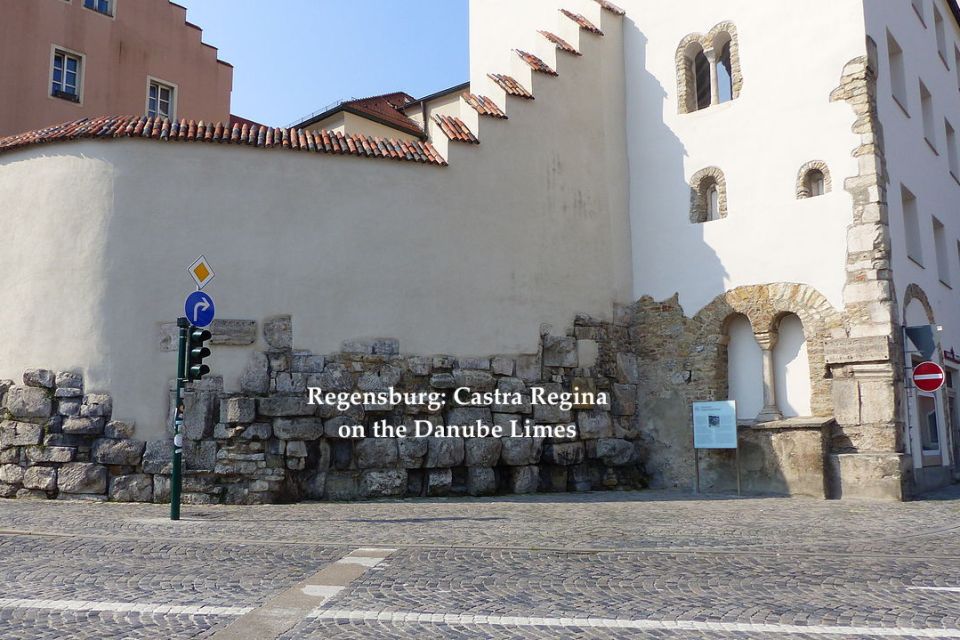
Northeast corner of old Roman fort, Regensburg, photo by Dr. Bernd Gross, Wiki CC3

Regensburg: remnants of Castra Regina on the Danube Limes

Above: former wall at the northeast corner of the Roman fort Castra Regina. Photo by Dr. Bernd Gross (image no. 7, Wiki CC3).

Regensburg is situated in central Bavaria, and is 1 and 1.5 hours from Nürnberg (Nuremberg) and München (Munich), respectively, with the train. While meandering through the Regensburg’s Old Town, it’s easy to forget most of this area was once occupied by a Roman fortress about 1800 years ago.

In 179 AD/CE, the Roman Empire established the fortress “Castra Regina”, or “fortress by the river Regen”, where the Regen enters the Danube river. The Danube became in effect a part of the Roman Empire’s northern frontier (“Danube Limes”). Emperor Marcus Aurelius recognized the need for extra security in the northern imperial province of Raetia where the Danube’s course reached its northernmost point. To ward off incursions by northern Germanic tribes, up to six thousand soldiers from the Third Italic Legion were stationed at the fortress.

At peak operation, the fortress encompassed an area 540 metres by 450 metres (24 hectares, or 60 acres) with a wall up to 10 metres (33 feet) high made of large sandstone blocks, 18 towers, 4 double-tower gates, and a wide trench. Within the grounds were barracks, headquarters building (principia), commanding officer’s own residence (praetorium), a military hospital (valetudinarium), granary (horrea), workshops, and stables. Civilians and support tradesmen built a settlement to the west of the fort. By the 5th-century, constant raids and migrations forced the Romans to abandon the area. A civilian settlement eventually grew over the fortress which is today’s Altstadt (Old Town)1.

The free-of-charge open-air museum includes restored remnants of the old Roman fortress complete with information displays in both English and German. The primary information location is at the parking garage at Dachauplatz (which is closed at night); the other three locations are accessible outdoors at any time.

The Porta Praetoria is one of multiple constituents in the tri-nation (AT DE SK) inscription for “Frontiers of the Roman Empire: Danube Limes” as UNESCO World Heritage Site (new, as of July 2021).

The map below shows the location of the Castra Regina encampment and locations of the “document Legionslagermauer” in the city’s Old Town. Click on the “arrow-window” icon at the upper-left corner of the map for additional details.

( Click here for images and more )