Fotoeins Fotografie

location bifurcation, place vs. home

Posts tagged ‘fotoeins’

Weimar: City Church at Herderplatz, UNESCO WHS

Weimar is a compact town with a large number of buildings as a part of two UNESCO World Heritage Sites. As part of the “Classic Weimar” World Heritage listing, Herderplatz (Herder Plaza) in the northern part of the city’s old town is known most for the church with two spires and a dark grey roof. This is the Stadtkirche (City Church), known also the Church of Saint Peter and Paul.

The church dates to the middle of the 13th-century AD (CE) when town and charter were first established, although a settlement in the area goes further back to the beginning of the 10th-century AD. Built initially as late-Gothic and redesigned as Baroque, and what fires and war bombing couldn’t destroy, several phases of rebuilding and renovations were completed in 1953, 1977, and 2000.

Johannes Gottfried Herder (1744-1803) was German philosopher, writer, and theologian. From 1776 until his death, he lived and worked in Weimar as General Superintendent for the Saxon-Weimar Duchy, Court Chaplain, member of the church advisory council, and President of the Supreme Consistory. For his service to the city’s people and contributions to German philosophy and literature, and as the site of his burial, the church is also known as Herderkirche (Herder Church).

Cranach Altar

The Cranach Altar is an important testament to the history of the Reformation in the state of Thuringia. The triptych was started by Lucas Cranach the Elder in 1552, and continued by his son, Lucas Cranach the Younger, in 1554. Completed in 1555, the entire piece was installed over the main church altar by 1557. The paintings include portraits of Lucas Cranach the Elder and Martin Luther, and centre around “Christus am Kreuz” (Christ’s crucifixion). Christ’s blood streams out and touches Cranach the Elder’s forehead, symbolizing a direct relationship between God and people without the need for or the intercession of priests; more here.

Contemporaries

Lucas Cranach the Elder, 1472-1553.
Martin Luther, 1483-1546.
Lucas Cranach the Younger, 1515-1586.

Johannes Gottfried Herder, 1744-1803.
Johann Wolfgang von Goethe, 1749-1832.
Friedrich Schiller, 1759-1805.

( Click here for images and more )

Vietnam’s Mekong: Life and Traffic in the River Delta

Under direct sunlight, the deep ochre hues in the Mekong are initially unsettling: is the entire river made of chocolate milk? Vibrant reds and blues await around the bend, amid the nutrient-rich fine rock-powder silt floating down from the continental interior.

The Mekong river stretches over 4200 kilometres from its source in the Tibetan plateau in southwestern China1 through Burma, Laos, Thailand, Cambodia, and Vietnam, to the river’s mouth at the South China Sea. The Mekong is one of Asia’s longest rivers, and is one of the world’s most productive rivers with number and volume of fish. There are over 1000 species of fish known in the Mekong, and despite the critical importance of the inland fishery industry, dangers are posed by overfishing threatening overall supply, disruption of natural flood cycles, and by the inhibition of spawning and migration from present dams and future dam construction. Based on the silt flowing from the Tibetan plateau, the Mekong Delta is also a critical fertile growing region supplying food and economic wealth throughout the region. International challenges remain about proper usage of the Mekong River.

We reach Mỹ Tho city (tp. Mỹ Tho), a two-hour drive from Ho Chi Minh City (Saigon). People have gathered at the docks, ready to join one of many river tours. Some boats are ferrying residents from the mainland to islands in the middle of the Tiền river (sông Tiền), the northern branch of the Mekong.

We hop from one wooden boat to the next, alternating between water and land, slipping in between and hiding among mangrove trees. The midday sun beats down, and the heat and humidity are unescapable. As we dart around the islands near Mỹ Tho, my eyes swing from one boat to the next: floating fish-farms, ferries shuttling people, dredging ships carrying mounds of silt towards the South China Sea, men carrying their hauls on fishing boats carrying their hauls, women running errands on skiffs.

Only four short decades have passed since the end of “The American War”: bullets flew, chemical bombs fell, landscape blighted, blood spilled, families destroyed. The smiles and hard looks are a big part of an indelible visual memory, a part of this nation’s recovery and of her people’s endurance.

I’ve had a few hours only to gloss over the machinery of daily river life, but like countless other experiences in the year-long worldwide journey, this afternoon is representative of another introduction, another “appetizer”. Because there’s always more, here and elsewhere, up- and downstream. It’s easy to forget we’re only 50 kilometres (30 miles) from the South China Sea.

1 See the location here or the map here

( Click here for images and more )

Denkmal fuer die ermordeten Sinti und Roma Europas, Memorial to Murdered Sinti and Romas in Europe, Dani Karavan, Tiergarten, Berlin, Germany, fotoeins.com

My Berlin: Moving Memorial to Murdered Sinti and Roma

In the German capital city, among the rustling of tall trees is a quiet space in the northeast corner of Tiergarten Park adjacent to the Reichstag. Between the chirps and whistles of small birds, a recording of a violin plays. Individual notes are held, as long as possible, as if life depended upon the existence of each note. Slowly, the sound accumulates into a keening wail, burrowing deep (if you let it) and tearing from within (if you feel it). You’d do well not to stumble, as you gingerly move through the memorial, careful not to step on words like “Auschwitz”. Inscribed on flattened stones spreading out from the pond are the names of important places, critical to maintaining memory, with intention and purpose.

Created by Dani Karavan, the Memorial to Murdered Sinti and Roma consists of a circular pond. At the centre is a triangular slab on which fresh flowers are placed. In a ring around the pond are the words of a poem, “Auschwitz”, by writer and composer, Santino Spinelli, a member of the Italian Sinti and Roma.

Muj šukkó, kjá kalé vušt šurde; kwit. Jilo čindó bi dox, bi lav, nikt ruvbé.

Drenperdo Mui, phagede Jakha, schiel Wuschtia; Pokunipen. Phagedo Dschi, kek Ducho, kek Labensa, kek Asvia.

Eingefallenes Gesicht, erloschene Augen, kalte Lippen. Stille. Ein zerrissenes Herz, ohne Atem, ohne Worte, keine Tränen.

Pallid face, dead eyes, cold lips. Silence. A broken heart without breath, without words, no tears.
( Click here for video and images

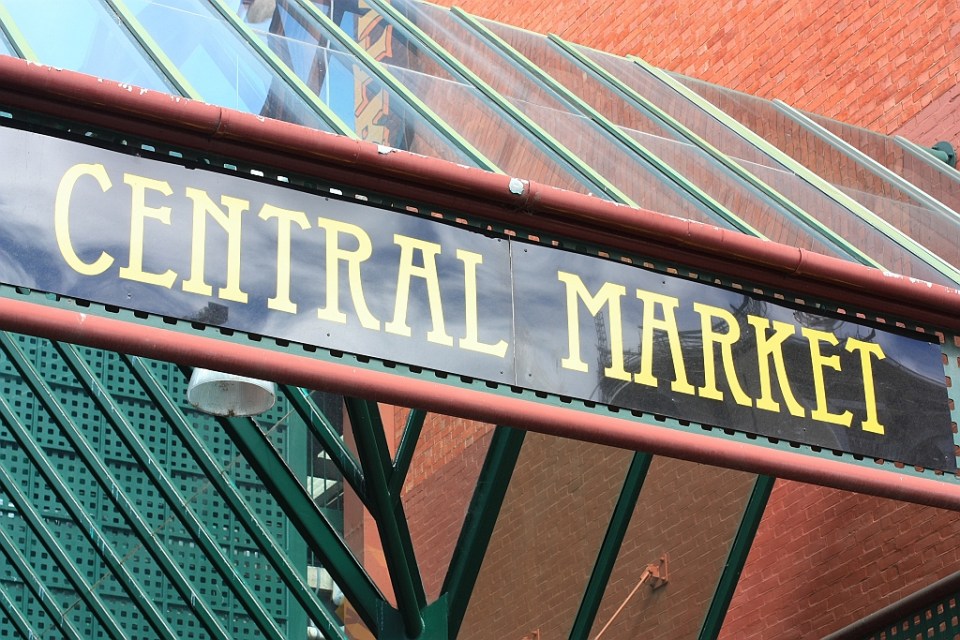
Central Market, Adelaide, SA, Australia, fotoeins.com

Adelaide Central Market: sweet, savoury, books!

Ah, the importance of correctly using the Oxford comma …

In the midst of my year-long around-the-world walkabout, it might be the middle of winter in Australia, and the weather is perfect for both a stroll and a coffee. I’m in the South Australian capital city of Adelaide, and my friend, Emily, insists we stroll through the Central Market. No surprise, then, my arm is sufficiently twisty and rubbery for the …

Bacon.
Colourful fruit and veg.
Assorted of used books.
Chicken hearts and livers.
A chocolate fountain.

But not all at the same time. Please …

( Click here for more )

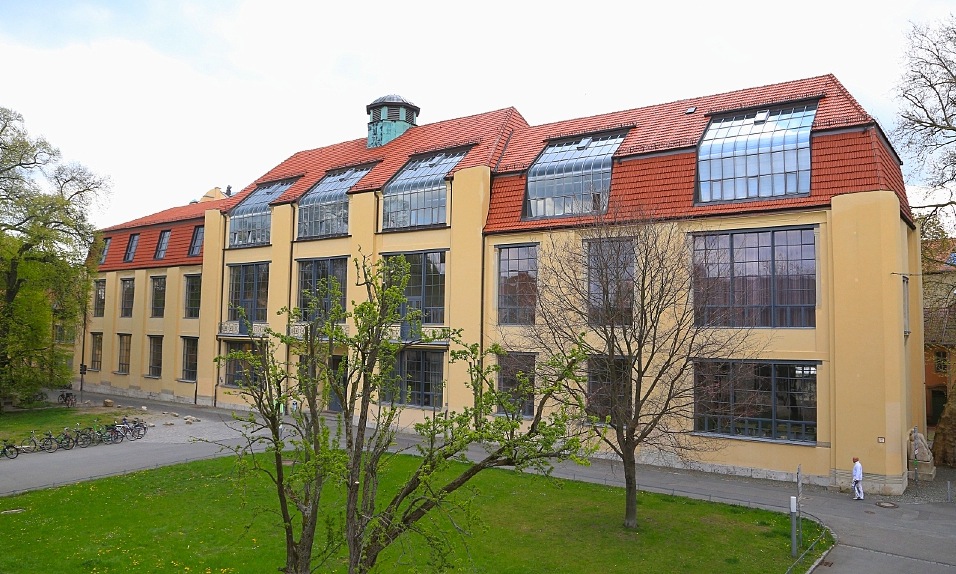
Uni-Hauptgebäude, Bauhaus Universität, Weimar, Thüringen, Germany, UNESCO World Heritage, Weltkulturerbe, fotoeins.com

Weimar Bauhaus Old & New, UNESCO WHS

There’s a clear transition in time where architecture and design took a step from behind closed doors for the sole purview of the rich and royal and out into the open for public and general consumption. It’s no surprise the years from the end of the 19th-century into the 20th-century marked big changes, with Art Nouveau at the time as part of the Secession movement. Throughout Europe, rebellion and revolution were in the air, economically, politically, and culturally.

The Bauhaus movement also helped initiate a conversation, creating and fostering a relationship between industry’s machinery and artistic or cultural creativity. Bauhaus opened in Weimar in 1919, before moving to Dessau and Berlin. The rise of the National Socialists deemed Bauhaus “degenerate” and did all they could to eliminate a movement and her people deemed counter to National Socialist policy. With Bauhaus’ forced closure in 1933 by the Nazis, a number of practitioners escaped Germany to other parts of the world, including the United States and Argentina.

For their deep and wide-ranging influence on 20th-century art, architecture, and design, an incomplete list of names includes Martin Gropius, Lyonel Feininger, Gerhard Marcks, Paul Klee, Wassily Kandinsky, Oskar Schlemmer, Herbert Bayer, Irene Bayer (née Hecht), Karla Grosch, Hannes Meyer, Ludwig Mies van der Rohe, etc. In particular, László Moholy-Nagy would move to Chicago in the United States and established in 1937 the New Bauhaus which became the Institute of Design in 1944.

Tucked away on a university campus a few minutes south of the Weimar city centre, two important building lie across from each other: the Saxony Academy of Art1 building and the Grand Ducal Saxony School of Arts and Crafts (College of Applied Arts)2. The former is now the main building for the present-day Bauhaus University, and the latter now houses Bauhaus University’s Faculty of Design. In 1996, these two buildings formed a part of the UNESCO World Heritage Site (WHS) listing and designation for Bauhaus sites in Weimar and Dessau.


( Click here for images and more )