When I lived in Germany, I remembered the ads for Radeberger Pilsner, and I wondered about some of the venues shown. I realized the buildings were in the famous city of Dresden on the Elbe river in southeast Germany, and the city of Radeberg was only 15 kilometres from Dresden. Images of the Dresden’s landmarks have been an important part of Radeberger brewery’s advertising campaign to show the beer’s exceptional quality and to associate that very same quality by (physical) proximity with the symbolism of Dresden’s historic landmarks.
Dresdner Wahrzeichen (Dresden Landmark)
As one of the city’s most well-known landmarks, the Semperoper (Semper Opera House) appears in countless images representing Dresden. The Semperoper is the showpiece structure at Theaterplatz (Theater Square) looking over the river Elbe in the city’s Altstadt (Old Town). The first version of the building opened in 1841 with the design provided by Gottfried Semper. After destruction by fire in 1869, the second version of the building, also to Semper’s design, was completed in 1878. Only the Semperoper’s outer facade remained in 1945 during the final stages of the Second World War. Built once again to Semper’s original designs, the third and present version of the Semperoper opened to great acclaim on 13 February 1985. The interiors were reconstructed according to original plans and designs, whereas stage machinery and technical and engineering requirements are all updated to the best standards in audio quality.
With the leading title “Sächsische Staatstheater-Staatsoper und Staatsschauspiel Dresden”, the opera house is home to the Saxon State Opera, the Saxon State Theatre, the Semperoper Ballet, and one of the world’s oldest orchestras, the Staatskapelle Dresden, founded by Prince Elector Moritz von Sachsen in 1548.
The Semper Oper is a natural part of any walking tour of Dresden, as Theaterplatz is minutes from the Zwinger, Residenzschloss, and the Frauenkirche. I’m awed by the night tour, a chance to see up close the building’s Baroque style exterior and the classic ornate interior. Everybody speaks in calm hushed voices, the unspoken agreement to be mindful and respectful of this venue. Despite the presence of other people in other tour groups, it feels like I have the Opera House to myself at 11pm.
Classic shot of the front by day
Classic shot of the front at night; also featured on the “night watch”
Ceiling mural
Some columns real marble (cool to touch); some faux-marble plaster (warm to touch). Full replacements were too expensive for the GDR/DDR at the time
S. Kurpiers, one of the stage managers and our guide for the evening
Main stage & orchestra, from central box section in the 1st balcony (Loge, 1. Rang). Clock at top-centre reads “XI 5”, or 1105pm
“Box” seats normally reserved for representatives and guests of the German federal state of Saxony
Separate guided tour to our left; there are 4 balconies
Another tour to the right
Looking up; lip of the 2nd balcony appears at top
Massive central chandelier light-fixture overhead; clock reads “XI 20” (1120pm)
Thanks to Semperoper for opening their facility to the public at night, and thanks to S. Kurpiers who kindly guided our tour of the venue. Thanks also to Germany Tourism, Saxony Tourism, and Dresden Tourism for their support and hospitality. I made all of the photos above on 22 April 2015 with the Canon EOS6D. This post appears on Fotoeins Fotopress at fotoeins.com as http://wp.me/p1BIdT-7sx.
The following is an advertisement for Radeberger brewery from 2014. The advert for their Pilsener ends with an image of Dresden’s Semper Oper at night and the slogan “schon immer besonders” (always special).
For me and my fellow travel media colleagues, the tall glass is a welcome sight. I never liked Radeberger sold in North America, but here in the original brewery in the city of Radeberg, that freshly drawn Pils tastes like sweet nectar.
You’re visiting Dresden, either on a day-trip from Berlin or Leipzig, or you’re staying in Dresden for a couple of nights. By day, you’ll see, for example, the Semper Oper and the Zwinger, and you’ll walk through the Neustadt. At night after dinner, you might catch the golden glow cast by lights on the architecture.
But by late-November in the Saxon state capital city, you will likely encounter at least one of the following Christmas markets in the city:
After tracing the likes of The Peaceful Revolution, Martin Luther, Bach, and Mendelssohn in Leipzig, the sparkle of bright lights and the promise of mulled wine beckon. Emerging from the Markt S-Bahn train station, the sounds of the underground give way to the din of crowds. The city’s central Marktplatz (Market Square) is home to the Leipziger Weihnachtsmarkt (Leipzig Christmas Market) and people are out en masse despite the cold bite in the evening air.
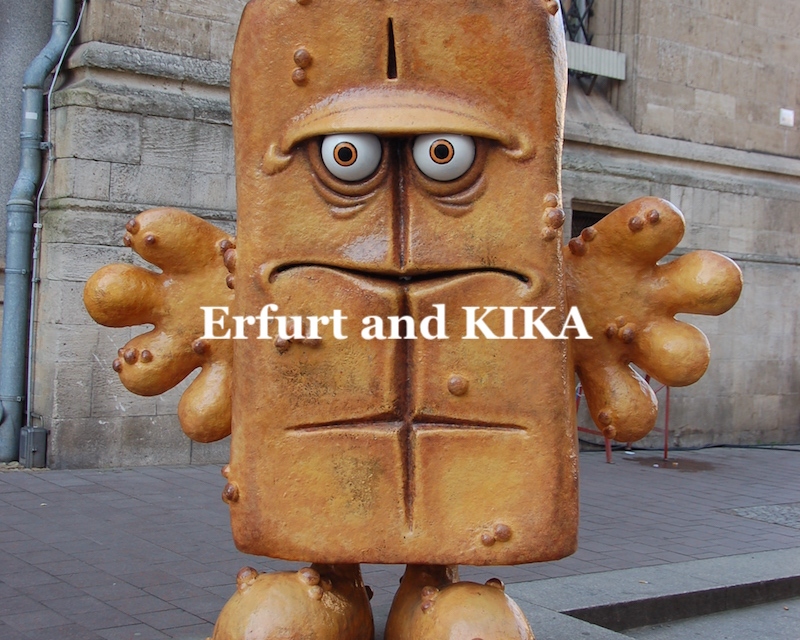
Erfurt is the capital city for the state of Thuringia (Landeshauptstadt Thüringen) and is included among many in the Historic Highlights of Germany. As a self-described hub for children’s media, Erfurt is headquarters for the German Children’s Channel, or KInderKAnal, better known in short as KIKA. In commemoration of the channel’s tenth anniversary in 2007, sculptures representing well-loved KIKA characters sprung to “life” around town.
Kids of all ages can now cross the city looking for KIKA characters. My personal favourite is Bernd das Brot (Bernd the bread), a grumpy loaf and reluctant star of late-night tedium … “in the KIKA lounge …” It’s easy to assume I would’ve incorporated a part of the KIKA lineup as part of my early German-language instruction. The truth is there were too many late-nights in my dark one-room apartment with a small television for illumination, and more often than not, crusty Bernd was present (on continuous loop). Like a loaf of bread’s “heel” or end piece that’s undesired and ignored, it’s always there if you need it …