Fotoeins Fotografie

location bifurcation, place vs. home

Posts from the ‘South America’ category

Grazing Antarctica over the Indian Ocean, QF63 SYD-JNB, fotoeins.com

The Antarctic flyby, QF63 SYD-JNB

On a plane again: it’s either a prayer or a curse.

I summon the sleep gods on this 14-hour flight, and going over this very large body of water seems like an eternity.

Over the last few years, I’ve become accustomed to 10-hour “shuttles” between Chile and the United States, and I’ve trained mind and body to divide 10-hour flights into three easy-to-digest chunks between take-off and landing: (1) dinner; (2) an attempt at sleep, movies, or reading; and the final third that is (3) breakfast.

But it’s always been the case that the extra flying hours beyond the 10 mark can be a big mental block.

Sometimes, the goal is the motivation. On this 14-hour flight, Cape Town is the destination.

Qantas flight 63 is a non-stop flight from Sydney, Australia to Johannesburg, South Africa, and it’s at the latter where I’ll transfer onto another plane to Cape Town.

This ‘marathon’ flight takes place mostly over the Indian Ocean, the third largest on the planet.

On a flat surface, the shortest route between two points is a line, but on a curved surface, the shortest route is a curved path (i.e., great circle). QF63’s flight path takes us over the South Indian Ocean, and the plane skirts past the edge of Antarctica, on the side opposite to South America.

About halfway into the flight, I’m standing in the rear galley of this jumbo jet plane, and I’m looking out the window. The optics through the window are weird, giving a weird warped view of the world outside. I’m leaving nose prints on the interior plexiglass screen.

Sure enough, there it is.

Peeking under cloud cover is a hint of land below.

Under the rippling deck lies the great southern continent of Antarctica.

That’s what the plane’s in-flight displays say, too.

Our plane’s path glances over the continent of Antarctica; the display helpfully supplies geographic information, locating Argentina, Brazil, and Chile as well.

How do I feel?

Nostalgic.

There’s loss, too. I’m not going to see Antarctica on this trip, and I have no plans to do so in the near future.

After 5 years in Chile, what I miss most are the people with whom I worked, my friends and colleagues. Perhaps this “near miss” is a reminder, that I should return to South America sometime soon in the future.

Approaching South Africa, I’ve just departed Australia, after ten weeks among friends in some of the most beautiful spots around. I feel loss and separation from friends and country.

As sure as I’m moving forward on this around-the-world journey, I’m confident I’m coming back someday soon.

On board Qantas flight QF63 SYD-JNB, I made the photos above on 10 October 2012 with a 4th-generation iPod Touch. This post appears on Fotoeins Fotopress at fotoeins.com as http://wp.me/p1BIdT-5q0.

https://www.instagram.com/p/QozxHvJIot/

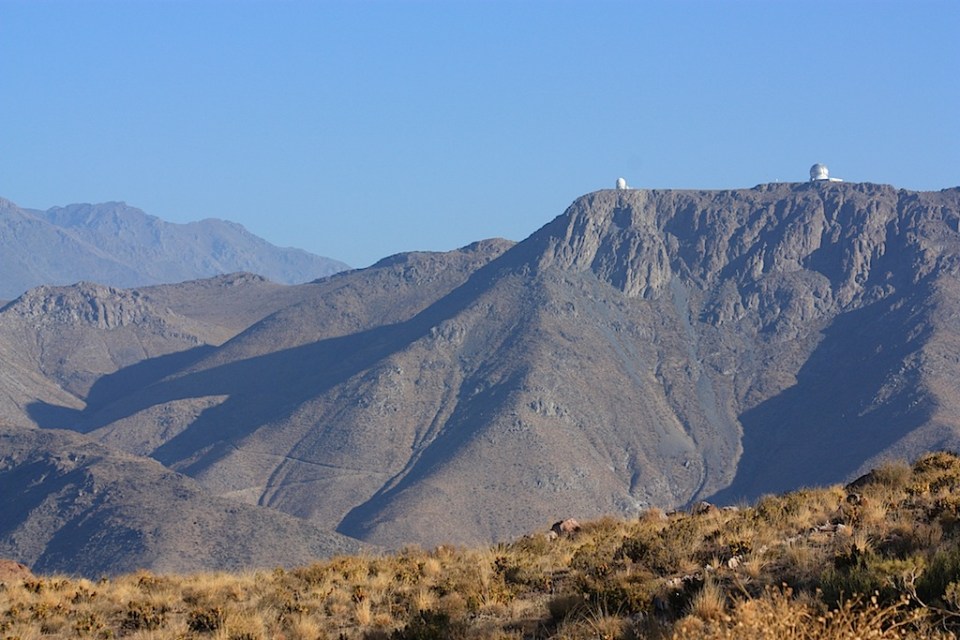
Cerro Tololo Interamerican Observatory, CTIO, Cerro Tololo, Región de Coquimbo, Chile, fotoeins.com

Chilean Andes: morning send-off with Atacama minions

Above/featured: Morning fog in the valleys below, facing north-northeast from Cerro Tololo Observatory – 9am CLDT (12pm UTC), 22 Sept 2011.

Late-2011: Cerro Tololo Observatory, Región de Coquimbo, Chile.

The morning creeps gently forward, up and over the desert sky. Sounds? What sounds? What scarce sounds there are, they pierce the silence with soft whistles and drawn-out wails. Alternating light and dark horizontal streamers, known also as “the rays of God,” mark the first light of dawn. Small clumps break loose, as the overnight shroud of valley fog pulls back slowly from view.

The sun climbs higher, the shadows grow shorter, the cotton patch dissolves. It isn’t long until a spectacular sight is revealed. This is what you get from a height of 7500 feet above sea level.

Dry river beds twist and sweep and stretch along canyon floors. Cactus and desert scrub carpets the surrounding hills in faded greens and dusty browns. To the east rise jagged rocky teeth capped with white frosting, fixing the location of the Andes along the Chilean spine.

In this desolate and isolated part of the world, I’ve often wondered about the few brave souls who make this place their home. They’re prospectors, miners, even some farmers, all of whom carry their burden for financial endeavour. People have been digging around in these parts for centuries, whether it’s plant, mineral, or some kind of monetary paydirt.

But there’s another human enterprise with different rewards, a quest that asks questions on a much larger scale.

How do planets take shape?
How do stars form?
How are galaxies assembled?
Is there life elsewhere in the universe?

These issues occupy astronomers from all over the world. Many astronomers go up onto mountains, just like this one, onto the summit of Cerro Tololo, peering into the skies. The telescopes point straight up, reaching out like outstretched hands, wanting more.

( Click here for images and more )

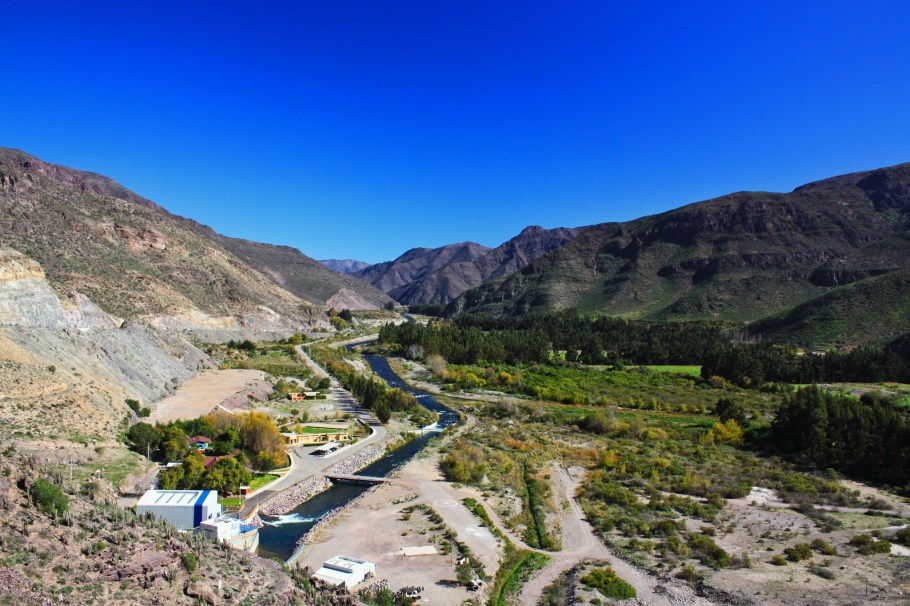
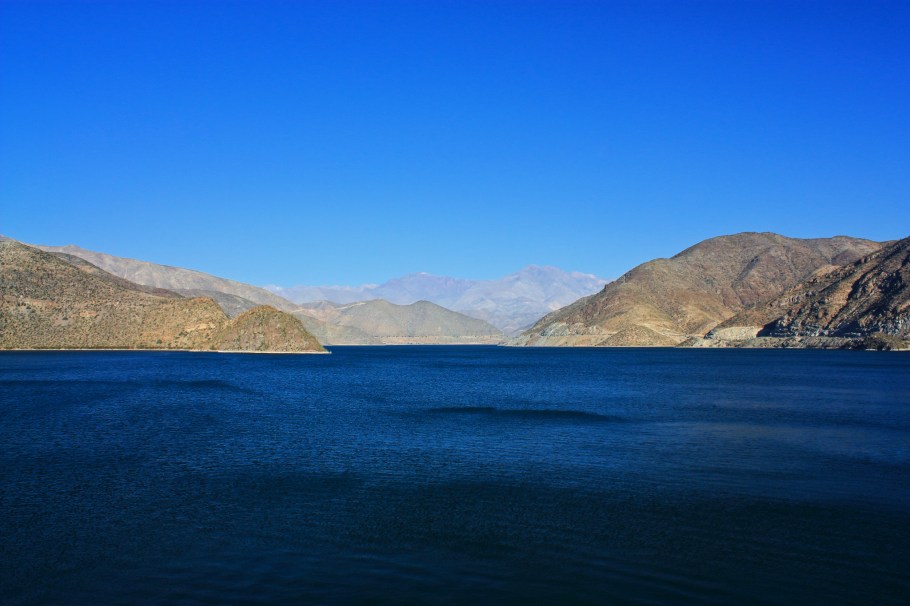
Embalse Puclaro, Puclaro, Rio Elqui, Elqui river, Region de Coquimbo, La Serena, Chile, fotoeins.com

My Chile: Elqui River, Puclaro Dam

Above/featured: Upstream and east to Andes – 9 August 2008.

27 September has been earmarked by the United Nations World Tourism Organization (UNWTO) as “World Tourism Day”. The following is a tweet by the United Nations for World Tourism Day in 2013.

The Elqui River in north-central Chile begins in the mountains of the lower Andes, and flows west to the Pacific along the southern edge of the Atacama desert through the towns of Vicuña and La Serena. The average annual total rainfall in La Serena is 10 to 13 cm (4 to 5 inches), less than one-tenth of the total for Vancouver, Canada.

The Elqui was dammed by 1999 to control water usage by farms in the lower valley and by pisco vinyards in the upper valley; however, construction of the dam displaced people in small low-lying towns on both sides of the river. Behind the dam in the Embalse or reservoir Puclaro (photo above), the water level has declined with lower annual snowfall in the mountains above and higher usage by farms and the increasing population below. The price for water continues to rise due to competition from mines, farms, and the growing population. Numerous research visits and five years living in La Serena emphasized the contrast of the importance of water to people’s lives in the region with the dominant presence of the neighbouring Atacama.


Embalse Puclaro, Puclaro, Rio Elqui, Elqui river, Region de Coquimbo, La Serena, Chile, fotoeins.com

Rio Elqui, downstream and west from the Embalse Puclaro – 9 Aug 2008.

Embalse Puclaro, Puclaro, Rio Elqui, Elqui river, Region de Coquimbo, La Serena, Chile, fotoeins.com

Retaining wall – 13 Sep 2009.

Embalse Puclaro, Puclaro, Rio Elqui, Elqui river, Region de Coquimbo, La Serena, Chile, fotoeins.com

Flags for the upcoming Fiestas Patrias national holiday – 13 Sep 2009.

Embalse Puclaro, Puclaro, Rio Elqui, Elqui river, Region de Coquimbo, La Serena, Chile, fotoeins.com

View east into the Andes – 13 Sep 2009.


I made all photos above with a Canon EOS450D/Rebel XSi on 9 Aug 2008 and 13 Sept 2009. This post appears on Fotoeins Fotografie at fotoeins DOT com as http://wp.me/p1BIdT-3PS.

Taxi in Chile, image by GatoOH on Wikipedia, CC3 license

How I spent $400 USD for a taxi in Chile

Imagine a cold foggy day in early-June, which is close to the end of fall here in the southern hemisphere. In the southeastern Pacific region along the Chilean coastline on which the town of La Serena lies, a wave of moist air can descend quickly from the ocean to sit snugly over town as a thick white puffy blanket.

On Friday, June 6, 2008, I was on my way from La Serena, Chile to a week-long meeting in Cambridge, England. I awoke on that Friday morning, puzzled by the unusually “dark” morning light. I pushed the drapes aside, and I was in a world of trouble.


I opened the front door and stepped outside onto the front porch – the fog was so thick I couldn’t see beyond about 10 metres (30 feet). I knew no airplanes would either land at or depart from La Serena airport in the thick grey soup, because at the time, the airport operated only under visual flight rules (VFR).

I asked around for possible options: taking a bus, driving a rental car to Santiago airport, or getting a taxi. The fog wasn’t budging by noon, and I made my decision. Instead of heading out to the airport in time for the scheduled early-afternoon flight, I asked a friend to drive me to the town’s bus station.

Throughout the country, long-distance transportation by bus is relatively inexpensive, is used by many, and works well. Although there are rail carriages carrying coal or other minerals, there are no longer any passenger train service between Santiago and the northern reaches of the country. Travel from La Serena to Santiago means plane, car, or bus.

I arrived at the La Serena bus station at about 1215pm. Through fault only of my own, this turned out to be about 15 minutes too late, because I had waited until the last possible minute to leave for the bus station.

I went around to the booths for various bus companies, asking when the next bus would leave La Serena to Santiago. Unfortunately, buses were leaving at either 130pm or 145pm, which was too late. Depending on the traffic on the Panamerican highway and through the outer suburbs of the capital region, the bus typically takes 6 to 7 hours to the terminus in downtown Santiago. With my flight from Santiago leaving at about 9pm, the math didn’t add right for me; I didn’t have enough time to go cross-town from downtown to the airport in time for check-in.

I was in a quandary, because I needed to catch my departing flight that evening from Santiago. The distance between La Serena and Santiago is about 475 kilometres on the highway. What to do, what to do … and I walked out the front-entrance of the bus station, considering my options.

Three vacant taxis were parked in front, their drivers in conversation. I then asked in broken-Spanish: “Excuse me, how much is a fare to the airport in Santiago?”

You know that moment when time slows down and you can see an individual leaf fluttering in a tree, or the up and down flap of a bird passing by. There’s also the moment where you can clearly see the thought bubbles go up over people’s heads, the words within the bubbles which are roughly translated as: “!!!”

In real time, only a few seconds had passed. One of the three gentlemen answered: “200 thousand mille (pesos)”, which at the time was about 400 US dollars. Without hesitation, I replied: “Great, let’s go!”

You know that moment when time slows down and … I can see the gears turning in their heads, and the bubbles in their heads suddenly popped, as they were clearly surprised that I’d been “silly enough” to take one of them up on their offer to drive me the 400 kilometres to Santiago.

At 1245pm, I stepped into one of the taxis, and we soon made our way south on the Panamerican highway. I offered to pay half of the fare up-front, and the other half upon arrival in Santiago. I have to admit that for about a minute I thought I was going to get robbed, and then dumped out of the taxi in the middle of nowhere.

About an hour south, the fog cleared, and it was crystal clear on the highway. Through most of the drive, I occasionally looked out the window to see if there was a plane with LAN-colours flying overhead on its way from La Serena to Santiago.

The taxi-ride itself was uneventful, I sat in the backseat, looked out at the scenery, dozed here and there, but I didn’t converse much with the driver. However, he received two interesting calls on his mobile in the first couple of hours.

I think his wife called first, because I imagined the first conversation to have gone something like this:

“Hi, honey … yeah, I’m not going to be home later tonight … yeah, I’m taking a gringo to Santiago … I’m taking him to the airport there … yeah, he’s paying me 200 thousand mille, can you believe it? … I’ll be okay … I’ll drive back tomorrow … love you …”

I think his drinking buddies called next, as I imagined the translation of the subsequent conversation to have gone something like this:

“Hey there … yeah, I can’t go out for a beer tonight … I’m taking a gringo to Santiago airport … yeah, the fog really messed things up … the guy’s paying me 200 thousand mille, can you believe it? … yeah, I know I’m buying a few rounds when we’re out for a beer … I’ll be back tomorrow night … yeah, talk to you later.”

I’ve taken the bus many times before, but the signage all state a maximum speed-limit of 100 kilometres per hour for buses on the highway, but the taxi’s crushing that limit in the middle stretches of the highway. From previous visits, I’m familiar with the scenery, the beautiful coast-hugging highway, weaving around the cliffs, saying hello to the waves crashing against the rocks from the Pacific.

Apart from a short break to tap a kidney, I stepped out of the taxi at the departures level of Santiago airport at 545pm – not bad for a brisk 5-hour taxi-ride. I hope the guy got back home to his wife okay, and bought many rounds for his buddies.

After check-in and clearing both passport-control and security, I walked into the American Airlines lounge, and connected the laptop to the internet. One of my colleagues was logged onto Skype, and I had to ask, I had to know : did the fog ever clear over La Serena?

She replied: no, still thick as ever, nothing got through the thick grey soup.

For the first time in hours, I exhaled a deep sigh of relief. Finally, I was on my way.

This really did happen on 6 June 2008 and I forked over 400 American dollars for a 5-hour 475-kilometre taxi ride. The top (featured) photo is from Wikipedia with the CC3 license. This post appears on Fotoeins Fotopress at fotoeins.com as http://wp.me/p1BIdT-as.