Fotoeins Fotografie

location bifurcation, place vs. home

Posts from the ‘Urban Photography’ category

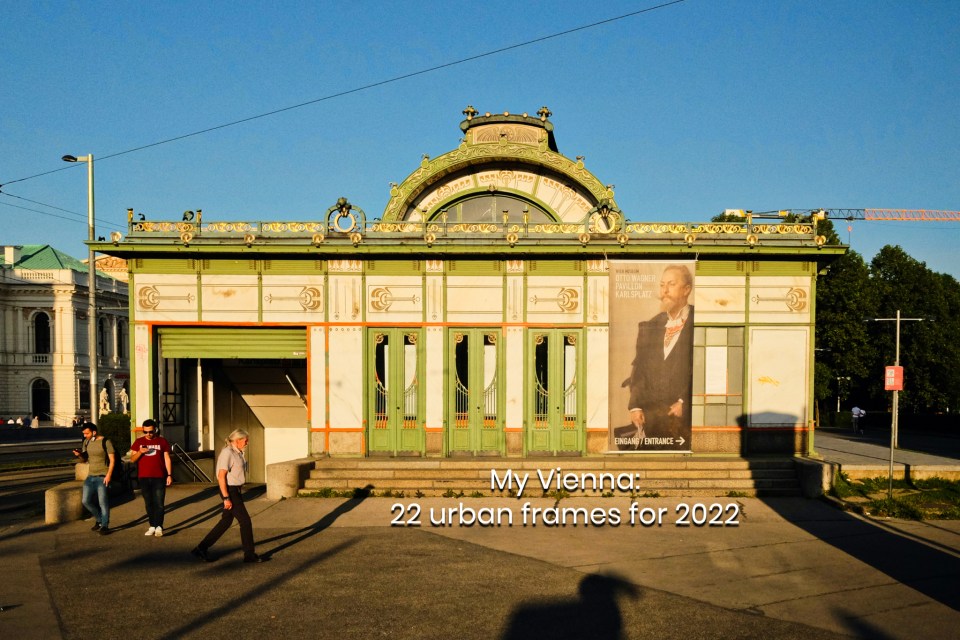
My Vienna: 22 urban frames for 2022

Above/featured: “The first Sunday.” Karlsplatz, 1st district – 15 May 2022.

Earlier in the year, I spent four weeks in Vienna, soaking in late-spring and early-summer weather in Austria’s capital city. I highlighted 3 images and scenes which in addition to time spent left personal impressions. Below, I highlight in a “last chance effort” an additional 22 visual examples of the urbanity in Wien, folding in splashes of colour, lines of focus, and accessibility to good timing.


( Click here for images and more )

Vienna: Imperial Court Pavilion Hietzing, by Otto Wagner

Above/featured: Hofpavillon Hietzing in afternoon light, facing east with the departing eastbound U-Bahn U4 train. Photo, 15 May 2022.

Along Vienna’s U4 metro line, a dark-domed white cube-like structure seems to float over the tracks between Schönbrunn and Hietzing stations. Most may not realize the building’s relevance to the history of the city’s first railway, the city’s rapid urban evolution into the 20th-century, and the railway architect’s eventual “break away” transition from historicism to modernism.

Vienna was going to look very different after 1890. The city undertook its second and greatest expansion, absorbing 6 outer districts and ballooning the total population to almost 1.4 million (almost doubled in 10 years). The city’s administration recognized the challenge of efficiently transporting people between its new outer suburbs and the inner city. In 1894, Vienna appointed architect Otto Wagner with the complete design and construction of the new Wiener Stadtbahn metropolitan railway. The railway saw the creation of four new lines: the Danube canal line (Donaukanallinie), the “Belt” line (Gürtellinie), the suburb line (Vorortlinie), and the Vienna river valley line (Wientallinie). Today, the city’s U-Bahn U4 and U6 lines and the S-Bahn S45 line operate electrified over much of the original routing.

The Vienna valley line brought track and construction in front of Schönbrunn, the imperial summer palace for the ruling Habsburgs. The rail line’s new Schönbrunn station was located at the northeast corner of the palace grounds. But at the grounds’ northwest corner, Wagner created two stations: one for the public, and one for the Habsburgs. Built for the inauguration of the city railway on 1 June 1898, the imperial pavilion was set aside for the emperor, family, and staff. Emperor Franz Josef I only used the pavilion twice, as he was reluctant (hostile) to accept rapid changes brought by modernity.

Wagner created a domed-building whose interior was furnished with floral and vegetal elements in the Jugendstil (Art Nouveau) style, a painting with a bird’s eye view of the city over Schönbrunn, a private suite for the emperor; and whose exterior included the uniform green and white colours seen throughout the entire rail network, glass and wrought-iron elements, and a separate portal providing a covered entrance for the imperials. Out of the many station buildings Wagner designed for the entire system, the imperial pavilion at Hietzing is most associated with the “historical” architectural style. The building is now a part of the city’s Wien Museum after successful post-war efforts to save and restore the structure.

The informal name is the “Hofpavillon Hietzing” (Imperial Court Pavilion Hietzing), but the building’s formal name is “Pavillon des kaiserlichen und königlichen Allerhöchsten Hofes” (Pavilion of the Imperial and Royal Highest Court). In the images below are divided sections: “exterior”, “interior”, and “sketches”.


( Click here for images and more )

My Fuji X70: Fujichrome Slide, Kodak Platinum 200 (XTrans2 recipes)

Above/featured: 1st Narrows, from John Lawson Pier.

My Fujifilm X70 mirrorless fixed-lens prime camera has been a big plus for photography at domestic and international locations. The built-into-camera film-simulations (e.g., Provia, Velvia) work beautifully in standard settings, but as I’ve never had a film camera, the advent of “camera recipes” to produce additional film-like settings stimulated interest in different colour or pictorial representations.

So far, I’ve tested these Fujifilm film-simulation (“film-sim”) recipes:

•   Ektachrome 100SW (saturated warm), simulating images with the Kodak colour transparency or slide films produced 1996–2002;
•   Kodachrome 64, simulating images with the Kodak colour film produced between the mid-1970s and 2009;
•   Kodacolor, “producing classic Kodak analog aesthetic closest to early-1980s Kodacolor VR200 colour film that’s been overexposed.”


( Click here for images )

Vienna: free city views from modest heights

At the eastern limit of the Alps, the city of Vienna is built at the “low end” where the hills meet the Danube river, at a minimum altitude of about 150 metres (500 feet) above sea-level. Visitors to the Austrian capital city who don’t have much time but want a broad overview of the city will make their way to one or all of the Donauturm (Danube Tower), Riesenrad (Ferris Wheel), and Stephansdom (St. Stephen’s Cathedral). Each of these landmarks requires the price of admission to get up high in the sky.

For other views at more modest heights, you’ll see there are options, especially because I’ve set foot in all 23 of the city’s districts. Below I highlight seven locations; all are free (zero charge) to access. All but one are well outside the inner city for the opportunity to explore other city districts and to gain a better sense of the physical size of the city. All images below are cropped square.


( Click here for more )

My Berlin: the buried Bibliothek at Bebelplatz

On a clear cool late-autumn morning, a young child is looking through an opening in the cobblestone plaza. She looks up to the man standing next to her.

Daddy, why is there a glass window? What happened here?

The thing to keep in mind is that this square in Berlin is called Bebelplatz (BAY-buhl-platz), and not Babbleplatz. It’s easy to make the mistake. After all, a great repository of books was once created inside the building seen above, in what was once home of the Königliche Bibliothek or Royal Library.

But then came along a large racist blather.

Accompanied by a big ugly fire.

( Click here for images and more )