Fotoeins Fotografie

location bifurcation, place vs. home

Posts from the ‘Urban Photography’ category

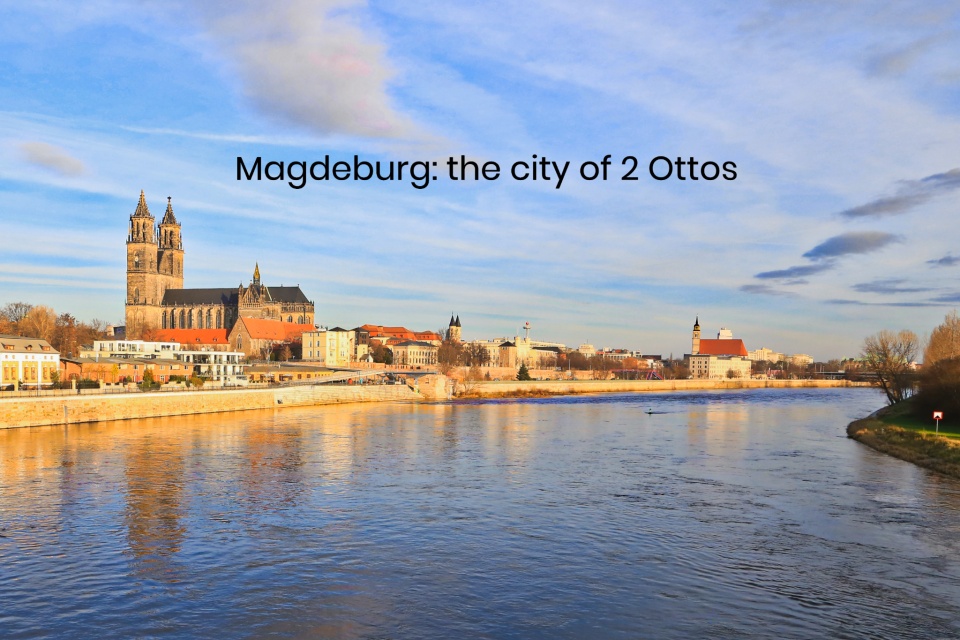
Morning view, Morgenblick, city view, Stadtblick, Hubbruecke, Elbe river, Romanesque Road, Strasse der Romanik, Magdeburg, Sachsen-Anhalt, Saxony Anhalt, Germany, Deutschland, fotoeins.com

Magdeburg: the Otto city where Romanesque meets Luther

Above/featured: From Hubbrücke bridge over the Elbe river, churches left to right are Dom, Kloster Unser Lieben Frauen, and Johanniskirche, respectively. Photo on 3 Dec 2015.

I’ve seen the city on the map, lying halfway between Hannover and Berlin. Over the last 15 years, there’ve been far too many ICE trains along that very same stretch, bypassing the heart of Saxony-Anhalt. Curiosity eventually wins, and I’m on a train to Magdeburg.

Magdeburg is the capital city of the German federal state of Saxony-Anhalt, home to two famous Ottos, a centre for the state’s Romanesque Road, and one of the stations for (Martin) Luther Country. Founded by Charlemagne in 805 AD/CE, the city is one of the oldest German cities, celebrating their 1200th anniversary in 2005. Magdeburg was an important medieval city in the Holy Roman Empire, a member of the Hanseatic League and important trade centre along the Elbe river, a welcome settlement for Jews in the 10th-century, and one of the first places to begin separating church- from civic-rule of law in the 13th-century with the Magdeburger Recht (Magdeburg Rights).


( Click here for more )

Rothenburg ob der Tauber: Jewish history since 1180 AD/CE

After their stop in town, most visitors depart Rothenburg ob der Tauber with memories of a romantic medieval town that seems almost frozen in time.

But a careful measured walk also produces a deeper examination of the town’s history with clear signs to an historical and centuries-old presence of Jews. A Jewish settlement goes back to at least 1180 AD/CE in written records with the appearance of the name of Samuel Biscopf, a Jew from Rothenburg ob der Tauber (“erste Erwähnung eines Rotenburger Juden”: [ℵ1], p. 136; [ℵ2], pp. 133-135).

The centuries are marked with a growing thriving Jewish community, persecution, violent death, explusion, and a return to life.

Summary Timeline:

•   1180 AD/CE, first mention of Jewish community in Rothenburg; 1st Jewish quarter and synagogue at present-day Kapellenplatz.
•   1250-1286, Rabbi Meir ben Baruch, teaching life and times in Rothenburg.
•   1298, Rintfleisch-Pogrom!: 450 Jews killed in Rothenburg; total 5000 Jews dead in Franconia.
•   1339, some of the first set of graves buried at the Jewish Cemetery, at present-day Schrannenplatz
•   1349, Pogrom! and persecution, Jews accused of poisoning wells with corpses due to the Black Death.
•   1370, Establishment of 2nd Jewish quarter, around Judengasse.
•   1404, 1st Synagogue converted to St. Mary’s Chapel.
•   1407, 2nd Synagogue constructed close to burial ground, at present-day Schrannenplatz.
•   1520, Theologian Johann Teuschlein incites anti-Jewish hysteria, forcing expulsion of all Jews from Rothenburg. No Jews allowed in the city for next 350 years; 2nd Synagogue and Jewish cemetery destroyed.
•   1861, all Jews allowed to settle anywhere in Bavaria.
•   1870-1875, Jews begin returning to the city.
•   1872, Equality granted among Jews and Christians, after the 1871 constitution of the new German Empire.
•   1888, Prayer hall (“3rd synagogue”) at present-day Herrngasse 21.
•   1875, 2nd Jewish cemetery at Würzburger Strasse and Wiesenstrasse.
•   1938, Rothenburg declared “free of Jews” on 22 October, as last remaining 17 Jews driven out, two and a half weeks before the Reichspogromnacht.
•   1942, 2nd cemetery desecrated and destroyed. Few, if any, descendants of early 20th-century community remain or known to be alive.

! The word “pogrom” is a late 19th- to early 20th-century Russian word (“погром”), derived from the verb “gromit” (громи́ть) meaning “to destroy with violence.” While “pogrom” is used generally to describe mob violence by one ethnic or religious group on another, the term is used in this post to describe attacks on the Jewish community.


( Click here for images and more )

Hennes, 1. FC Köln, Köln, Cologne, North Rhine Westphalia, Nordrhein-Westfalen, Germany, Deutschland, fotoeins.com

My Cologne: 1. FC Köln, Stadium, Anthem

Above/featured: “Hennes”, mascot for 1. FC Köln (GO4KÖLN, Breitestr. 36). Photo, 16 Jun 2023 (X70).

“Gute Laune, Laute Stimme”: the “EffZeh” (F-C) experience has me hooked.

I’m among men and women, young and old, swimming in a sea of red and white, and surrounded by full-volume chanting. Not only is it a big deal to procure a “Stehplatz” (standing spot) for under €20, but to be present in the stadium’s standing-only terraces is a big thrill. The terraces are present in German football stadia but banned in England (for historical reasons). I’m convinced I’m going to memorize their famous fan anthem as quickly as possible.

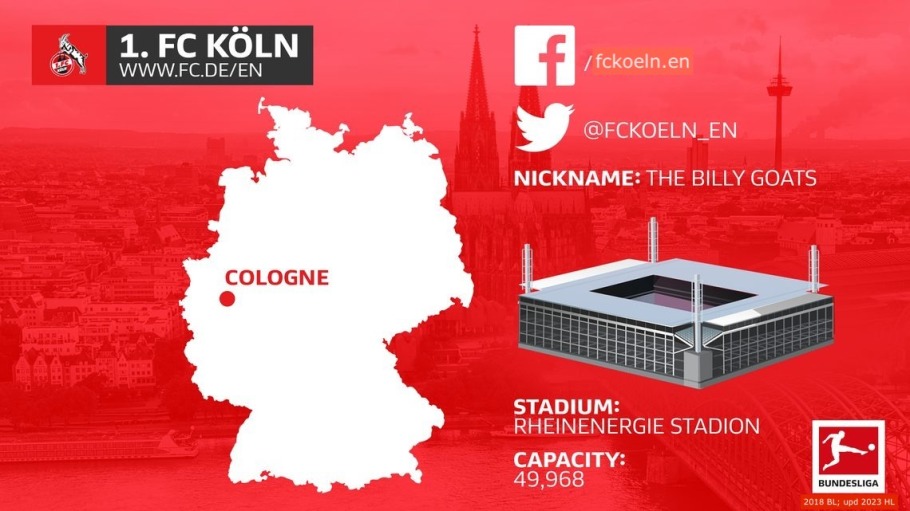
Founded on 13 February 1948, the football (soccer) team 1. FC Köln plays out of the Müngersdorfer Stadion, known also as the sponsored Rhein-Energie-Stadion (Rhine Energy Stadium) in Cologne. The stadium’s maximum capacity is about fifty-thousand, and the football side regularly sells out their home matches. The team’s mascot is a billy goat (Geissbock) for its steadfast stubborn perseverance; the team’s nickname is The Billy Goats. I’m also convinced there’s another “Kölle” verbal pun. “Geist-bock” is a compound noun consisting of “Geist” for (team-, fan-) spirit, and “Bock” for the people’s stubborn steadfast support. Various generations of “Hennes”, the mascot goat, have appeared on the sideline for home matches, and the mascot is prominent in the team badge’s and familiar red-and-white home kit (jersey).

The English version of the Bundesliga website highlights the team, reminding us they were the first ever champions of the newly established Bundesliga for the 1963-1964 season.

Bundesliga, 1. FC Köln, Rhein-Energie-Stadion, Köln, Cologne, North Rhine Westfalen, Nordrhein-Westfalen, Germany, Deutschland

Basic club info from Bundesliga (2018-2019), with updated FB link.

1. FC Köln, Bahnhof Ehrenfeld, Cologne, Köln, Germany, fotoeins.com

“1. FC Köln” mural at Ehrenfeld station – 14 Jan 2013 (450D).

Zesamme Simmer Stark, FC Kölle, 1. FC Köln, Effzeh, Hilton Cologne, Köln, Cologne, North Rhine Westphalia, Nordrhein-Westfalen, Germany, Deutschland, fotoeins.com

“Zesamme Simmer Stark”: Hilton Cologne. Photo, 26 May 2016 (6D1).

1. FC Köln, Köln Hauptbahnhof, Köln Hbf, Köln, Cologne, North Rhine Westphalia, Nordrhein-Westfalen, Germany, Deutschland, fotoeins.com

1. FC Köln fanshop “Stadion”, at Köln Hbf (Cologne central station). Photo, 13 May 2022 (X70).


( Click here for images and more )

Mi CDMX: unos momentos en las calles

Mexico City: people and streets of interest

The following is a cross-section through the massive metropolis that is Mexico City. The city proper has population around 9 million, but the greater urban area has in excess of 20 million. An afternoon walk provides a tiny visual slice of all that makes up the city in her streets: her people and where they live, work, eat, play/pray, and love.

( Click here for images and more )

Kölner Dom, Hohenzollernbrücke, Köln, Cologne, Germany, fotoeins.com

Cologne’s two grand landmarks

Give them any excuse, the people in Köln (Cologne) love to party at any time. It’s a wonder but no surprise this is where I find some of the happiest people in the country. As the calendar flips to a new year, the time heralds the annual shenanigans of the Kölner Karneval. For residents and visitors, two of the best-known landmarks in the city are the Kölner Dom (Cologne Cathedral) and the Hohenzollernbrücke (Hohenzollern Bridge).

( Click here for more )