Fotoeins Fotografie

location bifurcation, place vs. home

Posts from the ‘Urban Photography’ category

Spinnerei, Leipzig, Sachsen, Saxony, Germany, fotoeins.com

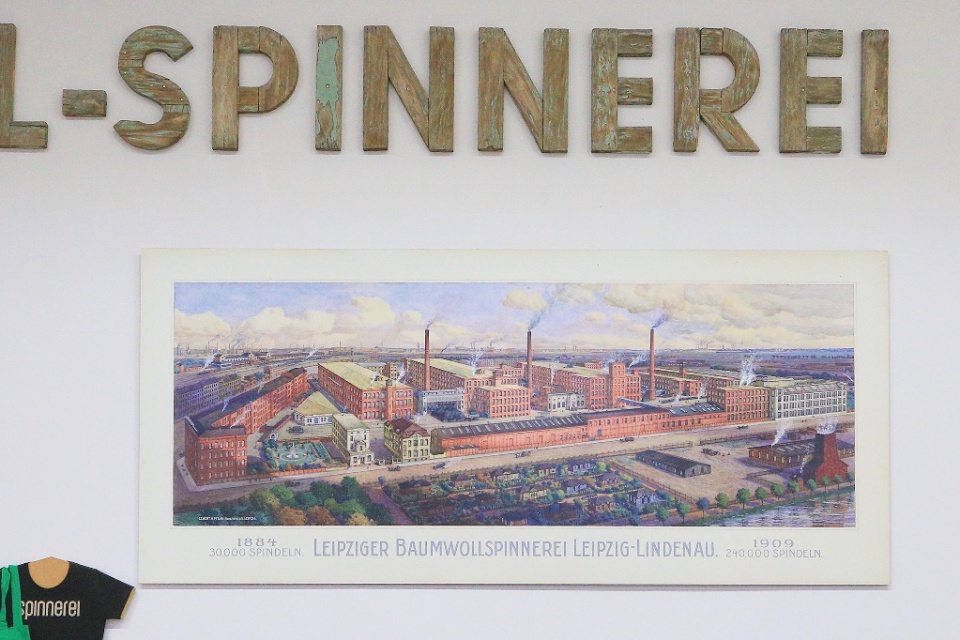
Leipzig Spinnerei: from cotton mill to arts centre

The Leipzig Spinnerei is a former cotton mill (Baumwollspinnerei) in the western industrial suburb of Plagwitz. The massive site at an area of 10 hectares (over 1 million square feet) with rows of factory buildings began operation in 1884 and eventually became the largest cotton mill in Europe with thousands working and living on-site. After the site ceased to produce spools of cotton thread shortly after reunification, artists took advantage of the cheap empty space, and transformed the area into studios, galleries, and exhibition halls. Much has been written about the impact and examples of art and space on Leipzig as the “new Berlin” as well as the “New Leipzig School.” The site as art and culture space opened its doors in 2005.

( Click here for images and more )

Home eye: a return to Vancouver streets (2013-2014)

What is “street photography”? How is street photography defined? Should it be defined? Who, if any, has the authority to define and maintain the definition? I presently subscribe to Eric Kim’s definition, but it’s important for people to photograph as they wish and desire. Whatever people think in terms of their streets is entirely up to them.

When I returned to my hometown for an extended period, I returned to the streets to became familiar with them again. Street names have remained unchanged for the most part, although many buildings have long since been demolished and replaced by something else. When I first picked up a camera, I rarely turned the lens onto people. It’s been a slow evolving process to shift my camera onto scenes with people. With that in mind, I’m fortunate to have some shots with people in decent scenes mixed with good timing.

( Click here for images and more )

Karlsruhe: Fächerstadt (fan-shaped city) in Baden-Württemberg

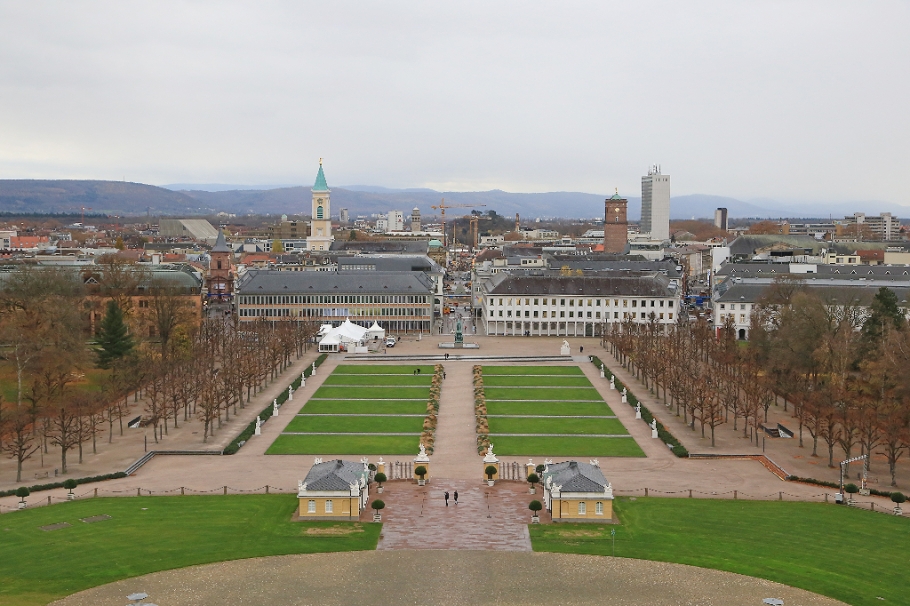
Above/featured: Karlsruhe Palace.

You won’t likely find another German city in the shape of a fan.

Sitting pretty near the Rhine river in southwest Germany, Karlsruhe is known as the “Fächerstadt” (“fan city”) for its very specific shape.

On 17 June 1715, Margrave1 Karl Wilhelm (Charles William) of Baden-Durlach celebrated breaking ground and the first laid stone for his new residence, palace, and seat of power. The story goes that after a vivid dream, Karl Wilhelm decided to build his new home of “rest and relaxation” (“Karls Ruhe”) in the middle of a nearby forest. A planned city would surround the palace, an appropriate symbol for the question of “who ruled whom.” The palace sat at the central hub of 32 “rays” or streets radiating outwards: 9 streets to make up the new city, and 23 for the palace gardens. Emerging from the palace was the “Via Triumphalis,” the north-south central axis road into the city. Karl Wilhelm moved the margraviate seat from nearby Durlach to the “new shiny city” of Karlsruhe upon completion of the new palace in 1718.

In the spring of 1788, Thomas Jefferson, while serving as America’s chief of mission (Minister Plenipotentiary) in France, embarked on a tour of Holland and the Rhine river in what is now Germany. He stayed in “Carlsruh”2 on 15 and 16 April 1788. Impressed by what he saw throughout his trip, he sent a letter and sketches3 to Pierre Charles L’Enfant4 who was charged by George Washington with the design and construction of a new American capital city. Jefferson wrote to L’Enfant on 10 April 1791:

“…in compliance with your request I have examined my papers and found the plans of Frankfort on the Mayne, Carlsruhe, Amsterdam Strasburg, Paris, Orleans, Bordeaux, Lyons, Montpelier, Marseilles, Turin and Milan, which I send in a roll by this post. They are on large and accurate scales, having been procured by me while in those respective cities myself. …”

With copies of European city plans in hand, these plans provided inspiration for L’Enfant’s eventual design for Washington, DC.

The Badisches Landesmuseum has occupied the palace since 1921, and the city of Karlsruhe celebrated its 300th anniversary5 in 2015.


What would Thomas Jefferson have seen?

Dated between 1739 and 1779, the following four maps from Stadt Karlsruhe city archives would have been representative of the young city at the time of Thomas Jefferson’s 1788 visit.
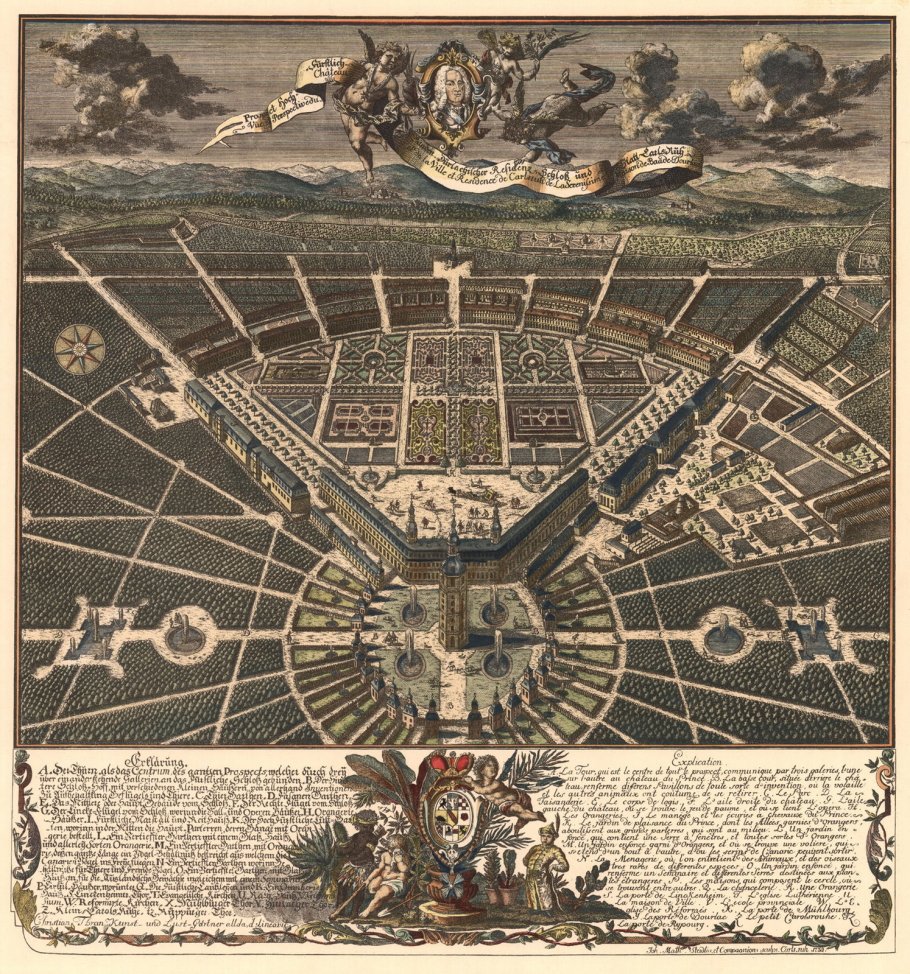
Historische Stadtpläne, Bilderbogen, Stadt Karlsruhe

1739 city view with south at top; coloured copper engraving by Christian Thran.

Historische Stadtpläne, Bilderbogen, Stadt Karlsruhe

1739 city view with north at top; the “fan” consists of 9 streets; coloured copper engraving by Christian Thran.
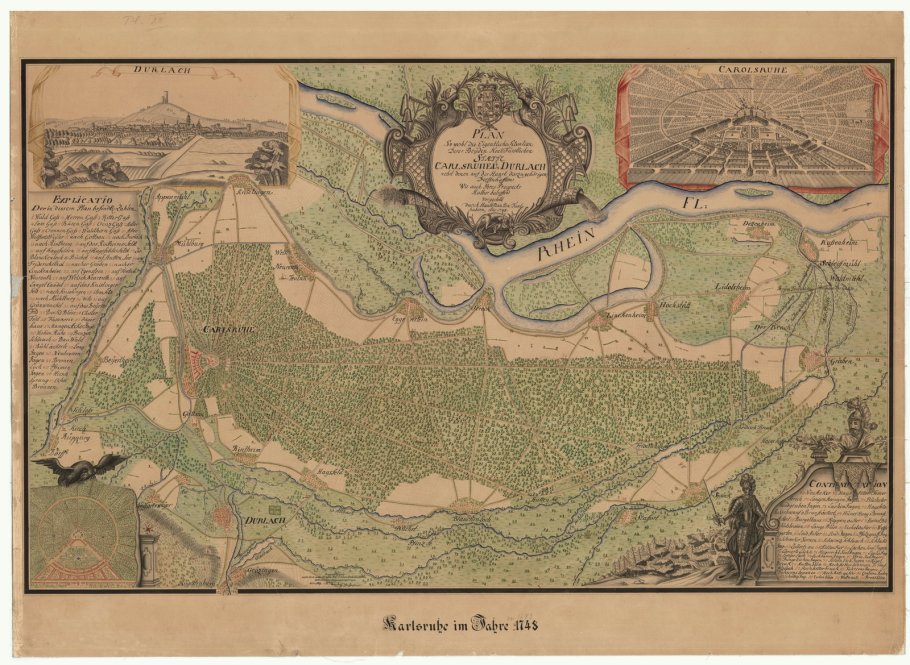
Historische Stadtpläne, Bilderbogen, Stadt Karlsruhe

Map dated 1745 of “Carlsruhe” (Karlsruhe), Durlach, and surroundings, with west at top, towards the Rhine river (Rhein Fl.).
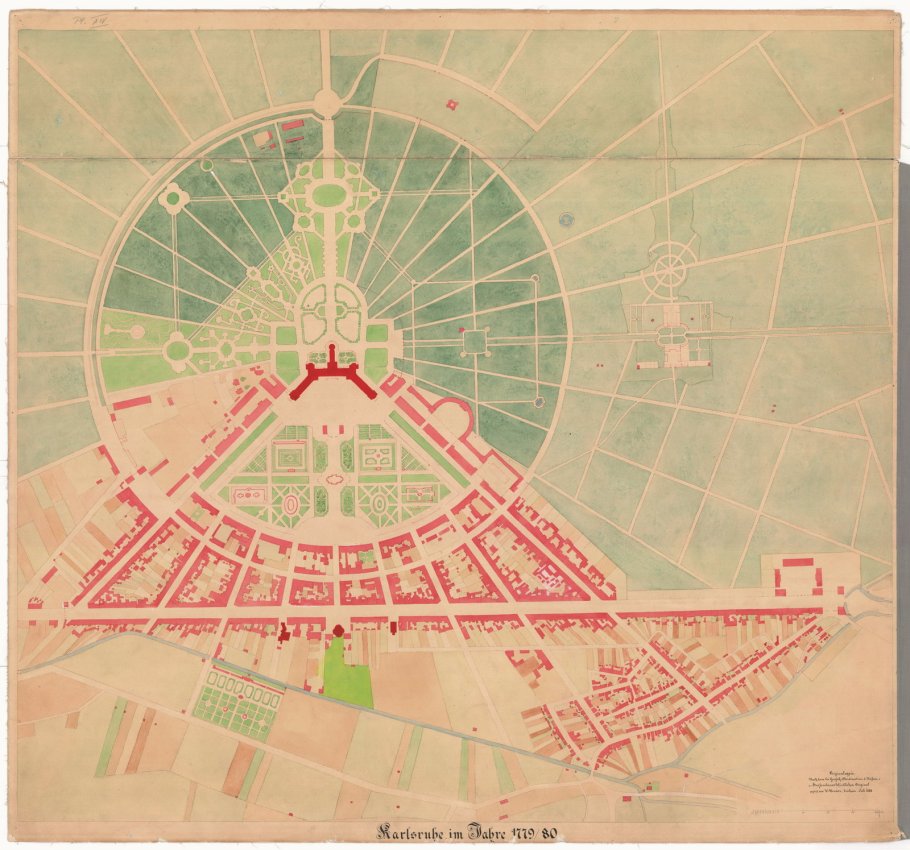
Historische Stadtpläne, Bilderbogen, Stadt Karlsruhe

1779 city map: north at top, Schloss (palace) at circle’s centre. Note how palace “wings” extend south into a “fan” of 9 streets into the young city.


Panorama from the Palace Tower

Even in the dreary days of late-fall and early-winter, there are sweeping views of the city and surrounding area from the top of the Schlossturm (Palace Tower); even the tower’s stairs are themselves a highlight of geometry. It’s also important to realize 14 kilometres to the German-French border isn’t far at all.

Schloss Karlsruhe, Badisches Landesmuseum, Karlsruhe, Baden-WĂĽrttemberg, Germany, fotoeins.com

Up the palace tower (HL).

City view, Schlossturm, Schloss Karlsruhe, Karlsruhe, Baden-Wuerttemberg, Germany, fotoeins.com

South view, along Via Triumphalis through Schlossplatz (palace square). The hills in the background are about 10 kilometres distant (HL).
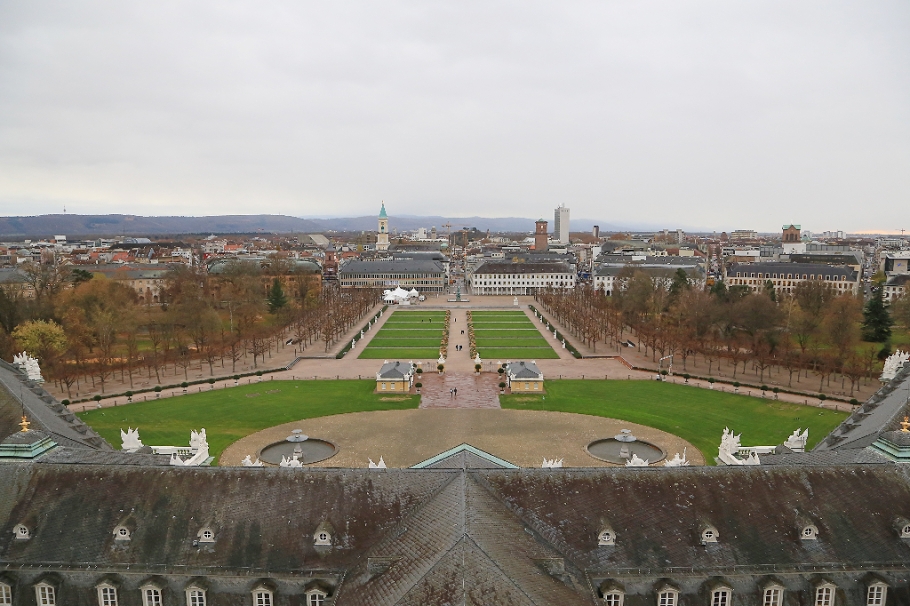
City view, Schlossturm, Schloss Karlsruhe, Karlsruhe, Baden-Wuerttemberg, Germany, fotoeins.com

Wide south view with the Via Triumphalis north-south axis at centre. Note palace “wings” at far-left and -right, making the “fan” into the city (HL).
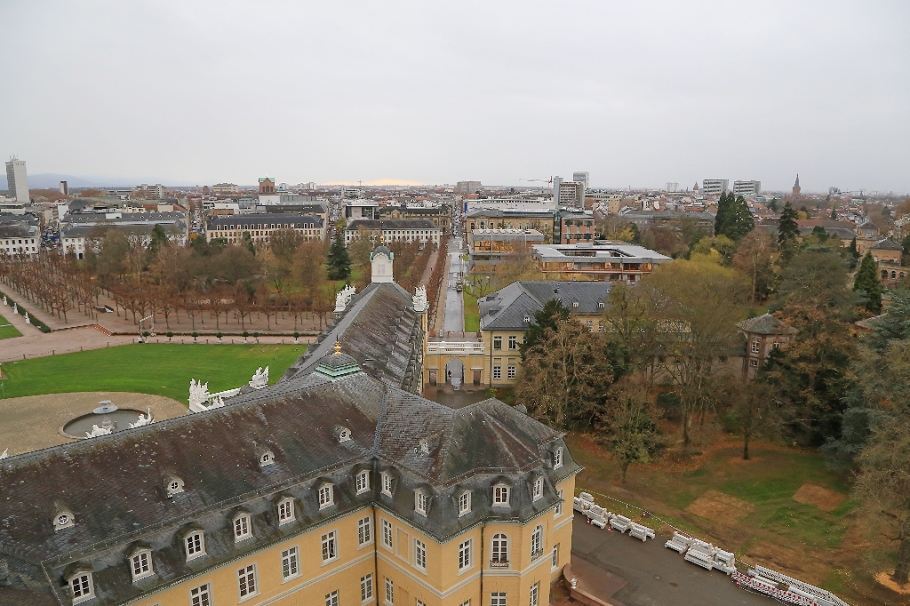
City view, Schlossturm, Schloss Karlsruhe, Karlsruhe, Baden-Wuerttemberg, Germany, fotoeins.com

Southwest, to Bundesverfassungsgericht (Federal Constitutional Court) at centre-right, just beyond the palace (HL).
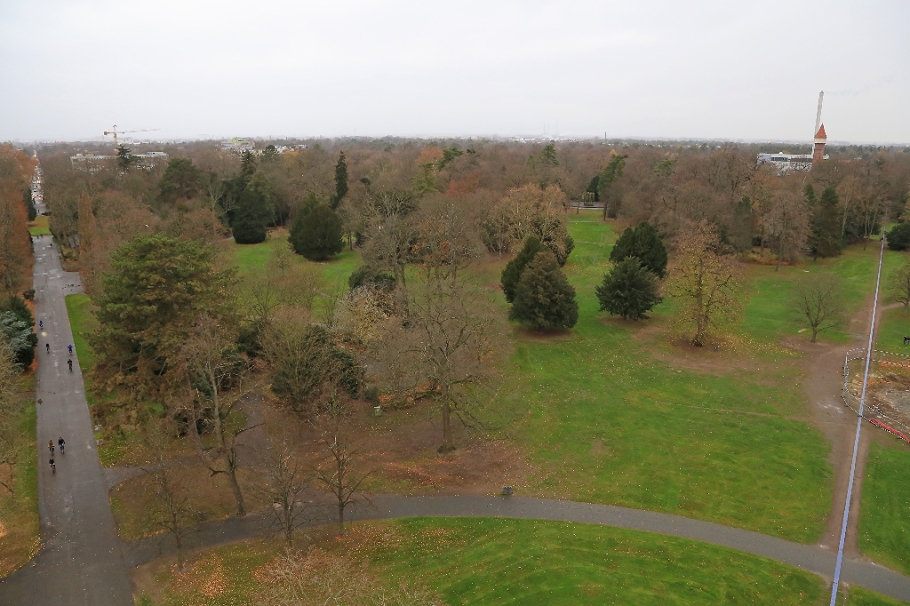
City view, Schlossturm, Schloss Karlsruhe, Karlsruhe, Baden-Wuerttemberg, Germany, fotoeins.com

Northwest, towards Majolika Manufaktur Karlsruhe at upper right (HL).
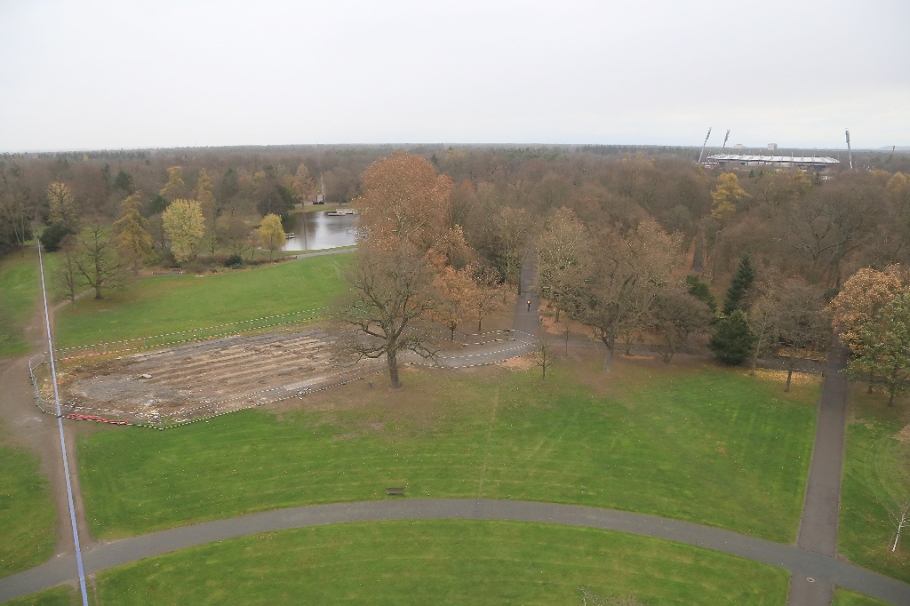
City view, Schlossturm, Schloss Karlsruhe, Karlsruhe, Baden-Wuerttemberg, Germany, fotoeins.com

North-northeast to Schlossgartensee (palace garden lake) at centre-left and Wildparkstadion (stadium) at right (HL).
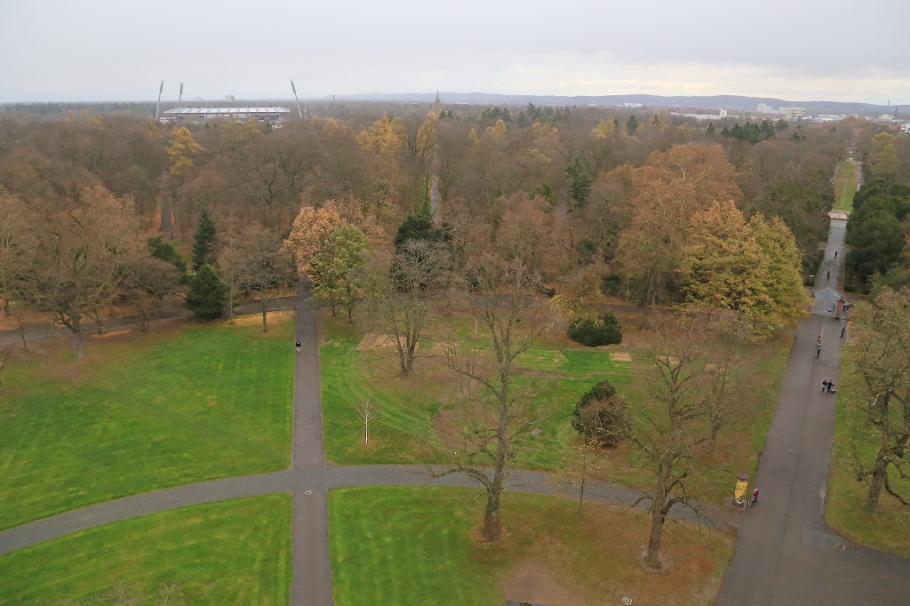
City view, Schlossturm, Schloss Karlsruhe, Karlsruhe, Baden-Wuerttemberg, Germany, fotoeins.com

Northeast: Wildstadion at left, Grossherzogliche Grabkapelle at centre in the distance (HL).
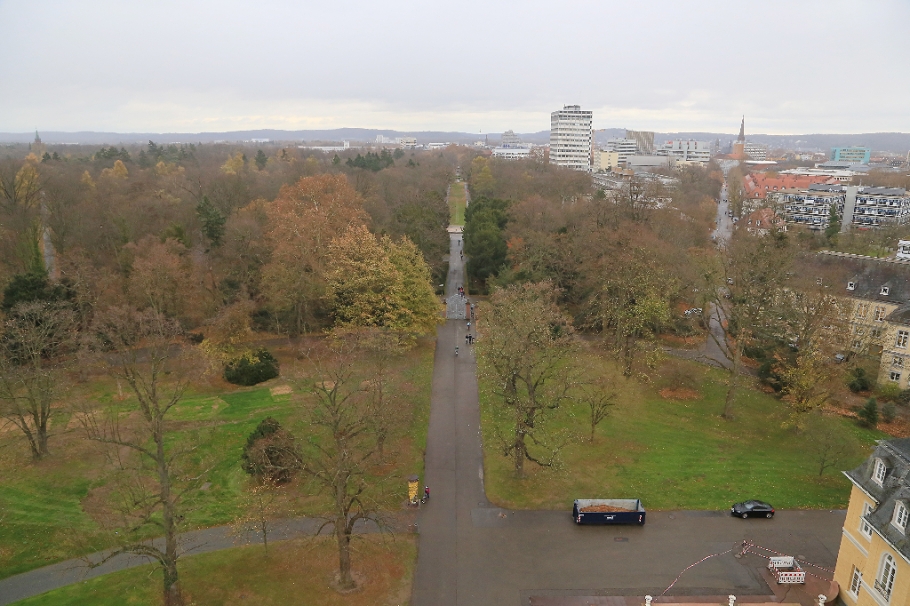
City view, Schlossturm, Schloss Karlsruhe, Karlsruhe, Baden-Wuerttemberg, Germany, fotoeins.com

Facing east; Grossherzogliche Grabkapelle at far left in the distance, Kirche St. Bernhard at right to the southeast (HL).

City view, Schlossturm, Schloss Karlsruhe, Karlsruhe, Baden-Wuerttemberg, Germany, fotoeins.com

Facing southeast; Kirche St. Bernhard at left, and beyond Schlossplatz at centre is Karlsruhe Institute of Technology (KIT) Campus Süd (HL)

City view, Schlossturm, Schloss Karlsruhe, Karlsruhe, Baden-Wuerttemberg, Germany, fotoeins.com

Return to the south-facing view of Schlossplatz, or palace square (HL).
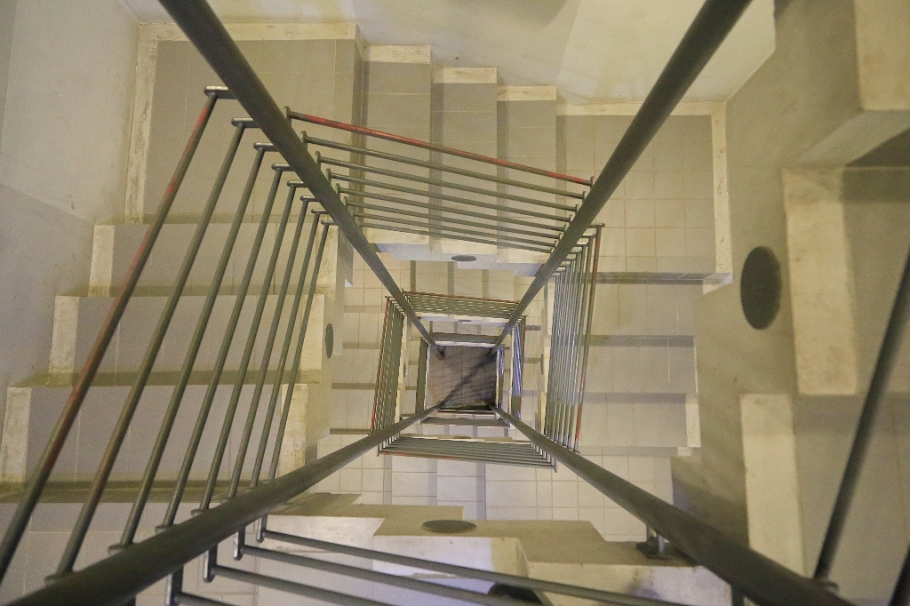
Schloss Karlsruhe, Badisches Landesmuseum, Karlsruhe, Baden-WĂĽrttemberg, Germany, fotoeins.com

Down the palace tower (HL).


Notes

1 A “margrave” was a hereditary title for a prince in the Holy Roman Empire; their territory was called a “margraviate” (Markgrafschaft). Margraviate Baden-Durlach and neighbouring Margraviate Baden-Baden reunited in 1771 to form the Margraviate of Baden. After dissolution of the Holy Roman Empire in 1806, the Grand Duchy of Baden was created as a member state within Napoleon’s Confederation of the Rhine.

2 “Notes of a Tour through Holland and the Rhine Valley, 3 March–23 April 1788,” Founders Online, National Archives, http://founders.archives.gov/documents/Jefferson/01-13-02-0003. [Original source: The Papers of Thomas Jefferson, vol. 13, March–7 October 1788, ed. Julian P. Boyd. Princeton: Princeton University Press, 1956, pp. 8–36.]

3 “XII. Thomas Jefferson to Pierre Charles L’Enfant, 10 April 1791,” Founders Online, National Archives, http://founders.archives.gov/documents/Jefferson/01-20-02-0001-0015. [Original source: The Papers of Thomas Jefferson, vol. 20, 1 April–4 August 1791, ed. Julian P. Boyd. Princeton: Princeton University Press, 1982, pp. 86–87.]

4 More about Pierre Charles L’Enfant appears at the US Library of Congress.

5 Wulf Rüskamp wrote this article for the Badische Zeitung (in German).

Thanks to Karlsruhe Tourismus and Hotel Rio Karlsruhe for a warm welcome and access to venues and services. Old city maps are from Stadt Karlsruhe’s archives. I made all remaining photographs on 17 November 2015 with a Canon EOS6D mark1. This post appears on Fotoeins Fotografie at fotoeins DOT com as http://wp.me/p1BIdT-8Cv.

Alone twice for the price of one

These photographs are a set of personal observations outlining places I’ve been and places where I want to be. The people appearing in these photographs are essentially proxies in my exploration of isolation and urbanity, and the universal concept of home. Over many years, I’ve wrestled against many demons, and in the present age of social media, the race to the most “looks, clicks, and likes” isn’t providing a healthy solution. Ultimately, what I dream is that a destination will offer some finality for the simple requirements of understanding and acceptance.

Detachment and atypicality have always been personal benchmarks carrying me from one location to the next. The privilege of living in Europe and South America have provided a palette of colour and flavour variations throughout my time as research scientist. Rationality and creativity always competed for supremacy, until I realized they could feasibly share the same stage. When I traveled around the world for a full year after leaving science behind, I hadn’t stopped running from research, from my birth-city, or from the person I had become. While running suggests an escape from something, running also implies there’s some endgame which is how writing and photography have helped shape my ongoing journey.

( Click here for images and more )

My Cologne: there’s a lighthouse that never goes out

Above/featured: Mural of the Helios structure, Köln Ehrenfeld, 9 Jan 2013 (450D).

Why is there a lighthouse located in the middle of the city? That makes no sense!

Did the Rhine river once flow here? Is that why there’s a lighthouse?

Is the structure some kind of forgotten remnant of the past?

Maybe that’s not a lighthouse, but rather a beacon that lets people know about a fire somewhere in the neighbourhood.

These are some of the questions and statements posed by Cologne residents when asked if they know anything about the lighthouse in their midst.

Located in the Ehrenfeld1 borough of Cologne is a red brick 44-metre (144-foot) high lighthouse. But why is there a lighthouse at all in the “middle” of Cologne? The Rhine river flows through the city, but the river is hardly visible from the lighthouse at a distance of about 3 kilometres (2 miles). The structure is not an actual operating lighthouse; it’s a symbol of early 20th-century enterprise from what was once one of the most important companies in Europe and marking the location of a big factory that once manufactured electrical equipment including maritime lights.

Founded in 1882, Helios2 established their presence in the town of Ehrenfeld before the latter was incorporated into the greater city of Cologne in 1888. The company once boasted a staff complement of over 2000 people, with products sold in Germany and Europe ranging from electrical generators and transformers, light bulbs, light fixtures in public spaces, and electrical streetcars. Helios also built light towers for the North and Baltic Sea coastlines, including ones at Roter Sand (Weser river estuary), Borkum and Wangerooge (East Frisian Islands), and Sylt. The onsite lighthouse in Ehrenfeld was constructed as a testing facility and never used as a navigational aid or marker. The company overextended its financial reach until Berlin’s AEG3 purchased Helios in 1905. Manufacturing operations in Ehrenfeld ceased in 1930, bringing a final end to Helios’ business presence in Cologne.

The present-day buildings which remain are used as office- and art-space. As historical landmark, the “Helios Leuchtturm” remains as part of the urban heritage in Ehrenfeld and Cologne. If the people in both borough and city have any final say in the matter, the lighthouse will never have to go out.4

( Click here for images and more )