Fotoeins Fotografie

location bifurcation, place vs. home

Posts from the ‘Urban Photography’ category

Macy's, Bon Marche building, The Bon, Thanksgiving, holiday star, Seattle, Washington, USA, fotoeins.com

Seattle: Thanksgiving holiday star & fireworks

As a wae lad, I was fascinated by comparative branding and marketing, and that’s how I got to thinking about the differences and similarities between Canada’s Hudson’s Bay Company in greater Vancouver and the American Bon Marché in Bellingham and Seattle. But I don’t ever recall a tradition of lighting a star for October/Canadian Thanksgiving.

In downtown Seattle, a grand building opened in 1929 for the locally-owned Bon Marché department store, operating for over 7 decades until “The Bon” became Macy’s in 2005. A holiday star designed by Bob James in 1957 would become a fixture for the city and her residents. In September 2019, Macy’s declared the downtown Seattle location would be closing at the end of February 2020. At the time, the announcement included no plans for lighting the holiday star.

However, the star looks to be coming back for one more (final?) illumination, as a local lighting company agreed to refurbish and reassemble the star in time for the 2019 Thanksgiving season. Festivities occur Friday November 29, beginning with the annual Thanksgiving parade followed by the star’s lighting and fireworks.

•   MyNorthwest, 27 Nov 2019.

( Click here for images and more )

Seattle: that tower again

Above/featured: from the base looking up – 10 Oct 2016.

“That Tower Again,” a three-word online phrase for the early 21st-century.

It’s a phrase I associate with Berlin and her TV Tower (Fernsehturm), and that comes with multiple stays and many months in the German capita, a city I feel very much at home (winters notwithstanding). With my return to the Canadian Southwest and near-proximity to Seattle, I reconsider my fondness for the city’s iconic landmark: the Space Needle observation tower. Sight of the tower hasn’t lost its allure since our first family visit in the late 1970s.

For the Seattle World Fair in 1962, construction of the Space Needle occurred over a mere 400 days in time for the “Century 21 Exposition”. The 605-foot (184 metre) tower stood for the spirit of innovation and the might of technology. The city of Seattle designated the tower as an official city landmark in 1999. Fast forward now into the 21st century, it’s unfathomable for resident and visitor alike to think about the Emerald City without its leading spire.


( Click here for images and more )

Albuquerque: highlights in the Duke City

To begin our journey through the American Southwest, one of our first destinations was the International Balloon Fiesta. The largest balloon festival in North America is held every October in Albuquerque, the most populous city in the American state of New Mexico. Located roughly in the centre of the state and bisected by two major interstate highways I-25 and I-40, Albuquerque has seen its fair share of human activity and history:

  • Inland trade road between Meso-America and southern Rocky Mountains, c. 1000 AD/CE.
  • El Camino Real de Tierra Adentro established between Mexico City and Santa Fe for the colony of New Spain.
  • City founded 1706 AD/CE, in a wooded area along the east bank of the Rio Grande river.
  • City named after Viceroy of New Spain who was the 10th Duke of Alburquerque; 1st ‘r’ dropped to ease spelling and pronunciation.
  • City population: over 560-thousand, metro area over 910-thousand.
  • City elevation, average: 1.6 kilometres (1.0 mile).
  • City shaped by Spanish presence, railroad, University of New Mexico, Route 66, Sandia National Laboratories, TV- & film-production.

Having arrived from our respective cities at sea-level, we needed about a day or two to adjust to 20% less atmosphere# at the city’s mile-high elevation. Not only did the balloon festival exceed our expectations, we’re happy to share some of our favourite moments and places in and around “The Duke City”. With a limited number of days in the city, a rental car is the easiest way of getting around the city.

( Click here for images and more )

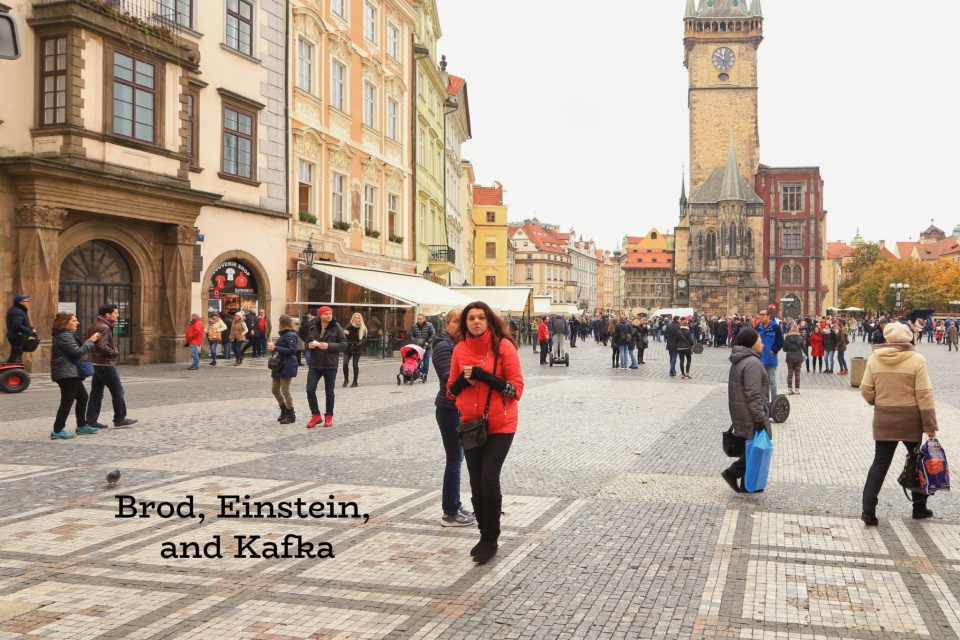
Albert Einstein, Franz Kafka, Max Brod, Dům U Kamenného beránka, At the stone lamb, Staromestske namesti, Old Town Square, Prague, Prag, Praha, Czech Republic, fotoeins.com

My Prague: Brod, Einstein, & Kafka at Fanta Salon

Above/featured: it’s as if I just pointed out a famous meeting place to her right (left for the reader).

Prague’s Old Town Square is one of the most visited landmarks, dominated by the two tall spires of the Church of our Lady before TĂ˝n, Old Town Hall, and a prominent sculpture dedicated to Czech icon Jan Hus at the centre of the square.

At the southeast corner of the square is a building called (DĹŻm) U KamennĂ©ho beránka or “At the Stone Lamb” at address StaromÄ›stskĂ© námesti 551/17 #. To the right of the building’s main entrance is a memorial plaque with an inscription in both Czech and English. The memorial plaque was created by Czech sculptor ZdenÄ•k KolářskĂ˝ and unveiled in 1998. Looking closer, you’ll recognize Albert Einstein’s face and his famous physics equation stating mass-energy equivalence and written in cursive script: E = mc2.

Over a 16-month period from 1911 to 1912, Albert Einstein lived in Prague with his family and was full professor of theoretical physics at the German Charles-Ferdinand University. Einstein enjoyed hanging out at a number of cafes for conversations, exchanges, and music, and he was a frequent visitor to this building where Czech liberal and intellectual Berta Fanta operated a literary-philosophical salon or lounge. The salon saw visits by many intellectuals, both domestic and international. “Domestic” writers Franz Kafka and Max Brod would have come here for the discourse as well, but it turns out little is actually known about whether all three arranged to meet or would have met here at the same time.

( Click here for images and more )

My Heidelberg: 40+ Highlights from Home

Above/featured: From Philosophenweg: across the Neckar, over the Altstadt, and up to Königstuhl – 21 May 2016 (HL).

Heidelberg is “eine adoptierte Heimatstadt” (an adopted hometown). Some have called this place “scenic, natural, and spectacular”; some call it “boring, provincial, and extortionate”. I could be referring to Vancouver, but that’s a subject for another time.

I’ve long struggled with questions of place: what defines “home”? Can those definitions and qualities change with time? Do people have choice(s) and do they apply their choices in their search? Can people find meaning with “home”? Must “home” be restricted to only one place, or can different needs be met from different places?

Images can provide access to memories of having lived in a new country, experiencing the shock of the new, and settling into the mundane. I remember advice someone once gave me which became constant companion and reminder: that I was inhabiting a place at the same latitude as my birthplace, 8000 km in distance and 9 time zones apart on the other side of the planet, a place that’s seen its compact share of activity with flair and impact.

Most recall is naturally connected to sight. Occasionally, it’s a rush of the senses: the quick breeze on the skin, the ankle-spraining undulations of the cobblestone, how fog clings like a cold clammy cloak, the sing-song of birds among tall trees in the forest on the hill, the smell of grilled sausages in town by day, and the satisfying late-night noms of a spicy Dürüm Döner with a cool Ayran. And other times, human history leaps out and buries its claws, when the unthinkable must be acknowledged and understood in a synapsis of memory and senses.

In the autumn of 2001, I moved to Germany and Heidelberg: both sight unseen and without having learned any of the language. I stayed in town for a little under two years. What’s astonishing is I have no pictorial record of my time in Heidelberg, Germany, and Europe: I had no camera before the dawn of the smart-phone.

I have some great memories, even if time is casting long shadows. What I lost (no, gave away) was some part of me that actually has little to do with the “Schlager” hit song “Ich hab mein Herz in Heidelberg verloren“. It might be a piece of the heart, a part of the soul, or simply a scrap of good sense; but what it is precisely still remains undefined and shapeless. Finding solid answers about what I’ve surrendered might take years. And so, for the sake of clarity, I’ve returned many times since leaving town in 2003. A sharper focus comes through the post-departure blur whenever I step off the train in town.

I couldn’t have possibly known the experience of moving to and living in Heidelberg would be life-changing. Time so far has been kind, because it didn’t take long for me to adopt Heidelberg as “home”.

( Click here for images and much more )