Fotoeins Fotografie

location bifurcation, place vs. home

Posts from the ‘Photography’ category

Links to photography blogs, information, sites

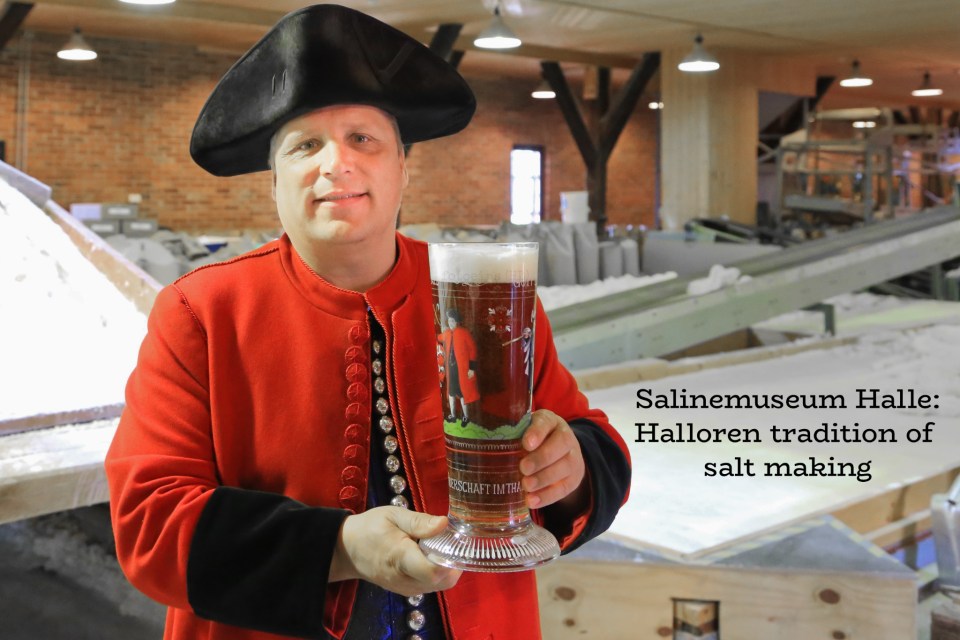
salt-making, Halloren- und Salinemuseum Halle, Halloren, Salinemuseum, Halle (Saale), Halle, Saxony-Anhalt, Sachsen-Anhalt, Germany, fotoeins.com

My Halle (Saale): Making White Gold Since 3000 BC

What do the following six towns and cities have in common?

  • Hall in Tirol, Austria
  • Hallein, Austria
  • Hallstatt, Austria
  • Schwäbisch Hall, Germany
  • Bad Reichenhall, Germany
  • Halle an der Saale, Germany

Hall, more than a large covered room

With “hall” in their names, all six towns listed above are historically associated with salt production1,2,3. The word “salt” is represented in Greek as hals and in Celtic (Brythonic) as hal. In pre-Roman Europe, the towns of Halle, Hallstatt, and Hallein were three centres for salt-evaporation4 which eventually became salt-making centres for the surrounding regions of Prussian Saxony, Salzkammergut, and Salzburg, respectively. Archaeological finds around Halle and along the Saale river5 uncovered evidence of heated brine (at Doläuer Heide) from the mid-neolithic age (about 3000 BCE) and briquetage ceramic vessels from the late-Bronze age (about 1000 BCE).

Mark Kurlansky wrote1: “… Salt is so common, so easy to obtain, and so inexpensive that we have forgotten that from the beginning of civilization until about 100 years ago, salt was one of the most sought after commodities in human history.

Once a rarity, salt was a unique additive to improve quality of food preparation and consumption. Food preservation with salt also became a critical measure for survival, but also for improving the quality of food preparation and consumption. Whoever controlled salt production, sales, and distribution held power, wealth, and prestige.

German sayings with salt:

•   “Freundschaft ist des Lebens Salz.” (Friendship is the salt of life.)
•   “Das Essen ist versalzen, du bist verliebt.” (The food is too salty; you must be in love.)

( Click here for images and more )

Göttingen: a circle of Nobel Prize winning scientists

What: Circular feature celebrating Nobel Prize winners, all of whom worked at the city’s university.
Where: Stadtfriedhof (city cemetery) in Göttingen.

Göttingen is a university town in central Germany. Not only will I find a memorial to Nobel Prizes, I’m here also to acknowledge my academic training. I spent many years studying physics and astronomy, and while I’m no longer active in science research, I enjoy the search and discovery of the final resting spots for scientists whose work formed a significant part of my education. Visiting their graves provides direct historical connection to “academic predecessors”; to go beyond the abstraction of simply learning their names and contributions to science, the gravestones belong to real people with keen minds, family lives, and all too human imperfections.

45 Nobel Prize laureates have been or are connected with the Georg-August-Universität Göttingen as of posting (2018). That’s a phenomenal number, as this single institution accounts for 8 per cent of all Nobel Prizes (585 as of 2017).


( Click here for images and more )

Freistaat Bayern, The Free State of Bavaria

Bavaria: 100 years of statehood (2018)

Featured image: The blue and white diamonds (fusils) are a familiar Bavarian symbol, adopted in the late 13th-century by the Wittelsbach family who ruled Bavaria from 1180 to 1918.

As a product of the coastal and mountainous Canadian Southwest, I always feel the pull exerted by the Bavarian Alps regardless of where I am in Germany; it’s been this way over the past 18 years. But there’s more to Bavaria than fairytale castles, Oktoberfest, and BMW, although they’re spot on for the Wurst (sausage). And frankly, there’s a ton more to Germany than Bavaria, but that’s one of many reasons for this entire blogsite after all.

Located in southeast Germany, Bavaria includes more than a half-dozen World Heritage Sites, the pre-Easter Fasching/Fastnacht festival, the sight of Audis on the Autobahn, over one thousand years of wine-making in Franconia, and violin-making since the late 17th-century, among many things to explore, eat, and experience.

( Click here for more )

17 for 17, Fotoeins Fotograms of 2017, fotoeins.com

17 for 17: Fotoeins Fotograms of 2017 (IG)

Featured: At the Germany-Austria border, from Fellhorn mountain near Oberstdorf: 8 March.

Another year gone, another 34-thousand images made*

As the image above shows, I also spent a lot of time this year at the Austrian-German frontier, much of it at altitude.

Below I look back at the year 2017 with a selection of 17 images. Each picture is a direct clickable link to the corresponding post on Instagram.

( Click here for more )

The Spheres, Amazon Spheres, 6th and Lenora, Amazon, Denny Regrade, Denny Triangle, Seattle, Washington, fotoeins.com

Seattle: curious glowing Amazon Spheres

Above: (A) The Spheres, northeast from 6th Avenue and Lenora Street (HL).

Glowing glass forms appear around the corner as if they’ve risen suddenly from the ground, eliciting odd looks and interested inquiries from passersby.

On Amazon’s urban campus at the feet of towers Day One and Doppler, The Spheres are located in downtown Seattle on Lenora Street between 6th Avenue and 7th Avenue. The futuristic structures provide a highly visible centre of attention for the electronic-commerce and -computing company. Three intersecting glass and steel half-spheres will contain a botanic garden to include exotic plants, waterfalls, and treehouses, and workspaces to further cultivate creativity by and collaboration among Amazon employees. The grand opening is scheduled for 18 January 2018.

The construction development projects are part of the joint efforts by NBBJ and Amazon to regenerate the Denny Regrade area with ample office space for the world headquarters of Amazon, and additional space for retail and public facilities.

The Spheres, Amazon Spheres, 7th and Lenora, Amazon, Denny Regrade, Denny Triangle, Seattle, Washington, fotoeins.com

(B) The Spheres, northwest from 7th and Lenora (HL).

Seattle Municipal Archives, item no. 4011

(C) Seattle Municipal Archives, item no. 4011.

Denny Hill was regraded and removed in multiple phases between 1898 and 1931. In the 1930 picture above (C), the 2017 Spheres in image (B) would be located to the right of the utility pole between the two cars in the foreground and the digging excavator in the background.


I made photos (A) and (B) above on 10 December 2017. This post appears on Fotoeins Fotografie at fotoeins.com as https://wp.me/p1BIdT-aVe.