Fotoeins Fotografie

location bifurcation, place vs. home

Posts from the ‘Expression’ category

Photography as personal expression

My Fuji X70: Portra Sunset (XTrans2 recipe)

Above/featured: Morning light in San Francisco’s Financial District. Photo, 29 Mar 2025.

The Fujifilm X70 mirrorless fixed-lens prime camera has added a lot to my approach to photography for projects in both domestic and international settings. To satisfy my curiosity about Fujifilm’s analog-film simulation (film-sim) recipes, I’ve provided examples of X70 images with the following recipes:

•   CineStill 800T
•   Ektachrome 100SW (saturated warm)
•   Fujichrome Slide
•   Kodachrome 64
•   Kodacolor
•   Kodak Color Negative
•   Kodak Platinum 200
•   Monochrome Red

What follows are images made with the “Portra Sunset” recipe, which Yon Pol describes in their YouTube video.

This recipe is for X-Trans II sensors and the built-in availability of “Classic Chrome”. The settings on my X70 are:

  • “Classic Chrome” built-in film-sim
  • Dynamic Range: DR200, but I’ve set this to DR400
  • Color: +2 (High)
  • Sharpness: -1 (Medium-Soft)
  • Highlight: -1 (Medium-Soft)
  • Shadow: -1 (Medium-Soft)
  • Noise Reduction: -2 (Low)
  • White Balance: Daylight; +3 Red, -5 Blue
  • ISO: Auto, up to 3200

I assigned this recipe for an “all-purpose or daytime” setting as 1 of the 7 camera’s custom presets. The following JPG images are “almost” straight-out-of-the-camera; only minor adjustments to brightness level and a crop to a predefined image size have been applied, with no corrections to colour, contrast, geometric distortion, or rotation.

Just like the Kodachrome 64 recipe, Portra Sunrise uses the Classic Chrome film-sim in-camera setting that produces accentuated reds and an overall orangey-flavour. Blues seem more “subdued”, until foreground objects are illuminated against a clear blue sky. There’s more “diffuse washout” when I point closer to the sun. I imagine I’d get similar results with the Standard Provia film-sim under a clear sky with higher dust- or smoke-content in the atmosphere.

( Click here for images )

10 years, to the place where I died

Seems like yesterday: ten years have disappeared in a flash. And yet, a hint of grief is as fresh, now as it was then.

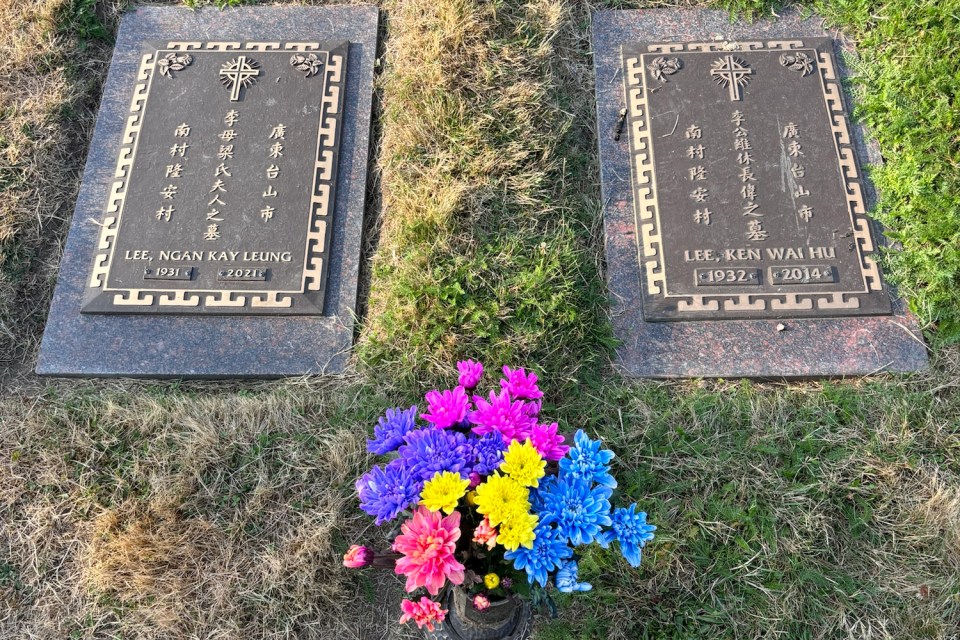
Before dawn, I swear I heard his voice calling out to me. The official pronouncement: 610am, 9 August 2014. Ken Lee, dead at 82. I was afraid I had already forgotten his voice.

Northern summer will always have an air of finality, tainted by memories of frailty and inevitability: entropy at its absolute finest.

One day, I’m on the well-travelled stretch between Mannheim and Cologne, fiddling between an online ticket for an express train and an online (Deutschland-) ticket for the next regional train.

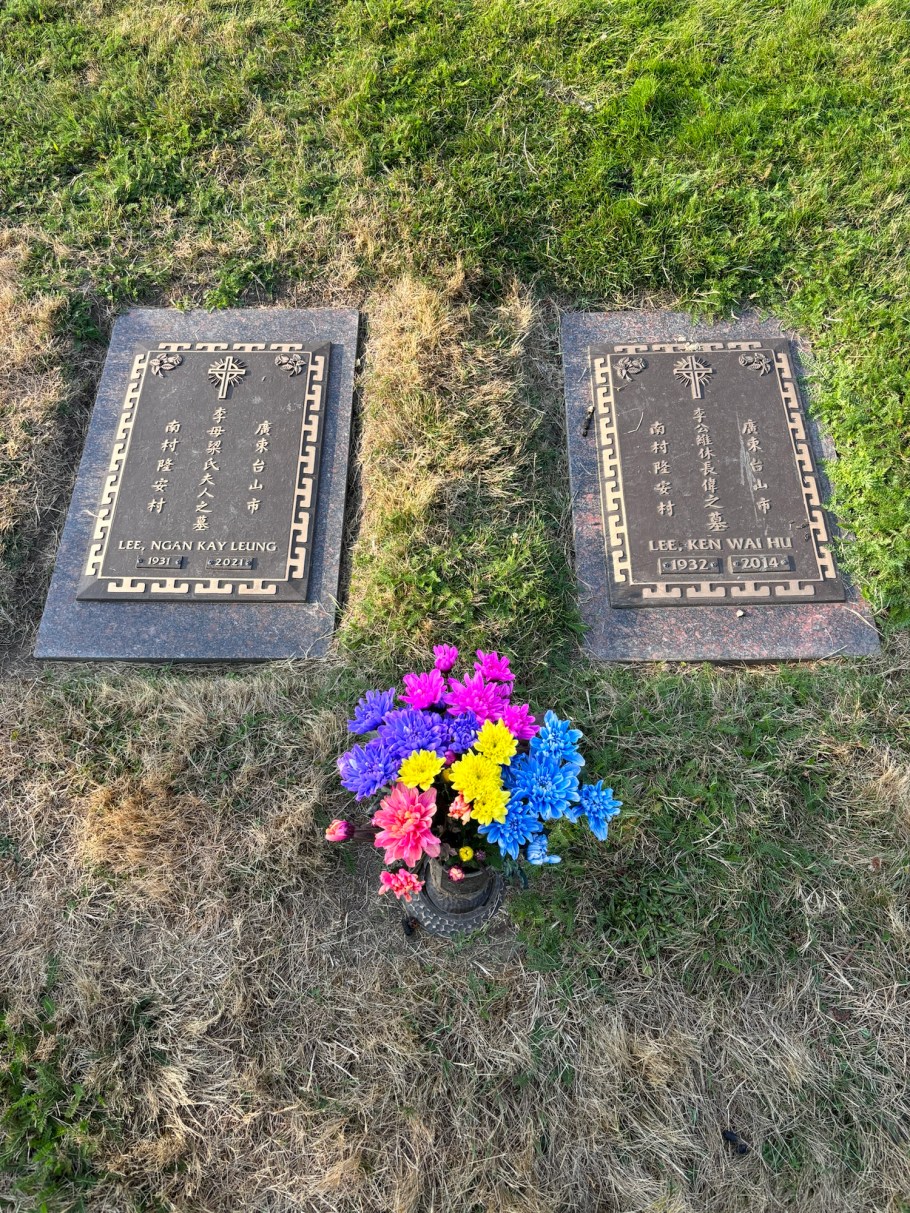
The next day, I’m in a Vancouver cemetery on a late Friday afternoon. I see only two to three other visitors out here. It is almost mid-August. Sun’s out, it’s almost 30C. Somewhere outside of this green patch of stone, metal, and flowers, life thrives and goes on. For me, I’ve come back to get “stuck”; I might as well be 8000 km away, back on the other side of the planet.
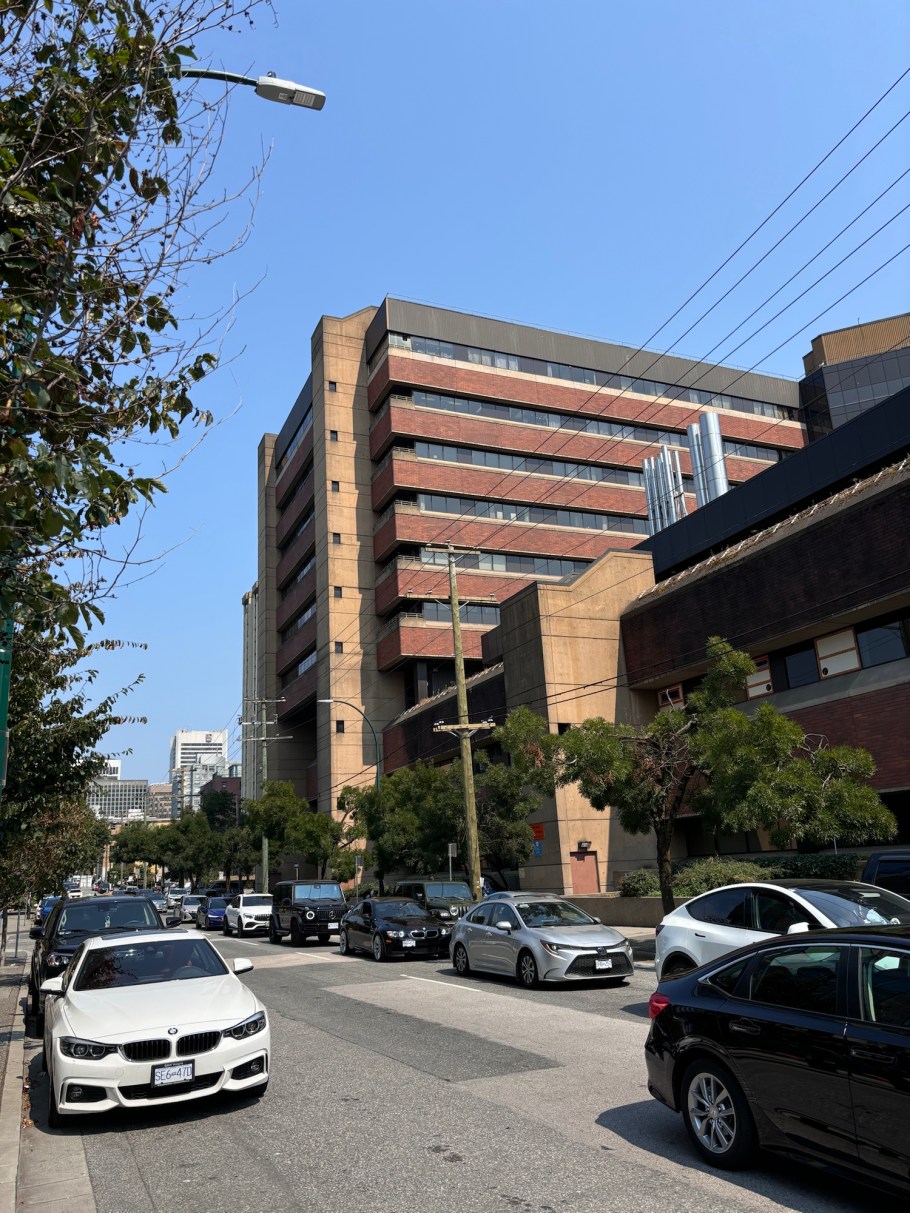

Up on the 10th floor is/was the palliative ward where Dad spent his final 2 weeks.
Ocean View Cemetery.
Hey, Mom and Dad: it’s me …

I made the photos above with an iPhone15 on 9 Aug 2024. This post composed with Jetpack for iOS appears on Fotoeins Fotografie at fotoeins DOT com.

My Vienna: Ludwig Boltzmann was here

The name is a large presence, particularly to many in science.

To others, the name might have little significance as any other name, like Helmut Grossuhrmacher. OK, I made that name up.

A name I didn’t make up is Ludwig Boltzmann, whose contributions to science are fundamental in an understanding of heat- or thermal-physics, thermodynamics, and statistical mechanics. After several years of undergraduate- and graduate-level physics, Boltzmann is one of many names imprinted into memory, firmly established in the left-side of my brain.


Boltzmann highlights

•   b/✵ 20 February 1844 – d/✟ 5 September 1906.
•   Born and raised in Vienna, Boltzmann enroled at age 19 in the University of Vienna to study mathematics and physics.
•   Supervised by Josef Stefan, Boltzmann completed his doctoral dissertation “Über die mechanische Bedeutung des zweiten Hauptsatzes der mechanischen Wärmetheorie” (On the mechanical significance of the 2nd Law of Thermodynamics) in 1866 at the age of 22.
•   1869–1873: University of Graz, with visits to Heidelberg and Berlin.
•   1873–1876: University of Vienna.
•   1876–1890: University of Graz.
•   1890–1894: (Ludwig Maximilian) University of Munich.
•   1894–1900: after Josef Stefan’s retirement, Boltzmann returns as professor of mathematics and physics at University of Vienna.
•   1900–1902: Leipzig University.
•   1902–1906: University of Vienna; he also teaches physics, mathematics, and philosophy.
•   Doctoral students Boltzmann supervised and advised included: Paul Ehrenfest, Lise Meitner, Stefan Meyer, Walther Nernst.
•   Speaking tour of the United States in 1905, including his stay that summer in Berkeley at the University of California. Evident from his trip report, Reise eines deutschen Professors ins Eldorado, is his sense of humour.

Time has been kind to Vienna, a city filled with notable personalities in arts, architecture, music, and science. Throughout its cemeteries, the city has assigned “graves of honour” (Ehrengrab) for many, including Boltzmann. Finding his final spot was one of many favourite moments in 2018. However, Boltzmann’s significance to the University of Vienna, to the physics world, and to time I spent in physics persuaded me to create a short (walking-)tour of Vienna to highlight some of his traces and memorialization in the city.


( Click here for more )

Nussberg, 19. Bezirk, Döbling, Wien, Vienna, Austria, Österreich, fotoeins.com

23 for 23: Foto(ein)s in 2023

Above/featured: Vienna’s green vineyards on Nussberg, with Kahlenberg at centre in the background. Photo, 14 Jun 2023.

A year in review typically provides coverage spanning a period of six months or more; the period doesn’t even have to be a continuous stretch. But in this case, my highlights come solely from a period of six weeks in May and June. All else pales by comparison.

All of the images presented below have been corrected for geometric distortion and rotation, with further adjustments to image-crop, brightness, contrast, highlights, shadows, clarity, sharpness, vibrance, saturation, and colour levels. These images are as always best viewed on screens larger than a miniscule mobile.


( Click here for images and more )

My Fuji X70: Kodak Color Negative (XTrans2 recipe)

Above/featured: Taunusanlage train station, Frankfurt am Main – 18 Jun 2023.

The Fujifilm X70 mirrorless fixed-lens prime camera has added a lot to my approach to photography for projects in domestic and international scope. To satisfy my curiosity about Fujifilm’s analog-film simulation (film-sim) recipes, I’ve provided examples of X70 images with the following recipes:

•   CineStill 800T
•   Ektachrome 100SW (saturated warm)
•   Fujichrome Slide
•   Kodachrome 64
•   Kodacolor
•   Kodak Platinum 200
•   Monochrome Red

Here I show images made with the “Kodak Color Negative” recipe, which Ritchie Roesch describes in Fuji X Weekly:

… The aesthetic that I was hoping to achieve with this recipe was Kodak Portra 400. I don’t believe that I succeeded in faithfully mimicking that (sometimes there’s a similarity); however, it does seem to produce a Kodak-like color negative film look, perhaps more like Ultramax, but not exactly that, either. Whatever it does or doesn’t resemble, I personally really like the aesthetic produced by this recipe …

The recipe is for X-Trans II sensors and the built-in availability of “Classic Chrome”. The settings on my X70 are:

  • “Classic Chrome” built-in film-sim
  • Dynamic Range: DR200
  • Color: +2 (High)
  • Sharpness: -1 (Medium-Soft)
  • Highlight: -2 (Soft)
  • Shadow: -1 (Medium-Soft)
  • Noise Reduction: -2 (Low)
  • White Balance: Incandescent; +6 Red, -7 Blue
  • ISO: Auto, up to 3200

I assigned this recipe for my “indoor” setting as 1 of the 7 camera’s custom presets, but the recipe’s versatility allowed for additional tests at outside locations. The following JPG images are “almost” straight-out-of-the-camera: only minor adjustments to brightness level and a crop to a predefined image size have been applied, with no corrections to colour, contrast, geometric distortion, or rotation. The blue (“cool”) colour-cast is very real, which is especially evident on images made outdoors under sunny conditions.

( Click here for images )