Fotoeins Fotografie

location bifurcation, place vs. home

Posts from the ‘New Zealand’ category

Aotearoa Landscapes

Featured: Aotearoa: “land of the long white cloud.” Marlborough Region from Cook Strait: photo by Krzysztof Golik, Wiki CC.

  • Landscape (noun), definition: visible features of an area of land, often considered in terms of aesthetic appeal.
  • Māori: “mano whenua“, heartland or interior of the country
  • Chinese: 景色
  • German: die Landschaft
  • Spanish: el paisaje

As part of my year-long around-the-world journey in 2012, I spent most of July in New Zealand (Aotearoa). The following 12 landscape images provide another perspective about how I feel about non-urban settings. I’ve had some say about urban cityscapes, but I’ll be the person to stop every few kilometres for every possible vista. The following images from the North Island (Te Ika a Māui) and South Island (Te Waipounamu) are reminders of my desire to return to Aotearoa.

New Zealand’s national day, Waitangi Day, is observed annually on 6 February.


( Click here for images and more )

Kea, alpine parrot, Homer Tunnel, Milford Road, South Island, Te Waipounamu, Aotearoa, New Zealand, fotoeins.com

Waitangi Day (6 Feb): 15 images from Aotearoa

Above/featured: The kea is the world’s only alpine parrot and on the endangered list; on Milford Road near Homer Tunnel.

On the 6th of February, I’ll be humming “E Ihowa Atua” and “Pokarekare Ana”.

Waitangi Day is a national holiday in New Zealand to commemorate the signing of the Treaty of Waitangi on 6 February 1840. As the founding document of the country, the Treaty of Waitangi (Te Tiriti o Waitangi) is an accord agreed upon by representatives of the Crown (British Empire) and of indigenous Māori iwi (tribes) and hapū (sub-tribes). The agreement is named after the name of the location in the Bay of Islands where the Treaty was first signed. Despite continuing disagreements between the two parties about contemporary extent and redress, I think the conversation and interactions between the communities are at a more advanced stage of integration within the nation’s fabric by comparison with Australia and Canada.

For Aotearoa, the New Zealand government approved in October 2013 formal names of the two main islands in Māori and English:

•   Te Ika a Māui (“the fish of Māui”) for the North Island, and
•   Te Wai Pounamu (“the waters of greenstone”) for the South Island.

I highlight Aotearoa with 15 images of the following locations:

  1. Akaroa
  2. Auckland
  3. Dunedin
  4. Franz Josef Glacier *
  5. Greymouth
  6. Hapuku (Seaward Kaikouras)
  7. Homer Tunnel *
  8. Lake Matheson *
  9. Milford Sound *
  10. Queen Charlotte Sound
  11. Queenstown
  12. Southern Alps *
  13. Waimakariri River
  14. Wellington City
  15. Wellington Harbour

Asterisks identify locations within the Te Wāhipounamu area in South West New Zealand which was inscribed in 1990 as UNESCO World Heritage Site that includes four national parks: Aoraki/Mount Cook, Fiordland, Mount Aspiring, and Westland Tai Poutini.

( Click here for images and more )

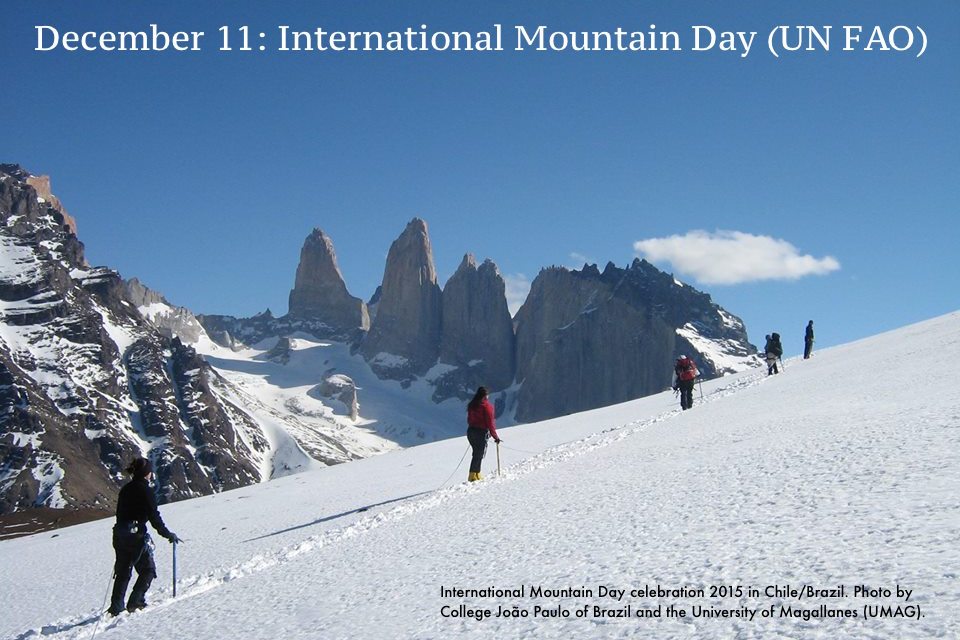
UN FAO International Mountain Day. International Mountain Day celebration 2015 in Chile/Brazil: photo by College João Paulo of Brazil and the University of Magallanes (UMAG).

11 December: International Mountain Day

Since 2003, December 11 is International Mountain Day as designated by the United Nations General Assembly. Annually, the Food and Agriculture Organization of the United Nations (FAO) observes the day:

… to create awareness about the importance of mountains to life, to highlight the opportunities and constraints in mountain development and to build alliances that will bring positive change to mountain peoples and environments around the world.

•   Mountains cover almost one-quarter (22 percent) of the Earth’s surface.
•   Mountains host about 50 percent of the world’s biodiversity hotspots.
•   Up to 80 percent of the world’s freshwater supply comes from mountains.
•   One in eight people (13 percent) around the world lives in the mountains.
•   Mountain tourism accounts for almost 20 percent of the worldwide tourism industry.

The following provides a glimpse to the mountain environments around the world and to the challenging conditions our ancestors would have faced and endured.


( Click here for images and more )

Fraser River, Port Mann Bridge, Coquitlam, Port Coquitlam, BC, Canada, fotoeins.com

World Rivers Day: 50+ rivers from around the world

Above: Fraser River, east from Port Mann Bridge, between Coquitlam and Surrey, BC (HL).

The fourth Sunday in September is World Rivers Day. The University of Oxford’s Dictionaries defines ‘river‘ as:

“a large natural stream of water flowing in a channel to the sea, a lake, or another river.”

A river has always been water supply and demand: daily use and consumption; farming and agriculture; and where the waste goes, often back into the same supply. A river has always been about transport: trade and delivery of goods; shuttling people between places; and with people travelling, the exchange of language and culture. Throughout history, the establishment of towns and cities and the subsequent development of rivers have been about a mix of urban and rural elements, and about the relationship and interactions between people and their waterways.


( Click here for images and more )