Fotoeins Fotografie

location bifurcation, place vs. home

Posts from the ‘Arts’ category

Spinnerei, Leipzig, Sachsen, Saxony, Germany, fotoeins.com

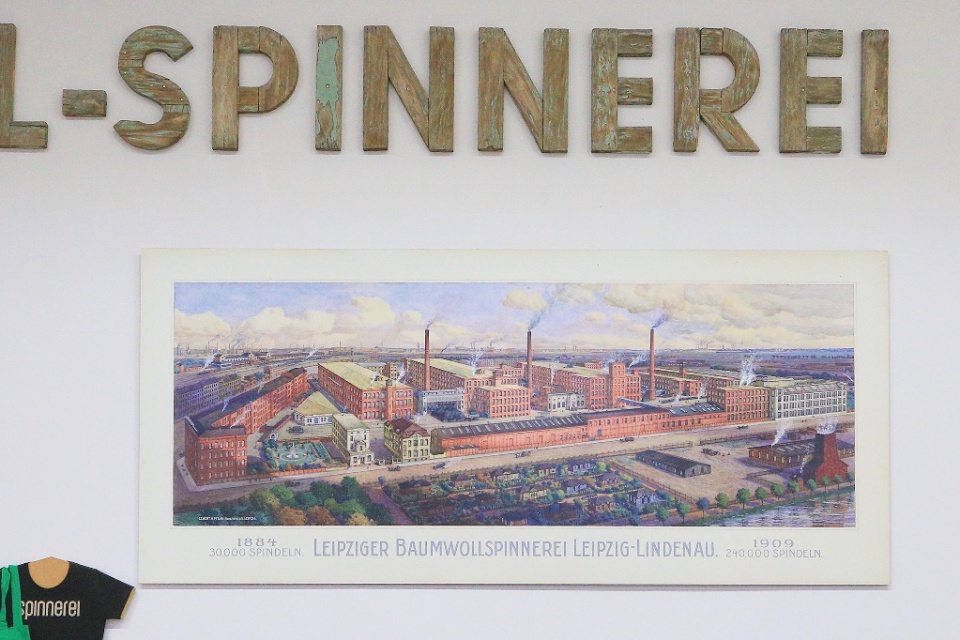
Leipzig Spinnerei: from cotton mill to arts centre

The Leipzig Spinnerei is a former cotton mill (Baumwollspinnerei) in the western industrial suburb of Plagwitz. The massive site at an area of 10 hectares (over 1 million square feet) with rows of factory buildings began operation in 1884 and eventually became the largest cotton mill in Europe with thousands working and living on-site. After the site ceased to produce spools of cotton thread shortly after reunification, artists took advantage of the cheap empty space, and transformed the area into studios, galleries, and exhibition halls. Much has been written about the impact and examples of art and space on Leipzig as the “new Berlin” as well as the “New Leipzig School.” The site as art and culture space opened its doors in 2005.

( Click here for images and more )

Karlsruhe: Fächerstadt (fan-shaped city) in Baden-Württemberg

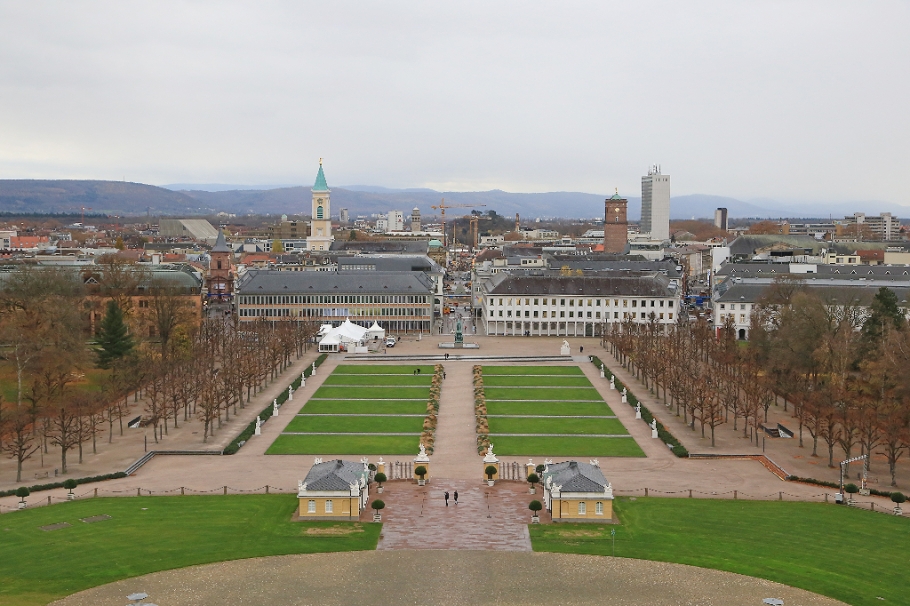
Above/featured: Karlsruhe Palace.

You won’t likely find another German city in the shape of a fan.

Sitting pretty near the Rhine river in southwest Germany, Karlsruhe is known as the “Fächerstadt” (“fan city”) for its very specific shape.

On 17 June 1715, Margrave1 Karl Wilhelm (Charles William) of Baden-Durlach celebrated breaking ground and the first laid stone for his new residence, palace, and seat of power. The story goes that after a vivid dream, Karl Wilhelm decided to build his new home of “rest and relaxation” (“Karls Ruhe”) in the middle of a nearby forest. A planned city would surround the palace, an appropriate symbol for the question of “who ruled whom.” The palace sat at the central hub of 32 “rays” or streets radiating outwards: 9 streets to make up the new city, and 23 for the palace gardens. Emerging from the palace was the “Via Triumphalis,” the north-south central axis road into the city. Karl Wilhelm moved the margraviate seat from nearby Durlach to the “new shiny city” of Karlsruhe upon completion of the new palace in 1718.

In the spring of 1788, Thomas Jefferson, while serving as America’s chief of mission (Minister Plenipotentiary) in France, embarked on a tour of Holland and the Rhine river in what is now Germany. He stayed in “Carlsruh”2 on 15 and 16 April 1788. Impressed by what he saw throughout his trip, he sent a letter and sketches3 to Pierre Charles L’Enfant4 who was charged by George Washington with the design and construction of a new American capital city. Jefferson wrote to L’Enfant on 10 April 1791:

“…in compliance with your request I have examined my papers and found the plans of Frankfort on the Mayne, Carlsruhe, Amsterdam Strasburg, Paris, Orleans, Bordeaux, Lyons, Montpelier, Marseilles, Turin and Milan, which I send in a roll by this post. They are on large and accurate scales, having been procured by me while in those respective cities myself. …”

With copies of European city plans in hand, these plans provided inspiration for L’Enfant’s eventual design for Washington, DC.

The Badisches Landesmuseum has occupied the palace since 1921, and the city of Karlsruhe celebrated its 300th anniversary5 in 2015.


What would Thomas Jefferson have seen?

Dated between 1739 and 1779, the following four maps from Stadt Karlsruhe city archives would have been representative of the young city at the time of Thomas Jefferson’s 1788 visit.
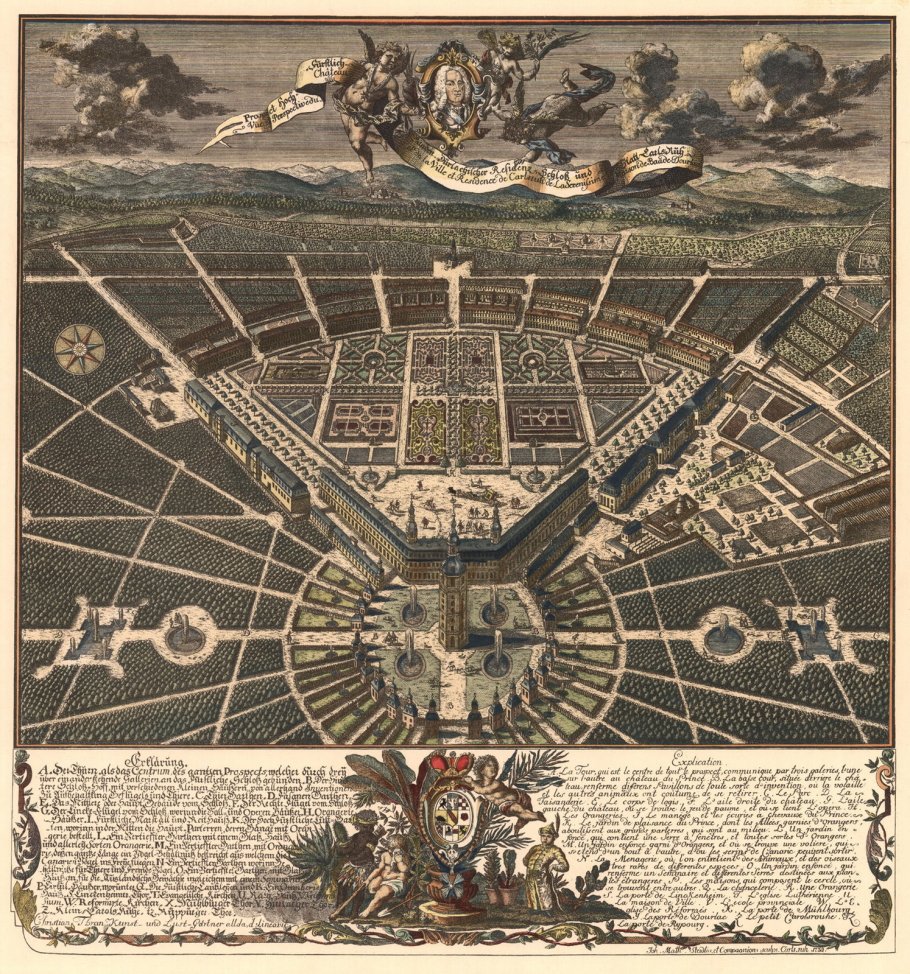
Historische Stadtpläne, Bilderbogen, Stadt Karlsruhe

1739 city view with south at top; coloured copper engraving by Christian Thran.

Historische Stadtpläne, Bilderbogen, Stadt Karlsruhe

1739 city view with north at top; the “fan” consists of 9 streets; coloured copper engraving by Christian Thran.
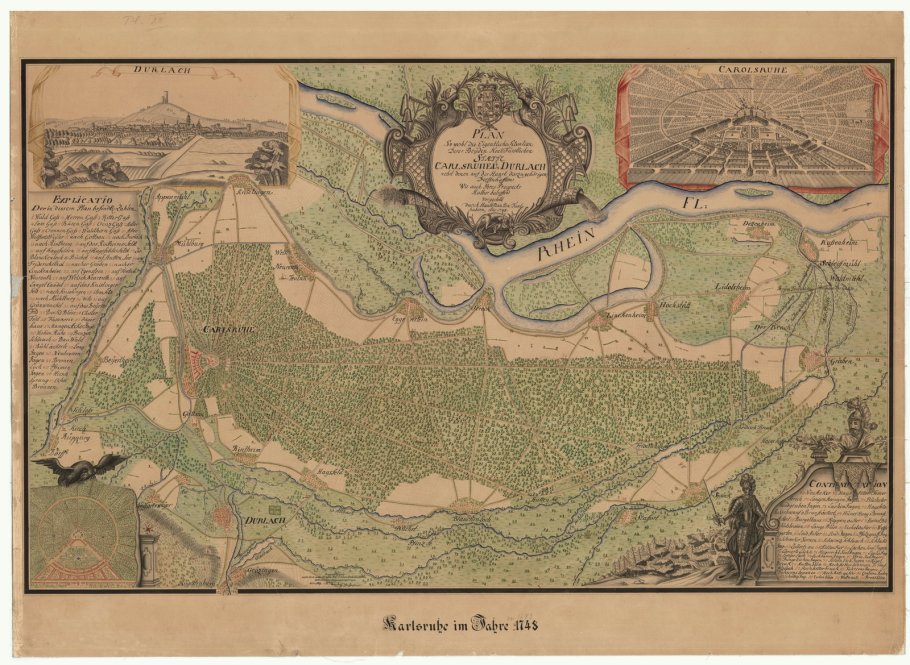
Historische Stadtpläne, Bilderbogen, Stadt Karlsruhe

Map dated 1745 of “Carlsruhe” (Karlsruhe), Durlach, and surroundings, with west at top, towards the Rhine river (Rhein Fl.).
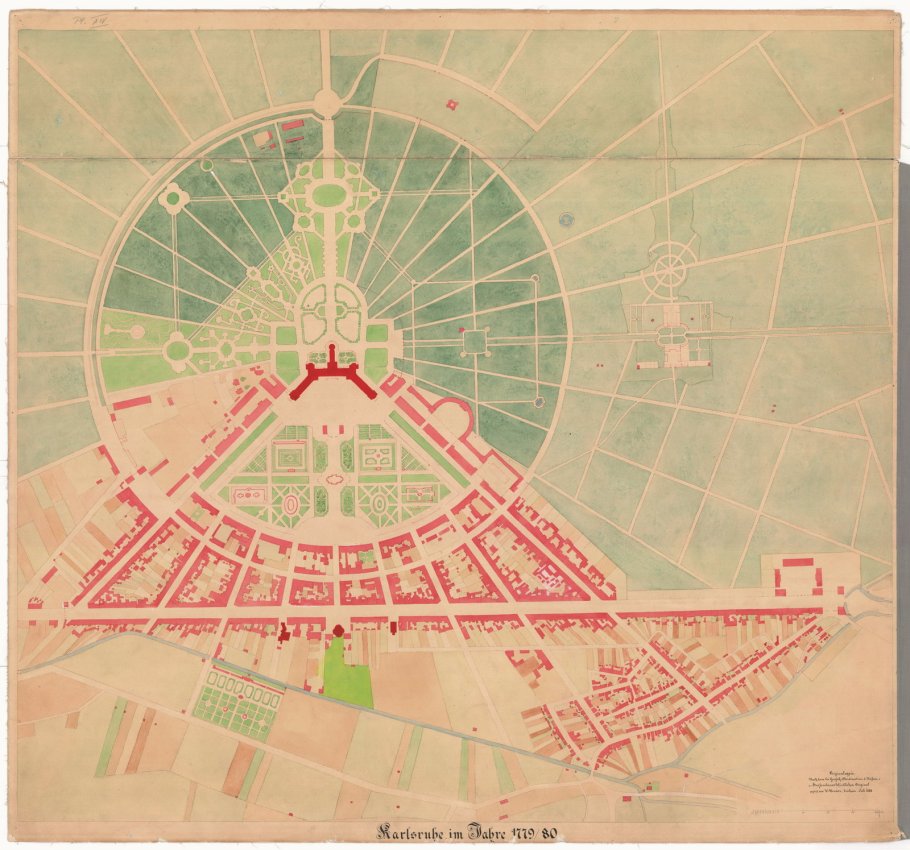
Historische Stadtpläne, Bilderbogen, Stadt Karlsruhe

1779 city map: north at top, Schloss (palace) at circle’s centre. Note how palace “wings” extend south into a “fan” of 9 streets into the young city.


Panorama from the Palace Tower

Even in the dreary days of late-fall and early-winter, there are sweeping views of the city and surrounding area from the top of the Schlossturm (Palace Tower); even the tower’s stairs are themselves a highlight of geometry. It’s also important to realize 14 kilometres to the German-French border isn’t far at all.

Schloss Karlsruhe, Badisches Landesmuseum, Karlsruhe, Baden-Württemberg, Germany, fotoeins.com

Up the palace tower (HL).

City view, Schlossturm, Schloss Karlsruhe, Karlsruhe, Baden-Wuerttemberg, Germany, fotoeins.com

South view, along Via Triumphalis through Schlossplatz (palace square). The hills in the background are about 10 kilometres distant (HL).
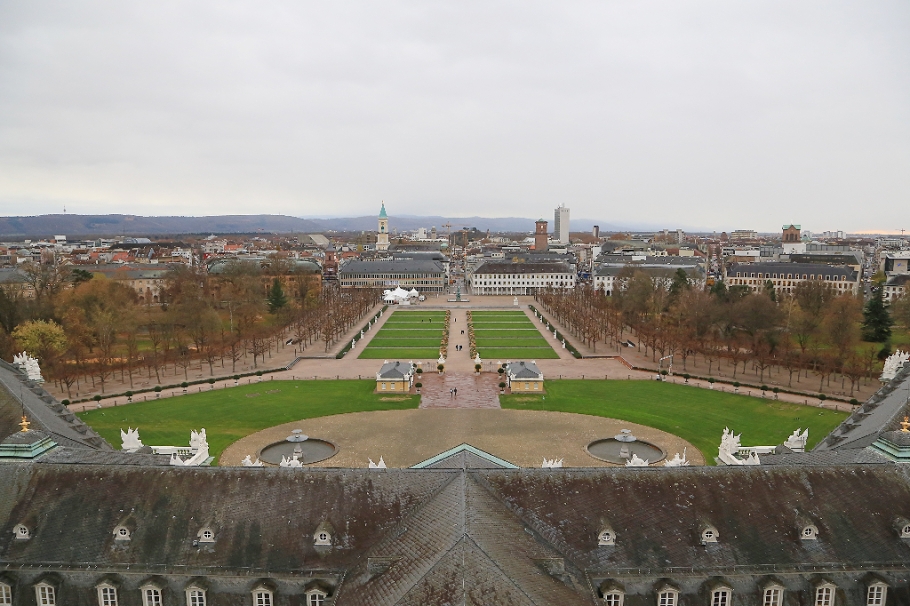
City view, Schlossturm, Schloss Karlsruhe, Karlsruhe, Baden-Wuerttemberg, Germany, fotoeins.com

Wide south view with the Via Triumphalis north-south axis at centre. Note palace “wings” at far-left and -right, making the “fan” into the city (HL).
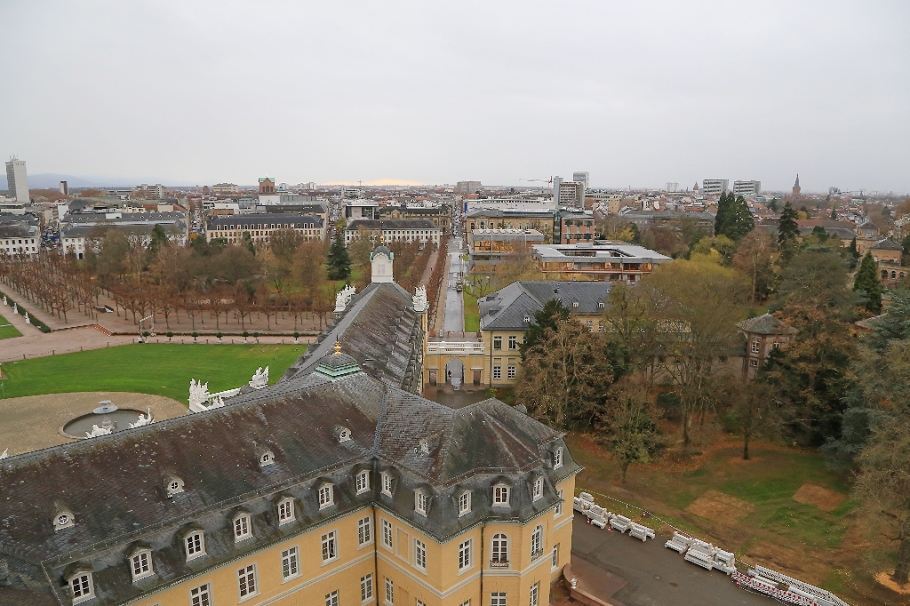
City view, Schlossturm, Schloss Karlsruhe, Karlsruhe, Baden-Wuerttemberg, Germany, fotoeins.com

Southwest, to Bundesverfassungsgericht (Federal Constitutional Court) at centre-right, just beyond the palace (HL).
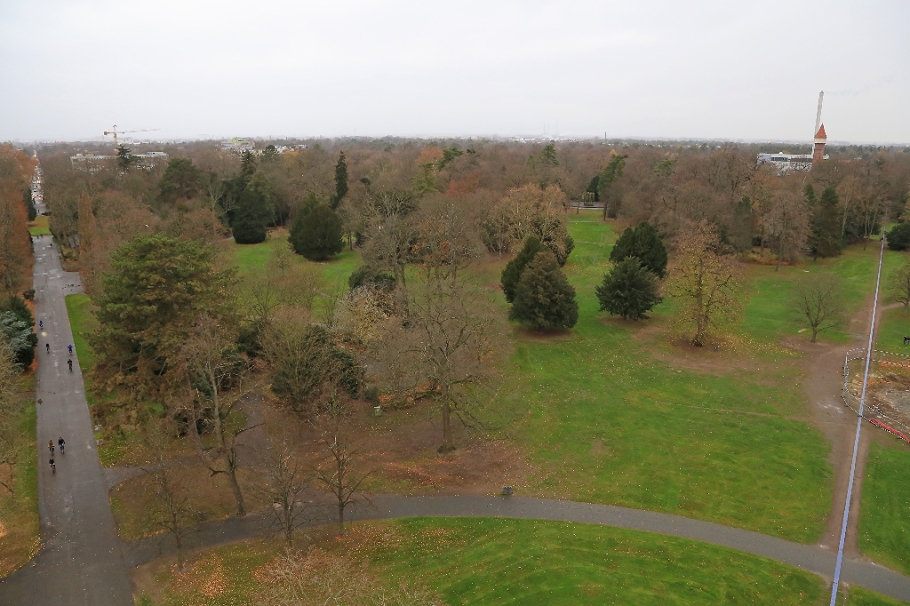
City view, Schlossturm, Schloss Karlsruhe, Karlsruhe, Baden-Wuerttemberg, Germany, fotoeins.com

Northwest, towards Majolika Manufaktur Karlsruhe at upper right (HL).
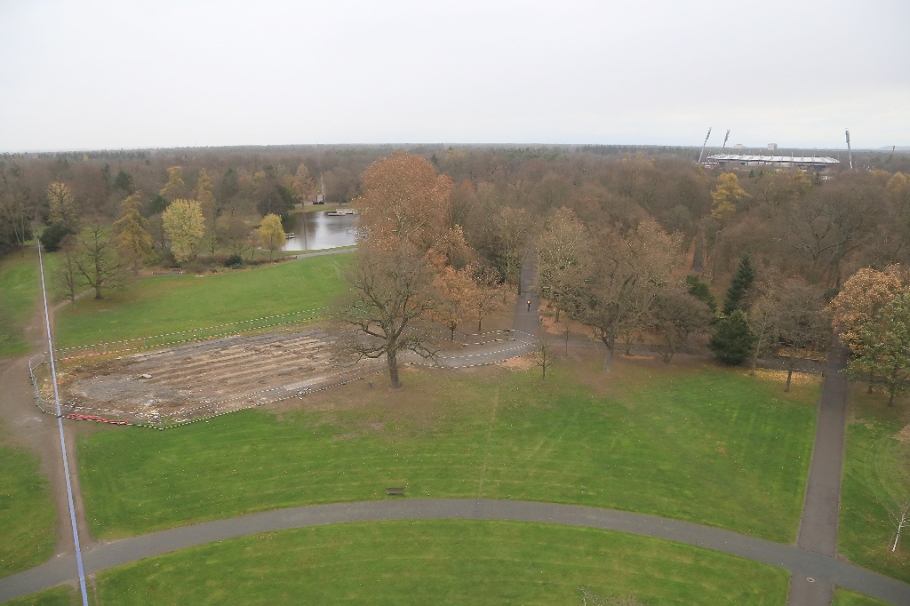
City view, Schlossturm, Schloss Karlsruhe, Karlsruhe, Baden-Wuerttemberg, Germany, fotoeins.com

North-northeast to Schlossgartensee (palace garden lake) at centre-left and Wildparkstadion (stadium) at right (HL).
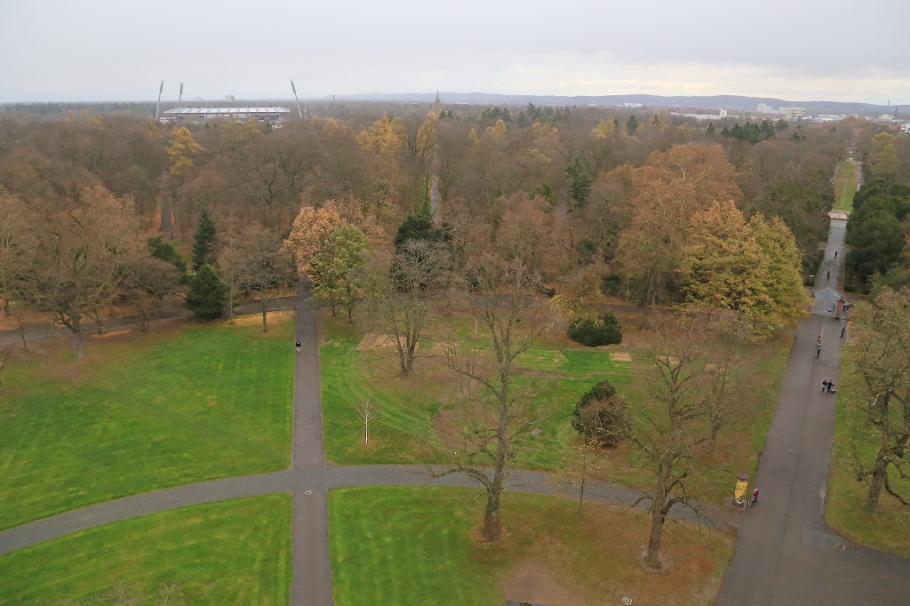
City view, Schlossturm, Schloss Karlsruhe, Karlsruhe, Baden-Wuerttemberg, Germany, fotoeins.com

Northeast: Wildstadion at left, Grossherzogliche Grabkapelle at centre in the distance (HL).
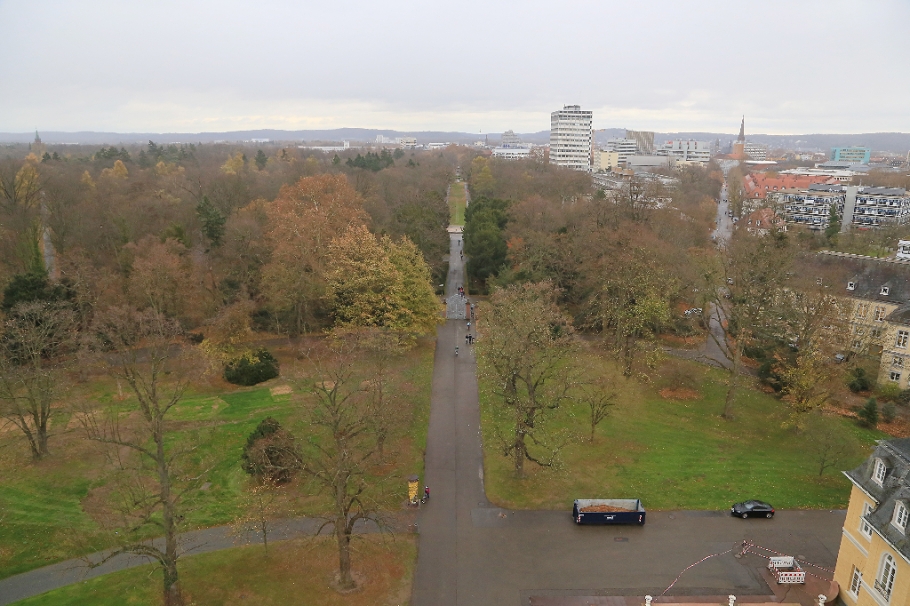
City view, Schlossturm, Schloss Karlsruhe, Karlsruhe, Baden-Wuerttemberg, Germany, fotoeins.com

Facing east; Grossherzogliche Grabkapelle at far left in the distance, Kirche St. Bernhard at right to the southeast (HL).

City view, Schlossturm, Schloss Karlsruhe, Karlsruhe, Baden-Wuerttemberg, Germany, fotoeins.com

Facing southeast; Kirche St. Bernhard at left, and beyond Schlossplatz at centre is Karlsruhe Institute of Technology (KIT) Campus Süd (HL)

City view, Schlossturm, Schloss Karlsruhe, Karlsruhe, Baden-Wuerttemberg, Germany, fotoeins.com

Return to the south-facing view of Schlossplatz, or palace square (HL).
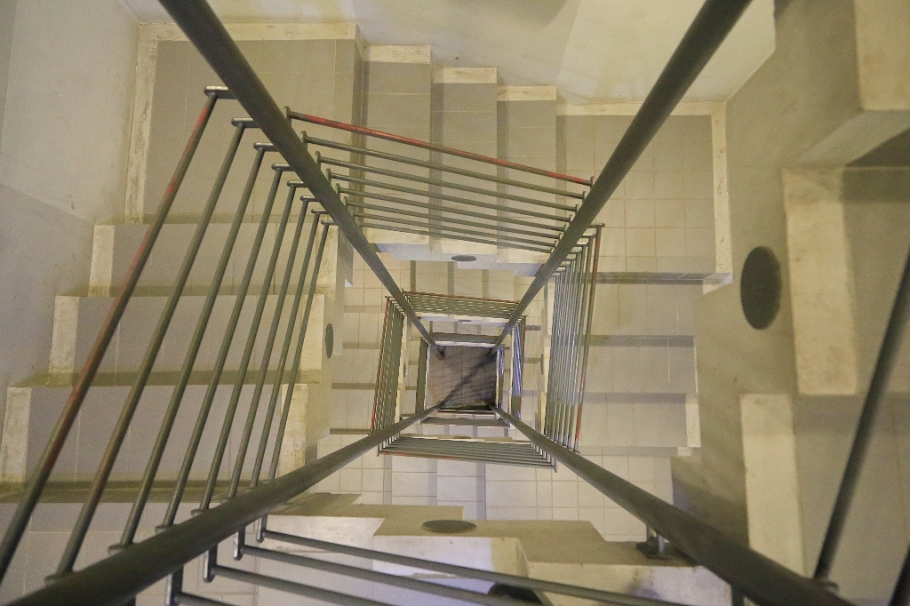
Schloss Karlsruhe, Badisches Landesmuseum, Karlsruhe, Baden-Württemberg, Germany, fotoeins.com

Down the palace tower (HL).


Notes

1 A “margrave” was a hereditary title for a prince in the Holy Roman Empire; their territory was called a “margraviate” (Markgrafschaft). Margraviate Baden-Durlach and neighbouring Margraviate Baden-Baden reunited in 1771 to form the Margraviate of Baden. After dissolution of the Holy Roman Empire in 1806, the Grand Duchy of Baden was created as a member state within Napoleon’s Confederation of the Rhine.

2 “Notes of a Tour through Holland and the Rhine Valley, 3 March–23 April 1788,” Founders Online, National Archives, http://founders.archives.gov/documents/Jefferson/01-13-02-0003. [Original source: The Papers of Thomas Jefferson, vol. 13, March–7 October 1788, ed. Julian P. Boyd. Princeton: Princeton University Press, 1956, pp. 8–36.]

3 “XII. Thomas Jefferson to Pierre Charles L’Enfant, 10 April 1791,” Founders Online, National Archives, http://founders.archives.gov/documents/Jefferson/01-20-02-0001-0015. [Original source: The Papers of Thomas Jefferson, vol. 20, 1 April–4 August 1791, ed. Julian P. Boyd. Princeton: Princeton University Press, 1982, pp. 86–87.]

4 More about Pierre Charles L’Enfant appears at the US Library of Congress.

5 Wulf Rüskamp wrote this article for the Badische Zeitung (in German).

Thanks to Karlsruhe Tourismus and Hotel Rio Karlsruhe for a warm welcome and access to venues and services. Old city maps are from Stadt Karlsruhe’s archives. I made all remaining photographs on 17 November 2015 with a Canon EOS6D mark1. This post appears on Fotoeins Fotografie at fotoeins DOT com as http://wp.me/p1BIdT-8Cv.

Ballet BC, Program 3, BalletBC30three, Queen Elizabeth Theatre, Vancouver, BC, Canada, fotoeins.com

Ballet BC season 30: Program 3 preview (2016)

I’ve learned over time to recognize key moments when special things are happening. I’ve been fortunate to arrive at situations where I’m swimming large and I’m intersecting spatial timelines with other people who’re immensely blessed with talent, who’ve trained long and hard, and who’ve shone brilliantly under the spotlight. Within that convergence, I see what it’s like, that shimmer of a blinding spark, a clear glimpse into a universe of creative expression. The rigours and precision of classic ballet are combined with the hypnotic rhythms of contemporary dance: something new is created, boundaries are pushed, and people’s eyes are opened to a brand new world under a different light.


( Click here for more )

Dresden Semperoper: outside by day, inside at night

When I lived in Germany, I remembered the ads for Radeberger Pilsner, and I wondered about some of the venues shown. I realized the buildings were in the famous city of Dresden on the Elbe river in southeast Germany, and the city of Radeberg was only 15 kilometres from Dresden. Images of the Dresden’s landmarks have been an important part of Radeberger brewery’s advertising campaign to show the beer’s exceptional quality and to associate that very same quality by (physical) proximity with the symbolism of Dresden’s historic landmarks.

Dresdner Wahrzeichen (Dresden Landmark)

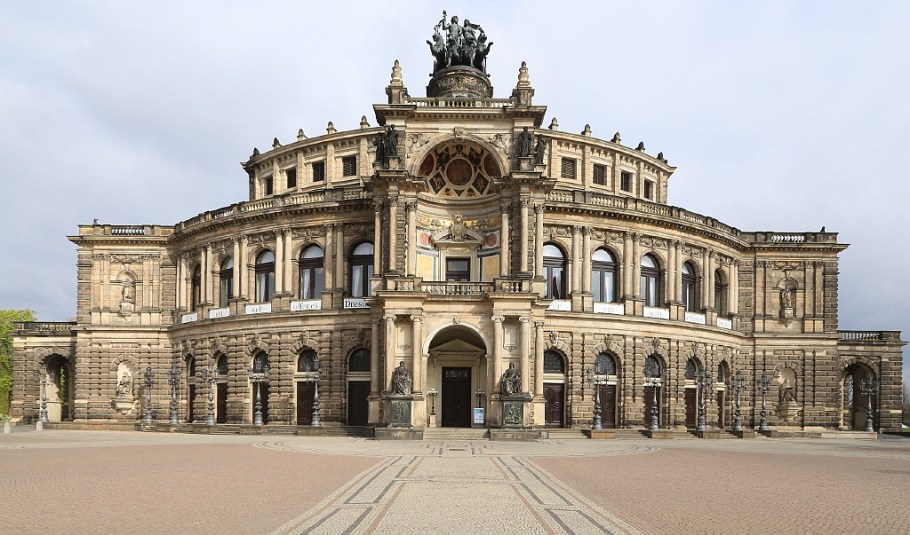
As one of the city’s most well-known landmarks, the Semperoper (Semper Opera House) appears in countless images representing Dresden. The Semperoper is the showpiece structure at Theaterplatz (Theater Square) looking over the river Elbe in the city’s Altstadt (Old Town). The first version of the building opened in 1841 with the design provided by Gottfried Semper. After destruction by fire in 1869, the second version of the building, also to Semper’s design, was completed in 1878. Only the Semperoper’s outer facade remained in 1945 during the final stages of the Second World War. Built once again to Semper’s original designs, the third and present version of the Semperoper opened to great acclaim on 13 February 1985. The interiors were reconstructed according to original plans and designs, whereas stage machinery and technical and engineering requirements are all updated to the best standards in audio quality.

With the leading title “Sächsische Staatstheater-Staatsoper und Staatsschauspiel Dresden”, the opera house is home to the Saxon State Opera, the Saxon State Theatre, the Semperoper Ballet, and one of the world’s oldest orchestras, the Staatskapelle Dresden, founded by Prince Elector Moritz von Sachsen in 1548.

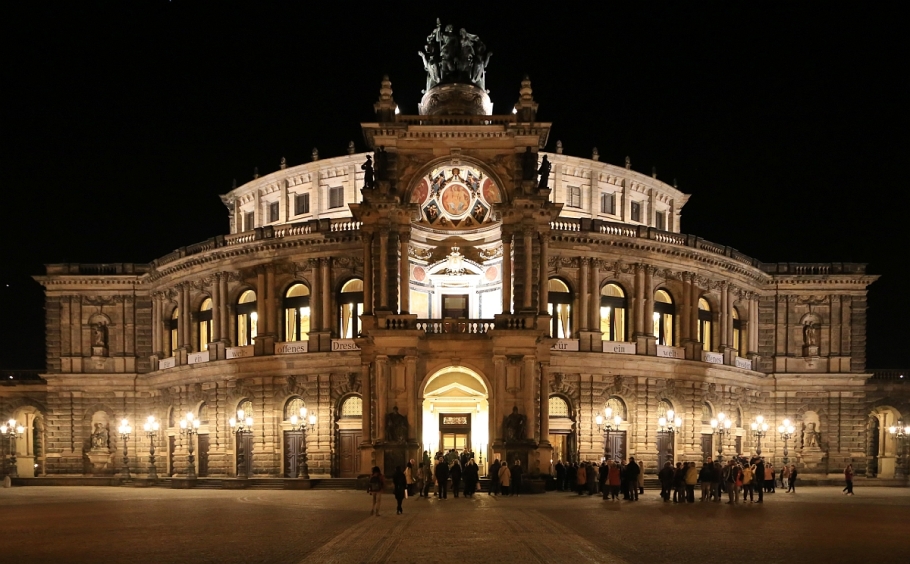
The Semper Oper is a natural part of any walking tour of Dresden, as Theaterplatz is minutes from the Zwinger, Residenzschloss, and the Frauenkirche. I’m awed by the night tour, a chance to see up close the building’s Baroque style exterior and the classic ornate interior. Everybody speaks in calm hushed voices, the unspoken agreement to be mindful and respectful of this venue. Despite the presence of other people in other tour groups, it feels like I have the Opera House to myself at 11pm.


Semper Oper, Theaterplatz, Dresden, Sachsen, Germany, fotoeins.com

Classic shot of the front by day

Semper Oper, Theaterplatz, Dresden, Sachsen, Germany, fotoeins.com

Classic shot of the front at night; also featured on the “night watch”

Semper Oper, Theaterplatz, Dresden, Sachsen, Germany, fotoeins.com

Ceiling mural

Semper Oper, Theaterplatz, Dresden, Sachsen, Germany, fotoeins.com

Some columns real marble (cool to touch); some faux-marble plaster (warm to touch). Full replacements were too expensive for the GDR/DDR at the time

Semper Oper, Theaterplatz, Dresden, Sachsen, Germany, fotoeins.com

S. Kurpiers, one of the stage managers and our guide for the evening

Semper Oper, Theaterplatz, Dresden, Sachsen, Germany, fotoeins.com

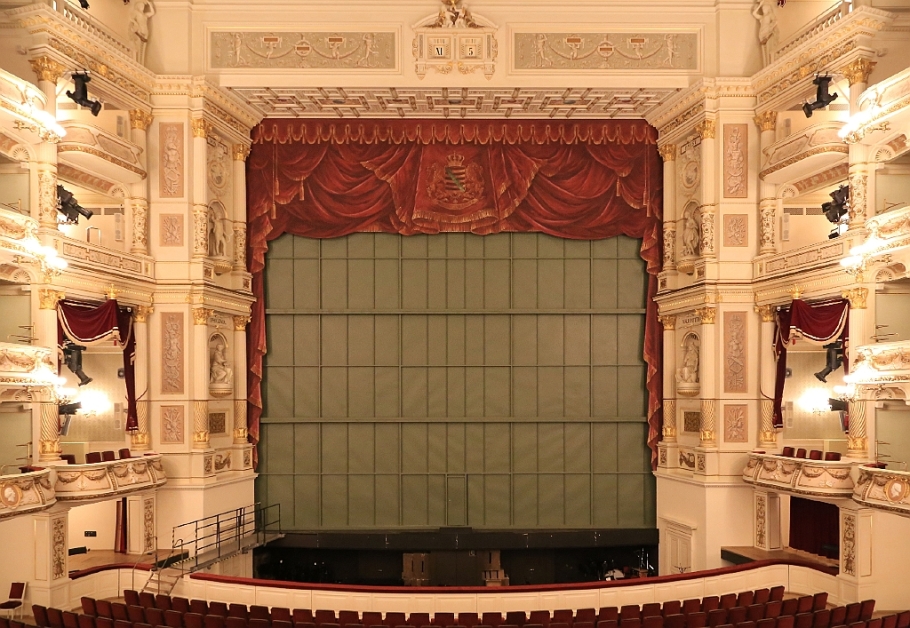
Main stage & orchestra, from central box section in the 1st balcony (Loge, 1. Rang). Clock at top-centre reads “XI 5”, or 1105pm

Semper Oper, Theaterplatz, Dresden, Sachsen, Germany, fotoeins.com

“Box” seats normally reserved for representatives and guests of the German federal state of Saxony

Semper Oper, Theaterplatz, Dresden, Sachsen, Germany, fotoeins.com

Separate guided tour to our left; there are 4 balconies

Semper Oper, Theaterplatz, Dresden, Sachsen, Germany, fotoeins.com

Another tour to the right

Semper Oper, Theaterplatz, Dresden, Sachsen, Germany, fotoeins.com

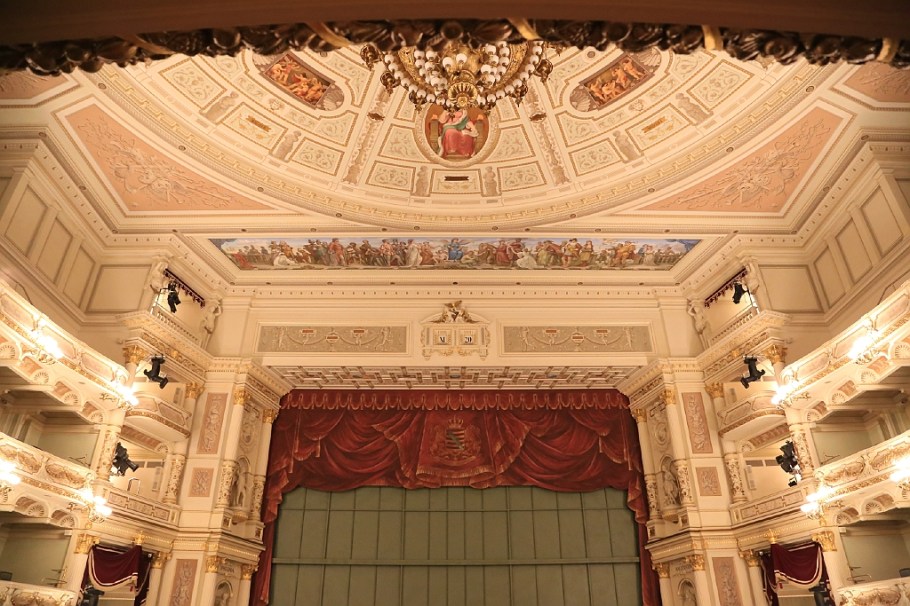
Looking up; lip of the 2nd balcony appears at top

Semper Oper, Theaterplatz, Dresden, Sachsen, Germany, fotoeins.com

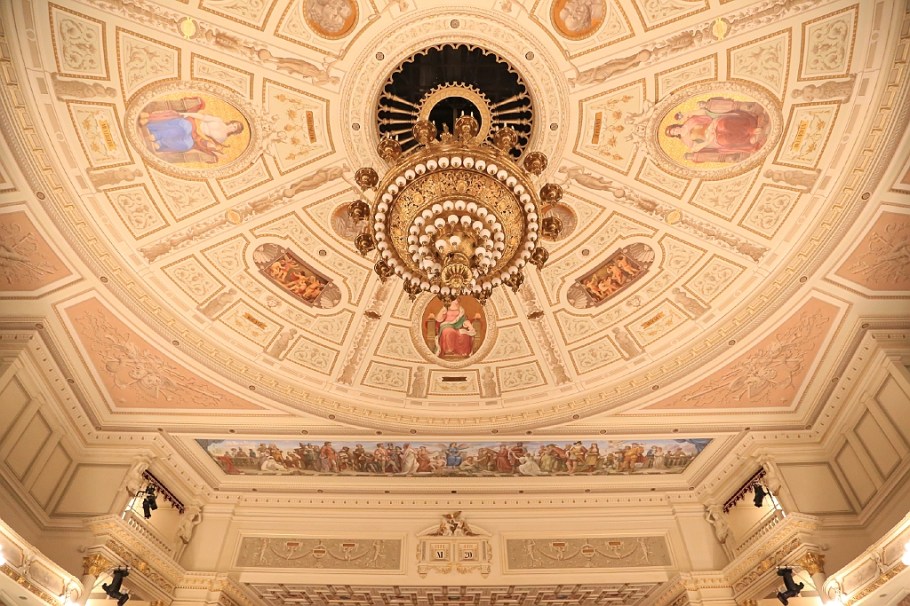
Massive central chandelier light-fixture overhead; clock reads “XI 20” (1120pm)


More

DresdenSaxony TourismDW, architecture

Thanks to Semperoper for opening their facility to the public at night, and thanks to S. Kurpiers who kindly guided our tour of the venue. Thanks also to Germany Tourism, Saxony Tourism, and Dresden Tourism for their support and hospitality. I made all of the photos above on 22 April 2015 with the Canon EOS6D. This post appears on Fotoeins Fotopress at fotoeins.com as http://wp.me/p1BIdT-7sx.

The following is an advertisement for Radeberger brewery from 2014. The advert for their Pilsener ends with an image of Dresden’s Semper Oper at night and the slogan “schon immer besonders” (always special).

Magdeburger Dom: oldest Gothic cathedral in Germany

As the largest Gothic church in northern Europe, Cologne’s Cathedral gets a lot of love in words and pictures for its size and splendour. But the distinction of oldest Gothic church in Germany goes to Magdeburg. The church is the city’s landmark and the church’s benefactor is part of the city’s nickname as “Ottostadt”. The full name of the church is “Dom zu Magdeburg St. Mauritius und Katharina”, or Magdeburg Cathedral of Saints Catherine and Maurice, reflecting the history at this very location since the 10th-century.

Magdeburg Cathedral is important because:

  • it’s the burial place for Otto the Great, the first German Holy Roman Emperor,
  • it’s the first church constructed in Gothic style on German soil, and
  • it’s the largest consecrated space in east Germany.

( Click here for more )