Fotoeins Fotografie

location bifurcation, place vs. home

Posts from the ‘Architecture’ category

My Vienna: Othmar Schimkowitz, 5 sculptural examples

Above/featured: Musenhaus (Muse House), Linke Wienzeile in Vienna – 18 May 2018.

Early 20th-century European artist Othmar Schimkowitz was one of many key figures in Vienna Modernism, an art movement which celebrated its centennial in 2018 in the Austrian capital city. Schimkowitz was born in Hungary and became well-known in Vienna for his architectural sculptures. In 1898, he joined the (Vienna) Secession, a group of artists which included Josef Hoffmann, Gustav Klimt, Max Kurzweil, Carl Moll, Koloman Moser, and Joseph Maria Olbrich.

Sculptures by Schimkowitz are often seen in a variety of architectural creations by Otto Wagner. Here below are four Schimkowitz examples in Vienna; all are accessible with public transit from Wiener Linien (WL) transport authority.


( Click here for images and more )

Vienna: Otto Wagner’s architectural legacy

Above/featured: On the Linke Wienzeile, opposite the Naschmarkt at right. Photo, 18 May 2018 (6D1).

What: Among many are 2 key structures: Post Savings Bank, Steinhof church.
Why: Some of the most important architectural examples of 20th-century modernism.
Where: Many examples found throughout the city of Vienna.
“Wagner School” included Josef Hoffmann, Joseph Maria Olbrich, Jože Plečnik.

To visit Vienna is to know Otto Wagner. A first-time visitor to the city will be forgiven for not knowing about Wagner or his creations, but throughout their time spent in the Austrian capital, they’ll encounter Wagner’s early 20th-century “Modern Architecture”.

Vienna is for many the city of Beethoven, Mozart, and Strauss; the city of historic and stylish cafés with coffee and Sacher Torte; the city whose pride is revealed in the combined World Heritage Site that are the classic period architecture within the Old Town and the beautiful palace and gardens at Schönbrunn. Flowing through the city is the Danube river, memorialized in Johann Strauss II’s “An der schönen blauen Donau” (The Blue Danube).

The evolution of architectural style is plainly evident throughout the city. Around the Ringstrasse (inner ring road) is architecture in the Historicism style, with big nods to Neoclassicism in the Parliament, Neo-Gothic in City Hall and the Votivkirche, and a lot of Neo-Renaissance represented by the City Theatre, Art History Museum, Natural History Museum, Opera House, and the University.

But as calendars flipped from 1899 to 1900, the fin-du-siècle heralded a move to bold thinking, different style, and a change in the way and reasons why buildings were put together. Consequently, Vienna is a city of 20th-century modernism whose traces are found in art, architecture, and urban planning. Even with post-war reconstruction in the mid-20th century and a mindful push for environmental rigour in the 21st-century, Vienna still remains in many ways Otto Wagner’s city.

Modern Architecture began with (Charles Rennie) Mackintosh in Scotland, Otto Wagner in Vienna, and Louis Sullivan in Chicago.

– Rudolph Schindler, who studied architecture under Otto Wagner (Sarnitz 2005).

( Click here for images and more )

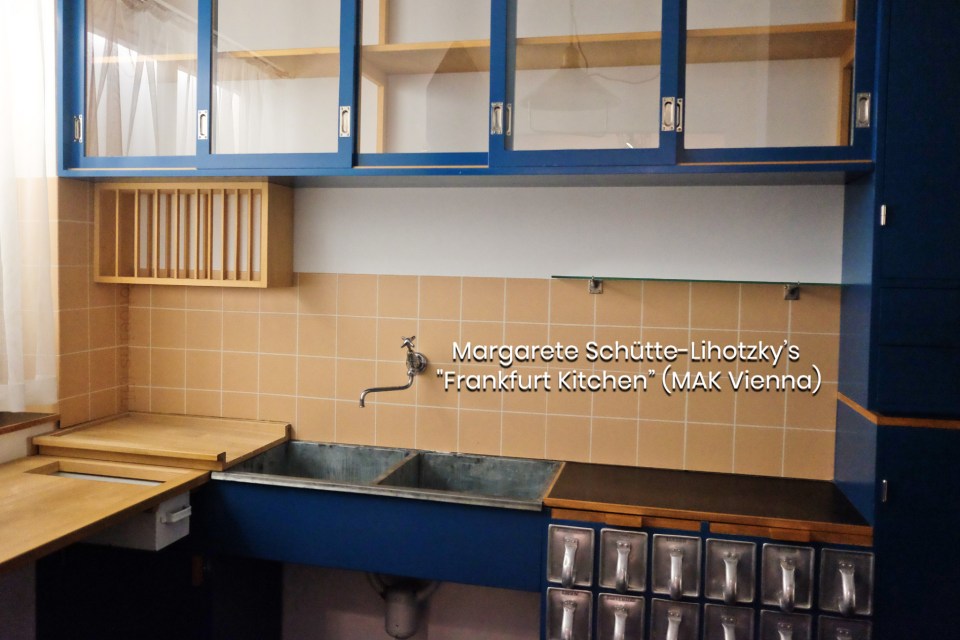
Frankurter Küche, Frankfurt kitchen, Margarete Schütte-Lihotzky, MAK Vienna, Vienna, Wien, Austria, Österreich, fotoeins.com

Vienna: Margarete Schütte-Lihotzky & the modern fitted kitchen

Who: Margarete Schütte-Lihotzky.
Key: 1st woman architect in Austria, designer of something we take entirely for granted.
Quote: “I developed the kitchen as an architect, not as a housewife.”

I always liked how cooking had well-defined endpoints: a desirable start, and a satisfying conclusion. I enjoy the process: the contemplation of “what to make,” the gathering of ingredients, the preparation, and naturally, the consumption. There might also be something to say about the duality of creation and annihilation …

That got me to thinking about kitchens as a critical unit of a home. Before the 20th-century, the wealthy could afford to have staffed kitchens; everybody else had access to no kitchen or an unsafe unhygienic kitchen in a building separate to their living quarters. The assumed universality of a kitchen within a home is a 20th-century concept and implementation that sought to overcome social and economic class. The design of a modern kitchen invites repeated patterns of movement and action around where cookware, utensils, condiments, glassware, etc. are stored and where the central focus of cooking activity takes place.

For everyone who spends any time in a kitchen, we have Margarete Schütte-Lihotzky (MSL) to thank.


( Click here for more )

Macy's, Bon Marche building, The Bon, Thanksgiving, holiday star, Seattle, Washington, USA, fotoeins.com

Seattle: Thanksgiving holiday star & fireworks

As a wae lad, I was fascinated by comparative branding and marketing, and that’s how I got to thinking about the differences and similarities between Canada’s Hudson’s Bay Company in greater Vancouver and the American Bon Marché in Bellingham and Seattle. But I don’t ever recall a tradition of lighting a star for October/Canadian Thanksgiving.

In downtown Seattle, a grand building opened in 1929 for the locally-owned Bon Marché department store, operating for over 7 decades until “The Bon” became Macy’s in 2005. A holiday star designed by Bob James in 1957 would become a fixture for the city and her residents. In September 2019, Macy’s declared the downtown Seattle location would be closing at the end of February 2020. At the time, the announcement included no plans for lighting the holiday star.

However, the star looks to be coming back for one more (final?) illumination, as a local lighting company agreed to refurbish and reassemble the star in time for the 2019 Thanksgiving season. Festivities occur Friday November 29, beginning with the annual Thanksgiving parade followed by the star’s lighting and fireworks.

•   MyNorthwest, 27 Nov 2019.

( Click here for images and more )

Seattle: that tower again

Above/featured: from the base looking up – 10 Oct 2016.

“That Tower Again,” a three-word online phrase for the early 21st-century.

It’s a phrase I associate with Berlin and her TV Tower (Fernsehturm), and that comes with multiple stays and many months in the German capita, a city I feel very much at home (winters notwithstanding). With my return to the Canadian Southwest and near-proximity to Seattle, I reconsider my fondness for the city’s iconic landmark: the Space Needle observation tower. Sight of the tower hasn’t lost its allure since our first family visit in the late 1970s.

For the Seattle World Fair in 1962, construction of the Space Needle occurred over a mere 400 days in time for the “Century 21 Exposition”. The 605-foot (184 metre) tower stood for the spirit of innovation and the might of technology. The city of Seattle designated the tower as an official city landmark in 1999. Fast forward now into the 21st century, it’s unfathomable for resident and visitor alike to think about the Emerald City without its leading spire.


( Click here for images and more )