Fotoeins Fotografie

location bifurcation, place vs. home

Posts from the ‘Australia’ category

Dover Heights, Sydney, Australia

Sydney’s April full-moon: fall and rise in a single day

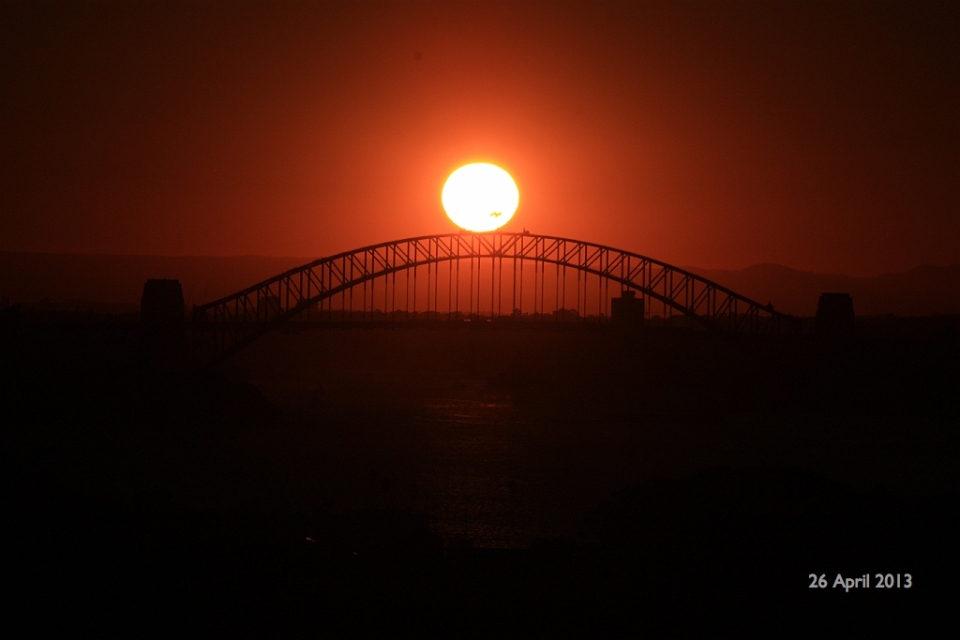
Previously I wrote about how I tracked the path of the setting sun over four consecutive days, until I captured the setting sun at the crown of the Harbour Bridge’s arch in Sydney.

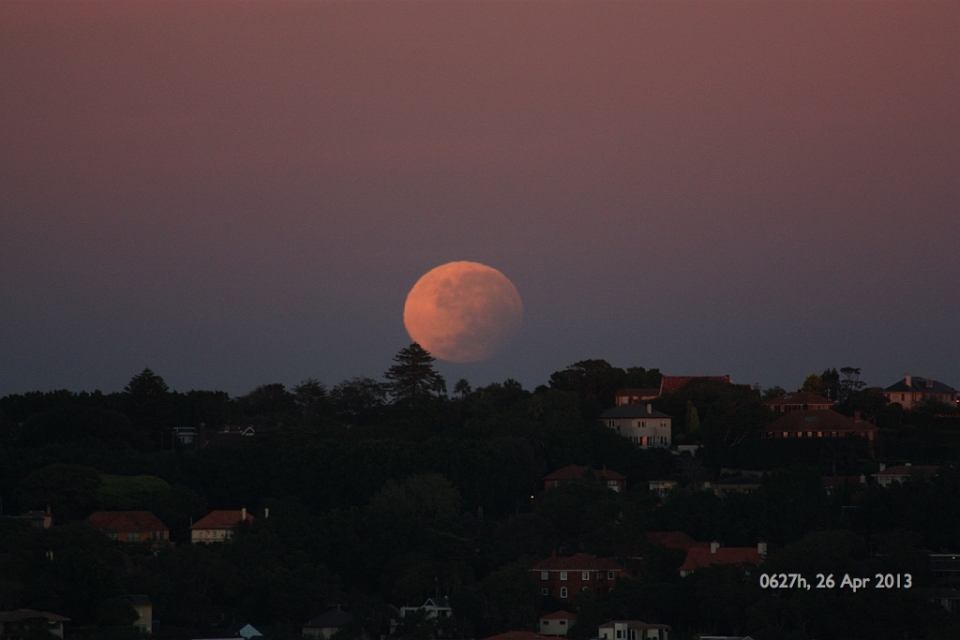
I understood that the full moon would occur on the morning of 26 April 2013, which would provide a good opportunity to observe the moon-set close in time with the sunrise in the morning, and the moon-rise close in time after the sunset later that day. At the full-moon phase, sunrise-moonset and sunset-moonrise observations can be made at about the same time in the morning and evening, respectively; for more, see notes about moon phases here.

I obtained the following sun and moon data from timeanddate.com. All times are in Australian Eastern Standard Time (UTC+10); azimuths are measured with 0° North, 90° East, 180° South, and 270° West.

Sun/Moon Rise time Set time Rise azimuth Set azimuth Other
SUN 0626h 1720h 74° 286° day-length 10hr54min
MOON 0632h 253° full-moon 0558h
1735h 109°

In the quiet morning hour, I watched the full-moon set before the sun bathed the Central Business District in golden light. The full-moon was also in partial eclipse, as there’s a visible “shadow” over the lower-right portion of the full-moon (2nd image in the sequence above). Ten hours later that afternoon, I returned to watch the sunset behind the Sydney Harbour Bridge, followed by the full-moon rising over the Tasman Sea.

With a bit of luck, a bit of dedication, and a good warm fleece to hold off the morning and early-evening chill, I enjoyed making this sequence of photos on the same calendar-day.
( Click here for more )

"Jeff Wall: Photographs" exhibition, Museum of Contemporary Art Australia, Sydney

My 70000th, at the MCA in Sydney (2013)

I’m making good progress with my five-year old Canon EOS450D camera.

As I continue to click away, I’m aware of the grind on both camera and lens(es). But with some luck and care, I’ve flipped the “number counter” on my camera a seventh time with over 70000 exposures to date.

I headed out to the Museum of Contemporary Art (MCA) Australia in Sydney to visit the “JEFF WALL Photographs” exhibition. Jeff Wall is also from my hometown of Vancouver, Canada, and while I was in Vancouver earlier this year, I’d seen a number of his photos on display in the Vancouver Art Gallery’s collection. With the exhibition in Sydney, the opportunity arose for a coherent perspective of his work.

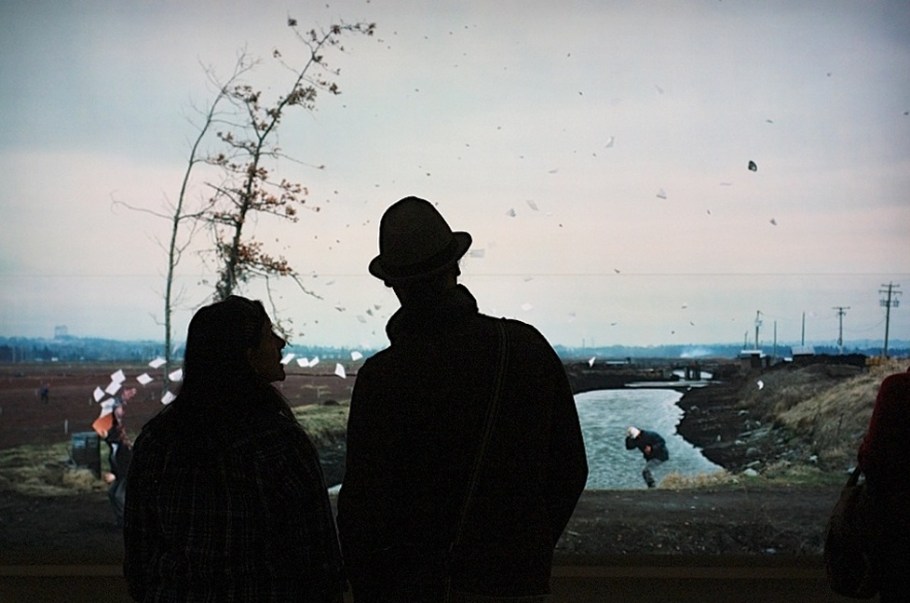
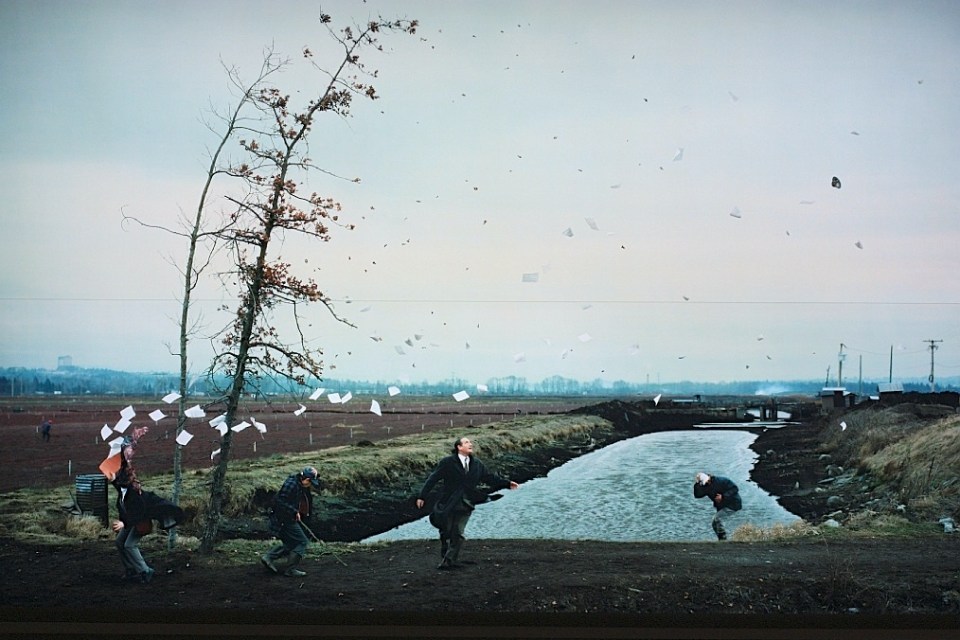
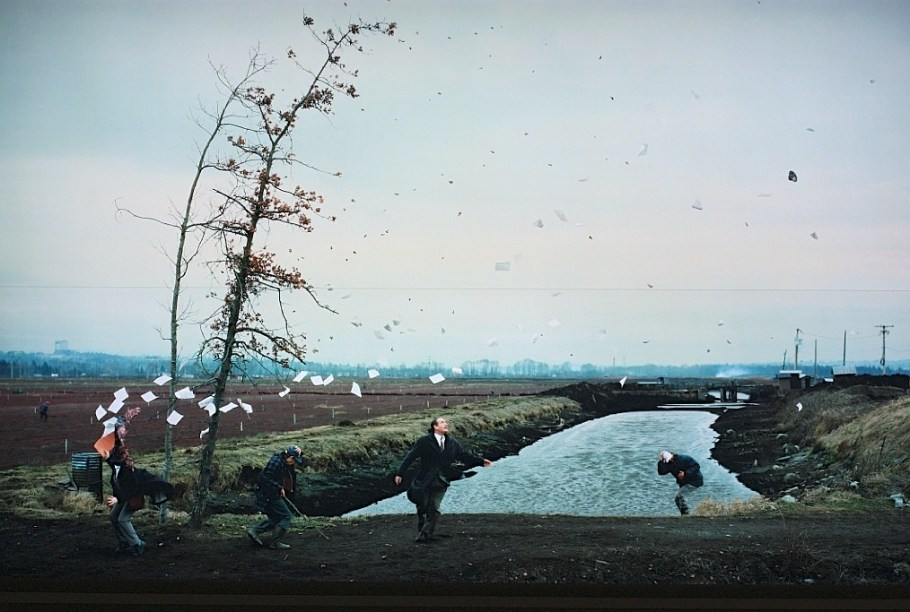
The following is one of my favourite Jeff Wall pieces, called “A sudden gust of wind (after Hokusai)”, which is on loan from the Tate London for the MCA exhibition. Wall’s work is based on a Japanese woodblock print by Katsushika Hokusai, Ejiri in Suruga Province (SunshΓ» Ejiri), AC 1830-33, housed at the British Museum.

Jeff Wall: Photographs exhibition, Museum of Contemporary Art Australia, Sydney

Photo of a photo: “A sudden gust of wind (after Hokusai)”, by Jeff Wall, 1993.

Beautifully constructed and a wonderful homage to Hokusai’s original, Wall’s photograph is presently mounted in one of the last rooms of the exhibition; so, there’s plenty of room for people to wander into the space and to admire the scale and movement of the photograph. With that in mind, I stood towards the back of the room, and I began photographing people standing in front of the photograph. It didn’t take long to find two people standing in the right place and leaning towards each other in conversation, the visitors providing complementary well-timed superposition with the photograph.

Jeff Wall: Photographs exhibition, Museum of Contemporary Art Australia, Sydney

Quiet discourse by visitors, and quietly, my 70000th exposure. At least his hat’s still on …

The “JEFF WALL Photographs” exhibition is free of charge at the MCA Australia from 1 May to 28 July 2013. The MCA Australia can be reached with CityRail to Circular Quay station or with Sydney Ferries to Circular Quay Ferry Wharf.

PostScript: after posting, I realized I made a dumb mistake with counting; what’s discussed above is the 67000th click. The actual “rollover” occurred a few weeks later with the following set of photographs at the VIVID Sydney festival.

I made the photos above on 5 May 2013 with the 450D along with the Canon EF 50mm f/1.4 USM lens. This post appears on Fotoeins Fotopress at fotoeins.com.

Dover Heights, Sydney, Australia

Sydney’s sunset heights: a golden crown at the Harbour Bridge arch

It’s late-April, and the days grow shorter in autumn here in the southern hemisphere. That also means that with each passing day towards the winter solstice, the sun’s path across the sky drifts a little bit northwards. The 23.4-degree tilt of the Earth’s rotation-axis with respect to the Earth’s orbital-plane around the Sun ensures that most of the planet experiences four seasons with every full orbit or revolution around the Sun.

From my desire to photograph sunsets here in Sydney, Australia, I knew that the setting sun would soon intersect the crown in the arch of Sydney’s Harbour Bridge as viewed from Dover Heights in the eastern suburbs. Frequent “reconnaissance” visits to Dover Heights (and getting to know the 380 bus-route very well), I had worked out how much the position of the (setting) sun would change in the sky with every passing day.

There would be an occasional day when a part of me would reject the notion of heading out to try again. The reasonable side of me wouldn’t hear of it. “It’s sunny, it’s +25C, you have to go through Bondi Beach (awww); so, get your butt out there before you regret it.” Aaaah, because regret and me, you know we’re … “this” close.

With a successful experiment to photograph sunsets (and the full moon) in late-April, I have no regrets.

( Click here for more )

Sydney: ANZAC Day (2013)

The guns are silent.

In Australia and New Zealand, ANZAC Day is a national day of remembrance to mark the 1915 landing at dawn of ANZAC troops at Gallipoli peninsula in Turkey in World War 1 (WW1). The Australia and New Zealand Army Corps (ANZACs) saw their first WW1 military action in Gallipoli as part of an Allied expeditionary force whose aim was to free passage for allied shipping through the Dardanelles, a narrow strait connecting the Aegean Sea with the Sea of Marmara, and onwards to Constantinople (now Istanbul). Instead, months of heavy fighting became a stalemate with major losses on both sides.

The importance of this date for both countries has ensured that ANZAC Day takes place annually on the 25th of April. In the present, ANZAC Day is a day to remember Australians and New Zealanders who have represented and served their countries in combat and peacekeeping efforts around the world.

Most veterans from the two great world wars of the 20th-century are gone, and soon, they’ll all fade away; the last surviving Australian participant at Gallipoli died in 2002. If ANZAC day has become an excuse for consumption and frivolity, the historical context for present-day commemoration is in danger of becoming lost. Michael Brissenden wrote for the Australian Broadcasting Corporation :

… It’s clear now that Anzac Day has grown to become our most important commemorative day. But is that in itself enough? Should it also spark more of a national conversation? And shouldn’t we at least try and invest the day with what historians like Clare Wright call “historical authenticity”? Along with the mass patriotic sentiment, the huge crowds and even the football grudge matches the day now inspires, some are still searching for more.

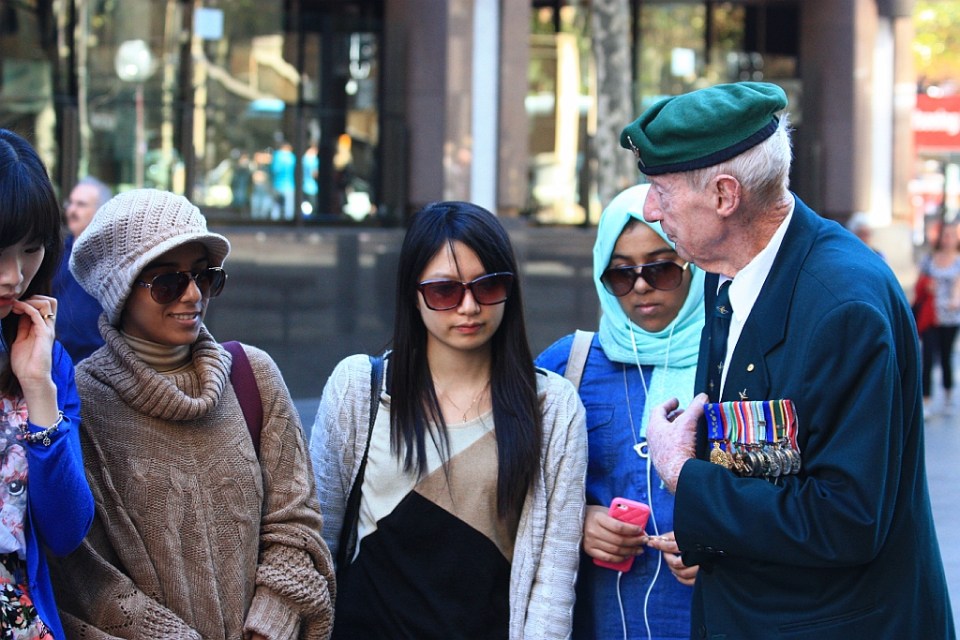
The photographs below reflect a small cross-section of people and their memories. By chance, I meet with Ken Curran, Australian World War 2 war-veteran and member of the Order of Australia; I write about him here.

I made all of the photos below on ANZAC Day (25 April) 2013 in the Sydney CBD with a Canon EOS450D/Rebel XSi. This post appears on Fotoeins Fotografie at fotoeins DOT com as http://wp.me/p1BIdT-3gp.

( Click here for images and more )