Fotoeins Fotografie

location bifurcation, place vs. home

Posts by HL fotoeins

My Tirol: Scharnitz and Porta Claudia

Where: Scharnitz, at the northern edge of Austria’s Tirol, next to the Austro-German frontier.
What: Porta Claudia, mid 17th-century fortifications directed by and named after Claudia de’ Medici.
BTW: Scharnitz Pass is technically not a mountain pass.

I’m interested in geography, historical relics, and the topography of European borders.

Scharnitz Pass is one of the lowest crossing points over the Alps at an elevation of only 955 metres (3130 feet) with the Wetterstein mountains on one side to the west and the Karwendel mountains to the other side in the east. The pass might better be described as a “gorge”, given how the Isar river traverses the valley floor between the two sets of mountains. Naturally, a road at this location would’ve been ideal as a vital north-south route for trade and communication, which is why the Romans built the stone road, Via Raetia, through the river valley. A 200-metre section of this old Roman road remains in the woods outside the nearby town of Klais. The location of the pass/gorge is also why the Romans built a guard station “Mansio Scarbia” here to control traffic between the northern outer provinces and the rest of the inner empire to the south.

One of the earliest records from the 8th-century AD/CE documents the establishment of Scaraza Monastery, known also as Scarantia#. The name evolved to “Scaraz”, “Scarbia”, “Scarnize”, and eventually “Scharnitz”. Today, between 1300 and 1400 people live in the Austrian town of Scharnitz in the Tirolean region of Seefeld. The town lies on the road between Innsbruck and Munich and next to the international border between Austria and Germany; the strategic importance of this modest town has never gone away.

“Porta Claudia” is the name of former fortifications on high ground at a narrow curve over the Isar river valley. In the midst of the pan-European Thirty Years War, Claudia de’ Medici, the Regent of Austrian Tirol, ordered in 1632 the construction of a strategic defensive rampart at the Tirol-Bavaria border to protect Tirol’s northern border from invasion by Swedish forces. The Bavarians overran the rampart in 1706, but fortifications were expanded in 1766. Johann Wolfgang von Goethe wrote about passing through Scharnitz in 1786 on his journey into Italy. In 1805, Napolean’s army laid siege and destroyed the fortifications, freeing the path for joint French-Bavarian armed forces to enter Austria. Remnants of the retaining wall up to six metres in height and an archway through the wall are visible today.

I’m up and about at dawn, and within 50 minutes on an S-Bahn Tirol S5* train from Innsbruck, I’m about to satisfy my curiosity about this stretch of the Tirolean landscape in Scharnitz. With the existing Schengen treaty among participating European nations, anyone can walk, bike, or drive freely across the unguarded international border between Austria and Germany%.

# “Scar” (noun), 2nd etymological meaning.
% I entered the European Union at Frankfurt am Main international airport where I went through passport check and control.
* S5 in May 2018; renumbered as S6 as of Oct 2020.


( Click here for images and more )

Dachau: nie wieder, never again

Where: KZ-Dachau, 20 km northwest from Munich, Germany.
What: The blueprint by which murder became a methodical industrialized process.

I once thought I wasn’t prepared emotionally; perhaps I never would. But I couldn’t go further in my long-term examination of Germany and Jewish-German history without a visit.

It’s an overcast morning in early June, and a couple of rain showers accompany me along with a handful of other people, waiting for the site to open at 9am. A dark heavy cloak descends the moment I step through the main gate and into the site. There is dread, waiting. I promise myself to be open as much as possible, to really look and listen.

This is KZ-Gedenkstätte Dachau, the Dachau Concentration Camp Memorial Site. The abbreviation KZ is “Konzentrationslager für Zivilpersonen” or concentration camp for civilians, although the initial terminology used by the Nazi Schutzstaffel (SS) was KL for “Konzentrationslager.”

There’s a lot to absorb. And maybe, it’s best not to.

Systematic torture and unrestrained cruelty. Forced medical experiments. Arbitrary execution by hanging or gunfire. The destruction of human dignity. The annihilation of hope. This camp as a “model” to broaden the scope and scale of industrial mass-murder. The first commandant of Auschwitz in 1940, Rudolf Höss, honed a career in brutality as SS support staff and block leader at the Dachau camp in late-1934.

I had planned to stay for a few hours at most and leave around noon. I didn’t notice the time. When I finally noticed clear skies and the change in sun-angle, I check my watch. It’s almost 5pm, closing time. Eight hours have flown by outside my bubble, which begins to dissolve.

( Click here for images and more )

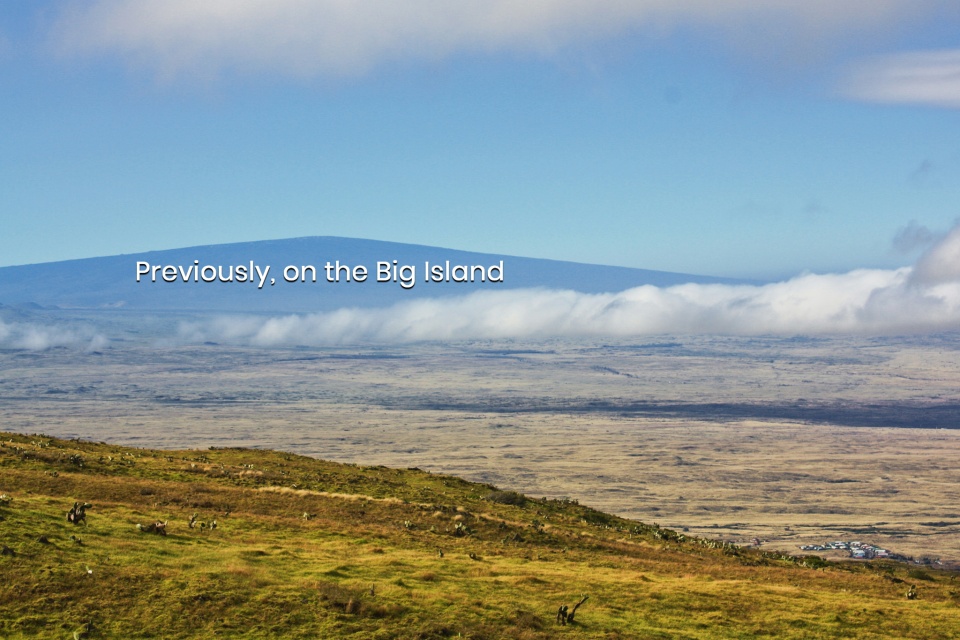
Kohala Mountain Road, Mauna Loa, volcano, Big Island, Hawaii, USA, fotoeins.com

Previously, on the Big Island

Above/featured: Facing south to Mauna Loa, from Kohala Mountain Road – 20 May 2008 (450D).

I’ve already described memorable return visits to Berlin and Prague, and I wanted to end the trio of “previous” posts with something a little more wild and natural, located in the middle of the Pacific Ocean.

In a previous life, my first visit to Hawaii and the Big Island occurred in 1999 after I had successfully applied for observing and research nights on the CFHT telescope near the Mauna Kea summit. Between 2006 and 2011, I worked at Gemini Observatory South in Chile, and I travelled occasionally to the Big Island for research meetings and consultations with colleagues at the offices of Gemini North. My last visit occurred in early-2012 at the outset of my year-long around the world journey.

The yearning to hop back across the great western pond is deeply imbedded with many memories; the following 10 images is as good a place to start.

( Click here for images and more )

Tempelhofer Feld, Flughafen Tempelhof, THF, Tempelhof, Berlin, Hauptstadt, Germany, Deutschland, fotoeins.com

Previously, in Berlin (2006–2017)

Above/featured: Tempelhofer Feld: runway 09R/27L at former THF airport – 16 Oct 2017 (6D1).

I made the cross-country rail journey to Berlin for the first time in 2002 when I lived and worked in Heidelberg. In the years since, I’ve answered the siren’s frequent call by returning to Berlin multiple times. I’ve lost track of the precise count that’s north of 10, but less than 20.

Berlin is Germany’s capital city, but in many respects, the city isn’t very German at all. Berlin is an “internationally German place.” The enigmatic moody metropolis isn’t the prettiest and can be one of isolation, especially in autumn and winter. During a cold gloomy stretch in late-2012, I survived by accessing the diverse array of arts and culture events and venues. What is very familiar is how Berlin’s residents show up outside when sunshine returns.

The following 16 images in chronological sequence show a slow forward progression to a quiet contemplative observation of the city and her residents.

( Click here for images and more )