Weimar: City Church at Herderplatz, UNESCO WHS
Weimar is a compact town with a large number of buildings as a part of two UNESCO World Heritage Sites. As part of the “Classic Weimar” World Heritage listing, Herderplatz (Herder Plaza) in the northern part of the city’s old town is known most for the church with two spires and a dark grey roof. This is the Stadtkirche (City Church), known also the Church of Saint Peter and Paul.
The church dates to the middle of the 13th-century AD (CE) when town and charter were first established, although a settlement in the area goes further back to the beginning of the 10th-century AD. Built initially as late-Gothic and redesigned as Baroque, and what fires and war bombing couldn’t destroy, several phases of rebuilding and renovations were completed in 1953, 1977, and 2000.
Johannes Gottfried Herder (1744-1803) was German philosopher, writer, and theologian. From 1776 until his death, he lived and worked in Weimar as General Superintendent for the Saxon-Weimar Duchy, Court Chaplain, member of the church advisory council, and President of the Supreme Consistory. For his service to the city’s people and contributions to German philosophy and literature, and as the site of his burial, the church is also known as Herderkirche (Herder Church).
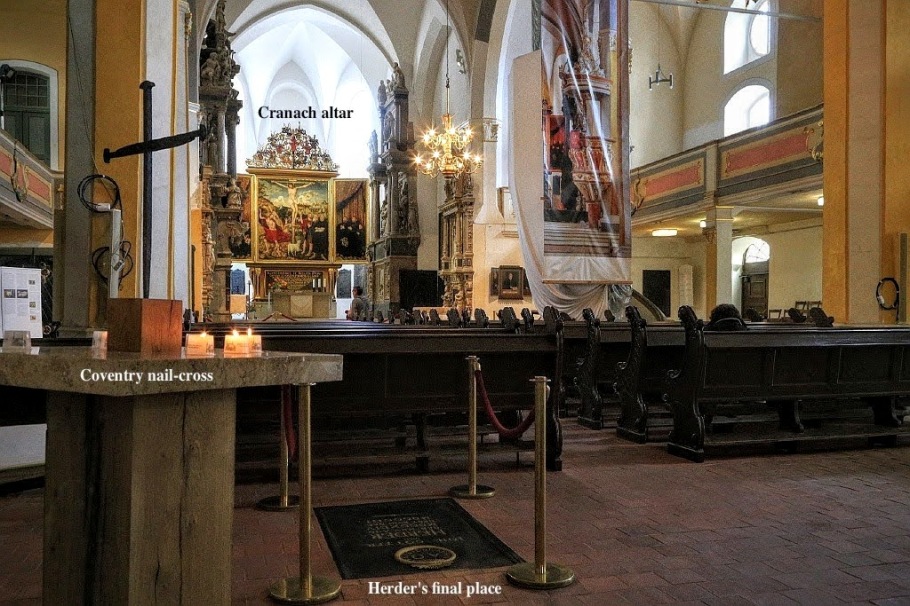
Cranach Altar
The Cranach Altar is an important testament to the history of the Reformation in the state of Thuringia. The triptych was started by Lucas Cranach the Elder in 1552, and continued by his son, Lucas Cranach the Younger, in 1554. Completed in 1555, the entire piece was installed over the main church altar by 1557. The paintings include portraits of Lucas Cranach the Elder and Martin Luther, and centre around “Christus am Kreuz” (Christ’s crucifixion). Christ’s blood streams out and touches Cranach the Elder’s forehead, symbolizing a direct relationship between God and people without the need for or the intercession of priests; more here.
Contemporaries
Lucas Cranach the Elder, 1472-1553.
Martin Luther, 1483-1546.
Lucas Cranach the Younger, 1515-1586.
Johannes Gottfried Herder, 1744-1803.
Johann Wolfgang von Goethe, 1749-1832.
Friedrich Schiller, 1759-1805.
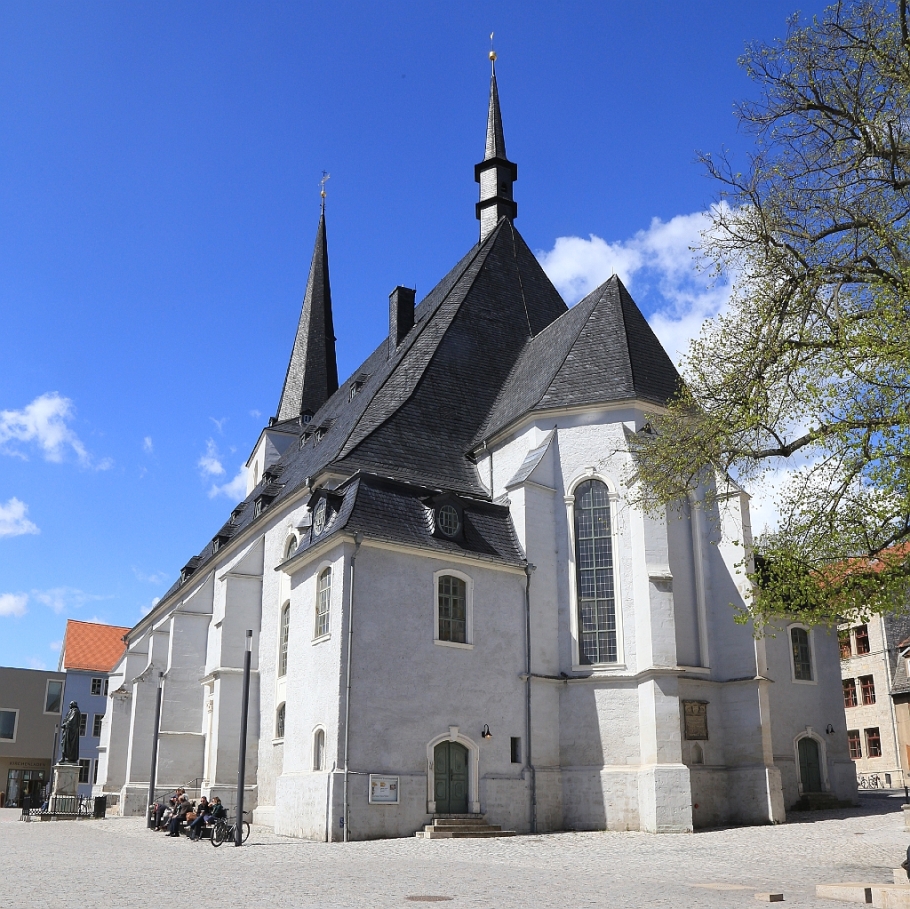
Herderplatz (Herder Plaza)
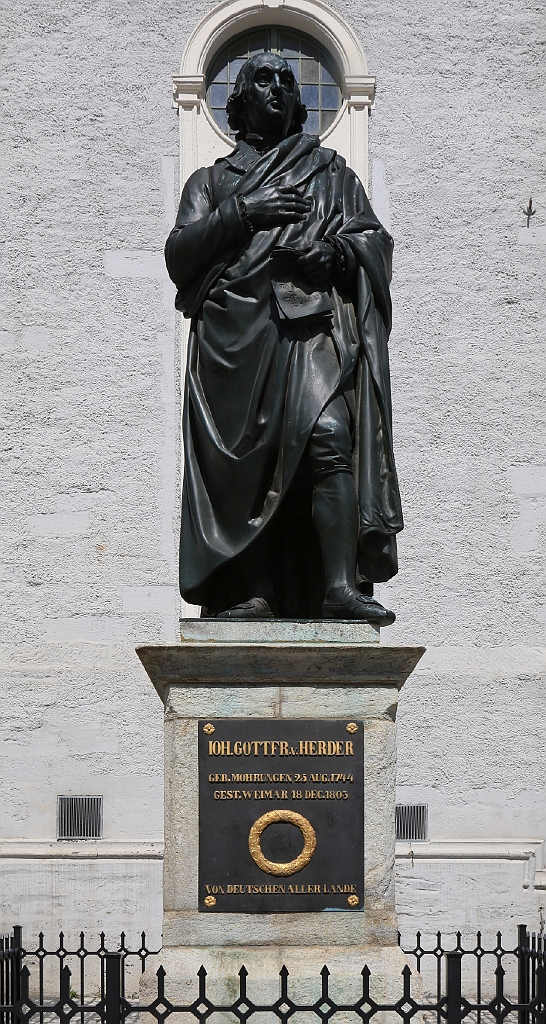
Bronze statue of Herder by Ludwig Schaller; unveiled in 1850 as the city’s first monument to a writer
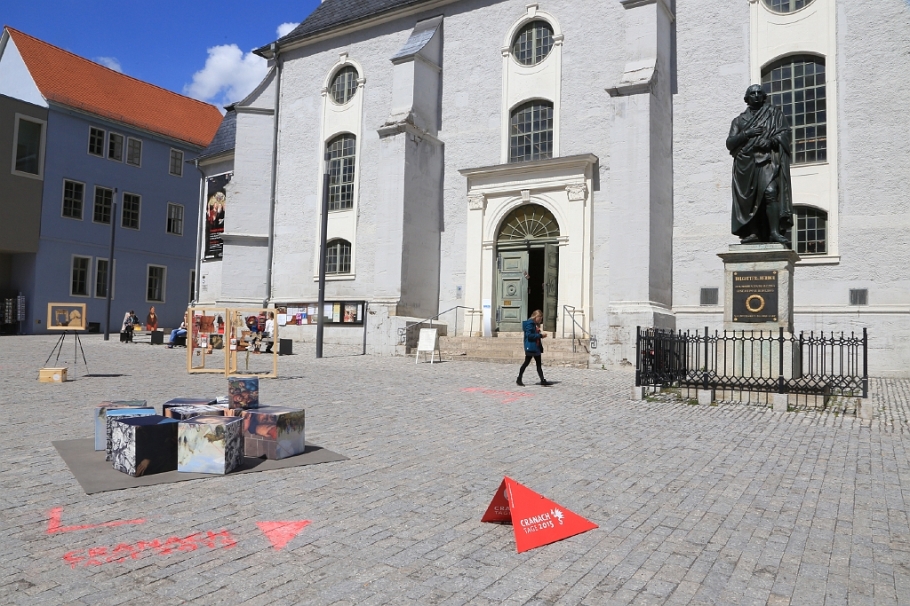
In front of the City Church
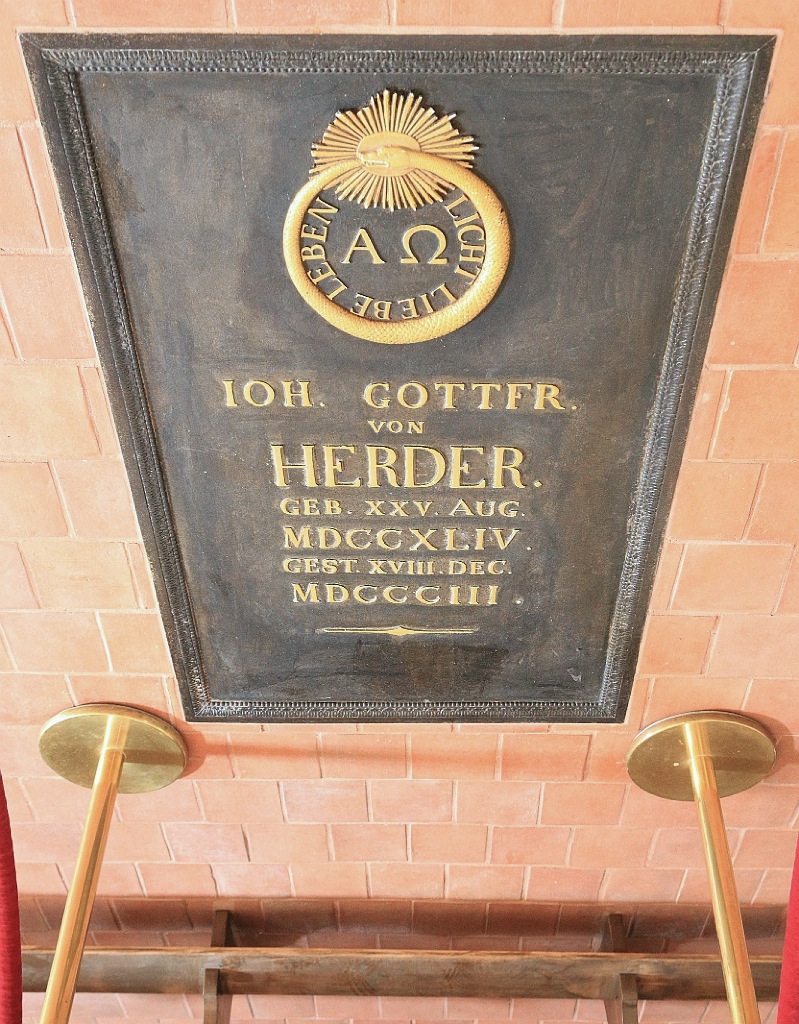
Herder’s final resting place; born 25 August 1744, died 18 December 1803.
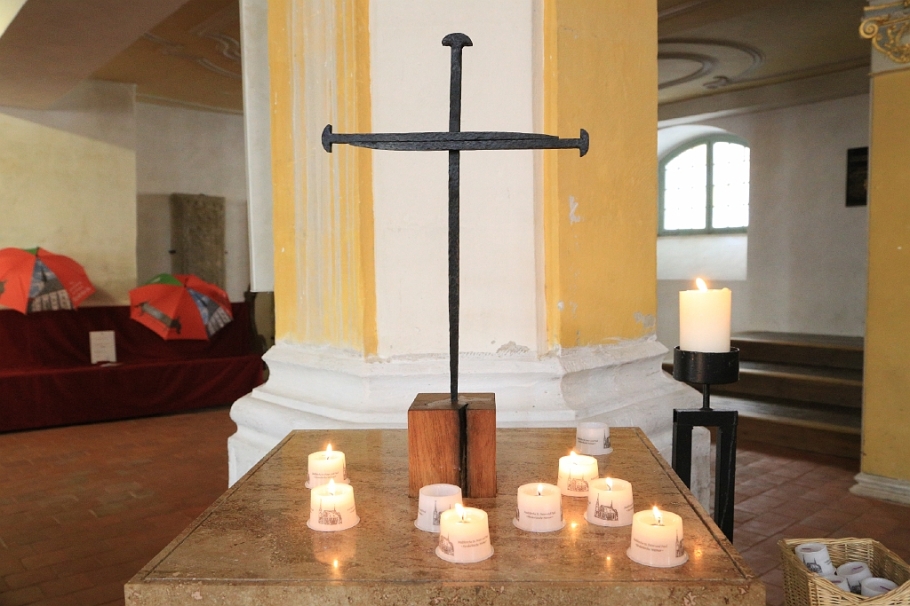
Coventry Nagelkreuz (Nail cross from Coventry)
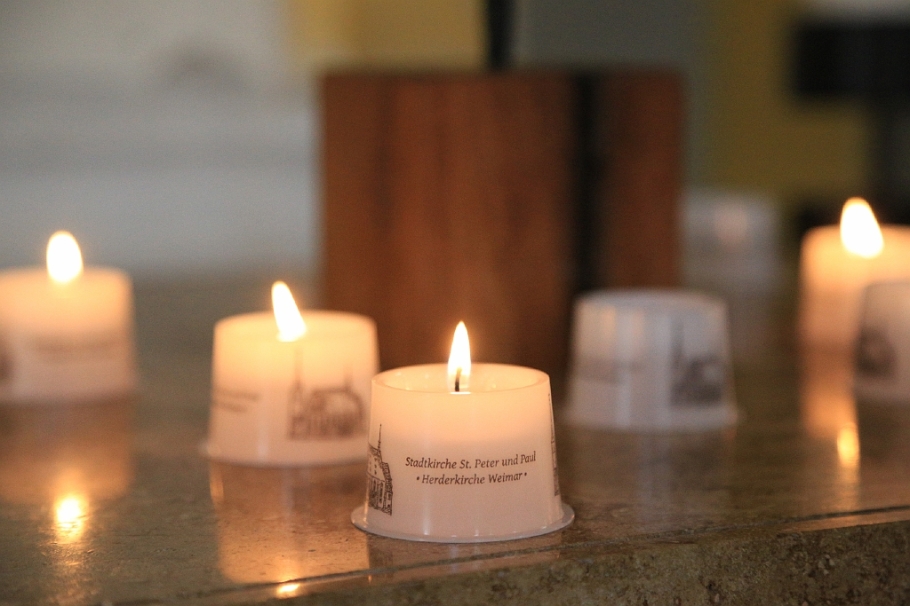
Stadtkirche St. Peter und Paul – Herderkirche Weimar
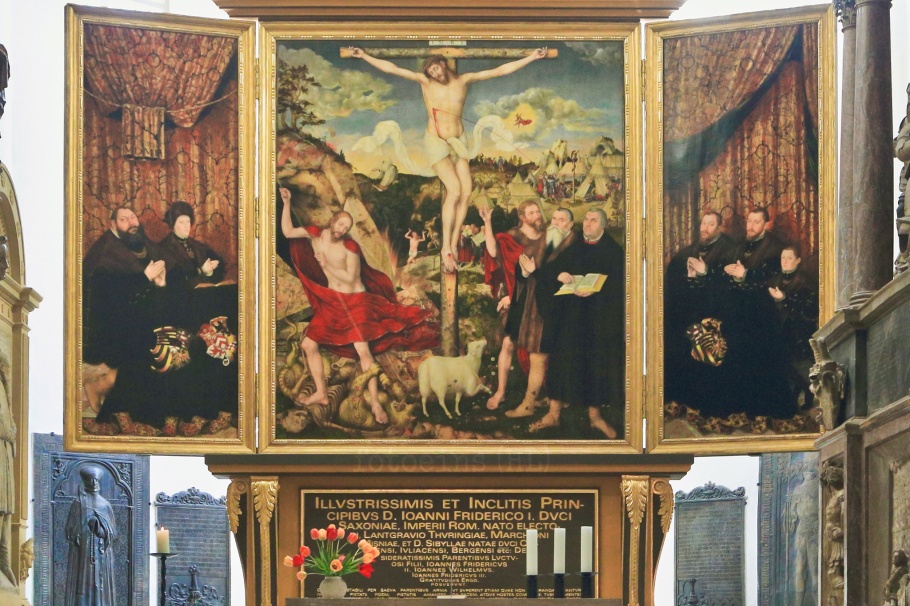
Cranach Altar, with triptych and reconstructed Predalla Latin inscription.
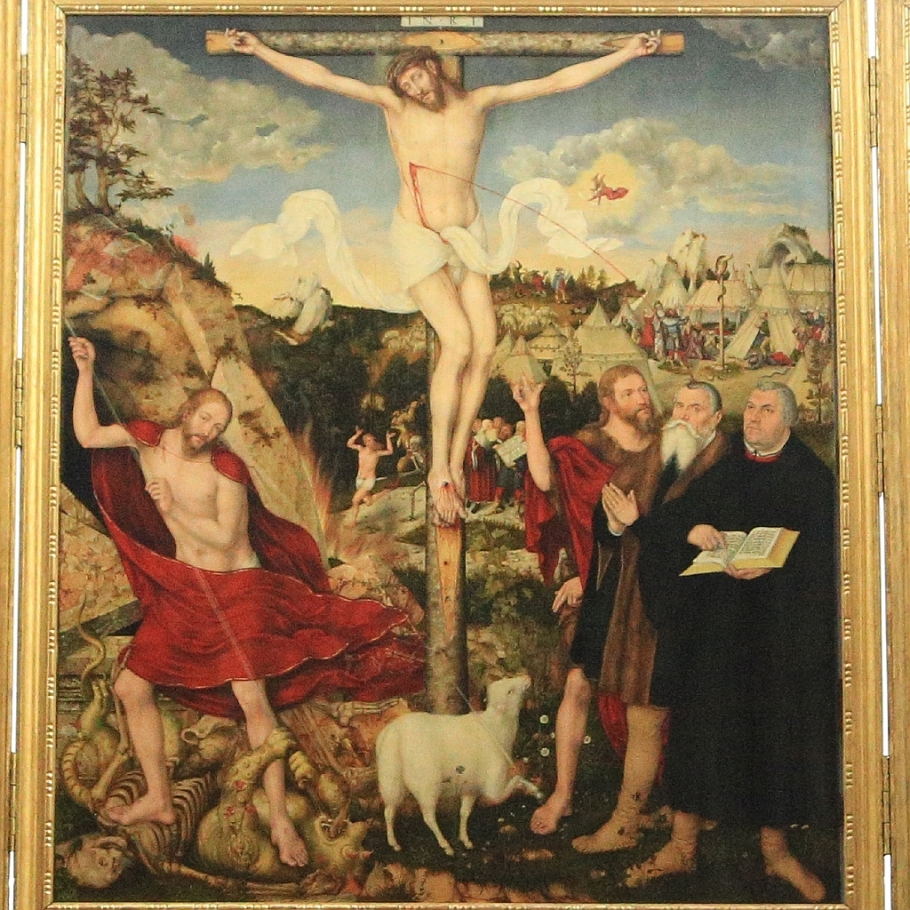
Triptych central panel, Christ’s crucifixion and to viewer right: a living Christ, Lucas Cranach the Elder, and Martin Luther, from left to right, respectively
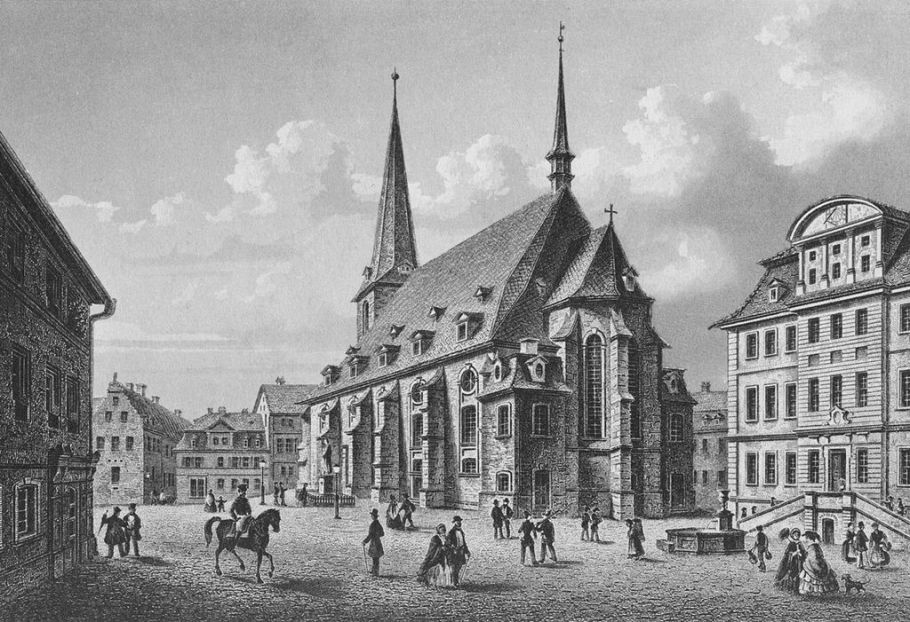
Steel engraving around 1840 by L. Oeder, Wikipedia
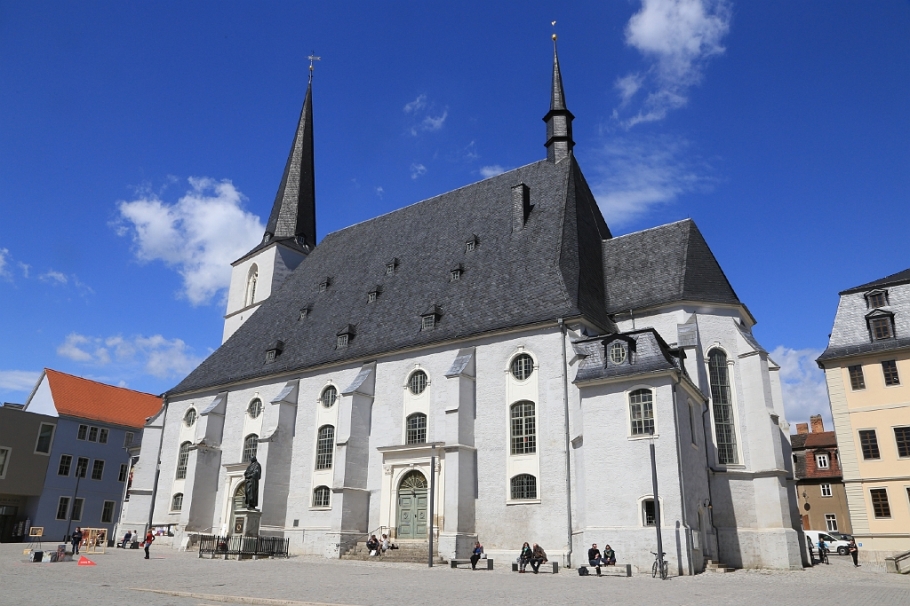
Herderplatz 2015, digital image (by HL) uncorrected for geometrical distortion.
Coventry Cross (Nagelkreuz)
German bombers destroyed the cathedral in Coventry, England, on 1940 November 14-15. Weimar’s City Church suffered the same fate on 1945 February 9. As a part of the reconciliation process, nails from the ruins of Coventry’s cathedral have been sent around the world and reassembled as commemorative crosses. In 2012, nails from Coventry were handed over to Weimar.
More about the City Church and Lucas Cranach
• Evangelisch-Lutherische Kirchengemeinde (Evangelical Lutheran Church), in German
• Thuringia Tourism, in English
• Cranach 2015, in English
• In the footsteps of Cranach, in English
More from Weimar
• Weimar UNESCO WHS: Bauhaus Old and New
• Weimar UNESCO WHS: Duchess Anna Amalia Library
• Weimar: an instant walk through the UNESCO town
Many thanks to Weimar Tourism, Thüringen Tourismus, Germany National Tourism Board for access to places and activities in the city; and to Dorint Hotel am Goethepark for a comfortable and welcoming stay. Except for the 1840 image by L. Oeder, I made the photos above on 30 April 2015. This post appears on Fotoeins Fotopress at fotoeins.com as http://wp.me/p1BIdT-77L.
 Fotoeins Fotografie
13 Responses to “Weimar: City Church at Herderplatz, UNESCO WHS”
Lots of great information here! Your photos are especially helpful and will be an asset to anyone planning a visit to Weimar. That painting of Christ’s crucifixion is really riveting
LikeLiked by 1 person
The symbolism in Cranach’s triptych is especially rich. Thanks, Michele, for stopping by and for your comment!
LikeLike
What a lovely photo tour of Weimar’s City Church.
LikeLiked by 1 person
Thanks, Carole, for stopping by and for your kind compliment!
LikeLike
It’s great to learn the backstory behind UNESCO sites, as well as the significant buildings of a destination like Weimar. What better time for this than an anniversary celebration such as Cranach Tage!
LikeLiked by 1 person
Hi, Anita. Yes, 2015 works out really well: 460 years of the triptych’s completion by Cranach the Younger, and 500 years of the birth of Cranach the Younger. “Cranach Tage 2015” is a big deal in Weimar and in other places throughout central Germany. Thanks for reading and for your comment!
LikeLike
Why didn’t I know about this UNESCO WHS? I would love to see the Cranach Altar in Herderplatz with my own eyes, thank you for showing us!
LikeLiked by 1 person
Hi, Nat and Tim. How does anyone keep track of existing and newly inscribed UNESCO World Heritage Sites? I was a little overwhelmed by the fact that “tiny” Weimar of about 65-thousand people is culturally rich with two separate UNESCO WHS inscriptions: one for early 20th-century Bauhaus, and one for “Classic Weimar”. The Cranach Altar and the City Church (aka Herder Church) are a part of the latter, and I’m glad to have found and learned about this place. I’m also very happy to have provided something new for you and others to consider. 🙂 Thanks for reading and for your comment!
LikeLike
[…] contains a pulpit that was used by Luther between 1518 and 1540. The church also features the 1555 altar triptych. The triptych was painted by Lucas Cranach the Senior and Junior, both of whom were Luther’s […]
LikeLike
[…] became close friends to the Luther family. The Cranachs would also become painters and artists for the Reformation. Cranach Senior was also an astute businessman as he purchased a variety of properties in town. Of […]
LikeLike
[…] Cranach Altar at the City Church (link, […]
LikeLike
[…] efforts to reach forgiveness, understanding, and peace. (I found another cross of nails at the Herder City Church in Weimar, […]
LikeLike
[…] full posts: ONE and […]
LikeLike