Fotoeins Fotografie

location bifurcation, place vs. home

Posts tagged ‘World Heritage’

Grand Canyon National Park: The North & South Rim

Above/featured: West-northwest from Mohave Point – 15 October 2018.

The Grand Canyon National Park has very different timescales: over 100 years of human inscription as a national park, but almost 2 billion years of geologic history.

European colonizers and settlers recognized protection was required for the big dramatic landscape. On 26 February 1919, U.S. Congress passed legislation “An Act to Establish the Grand Canyon National Park in the State of Arizona” which was signed by President Woodrow Wilson. With its official designation, the country’s 15th National Park encompasses over 1-million acres (almost 405-thousand hectares) in surface area and several thousand years of history of human habitation by indigenous peoples, including the Havasupai, Hualapai, Hopi, Navajo, Paiute, and the Zuni, who consider the Grand Canyon as their ancestral birthplace. UNESCO inscribed the Grand Canyon National Park as World Heritage Site in 1979.

The park also includes over a billion years of geologic history. By geologic standards, the Grand Canyon itself is relatively “young” with the Colorado River carving into the rock about 5 to 6 million years ago. However, the Vishnu basement rock in the Grand Canyon is over 1.7 billion years old, even though that age is only 38 percent as old as the Earth’s oldest rocks at 4.5 billion years.

Over three days in October 2018, we explored parts inside Grand Canyon National Park. After our drive from Flagstaff to Vermilion Cliffs, we pushed forward to the North Rim and the winding scenic drive through the Kaibab National Forest took us to Point Imperial and Cape Royal in time for the day’s final illumination.

With a night spent at the beautifully serene Cliff Dwellers Lodge, we retraced our drive back to Cameron, then heading west to Desert View to the eastern section of the South Rim. After establishing our new ‘base’ in Flagstaff, we drove the following day to the main entrance of the Grand Canyon National Park (via Valle and Tusayan), and we spent the day in the western and central sections of the South Rim. The 1126 km (700 mi) we covered over the three days made up 22 percent of the entire 5049 km (3138 mi) driving distance accumulated in New Mexico and Arizona.


( Click here for images and more )

Christian Doppler, Doppler birth house, Dopplers Geburtshaus, Salzburg, Austria, Oesterreich, fotoeins.com

My Salzburg: Christian Doppler’s birth house

In crossing the pedestrian bridge over the Salzach river, every step takes me away from the famous view of the fortress over Old Town classics of steeples and baroque in Salzburg. Before I get to where I want to be, I have to cross a busy street in the afternoon rush which has come to a halt. Wailing sirens approach and recede as red and white “Rettungswagen” race to the emergency situation somewhere in the city. The cyclical lights are in my favour, and upon turning the corner, I see the sign that tells me I’ve arrived.

One self-assigned goal during three weeks of travel within Austria was the search for places associated with physicists and mathematicians of my youth. And by youth, I mean the tender twenties when all I cared about was a succinct explanation of the natural world through various equations1. In Alpbach, I found Erwin and Annemarie Schrödinger’s grave. In Vienna, I found Ludwig Boltzmann’s grave. Here in Salzburg across the street from the Mozart family house, I found Christian Doppler after whom the Doppler effect is named.


( Click here for more )

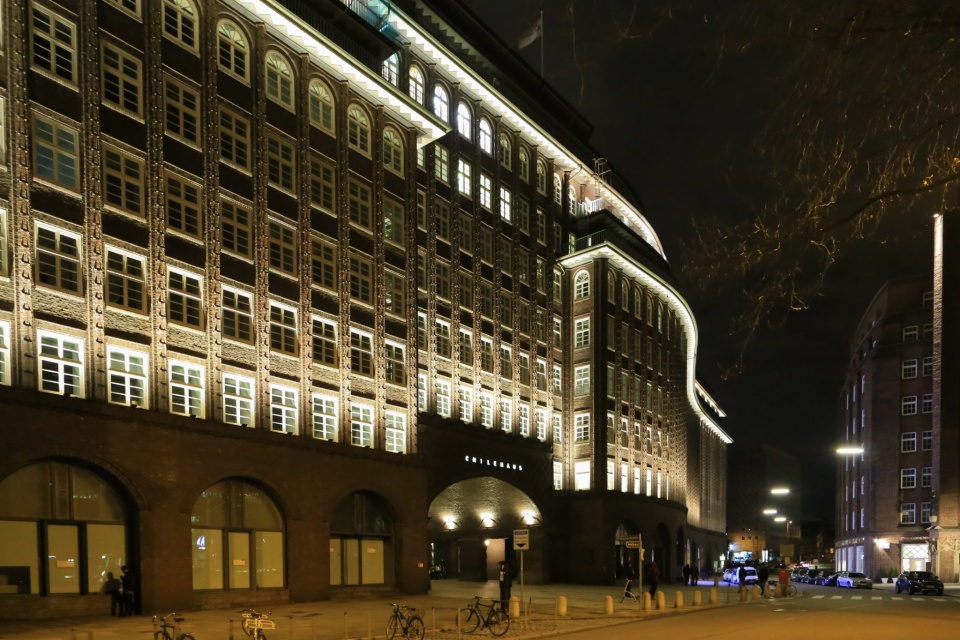
Chilehaus, Kontorhausviertel, UNESCO, Weltkulturerbe, World Heritage, Hamburg, Germany, fotoeins.com

Hamburg UNESCO WHS: Kontorhausviertel (Commercial District)

On 5 July 2015, UNESCO awarded World Heritage status to two sites in Hamburg: the Speicherstadt (Warehouse District) and the Kontorhausviertel (Office Building District). In the latter are two important brick buildings: Chilehaus and the Sprinkenhof, representative of the construction in the late 19th- and early 20th-century.

The Chilehaus was built by Fritz Höger for client Henry Sloman from 1922 to 1924 in the Kontorhausviertel as a prime example of German expressionist architecture using hard-fired brick. Höger undertook the project for Hamburg merchant and banker Sloman who made his fortune in importing nitrates from Chile. Built entirely to serve and complement the functions of the warehouses in neighbouring Speicherstadt, the Kontorhausviertel was the first dedicated office- and commercial-district on the European continent.


( Click here for images )

Kea, alpine parrot, Homer Tunnel, Milford Road, South Island, Te Waipounamu, Aotearoa, New Zealand, fotoeins.com

Waitangi Day (6 Feb): 15 images from Aotearoa

Above/featured: The kea is the world’s only alpine parrot and on the endangered list; on Milford Road near Homer Tunnel.

On the 6th of February, I’ll be humming “E Ihowa Atua” and “Pokarekare Ana”.

Waitangi Day is a national holiday in New Zealand to commemorate the signing of the Treaty of Waitangi on 6 February 1840. As the founding document of the country, the Treaty of Waitangi (Te Tiriti o Waitangi) is an accord agreed upon by representatives of the Crown (British Empire) and of indigenous Māori iwi (tribes) and hapū (sub-tribes). The agreement is named after the name of the location in the Bay of Islands where the Treaty was first signed. Despite continuing disagreements between the two parties about contemporary extent and redress, I think the conversation and interactions between the communities are at a more advanced stage of integration within the nation’s fabric by comparison with Australia and Canada.

For Aotearoa, the New Zealand government approved in October 2013 formal names of the two main islands in Māori and English:

•   Te Ika a Māui (“the fish of Māui”) for the North Island, and
•   Te Wai Pounamu (“the waters of greenstone”) for the South Island.

I highlight Aotearoa with 15 images of the following locations:

  1. Akaroa
  2. Auckland
  3. Dunedin
  4. Franz Josef Glacier *
  5. Greymouth
  6. Hapuku (Seaward Kaikouras)
  7. Homer Tunnel *
  8. Lake Matheson *
  9. Milford Sound *
  10. Queen Charlotte Sound
  11. Queenstown
  12. Southern Alps *
  13. Waimakariri River
  14. Wellington City
  15. Wellington Harbour

Asterisks identify locations within the Te Wāhipounamu area in South West New Zealand which was inscribed in 1990 as UNESCO World Heritage Site that includes four national parks: Aoraki/Mount Cook, Fiordland, Mount Aspiring, and Westland Tai Poutini.

( Click here for images and more )

Koblenz: 1st and 2nd Deutsches Eck (German Corner)

Above: West view to Deutsches Eck from Ehrenbreitstein. 2015 photo by Taxiarchos228 (Wladyslaw Sojka). I’ve added the following labels: (1) Seilbahn/Gondola, (2) St. Kastor Basilica, (3) Deutschherrenhaus, (4) first Deutsches Eck, (5) Memorial to German Unity (Kaiser Wilhelm Memorial), (6) reclamation in the late 19th-century, (7) second Deutsches Eck.

Many will know, have seen, or have read about the Deutsches Eck (German Corner) in the German city of Koblenz. The river city has plenty to provide: visitors wander into the vineyards to sip on crisp white wine from local grapes, vacation on long cabin-boats to enjoy the river scenery, or explore the surrounding Upper Rhine River Valley.

But Koblenz is also well known by virtue of its name after the junction where the rivers Moselle and Rhine meet. By the first-century AD/CE, the Romans had built for strategic protection a fort1 called “Castellum apud Confluentes“, Latin for “the castle at the confluence”. What most commonly acknowledge as the Deutsches Eck (German corner) is not the original location. Half concealed among the trees some 200 metres back near the Deutschherrenhaus is the first location of the Deutsches Eck.

What follows:

  • a map to the area and my photos from the present-day,
  • a short history of the “Deutsches Eck,” and
  • archival images from the mid-16th century to early 20th century.

( Click here for images and more )