Fotoeins Fotografie

location bifurcation, place vs. home

Posts tagged ‘Weltkulturerbe’

Weimar: Duchess Anna Amalia Library, UNESCO WHS

As one of over ten buildings, residences, and properties making up what is called “Classic Weimar”, the Duchess Anna Amalia Library (Herzogin Anna Amalia Bibliothek) has been a UNESCO World Heritage Site since 1998.

To consolidate her love of books into a larger holding space, Duchess Anna Amalia commissioned in 1761 the State Architect to rebuild and convert the Renaissance-style French (Green) Castle into a library, which opened in 1766. Becoming one of the most important libraries in the country, the collections included some of the finest written and produced in German literature, art and culture, history, and architecture. Johann Wolfgang von Goethe himself was Library Director between 1797 and 1832.

The library has had its fair share of names: initially called the Ducal Library (Herzogliche Bibliothek); in 1815 renamed as the Grand Ducal Library (Großherzoglichen Bibliothek); in 1918 renamed as the Thuringia State Library (Thüringische Landesbibliothek); in 1969 renamed as the Central Library of German Classics (Zentralbibliothek der deutschen Klassik); and in 1991, renamed as Duchess Anna Amalia Library (Herzogin Anna Amalia Bibliothek) in honour of the library’s founder.

An electrical short from aging damaged wiring sparked a fire on 2 September 2004; the fire held on for over two days before the final hotspot was put out. Over 100 thousand books were damaged or destroyed by fire, water, and smoke. The fire was the largest to strike a German library in post-war history. Subsequent donations and volunteers poured into Weimar from throughout Germany and Europe to help with rescue and preservation efforts. After conclusion of extensive restoration work to the building, the interior Rococo Hall, and to thousands of rescued books, the library was reopened on 24 October 2007, the birthday of the library’s namesake (Anna Amalia born 24 October 1739).

( Click here for more )

Lübeck, Hansestadt Lübeck, Luebeck, Schleswig-Holstein, Germany, Deutschland, UNESCO, World Heritage, Welterbe, Weltkulturerbe, fotoeins.com

All hail Lübeck: Queen of the Hansa

I’m walking gingerly on the uneven cobblestone, the narrow streets surrounded by tall gabled buildings. The air is full of history, permeating structures and streets, in contrast with modern activities taking place. Much of the architecture falls within the red brick Gothic style uniquely representing the height of an era going back one thousand years.

Slowly, I’m sensing from centuries past the apparitions of people who’ve passed through this place. I tuck into a narrow passageway and stop. If I close my eyes, I hear the ancient sounds as though they’re etched into the grooves between the red brick. Shouting, negotiating, best products from around the world, best stuff money can buy, best deals you can get for miles around.

I’m fascinated by the influence of merchants who cast a massive net across northern Europe. I’m interested in the history of architecture and trade, how a town surrounded by an important river a mere 20 kilometres from the sea became a hub and crossroads for the movement of people and goods.

This special place is the “Hansekönigin”: Queen of the Hanseatic League.
( Click here for more )

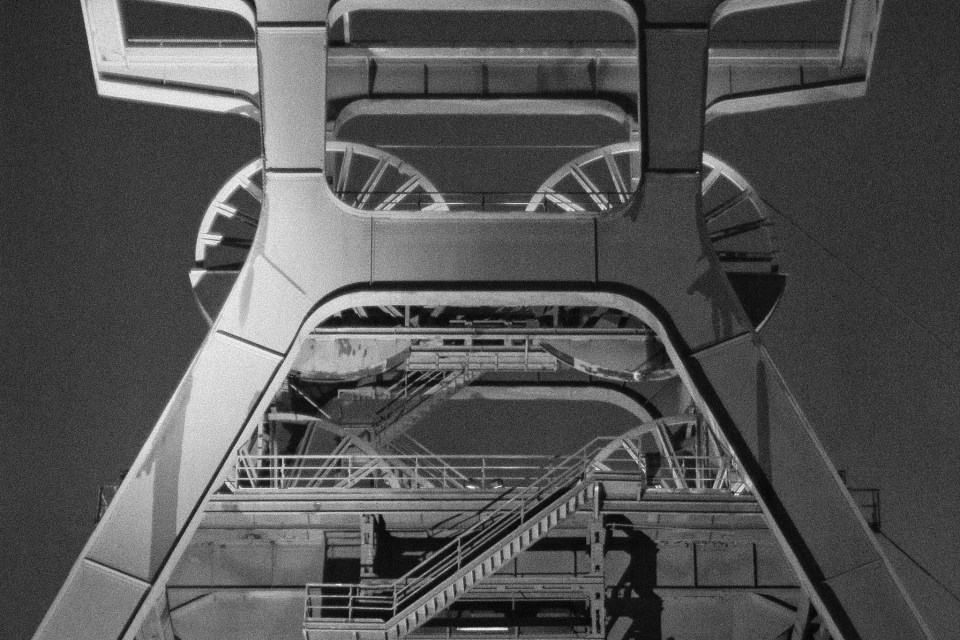
Zollverein Colliery, Essen, Ruhrgebiet, Germany, Deutschland, Welterbe Weltkulturerbe, UNESCO, World Heritage, fotoeins.com

Essen UNESCO WHS: Zollverein and Coal-Mining History

A desolate former coal-mining industrial region isn’t a usual candidate for a place to visit. However, the Zollverein coal mine in Essen, Germany provided the impetus to seek out aspects of industrial photography. There’s something special about the way light strikes metal which brings out various aspects of shape, form, and texture.

I’m beginning to understand the historical significance of coal-mining to the people and to the economy in the Ruhrgebiet (Ruhr river region). Over decades, a cloud of “grey” hung over the region, as air- and water-pollution took its toll, and the economic influence of coal began to diminish.

To mark its importance to the modern industrial development and history of the region, the Zollverein Coal Mine Industrial Complex was listed as a UNESCO World Heritage Site in 2001. The entire refurbished complex now houses space for art, design, and cultural exhibitions, and is also home to the Ruhr Museum, shedding light on the industrial history of the Ruhrgebiet, providing historical accounts of the economic importance of coal mining and its consequent decline, as well as descriptions of existing and future economic redevelopment plans for the Ruhr region.

Essen was designated as one of three European Capital Cities of Culture for 2010; a number of projects, sites, and monuments throughout the Ruhrgebiet were on display, including the Zollverein.

( Click here for images and more )