Bayreuth, Germany: inside the main hall of the Margravial Opera House (Markgräfliches Opernhaus) during guided tour. The building was inscribed as UNESCO World Heritage Site in 2012.
I made the image above on 9 Jun 2024 with a Fujifilm X70 fixed-lens prime and the following settings: 1/30-sec, f/2.8, ISO6400, and 18.5mm focal length (28mm full-frame equivalent). This post appears on Fotoeins Fotografie at fotoeins DOT com as https://wp.me/p1BIdT-wBK.
The Alter Markt square in Stralsund is brilliantly illuminated in late-day sun with St. Nikolaikirche (St. Nicholas Church) and the Rathaus (City Hall) framing the scene at right. The greenish building at centre-left is the heritage-protected mid-18th century building Commandantenhus. Stralsund’s Old Town has been inscribed as UNESCO World Heritage Site since 2002.
I made the image above on 31 May 2024 with an iPhone15; the image is corrected for geometric distortion. This post appears on Fotoeins Fotografie at fotoeins DOT com as https://wp.me/p1BIdT-wIH.
Just outside the city of Schleswig, Germany is the site of a former Viking settlement near the western end of the inlet Schlei. The sheltered harbour and a relatively short overland (portage) distance between the North and Baltic Seas made this an ideal location for settlement. The Viking sites Haithabu and Danevirke nearby have been inscribed as UNESCO World Heritage Site since 2018.
I made the image above on 30 May 2024 with a Fujifilm X70 fixed-lens prime and the following settings: , and 18.5mm focal length (28mm full-frame equivalent). This post appears on Fotoeins Fotografie at fotoeins DOT com as https://wp.me/p1BIdT-wI3.
There’s no finer way to mark today’s Canada Day than to find the Canadian Embassy 🇨🇦 in the Austrian capital city. It’s all part of my walk through the Inner City, starting at U1/U4 Schwedenplatz and ending near U2/U3 Volkstheater.
Vienna’s historic city centre was inscribed onto the list of UNESCO World Heritage Sites in 2001, but its status was put onto the Danger list in 2017 with plans (threats?) for development.
It’s 501am and 801am in Vancouver and Toronto, respectively. But here in Vienna, I completed food shopping for the next few days. I’m about to have lunch, after which is some time in the inner city. “3” (Drei) is Austria’s third largest mobile carrier after A1 and Magenta Telekom. Naturally, all temperatures are in degrees Celsius.
While the building has multiple tenants, the uppermost floor is occupied by the Government of Canada with its embassy (Botschaft).
The flag pole is attached to the wall with a metal plate in the shape of a maple leaf.
Summertime shop for Eis Greissler (Greissler’s Ice Cream).
Their flavours for the day 🍨😋
At Stephansplatz, the northwest corner of St. Stephen’s Cathedral (near the cathedral model) has on its wall a small rectangular plaque whose text inscription is almost entirely faded.
This plaque dates to 1945 when Soviet troops had moved into the city and checked building by building. The two words in Cyrillic are: квартал проверен (kvartal proveren), “Häuserblock geprüft”, building checked. There are at least 2 more Soviet inscription-plates like this appearing elsewhere in Vienna.
Steiff: it’s not only about teddy bears 🧸 so how about Riddler bear, Bat-bear, and Elton John bear. At lower-left is a more modest-sized bear holding a little red heart 🫶🏽
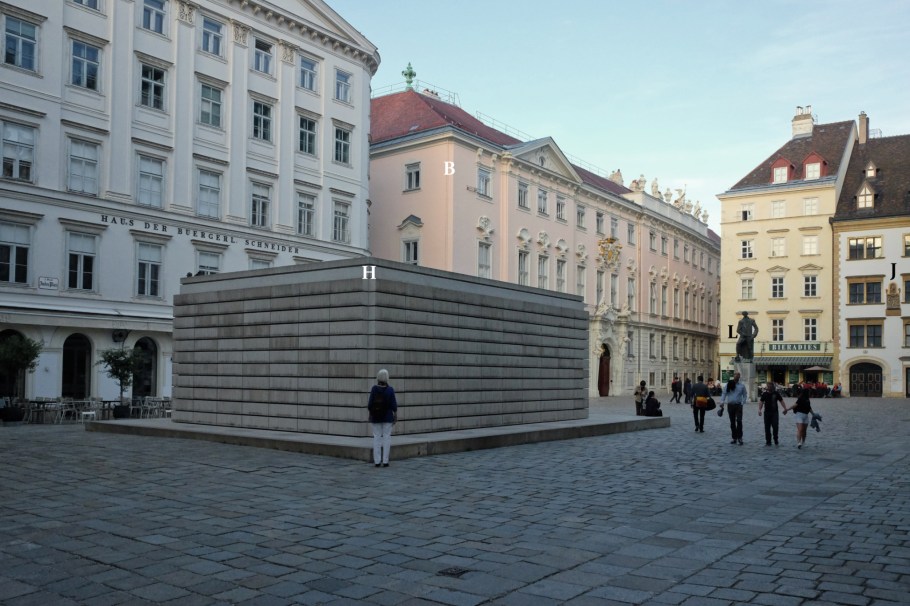
מוּזֵיאוֹן “Museum“, 2011 light installation by artist Brigitte Kowanz for the Jewish Museum Vienna.
Bräunerstrasse, west towards Josefsplatz.
“Henry: the art of living”, at Billa Corso Michaelerplatz.
Hofburg Palace, from Michaelerplatz.
“Volkspartei, Volksgarten”
“Island” platform for U-Bahn U3 (orange) station Volkstheater. This is also a junction station with the U2 line (purple).
I made all images above with an iPhone15 on 1 July 2025. This post composed within Jetpack for iOS appears on Fotoeins Fotografie at fotoeins DOT com.
Potsdam’s Sanssouci (“care free”) palace and park are very popular places for visitors in summer. However, a couple of days with severe thunderstorms and high winds in the past week forced the closure of the entire grounds, as announced earlier today on their website and as seen with signs on their locked gates. Downed branches and tree segments needed clearing. By mid-afternoon, some of the grounds opened to foot traffic, bicycles, and motor vehicles. It’s no surprise there were far fewer number of visitors observed on the grounds today.
In 1990, selected gardens and palaces in Potsdam including Sanssouci were inscribed by UNESCO as a single item onto their list of World Heritage Sites.
Locked gate on the grounds’ southern perimeter in morning hours.
Orangerieschloss: 1851 to 1860/1864, by Stüler and Persius.
Neue Kammern: 1748 by Knobelsdorff; first an orangery, then guest palace.
Hauptallee, facing west to Neues Palais.
From Hauptallee up to Sanssouci palace.
Weinbergterrasse (vineyard terrace), facing north to Sanssouci palace.
Weinbergterrasse (vineyard terrace), facing south to the Great Fountain.
On the terrace steps, up to the palace.
The final spots for Friedrich the Great (below) and his beloved dogs (above center).
Grave for Friedrich the Great (1712-1786) who ruled as Prussia’s monarch from 1740 until his death. Yes, those are spuds on the plaque; legend has him responsible as the first to getting potatoes into German hands and bellies.
The visual jewel that is the centre portion of Sanssouci Palace.
I made all images above with an iPhone15 on 27 June 2025. This post composed within Jetpack for iOS appears on Fotoeins Fotografie at fotoeins DOT com.