Fotoeins Fotografie

location bifurcation, place vs. home

Posts tagged ‘Vienna’

Vienna: Otto Wagner’s architectural legacy

Above/featured: On the Linke Wienzeile, opposite the Naschmarkt at right. Photo, 18 May 2018 (6D1).

What: Among many are 2 key structures: Post Savings Bank, Steinhof church.
Why: Some of the most important architectural examples of 20th-century modernism.
Where: Many examples found throughout the city of Vienna.
“Wagner School” included Josef Hoffmann, Joseph Maria Olbrich, Jože Plečnik.

To visit Vienna is to know Otto Wagner. A first-time visitor to the city will be forgiven for not knowing about Wagner or his creations, but throughout their time spent in the Austrian capital, they’ll encounter Wagner’s early 20th-century “Modern Architecture”.

Vienna is for many the city of Beethoven, Mozart, and Strauss; the city of historic and stylish cafés with coffee and Sacher Torte; the city whose pride is revealed in the combined World Heritage Site that are the classic period architecture within the Old Town and the beautiful palace and gardens at Schönbrunn. Flowing through the city is the Danube river, memorialized in Johann Strauss II’s “An der schönen blauen Donau” (The Blue Danube).

The evolution of architectural style is plainly evident throughout the city. Around the Ringstrasse (inner ring road) is architecture in the Historicism style, with big nods to Neoclassicism in the Parliament, Neo-Gothic in City Hall and the Votivkirche, and a lot of Neo-Renaissance represented by the City Theatre, Art History Museum, Natural History Museum, Opera House, and the University.

But as calendars flipped from 1899 to 1900, the fin-du-siècle heralded a move to bold thinking, different style, and a change in the way and reasons why buildings were put together. Consequently, Vienna is a city of 20th-century modernism whose traces are found in art, architecture, and urban planning. Even with post-war reconstruction in the mid-20th century and a mindful push for environmental rigour in the 21st-century, Vienna still remains in many ways Otto Wagner’s city.

Modern Architecture began with (Charles Rennie) Mackintosh in Scotland, Otto Wagner in Vienna, and Louis Sullivan in Chicago.

– Rudolph Schindler, who studied architecture under Otto Wagner (Sarnitz 2005).

( Click here for images and more )

Vienna Hietzing Cemetery: F.Grillparzer, G.Klimt, K.Moser, O.Wagner

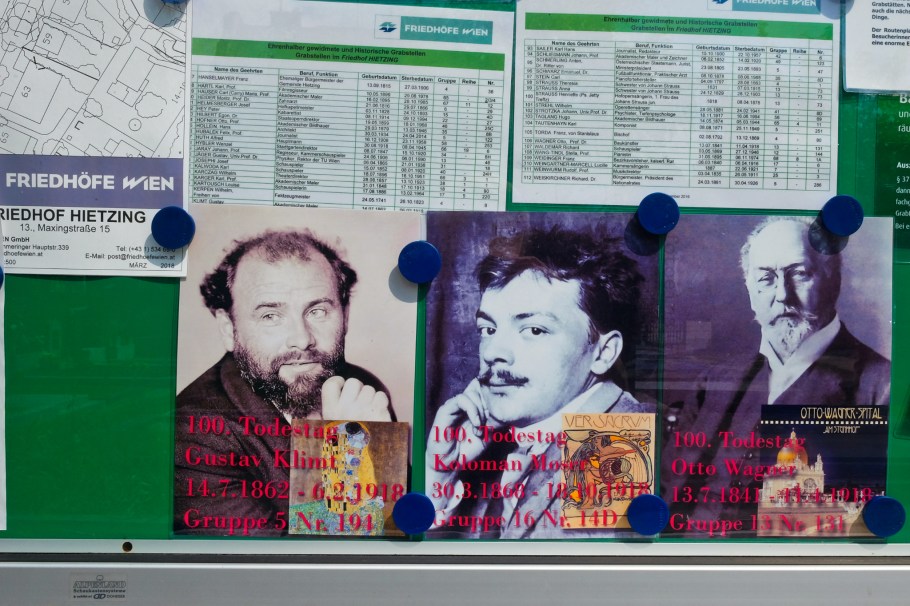
Previously, I provided short biographies for artist Gustav Klimt, artist and designer Koloman Moser, and architect Otto Wagner, and why they are important figures to the arts and culture scene in early 20th-century Vienna. These three figures are buried in Hietzing Cemetery in the 13th district of Hietzing at the city’s western periphery.

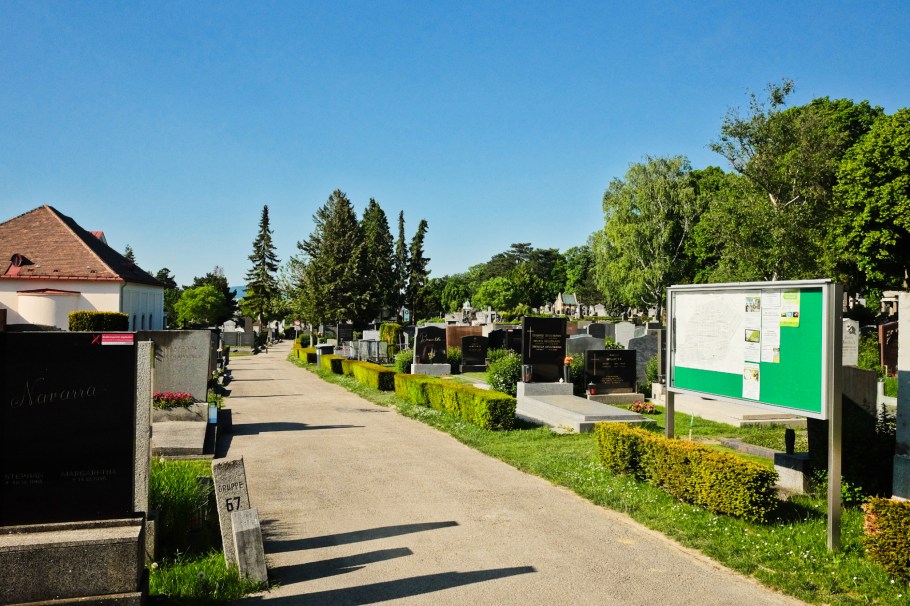
Located to the southwest of the former imperial summer residence Schönbrunner Schlosspark, Hietzing Cemetery is modest in size with an area of over 10 hectares (25 acres) and containing over 11-thousand graves. With the present site inaugurated in 1787, the cemetery has seen several expansion phases and survived damage from the Second World War.

I highlight the final resting places for Alban Berg, the Fröhlich sisters, Franz Grillparzer, Hans Hollein, Gustav Klimt, Koloman Moser, Strauss women, and Otto Wagner.

Friedhof Hietzing, Hietzing Cemetery, Friedhoefe Wien, Hietzing, Wien, Vienna, Austria, Oesterreich, fotoeins.com

2018 was the 100th anniversary of the deaths of Gustav Klimt (1862–1918), Koloman Moser (1868–1918), and Otto Wagner (1841–1918). Photo, 16 May 2018.

13. Bezirk, Hietzing, Friedhof Hietzing, Hietzing Cemetery, Friedhoefe Wien, Hietzing, Wien, Vienna, Austria, Oesterreich, fotoeins.com

Inside the front entrance – 15 May 2022.

Friedhof Hietzing, Hietzing Cemetery, Friedhoefe Wien, Hietzing, Wien, Vienna, Austria, Oesterreich, fotoeins.com

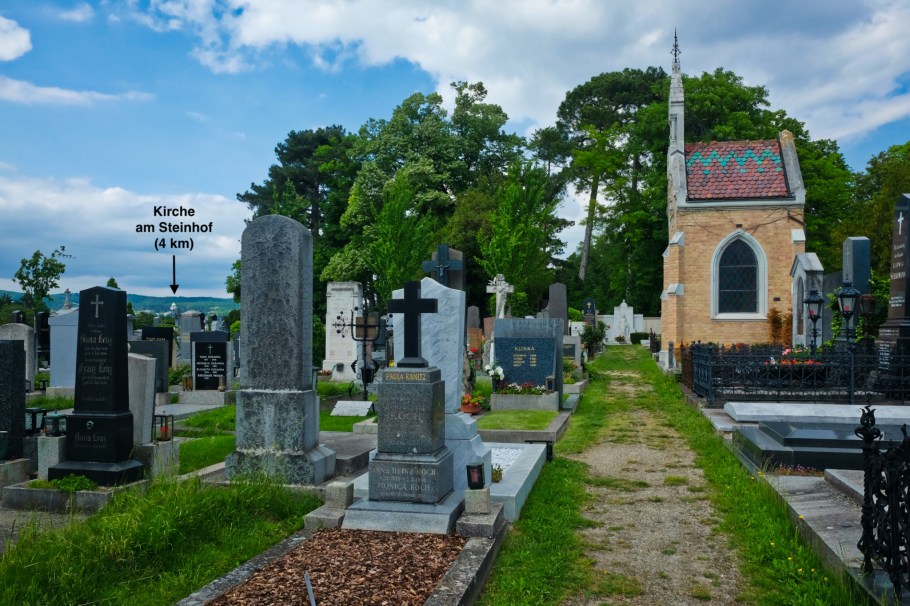
Visitors to the cemetery can look northwest to see the glowing golden dome of Otto Wagner’s Steinhof Church at a distance of 4 km (2.5 mi). Photo, 16 May 2018.


( Click here for images and more )

Vienna Central Cemetery: a city of the dead

Above/featured: The cemetery’s gate 2. Photo, 20 May 2018.

Where: Vienna Central Cemetery (Wiener Zentralfriedhof).
Who: Beethoven, Boltzmann, Falco, Lamarr, Schütte-Lihotzky, Strauss I and II.
Why: Cross-section of cultural and economic history for capital city and nation.

In Vienna, tram 71 begins in the Old Town; goes around the western half of the inner ring past City Hall, national Parliament, and the Opera House; and heads southeast to the city’s main cemetery or the Zentralfriedhof. Because coffins to the cemetery were once transported on the tram, there’s a saying particular to the city’s residents, a phrase which means they’ve died by “going to the end of the line.”

Sie haben den 71er genommen.
(They took/rode the 71.)

( Click here for images and more )

Vienna: Holocaust Memorial by Rachel Whiteread

Where: Judenplatz, in Vienna’s Altstadt.
What: Holocaust Memorial, by Rachel Whiteread (2000).

How do you commemorate or memorialize the absent or missing? How should the void be acknowledged, recognized, and remembered? Does the act of constructing a physical monument “draw a line”, creating a physical manifestation of marking an end that gathers and wipes away all subsequent future responsibility for remembering?

In Vienna’s Old Town, what was unjustly and violently removed from the city’s long historical memory and cultural identity comes into shape at Judenplatz. Under the public square are ruins of the medieval synagogue destroyed in the pogrom of 1421 with hundreds of Jews driven out, hundreds killed by burning, and the community erased. Directly above these ruins is the Holocaust Memorial which attempts to generate experiences and memories to address the void left behind after the systematic murder of 65-thousand people.

( Click here for images and more )

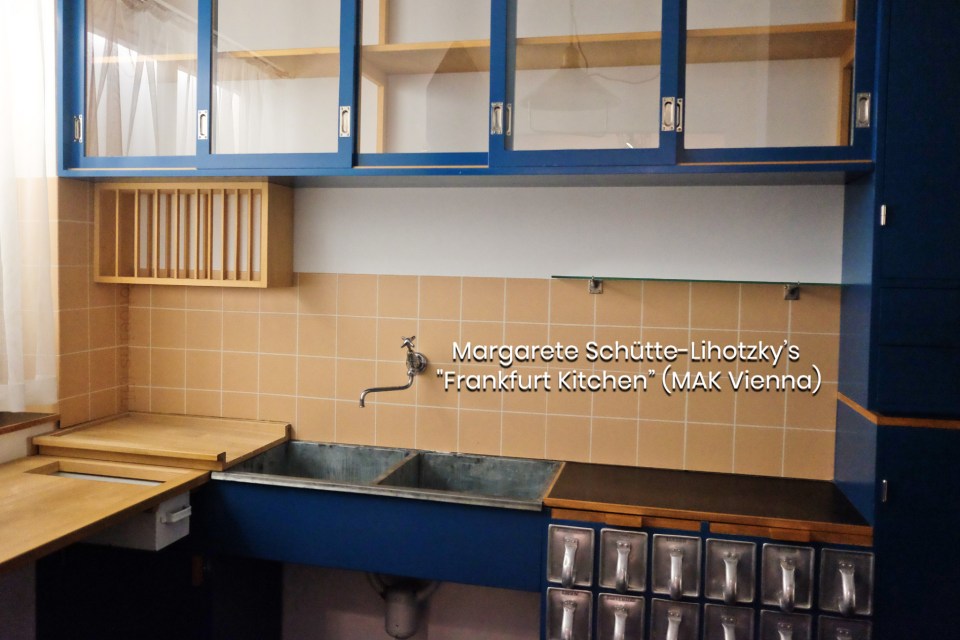
Frankurter Küche, Frankfurt kitchen, Margarete Schütte-Lihotzky, MAK Vienna, Vienna, Wien, Austria, Österreich, fotoeins.com

Vienna: Margarete Schütte-Lihotzky & the modern fitted kitchen

Who: Margarete Schütte-Lihotzky.
Key: 1st woman architect in Austria, designer of something we take entirely for granted.
Quote: “I developed the kitchen as an architect, not as a housewife.”

I always liked how cooking had well-defined endpoints: a desirable start, and a satisfying conclusion. I enjoy the process: the contemplation of “what to make,” the gathering of ingredients, the preparation, and naturally, the consumption. There might also be something to say about the duality of creation and annihilation …

That got me to thinking about kitchens as a critical unit of a home. Before the 20th-century, the wealthy could afford to have staffed kitchens; everybody else had access to no kitchen or an unsafe unhygienic kitchen in a building separate to their living quarters. The assumed universality of a kitchen within a home is a 20th-century concept and implementation that sought to overcome social and economic class. The design of a modern kitchen invites repeated patterns of movement and action around where cookware, utensils, condiments, glassware, etc. are stored and where the central focus of cooking activity takes place.

For everyone who spends any time in a kitchen, we have Margarete Schütte-Lihotzky (MSL) to thank.


( Click here for more )