Fotoeins Fotografie

location bifurcation, place vs. home

Posts tagged ‘Vienna’

Vienna: Aspang Station Deportation Memorial

“Well into the 1970s, the area around present-day Leon Zelman Park was the site of the Aspang Railway Station, which was built in 1880–1881 as a terminal for the regional Vienna-Aspang-Pitten rail line. Despite its relatively central location in the city’s 3rd district, the station served only regional rail traffic and was not very busy. These were likely reasons why after the “Anschluss” the Nazis chose this station for deportation transports.

Two transport trains departed in October 1939 with 1584 Jewish men deported to Nisko in the Lublin District of the General Governorate of occupied Poland as a failed attempt to create the Lublin reservation for expelled European Jews. Much larger deportations resumed from February 1941 to October 1942. 45451 Austrian-Jewish men and women were deported on a total of 45 transport trains to ghettos and extermination sites in (what are now) Czechia, Poland, Belarus, Lithuania, and Latvia.

In Vienna, the cynically-named Nazi ‘Zentralstelle für jüdische Auswanderung’ (Central Agency for Jewish Emigration) organized deportation efforts including forced captivity and assembly or collection points. Four internment stations were established in the city’s 2nd district where prisoners were abused and stripped of their possessions. For every transport, about one thousand people were driven to Aspang Station in uncovered trucks, in plain and open sight of the city’s population.

Of the 47035 Jewish men and women deported from Aspang Railway Station, only 1073 (2%) survived, according to the research by Austrian historian Jonny Moser, himself a survivor of the Holocaust/Shoah. In total, more than 65-thousand Austrian Jews fell victim; most of them began their road to their deaths at Aspang Station.”

•   Paraphrased from Kunst im öffentlichen Raum Wien (Art in public spaces Vienna).

After the war and Allied-occupation period, little was done to improve the station and its tracks. The station was closed in 1971 and the station building was demolished by 1977. The turn of the millennium provided momentum to both city and the national rail company for redevelopment of the area, including apartment blocks, green space, and a memorial. Today, the former railway station is Leon Zelman Park, named after Dr. Leon Zelman who established in 1980 the Jewish Welcome Service Vienna and led the organization until his passing in 2007. The inauguration of the deportation memorial occurred on 7 September 2017 with full opening to the public on the following day.


( Click here for images and more )

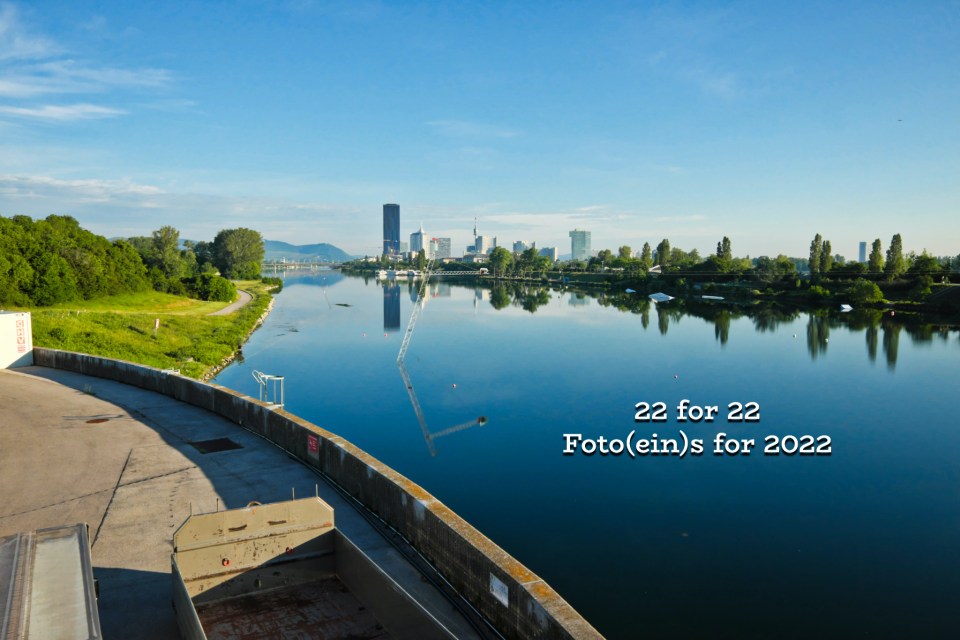
Kleinwasserkraftwerk Wehr 1, Neue Donau, 22. Bezirk, Donaustadt, Wien, Vienna, Austria, Ă–sterreich, fotoeins.com

22 for 22: Foto(ein)s for 2022

Above/featured: Vienna skyline from Kleinwasserkraftwerk Wehr I in early morning light. Photo, 7 Jun 2022.

For 2022, the act of looking forward and backward is dominated by a 4-week stay in the city of Vienna. In between the collected images is a reclaimed longing for the Austrian capital to which I was first introduced 20 years ago, but for which there was no camera and, sadly, no recorded pixels.

I’ve already described a set of images setting the urban scenes in Vienna from 2022. Below is an additional set of 22 images selected from a period of 35 days; the time interval represents only 10% of the year, but it appears to be a personally important “watershed moment” as well.


( Click here for images and more )

My Vienna: 22 urban frames for 2022

Above/featured: “The first Sunday.” Karlsplatz, 1st district – 15 May 2022.

Earlier in the year, I spent four weeks in Vienna, soaking in late-spring and early-summer weather in Austria’s capital city. I highlighted 3 images and scenes which in addition to time spent left personal impressions. Below, I highlight in a “last chance effort” an additional 22 visual examples of the urbanity in Wien, folding in splashes of colour, lines of focus, and accessibility to good timing.


( Click here for images and more )

Vienna: Imperial Court Pavilion Hietzing, by Otto Wagner

Above/featured: Hofpavillon Hietzing in afternoon light, facing east with the departing eastbound U-Bahn U4 train. Photo, 15 May 2022.

Along Vienna’s U4 metro line, a dark-domed white cube-like structure seems to float over the tracks between Schönbrunn and Hietzing stations. Most may not realize the building’s relevance to the history of the city’s first railway, the city’s rapid urban evolution into the 20th-century, and the railway architect’s eventual “break away” transition from historicism to modernism.

Vienna was going to look very different after 1890. The city undertook its second and greatest expansion, absorbing 6 outer districts and ballooning the total population to almost 1.4 million (almost doubled in 10 years). The city’s administration recognized the challenge of efficiently transporting people between its new outer suburbs and the inner city. In 1894, Vienna appointed architect Otto Wagner with the complete design and construction of the new Wiener Stadtbahn metropolitan railway. The railway saw the creation of four new lines: the Danube canal line (Donaukanallinie), the “Belt” line (Gürtellinie), the suburb line (Vorortlinie), and the Vienna river valley line (Wientallinie). Today, the city’s U-Bahn U4 and U6 lines and the S-Bahn S45 line operate electrified over much of the original routing.

The Vienna valley line brought track and construction in front of Schönbrunn, the imperial summer palace for the ruling Habsburgs. The rail line’s new Schönbrunn station was located at the northeast corner of the palace grounds. But at the grounds’ northwest corner, Wagner created two stations: one for the public, and one for the Habsburgs. Built for the inauguration of the city railway on 1 June 1898, the imperial pavilion was set aside for the emperor, family, and staff. Emperor Franz Josef I only used the pavilion twice, as he was reluctant (hostile) to accept rapid changes brought by modernity.

Wagner created a domed-building whose interior was furnished with floral and vegetal elements in the Jugendstil (Art Nouveau) style, a painting with a bird’s eye view of the city over Schönbrunn, a private suite for the emperor; and whose exterior included the uniform green and white colours seen throughout the entire rail network, glass and wrought-iron elements, and a separate portal providing a covered entrance for the imperials. Out of the many station buildings Wagner designed for the entire system, the imperial pavilion at Hietzing is most associated with the “historical” architectural style. The building is now a part of the city’s Wien Museum after successful post-war efforts to save and restore the structure.

The informal name is the “Hofpavillon Hietzing” (Imperial Court Pavilion Hietzing), but the building’s formal name is “Pavillon des kaiserlichen und königlichen Allerhöchsten Hofes” (Pavilion of the Imperial and Royal Highest Court). In the images below are divided sections: “exterior”, “interior”, and “sketches”.


( Click here for images and more )

Vienna: 1 capital city, 4 Danubes

Above/featured: Southeast view from Leopoldsberg in the city’s 19th district. Visible are the waters of the Old Danube, New Danube, Danube, and the Danube Canal. Photo, 1 Jun 2022.

Vienna loves the Danube so much that the city now has four water features with the label “Donau”.

All of it is thanks to the regulation of the Danube river after the city of Vienna and the surrounding region had to put up with frequent flooding. Vienna embarked on works of flood-control engineering in two major periods of construction: 1870 to 1875, and 1972 to 1988.

Once a former arm of the river, the Old Danube is now a crescent-shaped lake that’s been cutoff by “linearization” and straightening of the Danube. A former natural arm of the river, the Danube Canal was regulated for the first time around 1600. Most visitors will encounter the Danube Canal which is best integrated with the city with the appearance of multiple road and rail crossings and the canal’s reach with 7 of the 23 city’s districts. The Danube river proper was completely regulated and straightened during the second engineering period, which also saw construction of the New Danube as a secondary flood channel in parallel with the primary river.


( Click here for images and more )