Fotoeins Fotografie

location bifurcation, place vs. home

Posts tagged ‘Vienna architecture’

Vienna Steinhof Church: city- & Wagner-landmark

Above/featured: East side of the church, in afternoon light. Photo on 28 May 2023, X70 with wide-field WCL-X70 lens attachment, image corrected for geometric distortion.

Building: Steinhof church, also St. Leopold Church, 1907 // Kirche am Steinhof, Kirche zum heiligen Leopold.
Address: Baumgartner Höhe 1, in Penzing, the city’s 14th district.

Up on the city’s Baumgartner Heights is an example of Europe’s first modernist church at Steinhof. Dedicated to St. Leopold, the structure is one of the city’s finest examples of turn-of-the-century architecture, and one of the world’s most important churches in the Jugendstil or Art Nouveau architectural style. The church was designed and built by architect Otto Wagner, inaugurated in 1907 for patients and staff within the surrounding hospital complex the Lower Austria state, sanatorium, and nursing home for the mentally ill (Niederösterreichische Landes-, Heil-, und Pflegeanstalt für Geistes- und Nervenkranke) which included over 30 buildings and room for over 2000 beds. The bright, airy, and spacious modern design was met at that time with skepticism and criticism by local church officials. Of utmost importance on Wagner’s mind were the hospital patients: his church design was about gentle solitude, not fire and damnation.

The church was a collaborative effort with other Viennese artists, including mosaics and stained glass by Koloman Moser, angel sculptures by Othmar Schimkowitz, and exterior tower sculptures by Richard Luksch. The church roof is topped with a dome covered in gold-plated copper plates, whose bright yellow appearance in daylight merits the nickname “Limoniberg” (lemon hill) that’s visible in different parts of the city. The Steinhof church is an example of a “Gesamtkunstwerk“, where every detail and fixture contributed to a “total and functional work of art”; an architectural masterpiece of the period; and one of Otto Wagner’s most important creations.

I included this building as part of my description of Otto Wagner’s architectural legacy in Vienna and of the recent centenary celebration in Vienna of the city’s 19th- to 20th-century architectural transition from historicism to modernism.

( Click here for images and more )

Vienna: Heinrich Ferstel’s architectural legacy

Above/featured: Entrance into the Ferstel Passage (Ferstelpalais, Herrengasse 14). Photo, 2 Jun 2023 (X70).

The following structures in the city of Vienna share something (and someone) in common:

•   Café Central,
•   the University of Vienna,
•   Votive Church, and
•   the Museum for Applied Arts.

These buildings were all designed by Viennese architect Heinrich Ferstel. His architectural works left a deep and lasting impression on the city and her residents. What follows is a brief life summary and highlights from a number of his projects.

•   born/✵ 7 Jul 1828 – died/✟ 14 Jul 1883.
•   One of many architects contributing to the development of Vienna’s “Ringstrasse.”
•   1843–1847: student at Imperial & Royal Polytechnic Institute.
•   1850: completed studies at Architekturschule der Akademie der bildenden KĂĽnste (Architectural School, Academy of Fine Arts) under Carl Rösner, Eduard van der Nüll, August Sicard von Sicardsburg.
•   1866: appointed Professor of Architecture at Polytechnic Institute; subsequently, dean 1866–1870; rector 1880–1881 after institute became the Technical University in 1872.
•   1872: founded the Cottageverein (Cottage Association) for the construction of English-style family homes in the Währing district.

… Prolific Austrian architect. He (Ferstel) designed the twin-towered Gothic Revival Votivkirche (1856–1882) and various other Historicist buildings, including the vast Italian Renaissance Revival University (1873–1884) in Vienna. Much of his important work (where the influence of Semper is often clear) was done for the area adjoining the Ringstrasse, but he also designed many buildings throughout the Austro-Hungarian Empire. An advocate of housing reform, he admired English low-density developments, which influenced the Cottageverein (Cottage Association), Vienna (1872–1874), responsible for building small single-family houses. Ferstel also promoted the laying out of the TĂĽrkenschanzpark, a public park on English lines (from 1883) …

— from “A Dictionary of Architecture and Landscape Architecture


( Click here for images and more )

Vienna Ringstrasse & Architectural Historicism

Above/featured: Examples of the “Ringstraßenstil” historicism style at Maria Theresa Square, with Maria Theresa Monument at left and the Museum of Natural History at right. Photo, 15 May 2022 (X70).

•   Can a street alone define its surrounding architecture?
•   Do the buildings themselves establish the street’s visual impression?
•   Is Vienna (un)fairly defined by the Ringstrasse and the inner city?

The answers, as always, are a little complicated.

Like many, I’m also fond of Vienna’s Ringstrasse (Ring Road), as a kind of “hello” and re-introduction to the city after my first visit in 2002. At 5 kilometres in length, the Ringstrasse is one of the longest streets in Europe, longer than the nearly 2-km Champs-Élysées in Paris and longer than the 4.5-km Nevsky Prospekt in St. Petersburg. The boulevard is surrounded by Prachtbauten (buildings of splendour), constructed in the architectural style of “historicism,” a big nod to classic “forms” reflecting structural “functions”. The late-19th century “Ringstrassenstil” (Ring Road architectural style) continued the practiced habit of choosing a historical style which best identified with the purpose of the building. For example, the Neo-Baroque architectural style is represented in the Civic Theater; the Neo-Classical style in the Parliament and New Palace; the Neo-Gothic style in City Hall and the Votive Church; and the Neo-Renaissance style in the museums, palatial mansions, Opera House, and the University.

On Christmas Day 1857, the Wiener Zeitung newspaper published an imperial decree written 5 days earlier (on 20 December) by Habsburg emperor Franz Joseph I. He ordered the demolition of the inner-city wall and the subsequent creation of a circular boulevard, bordered by grand buildings and filled with green spaces. The large outward extension of the inner city changed and influenced the urban development of Vienna, still seen to this very day.

It is my will that the extension of the inner city of Vienna should proceed as soon as possible, providing for appropriate connections between the city and the suburbs as well as the embellishment of my imperial residence and capital. To this end, I authorise the removal of the walls and fortifications of the inner city as well as the ditches around it …

– Emperor Franz Joseph I: 20 Dec 1857, published 25 Dec 1857.

On 1 May 1865, Emperor Franz Josef unveiled the Ringstrasse in an official ceremony, even though large areas remained under construction. Ringstrasse structures included the religious and the secular, as well as the public and the private. The Ringstrasse symbolized the power of the imperial state, and the growth of a new arts and culture scene with the increasing popularity of coffee houses.

It’s also important to note the architectural impact made by the Jewish middle- and upper-class to integrate within the Habsburg empire. For example, the families Ephrussi, Epstein, and Todesco commissioned architect Theophil Hansen to construct palatial mansions as visible manifestations and partial realization of the dream of many Viennese Jews: assimilation into and emancipation within Viennese society. (Viennese journalist and political activist Theodor Herzl might have had a different opinion about that.)

For residents and long-term visitors today, it’s entirely possible to fit into the unintended shape and mentality of the “modern” city: that the inner-city wall was simply replaced by a different wall of “economic class”, that the architectural callback to historicism “freezes” the inner-city in time, and that like many, I can live, traverse, and work in the outer districts and avoid entering the inner city.

For short-term visitors today, the Ringstrasse buildings form a golden shiny “ring” around the “fingers” of the U1 and U3 metro lines traversing through the UNESCO World Heritage inscribed inner-city. For these visitors, all that’s needed for their limited time in Vienna is the inner city.


( Click here for images and more )

Vienna Judenplatz: centuries & memories of the Jewish community

Above/featured: Judenplatz at night. The Holocaust memorial is in the foreground at centre. In the background are “To the little trinity” at centre and Misrachi House (Museum Judenplatz) at right. Photo, 10 Jun 2022.

At Judenplatz are clear visual reminders of the city’s first Jewish community in medieval times.

The first Jewish community in Vienna settled around present-day Judenplatz in the Middle Ages with mention in written documents dated mid- to late-13th century AD/CE. Daily Jewish life thrived around the Or-Sarua Synagogue, the Jewish School, and the Mikveh ritual bath. The community along with the surrounding Jewish neighbourhood came to an end with the Pogrom of 1421. Catholic Habsburg Duke Albrecht II rolled out a decree (Wiener Geserah, Vienna Gesera) which legitimatized the expulsion, incarceration, torture, and murder of some 800 Jewish residents; accompanied by destruction and forced takeover of buildings and property.

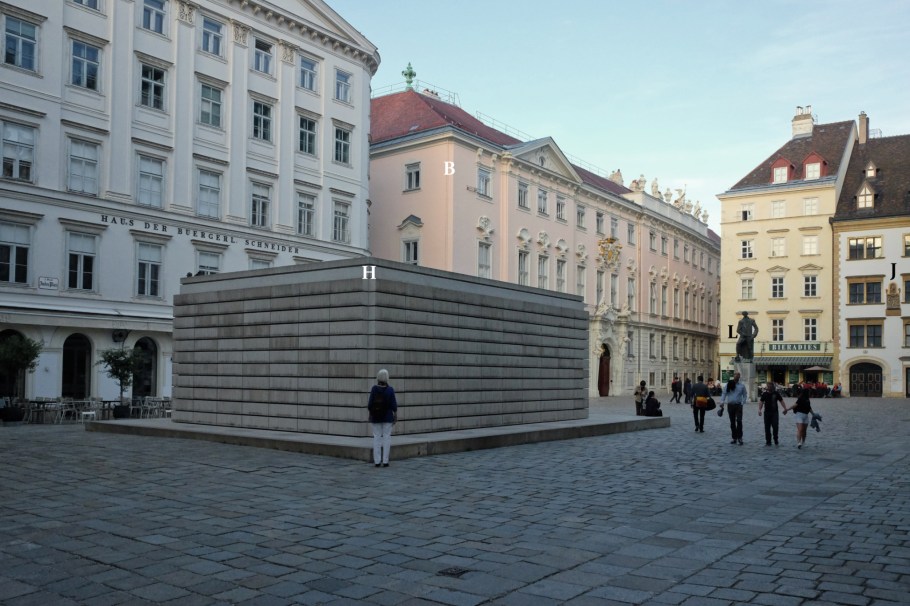
Below I highlight remnants and traces to the medieval Jewish community at this square in central Vienna.

Judenplatz, Vienna, Wien, Oesterreich, Austria, fotoeins.com

Facing northwest: B, Bohemian Chancellery; H, Holocaust Memorial; L, Lessing monument; M, Misrachi House; T, To the little Trinity. Photo, 20 May 2018.

Judenplatz, Vienna, Wien, Oesterreich, Austria, fotoeins.com

Facing southeast: B, Bohemian Chancellery; J, Jordan House; H, Holocaust memorial; L, Lessing monument. Photo, 20 May 2018.


( Click here for images and more )

Vienna: Art Nouveau (Jugendstil) examples

Above/featured: A captive audience surrounds the Gustav Klimt painting “The Kiss” in Vienna’s Upper Belvedere. Photo, 19 May 2018 (X70).

If you’re paying attention, traces of the turn-of-the-century Viennese Art Nouveau (Wiener Jugendstil) art and design movement are visible throughout the Austrian capital city.

A painting.
A sculpture.
A building.
A clock.
A church.
A building mural.
A staircase, with railings and light fixtures.
The front facade of an apartment block.
The entrance pavilion to the municipal railway.
A decorative structure marking the exit/end of a river’s diverted route underneath the city.

I provide ten visual examples below, all of which are accessible with public transport.


( Click here for images and more )