Fotoeins Fotografie

location bifurcation, place vs. home

Posts tagged ‘Via Imperii’

Fasching, Maschkera, Oimrausch: pre-Lent shenanigans in Mittenwald

This ain’t no Hallowe’en1.

In southern Germany, this is Fasching, known also as Werdenfelser Fosanacht, to go along with the masks for Maschkera. It’s also about about distinctions and differences by comparison with Karneval on the Rhein.

Festivities take place before Catholic Lent, and the key idea behind the wild colourful costumes and wooden masks is the very pagan origin and ritual of driving out or driving away evil spirits of winter lurking inside people and their homes and welcoming the friendly spirits of spring for a productive growing season.


( Click here for images and more )

Stadt- und Pfarrkirche St. Marien, St. Mary's Town and Parish Church, Wittenberg, Saxony-Anhalt, Sachsen-Anhalt, UNESCO, World Heritage, Luther Country, Luther 2017, Germany, fotoeins.com

Wittenberg UNESCO WHS: St. Mary’s Church

Above: West side illuminated by afternoon sun, 30 Oct 2016 (HL).

The Stadtkirche Sankt Marien (St. Mary’s Town and Parish Church) is the oldest building in Wittenberg, and is one of four sites in town as part of the town’sasx inscription as UNESCO World Heritage Site since 1996. Not only is this the location where Luther preached, the church also contains important relics by the Cranachs highlighting the young Reformation movement. The Cranach and Luther families were close, as well as contemporary colleagues.

The east chancel (near the main altar) was part of the original St. Mary’s chapel built around 1280. By the early 15th-century, the chapel was incorporated into a triple-naved structure with two towers in the late-Gothic style at the west end of the new church; the Gothic tops were removed and replaced by octagonal shapes by the mid-16th century. The original pulpit from which Luther delivered his sermons has survived the centuries, and is now located in Wittenberg’s Luther House (Lutherhaus).

( Click here for images and more )

Stadtkirche, Schlosskirche, Lutherstadt Wittenberg, Wittenberg, Saxony-Anhalt, Sachsen-Anhalt, Germany, UNESCO World Heritage Site, fotoeins.com

Wittenberg: 13 historical highlights in the Lutherstadt

Above: Facing west from Kirchplatz, the Stadtkirche (City Church) and Schlosskirche (Castle Church) at upper-left and lower-right, respectively, are Wittenberg’s major landmarks.

If you’re thinking about or you’re already present in Wittenberg, two words have already provided the marquee reasons why you’re here at this blogsite and there in the town: Martin Luther.

The biggest reason why people will step foot in Wittenberg is to see and learn about how the Protestant and Reformation movement began and took hold, who the major players were, and what their roles were in the movement. For most, they’ll want to visit the four sites which form the basis for the town’s status as UNESCO World Heritage Site (WHS; see below). In addition to these four, there are other highlights for the curious and interested visitor, and all of them are easy to reach in the compact Old Town.


( Click here for images and more )

Martin Luther, Museum Lutherstiege, St.-Anna-Kirche, Augsburg, Bayern, Bavaria, Germany, fotoeins.com

Augsburg: Luther vs. Cajetan (1518), Confessions (1530)

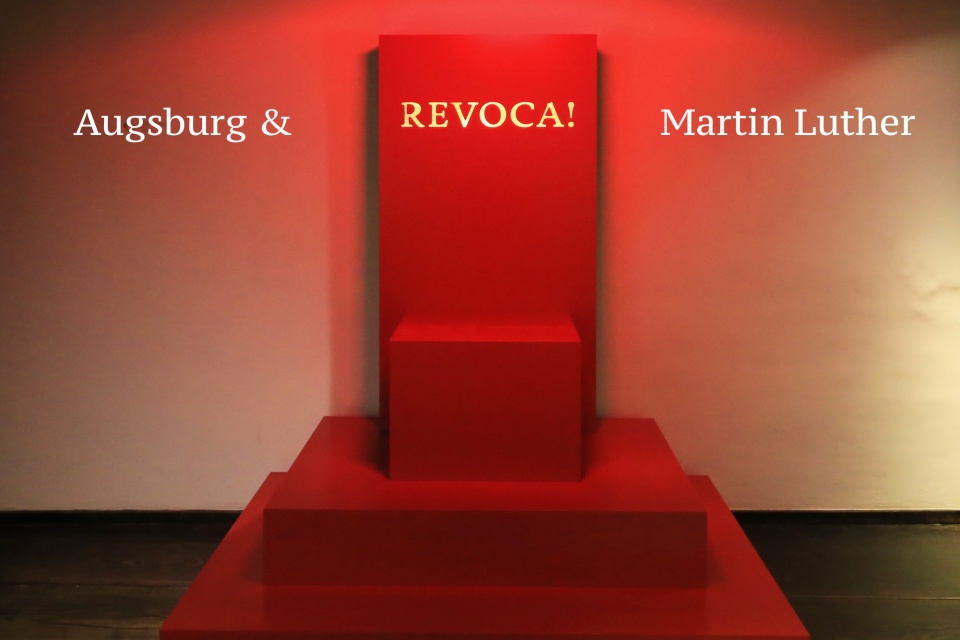
Above/featured: REVOCA! (Cajetan to Luther, 1518), Museum Lutherstiege.

With its founding date as “Augusta Vindelicorum” by the Roman Empire in 15 BC/BCE, Augsburg is one of the oldest cities in Germany, and has ties with Martin Luther and the Reformation which marks its 500th anniversary in 2017.

Months after making his 95 Theses known to church authorities and the public, Martin Luther was called to the free imperial city of Augsburg in 1518 by Cardinal and papal legate and representative Cajetan to answer charges of heresy, for challenging the morality of indulgences, and for questioning the supreme authority of the Pope. Cajetan urged Luther to recant or revoke his statements (“revoca!”), but Luther held firm and refused to obey Cajetan.
( Click here for images and more )

Wittenberg UNESCO WHS: The Castle Church

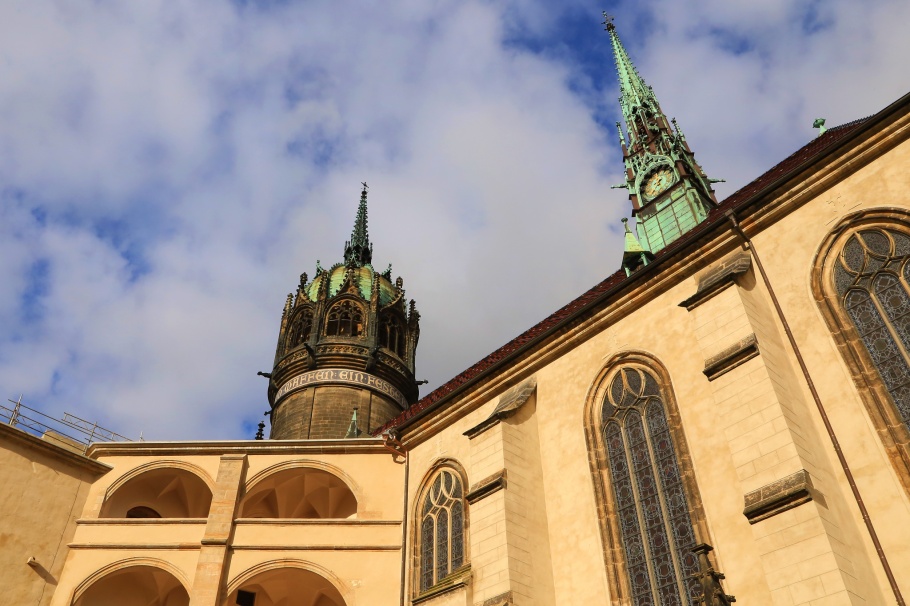
In the east German town of Wittenberg, the Schlosskirche (Castle- or All Saints’-Church) is one of four sites as part of the town’s status as UNESCO World Heritage Site since 1996.

Elector Frederick III of Ernestine Saxony (1463-1525, also known as Frederick the Wise, Friederich der Weise) became the first patron of the Protestant Reformation with his support and defence of Martin Luther. On the site of the original city castle, Frederick the Wise authorized in 1489-1490 a renaissance palace with the entire north wing occupied by the Castle Church. The church was consecrated and inaugurated in 1503 as the castle and university church “Allerheiligen” (All Saints); Martin Luther taught theology as professor at the neighbouring university. The first Protestant service at the Castle Church was held in 1524-1525.

A significant portion of the church including the original wooden doors was burned and destroyed in 1760 during Europe’s Seven Years’ War (1754-1763). The 1770 replacement church was subsequently destroyed in the conflict against France’s Napoleon which ended with the town under Prussian control in 1815. With support and backing by Emperor Wilhelm II, a full renovation of the church took place between 1885 and 1892 with the west tower taking the form and shape we see today (see also below). The graves for Martin Luther, contemporary colleague and fellow reformer Philipp Melanchthon, and Frederick the Wise are inside the church. After three years of renovation and restoration work in time for the Reformation quincentenary in 2017, the Castle Church was reopened in the autumn of 2016.

Schlosskirche, Castle Church, Wittenberg, Sachsen-Anhalt, Saxony-Anhalt, UNESCO World Heritage Site, Germany, fotoeins.com

( Click here for images and more )