Fotoeins Fotografie

location bifurcation, place vs. home

Posts tagged ‘Swabia’

Allgäu winter: Fellhorn in the German-Austrian Alps

Above: A group of skiers gather before their run near the Fellhorn summit.

As a product of the Canadian southwest, I’ve maintained a fascination with mountains. I don’t necessarily need to climb the mountains, but I’ve always been curious about the names of mountains, the reasons for their names, and the people who named them. I’m not always going to get answers, but if there’s a lift to take me to a view, I’m always game.

With an easy bus from Oberstdorf in the southwest corner of Germany, I’m headed 10 km south to Faistenoy for the gondola up to the summit of Fellhorn (2038 metres) among the Allgäu Alps. There’s a lot of snow up top with a depth of about 1.5 metres; skiing and snowboarding conditions look good in the Skigebiet Fellhorn-Kanzelwand (Fellhorn-Kanzelwand Ski Area). But what do I know? I don’t ski or snowboard, but the winter-afternoon light is decent on the smooth snowy landscape. I’m drawn to the information displays to learn more about Fellhorn and the mountains I’m seeing in the near 360-degree panorama. In the distance the flat-topped Hoher Ifen mountain looks like a multiple-layer cream-filled cake. I arrive quickly at a couple of conclusions: one, it’s fun to stand on a border between two countries at altitude, even if an international frontier is set somewhat arbitrarily; and two, I promise to return in the summertime to do a loop: return to Fellhorn, hike along the relatively flat ridge-line west, take the Kanzelwandbahn gondola down into Austria’s Kleinwalsertal, have a sip and nosh in one of the alpine towns, and return to Germany’s Oberstdorf on a local bus.


( Click here for images and more )

Augsburg: Fugger, Luther, & water in Germany’s 3rd oldest city

Above/featured: Facing north on Maximilianstrasse: Steigenberger Hotel Drei Mohren (left), Fuggerhäuser (orange) – HL, 12 Mar 2017.

Why Augsburg?

  • Fugger family legacy
  • Martin Luther and the Reformation legacy
  • Water supply management, newly inscribed World Heritage Site

I had come to Augsburg to find and understand traces Martin Luther left behind in the city. What I learned was the extent of the lasting legacy provided by the Fugger family, and how the city has for centuries provided safe clean water to her citizens, and how that water management system has become world-renowned as a piece of cultural heritage, forming the basis of an application for recognition as a World Heritage Site.

( Click here for images and more )

Freistaat Bayern, The Free State of Bavaria

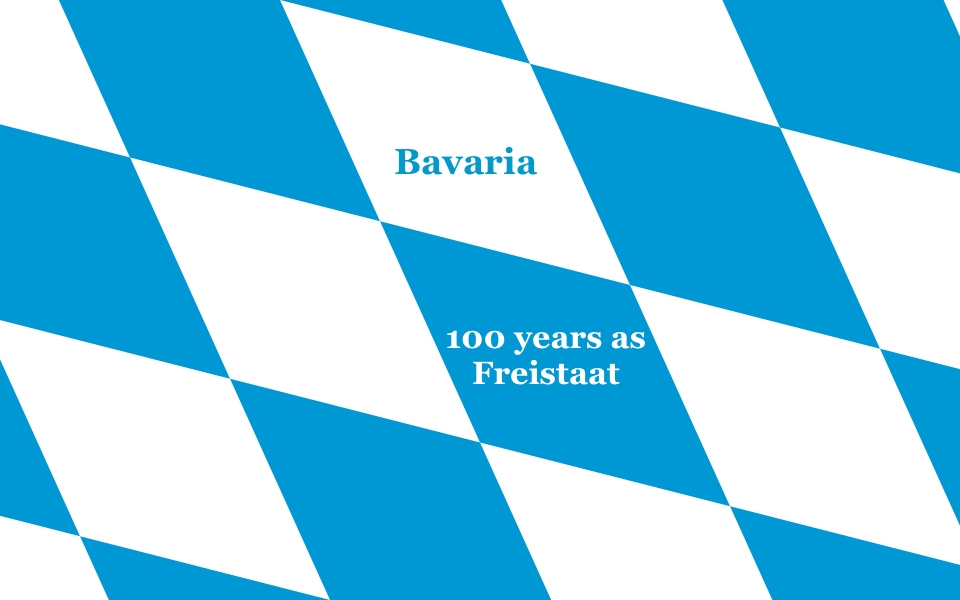
Bavaria: 100 years of statehood (2018)

Featured image: The blue and white diamonds (fusils) are a familiar Bavarian symbol, adopted in the late 13th-century by the Wittelsbach family who ruled Bavaria from 1180 to 1918.

As a product of the coastal and mountainous Canadian Southwest, I always feel the pull exerted by the Bavarian Alps regardless of where I am in Germany; it’s been this way over the past 18 years. But there’s more to Bavaria than fairytale castles, Oktoberfest, and BMW, although they’re spot on for the Wurst (sausage). And frankly, there’s a ton more to Germany than Bavaria, but that’s one of many reasons for this entire blogsite after all.

Located in southeast Germany, Bavaria includes more than a half-dozen World Heritage Sites, the pre-Easter Fasching/Fastnacht festival, the sight of Audis on the Autobahn, over one thousand years of wine-making in Franconia, and violin-making since the late 17th-century, among many things to explore, eat, and experience.
( Click here for more )

Martin Luther, Museum Lutherstiege, St.-Anna-Kirche, Augsburg, Bayern, Bavaria, Germany, fotoeins.com

Augsburg: Luther vs. Cajetan (1518), Confessions (1530)

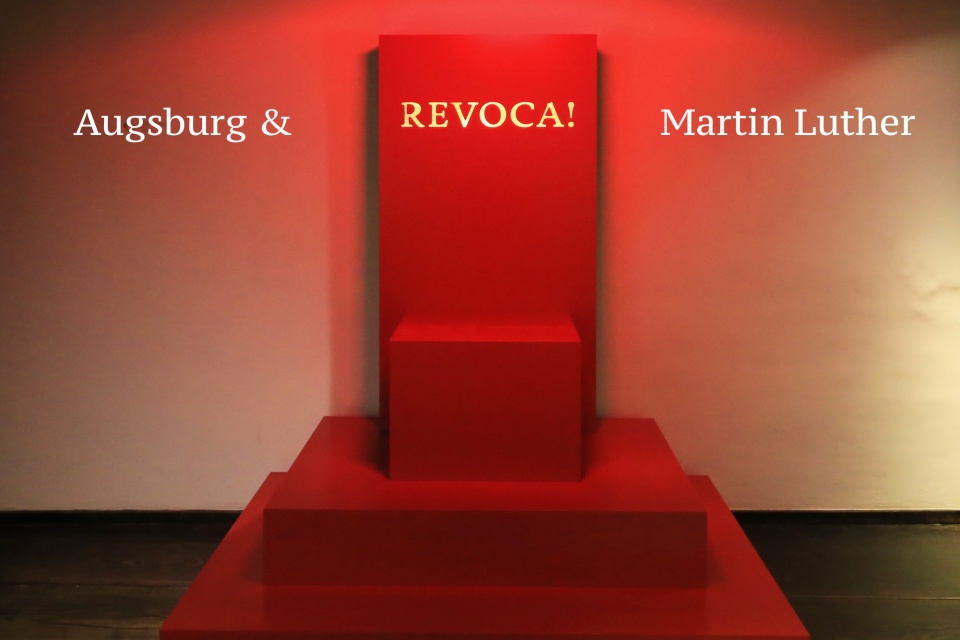
Above/featured: REVOCA! (Cajetan to Luther, 1518), Museum Lutherstiege.

With its founding date as “Augusta Vindelicorum” by the Roman Empire in 15 BC/BCE, Augsburg is one of the oldest cities in Germany, and has ties with Martin Luther and the Reformation which marks its 500th anniversary in 2017.

Months after making his 95 Theses known to church authorities and the public, Martin Luther was called to the free imperial city of Augsburg in 1518 by Cardinal and papal legate and representative Cajetan to answer charges of heresy, for challenging the morality of indulgences, and for questioning the supreme authority of the Pope. Cajetan urged Luther to recant or revoke his statements (“revoca!”), but Luther held firm and refused to obey Cajetan.


( Click here for images and more )