Fotoeins Fotografie

location bifurcation, place vs. home

Posts tagged ‘Otto Wagner’

Vienna Steinhof Church: city- & Wagner-landmark

Above/featured: East side of the church, in afternoon light. Photo on 28 May 2023, X70 with wide-field WCL-X70 lens attachment, image corrected for geometric distortion.

Building: Steinhof church, also St. Leopold Church, 1907 // Kirche am Steinhof, Kirche zum heiligen Leopold.
Address: Baumgartner Höhe 1, in Penzing, the city’s 14th district.

Up on the city’s Baumgartner Heights is an example of Europe’s first modernist church at Steinhof. Dedicated to St. Leopold, the structure is one of the city’s finest examples of turn-of-the-century architecture, and one of the world’s most important churches in the Jugendstil or Art Nouveau architectural style. The church was designed and built by architect Otto Wagner, inaugurated in 1907 for patients and staff within the surrounding hospital complex the Lower Austria state, sanatorium, and nursing home for the mentally ill (Niederösterreichische Landes-, Heil-, und Pflegeanstalt für Geistes- und Nervenkranke) which included over 30 buildings and room for over 2000 beds. The bright, airy, and spacious modern design was met at that time with skepticism and criticism by local church officials. Of utmost importance on Wagner’s mind were the hospital patients: his church design was about gentle solitude, not fire and damnation.

The church was a collaborative effort with other Viennese artists, including mosaics and stained glass by Koloman Moser, angel sculptures by Othmar Schimkowitz, and exterior tower sculptures by Richard Luksch. The church roof is topped with a dome covered in gold-plated copper plates, whose bright yellow appearance in daylight merits the nickname “Limoniberg” (lemon hill) that’s visible in different parts of the city. The Steinhof church is an example of a “Gesamtkunstwerk“, where every detail and fixture contributed to a “total and functional work of art”; an architectural masterpiece of the period; and one of Otto Wagner’s most important creations.

I included this building as part of my description of Otto Wagner’s architectural legacy in Vienna and of the recent centenary celebration in Vienna of the city’s 19th- to 20th-century architectural transition from historicism to modernism.
( Click here for images and more )

Vienna: Imperial Court Pavilion Hietzing, by Otto Wagner

Above/featured: Hofpavillon Hietzing in afternoon light, facing east with the departing eastbound U-Bahn U4 train. Photo, 15 May 2022.

Along Vienna’s U4 metro line, a dark-domed white cube-like structure seems to float over the tracks between Schönbrunn and Hietzing stations. Most may not realize the building’s relevance to the history of the city’s first railway, the city’s rapid urban evolution into the 20th-century, and the railway architect’s eventual “break away” transition from historicism to modernism.

Vienna was going to look very different after 1890. The city undertook its second and greatest expansion, absorbing 6 outer districts and ballooning the total population to almost 1.4 million (almost doubled in 10 years). The city’s administration recognized the challenge of efficiently transporting people between its new outer suburbs and the inner city. In 1894, Vienna appointed architect Otto Wagner with the complete design and construction of the new Wiener Stadtbahn metropolitan railway. The railway saw the creation of four new lines: the Danube canal line (Donaukanallinie), the “Belt” line (Gürtellinie), the suburb line (Vorortlinie), and the Vienna river valley line (Wientallinie). Today, the city’s U-Bahn U4 and U6 lines and the S-Bahn S45 line operate electrified over much of the original routing.

The Vienna valley line brought track and construction in front of Schönbrunn, the imperial summer palace for the ruling Habsburgs. The rail line’s new Schönbrunn station was located at the northeast corner of the palace grounds. But at the grounds’ northwest corner, Wagner created two stations: one for the public, and one for the Habsburgs. Built for the inauguration of the city railway on 1 June 1898, the imperial pavilion was set aside for the emperor, family, and staff. Emperor Franz Josef I only used the pavilion twice, as he was reluctant (hostile) to accept rapid changes brought by modernity.

Wagner created a domed-building whose interior was furnished with floral and vegetal elements in the Jugendstil (Art Nouveau) style, a painting with a bird’s eye view of the city over Schönbrunn, a private suite for the emperor; and whose exterior included the uniform green and white colours seen throughout the entire rail network, glass and wrought-iron elements, and a separate portal providing a covered entrance for the imperials. Out of the many station buildings Wagner designed for the entire system, the imperial pavilion at Hietzing is most associated with the “historical” architectural style. The building is now a part of the city’s Wien Museum after successful post-war efforts to save and restore the structure.

The informal name is the “Hofpavillon Hietzing” (Imperial Court Pavilion Hietzing), but the building’s formal name is “Pavillon des kaiserlichen und königlichen Allerhöchsten Hofes” (Pavilion of the Imperial and Royal Highest Court). In the images below are divided sections: “exterior”, “interior”, and “sketches”.


( Click here for images and more )

Vienna: Othmar Schimkowitz sculptures in the capital

Above/featured: Musenhaus (Muse House), Linke Wienzeile in Vienna – 18 May 2018.

Early 20th-century European artist Othmar Schimkowitz was one of many key figures in Vienna Modernism, an art movement which celebrated its centennial in 2018 in the Austrian capital city. Schimkowitz was born in Hungary and became well-known in Vienna for his architectural sculptures. In 1898, he joined the (Vienna) Secession, a group of artists which included Josef Hoffmann, Gustav Klimt, Max Kurzweil, Carl Moll, Koloman Moser, and Joseph Maria Olbrich.

Sculptures by Schimkowitz are often seen in a variety of architectural creations by Otto Wagner. Here below are four Schimkowitz examples in Vienna; all are accessible with public transit from Wiener Linien (WL) transport authority.


( Click here for images and more )

Vienna: Otto Wagner’s architectural legacy

Above/featured: On the Linke Wienzeile, opposite the Naschmarkt at right. Photo, 18 May 2018 (6D1).

What: Among many are 2 key structures: Post Savings Bank, Steinhof church.
Why: Some of the most important architectural examples of 20th-century modernism.
Where: Many examples found throughout the city of Vienna.
“Wagner School” included Josef Hoffmann, Joseph Maria Olbrich, JoĹľe PleÄŤnik.

To visit Vienna is to know Otto Wagner. A first-time visitor to the city will be forgiven for not knowing about Wagner or his creations, but throughout their time spent in the Austrian capital, they’ll encounter Wagner’s early 20th-century “Modern Architecture”.

Vienna is for many the city of Beethoven, Mozart, and Strauss; the city of historic and stylish cafĂ©s with coffee and Sacher Torte; the city whose pride is revealed in the combined World Heritage Site that are the classic period architecture within the Old Town and the beautiful palace and gardens at Schönbrunn. Flowing through the city is the Danube river, memorialized in Johann Strauss II’s “An der schönen blauen Donau” (The Blue Danube).

The evolution of architectural style is plainly evident throughout the city. Around the Ringstrasse (inner ring road) is architecture in the Historicism style, with big nods to Neoclassicism in the Parliament, Neo-Gothic in City Hall and the Votivkirche, and a lot of Neo-Renaissance represented by the City Theatre, Art History Museum, Natural History Museum, Opera House, and the University.

But as calendars flipped from 1899 to 1900, the fin-du-siècle heralded a move to bold thinking, different style, and a change in the way and reasons why buildings were put together. Consequently, Vienna is a city of 20th-century modernism whose traces are found in art, architecture, and urban planning. Even with post-war reconstruction in the mid-20th century and a mindful push for environmental rigour in the 21st-century, Vienna still remains in many ways Otto Wagner’s city.

Modern Architecture began with (Charles Rennie) Mackintosh in Scotland, Otto Wagner in Vienna, and Louis Sullivan in Chicago.

– Rudolph Schindler, who studied architecture under Otto Wagner (Sarnitz 2005).

( Click here for images and more )

Vienna Hietzing Cemetery: F.Grillparzer, G.Klimt, K.Moser, O.Wagner

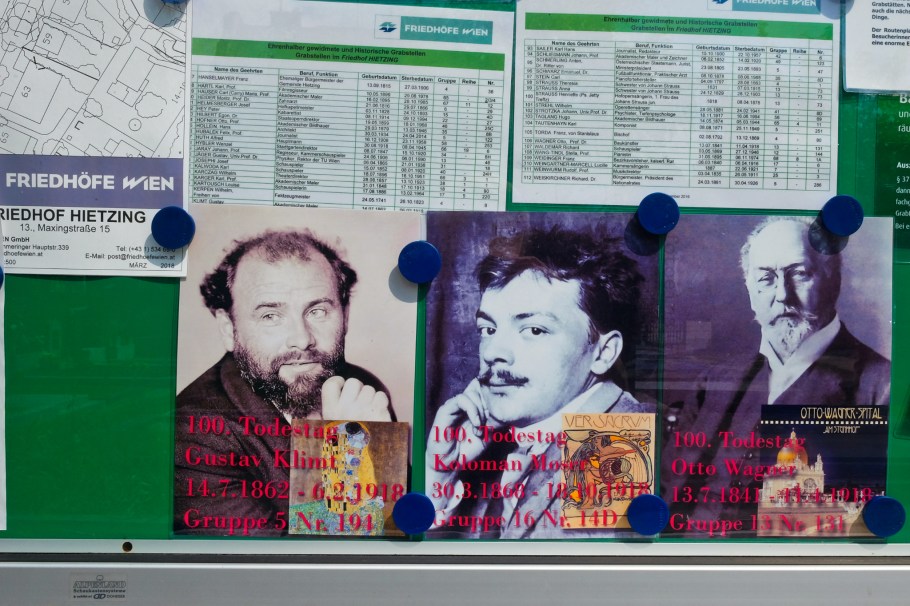
Previously, I provided short biographies for artist Gustav Klimt, artist and designer Koloman Moser, and architect Otto Wagner, and why they are important figures to the arts and culture scene in early 20th-century Vienna. These three figures are buried in Hietzing Cemetery in the 13th district of Hietzing at the city’s western periphery.

Located to the southwest of the former imperial summer residence Schönbrunner Schlosspark, Hietzing Cemetery is modest in size with an area of over 10 hectares (25 acres) and containing over 11-thousand graves. With the present site inaugurated in 1787, the cemetery has seen several expansion phases and survived damage from the Second World War.

I highlight the final resting places for Alban Berg, the Fröhlich sisters, Franz Grillparzer, Hans Hollein, Gustav Klimt, Koloman Moser, Strauss women, and Otto Wagner.

Friedhof Hietzing, Hietzing Cemetery, Friedhoefe Wien, Hietzing, Wien, Vienna, Austria, Oesterreich, fotoeins.com

2018 was the 100th anniversary of the deaths of Gustav Klimt (1862–1918), Koloman Moser (1868–1918), and Otto Wagner (1841–1918). Photo, 16 May 2018.

13. Bezirk, Hietzing, Friedhof Hietzing, Hietzing Cemetery, Friedhoefe Wien, Hietzing, Wien, Vienna, Austria, Oesterreich, fotoeins.com

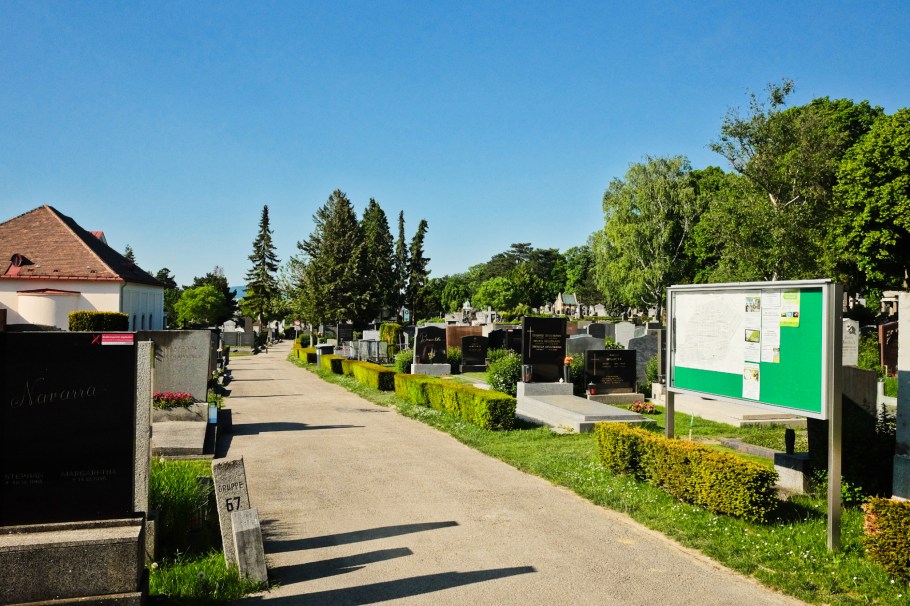
Inside the front entrance – 15 May 2022.

Friedhof Hietzing, Hietzing Cemetery, Friedhoefe Wien, Hietzing, Wien, Vienna, Austria, Oesterreich, fotoeins.com

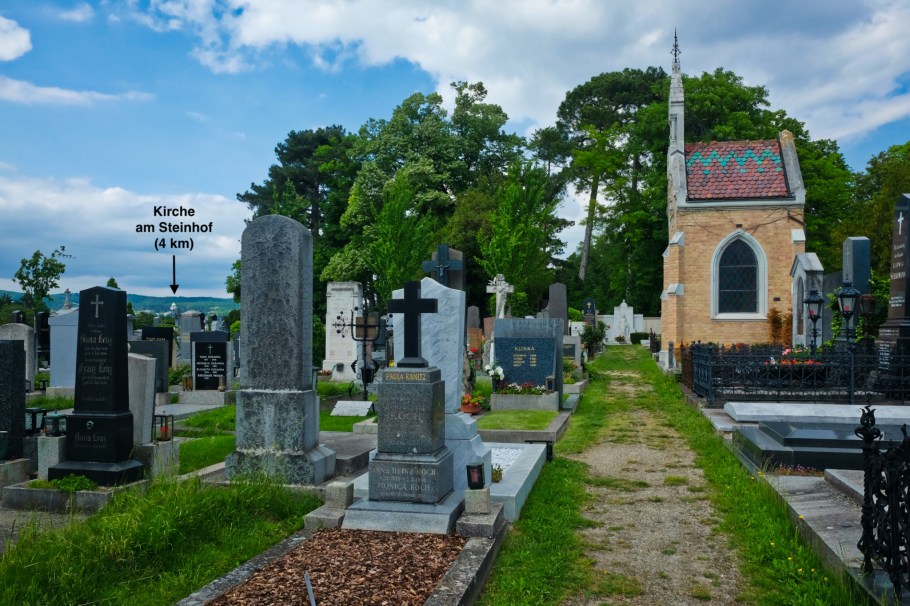
Visitors to the cemetery can look northwest to see the glowing golden dome of Otto Wagner’s Steinhof Church at a distance of 4 km (2.5 mi). Photo, 16 May 2018.


( Click here for images and more )