Fotoeins Fotografie

location bifurcation, place vs. home

Posts tagged ‘Oesterreich’

My Tirol: Scharnitz and Porta Claudia

Where: Scharnitz, at the northern edge of Austria’s Tirol, next to the Austro-German frontier.
What: Porta Claudia, mid 17th-century fortifications directed by and named after Claudia de’ Medici.
BTW: Scharnitz Pass is technically not a mountain pass.

I’m interested in geography, historical relics, and the topography of European borders.

Scharnitz Pass is one of the lowest crossing points over the Alps at an elevation of only 955 metres (3130 feet) with the Wetterstein mountains on one side to the west and the Karwendel mountains to the other side in the east. The pass might better be described as a “gorge”, given how the Isar river traverses the valley floor between the two sets of mountains. Naturally, a road at this location would’ve been ideal as a vital north-south route for trade and communication, which is why the Romans built the stone road, Via Raetia, through the river valley. A 200-metre section of this old Roman road remains in the woods outside the nearby town of Klais. The location of the pass/gorge is also why the Romans built a guard station “Mansio Scarbia” here to control traffic between the northern outer provinces and the rest of the inner empire to the south.

One of the earliest records from the 8th-century AD/CE documents the establishment of Scaraza Monastery, known also as Scarantia#. The name evolved to “Scaraz”, “Scarbia”, “Scarnize”, and eventually “Scharnitz”. Today, between 1300 and 1400 people live in the Austrian town of Scharnitz in the Tirolean region of Seefeld. The town lies on the road between Innsbruck and Munich and next to the international border between Austria and Germany; the strategic importance of this modest town has never gone away.

“Porta Claudia” is the name of former fortifications on high ground at a narrow curve over the Isar river valley. In the midst of the pan-European Thirty Years War, Claudia de’ Medici, the Regent of Austrian Tirol, ordered in 1632 the construction of a strategic defensive rampart at the Tirol-Bavaria border to protect Tirol’s northern border from invasion by Swedish forces. The Bavarians overran the rampart in 1706, but fortifications were expanded in 1766. Johann Wolfgang von Goethe wrote about passing through Scharnitz in 1786 on his journey into Italy. In 1805, Napolean’s army laid siege and destroyed the fortifications, freeing the path for joint French-Bavarian armed forces to enter Austria. Remnants of the retaining wall up to six metres in height and an archway through the wall are visible today.

I’m up and about at dawn, and within 50 minutes on an S-Bahn Tirol S5* train from Innsbruck, I’m about to satisfy my curiosity about this stretch of the Tirolean landscape in Scharnitz. With the existing Schengen treaty among participating European nations, anyone can walk, bike, or drive freely across the unguarded international border between Austria and Germany%.

# “Scar” (noun), 2nd etymological meaning.
% I entered the European Union at Frankfurt am Main international airport where I went through passport check and control.
* S5 in May 2018; renumbered as S6 as of Oct 2020.


( Click here for images and more )

Vienna Central Cemetery: living city of the dead

Above/featured: The cemetery’s gate 2. Photo, 20 May 2018.

Where: Vienna Central Cemetery (Wiener Zentralfriedhof).
Who: Beethoven, Boltzmann, Falco, Lamarr, Schütte-Lihotzky, Strauss I and II, and many more.
Why: Cross-section of cultural and economic history for capital city and nation.

In Vienna, tram 71 begins in the Old Town; goes around the western half of the inner ring past City Hall, national Parliament, and the Opera House; and heads southeast to the city’s main cemetery or the Zentralfriedhof. Because coffins to the cemetery were once transported on the tram, there’s a saying particular to the city’s residents, a phrase which means they’ve died by “going to the end of the line.”

Sie haben den 71er genommen.
(They took/rode the 71.)

( Click here for images and more )

Vienna: Holocaust Memorial by Rachel Whiteread

Where: Judenplatz, in Vienna’s Altstadt.
What: Holocaust Memorial, by Rachel Whiteread (2000).

How do you commemorate or memorialize the absent or missing? How should the void be acknowledged, recognized, and remembered? Does the act of constructing a physical monument “draw a line”, creating a physical manifestation of marking an end that gathers and wipes away all subsequent future responsibility for remembering?

In Vienna’s Old Town, what was unjustly and violently removed from the city’s long historical memory and cultural identity comes into shape at Judenplatz. Under the public square are ruins of the medieval synagogue destroyed in the pogrom of 1421 with hundreds of Jews driven out, hundreds killed by burning, and the community erased. Directly above these ruins is the Holocaust Memorial which attempts to generate experiences and memories to address the void left behind after the systematic murder of 65-thousand people.

( Click here for images and more )

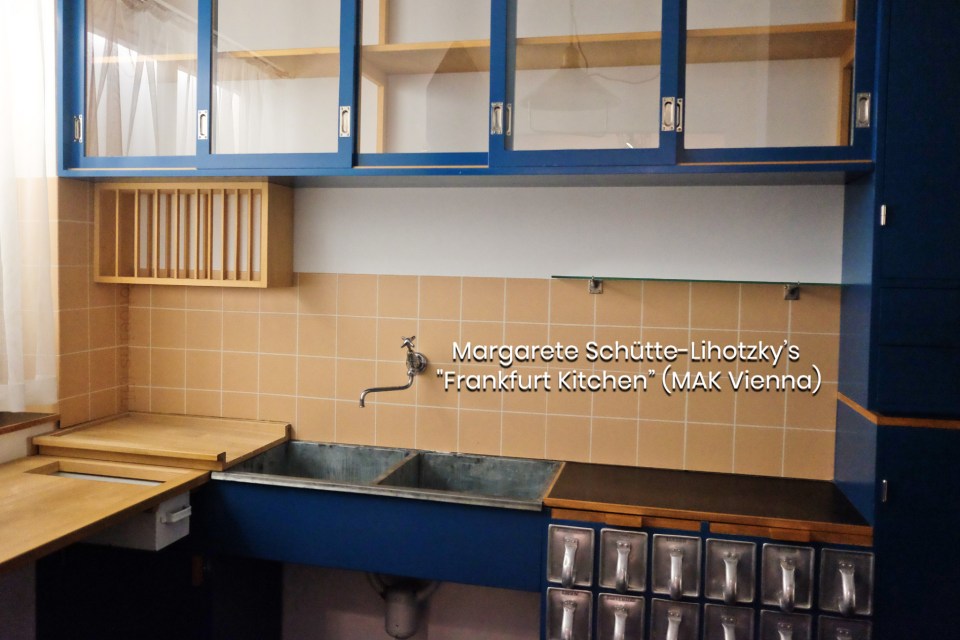
Frankurter Küche, Frankfurt kitchen, Margarete Schütte-Lihotzky, MAK Vienna, Vienna, Wien, Austria, Österreich, fotoeins.com

Vienna: Margarete Schütte-Lihotzky & the modern fitted kitchen

Who: Margarete Schütte-Lihotzky.
Key: 1st woman architect in Austria, designer of something we take entirely for granted.
Quote: “I developed the kitchen as an architect, not as a housewife.”

I always liked how cooking had well-defined endpoints: a desirable start, and a satisfying conclusion. I enjoy the process: the contemplation of “what to make,” the gathering of ingredients, the preparation, and naturally, the consumption. There might also be something to say about the duality of creation and annihilation …

That got me to thinking about kitchens as a critical unit of a home. Before the 20th-century, the wealthy could afford to have staffed kitchens; everybody else had access to no kitchen or an unsafe unhygienic kitchen in a building separate to their living quarters. The assumed universality of a kitchen within a home is a 20th-century concept and implementation that sought to overcome social and economic class. The design of a modern kitchen invites repeated patterns of movement and action around where cookware, utensils, condiments, glassware, etc. are stored and where the central focus of cooking activity takes place.

For everyone who spends any time in a kitchen, we have Margarete Schütte-Lihotzky (MSL) to thank.


( Click here for more )

Einöden, Gasthof Hauserwirt, Wörgl, Tyrol, Tirol, Kufstein, Austria, Österreich, fotoeins.com

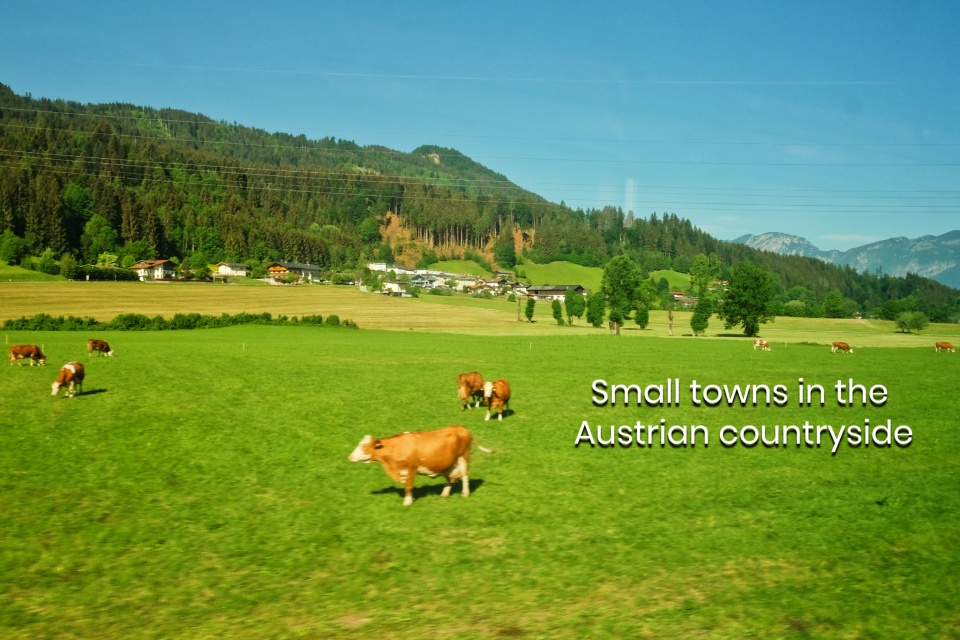
Small towns in the Austrian countryside

Above/featured: Bovine goodness with Gasthof Hauserwirt in the background, in Einöden at the outskirts of Wörgl – 13 May 2018.

Österreichische Dörfer auf dem Land

Spending a few weeks exploring Austria in spring between peak winter and summer seasons got me to examine a variety of artistic and cultural aspects, including:

•   a search for Erwin Schrödinger’s grave,
•   a century of Vienna Modernism,
•   a day-trip from Vienna to Bratislava with a boat on the Danube, and
•   looking for modern Salzburg beyond Mozart and The Sound of Music,

Because I’m all about trains and buses in Europe, there were many towns encountered: some passed by, and others planned and visited. The following examples of small towns in Austria includes a generous portion of mountains from the Austrian Alps.


( Click here for images and more )