Fotoeins Fotografie

location bifurcation, place vs. home

Posts tagged ‘Oesterreich’

My Vienna: Austrian artist Julia Bugram

Above/featured: The artist in their workspace in Vienna. Photo, 11 Jul 2025 (X70).

The sculpture provided the introduction in 2022.

Two clasped hands, each as tall as a person. Each hand made with 1-million 1-Eurocent coins.

Seen in 2022, next to St. Stephan’s Cathedral. Seen next in 2023, the sculpture moved near the big fountain at Schwarzenbergplatz. A wonderful crowdfunded project, created by Austrian artist Julia Bugram.

In spring 2025, I receive a kind invitation to visit her studio in Vienna; come July and I’m in the city’s 5th district. I make my way up to the 2nd floor of a renovated pre-war building, and arrive at a cozy working art-space shared between Julia and a second artist. I’m not surprised to find tall ceilings, big windows, a small kitchen, and just enough space and storage for two artists to share and split the rent.

In her practice, Julia explores themes surrounding community and society; and how art can create, enhance, and strengthen connections among people. Her artistic influences include: Hilma af Klimt, Mela Diamant, Renate Bertlmann, Margot Pilz, Jakob Lena Knebl, Martha Jungwirth. We spoke at some length about the economic and cultural challenges facing contemporary Austrian artists in the creation and distribution of their work, as well as the difficulty of commuting between Vienna and her home in Burgenland. I’m looking forward to seeing what she’ll create in the near future.

Links to her website and Instagram.


Raising Hands, Stephansplatz, Stephansdom, 1. Bezirk, Innere Stadt, Wien, Vienna, Austria, Ă–sterreich, fotoeins.com

“Raising Hands”, by Julia Bugram, at Stephansplatz next to Stephansdom (St. Stephen’s Cathedral). Photo, 23 May 2022 (X70).

Raising Hands, Stephansplatz, Stephansdom, 1. Bezirk, Innere Stadt, Wien, Vienna, Austria, Ă–sterreich, fotoeins.com

Closeup of “Raising Hands”, at Stephansplatz. Photo, 23 May 2022 (X70).

Raising Hands, Schwarzenbergplatz, 3. Bezirk, Landstrasse, Wien, Vienna, Austria, Ă–sterreich, fotoeins.com

A year later, “Raising Hands” was moved to Schwarzenbergplatz in front of the Hochstrahlbrunnen fountain. Photo, 13 May 2023 (X70).

Raising Hands, Schwarzenbergplatz, 3. Bezirk, Landstrasse, Wien, Vienna, Austria, Ă–sterreich, fotoeins.com

“Raising Hands”, facing northwest at Schwarzenbergplatz. As of 2024, the sculpture was no longer at Schwarzenbergplatz; the artwork is presently in storage as mentioned by the artist. Photo, 13 May 2023 (X70).

Julia Bugram, 5. Bezirk, Margareten, Wien, Vienna, Austria, Ă–sterreich, fotoeins.com

Working art space shared by Julia Bugram and Elisabeth Hansa; I’ve obscured their contact numbers. As the sign next to the building entrance states, appointments are only by agreed arrangement. Photo, 11 Jul 2025 (P15).

Julia Bugram, 5. Bezirk, Margareten, Wien, Vienna, Austria, Ă–sterreich, fotoeins.com

“Widerstand & Neugierde: Kunst, die Veränderung fordert.” (Resistance & Curiosity: art that demands change): her recent monograph with images of recent art pieces, including extensive discussion and the context of her work. Photo, 11 Jul 2025 (P15).

Julia Bugram, 5. Bezirk, Margareten, Wien, Vienna, Austria, Ă–sterreich, fotoeins.com

Her acknowledgements: those who directly supported the publishing of her book are mostly from Vienna and other parts of Austria. Photo, 11 Jul 2025 (P15).

Julia Bugram, 5. Bezirk, Margareten, Wien, Vienna, Austria, Ă–sterreich, fotoeins.com

Many of the pieces on the wall include sketches of plants, emphasizing her desire to commune with and derive inspiration from nature. Photo, 11 Jul 2025 (X70).

Julia Bugram, 5. Bezirk, Margareten, Wien, Vienna, Austria, Ă–sterreich, fotoeins.com

“Fut” (vulgar word whose English translation rhymes with ‘punt’), as part of her triptych “Fut — Mut — Wut”. Photo, 11 Jul 2025 (P15).

Julia Bugram, 5. Bezirk, Margareten, Wien, Vienna, Austria, Ă–sterreich, fotoeins.com

“Mut” (courage), as part of her triptych “Fut — Mut — Wut”. Photo, 11 Jul 2025 (P15).

Julia Bugram, 5. Bezirk, Margareten, Wien, Vienna, Austria, Ă–sterreich, fotoeins.com

“Wut” (fury). Her triptych creation, “Fut — Mut — Wut” (2021), presented here in alphabetical order with carefully selected wallpaper-like background motifs. Three words of equal length in rhyme, each word describing an aspect of womanhood; women in sole possession and complete command of expression, connotation, meaning, and application. Photo, 11 Jul 2025 (P15).

Julia Bugram, 5. Bezirk, Margareten, Wien, Vienna, Austria, Ă–sterreich, fotoeins.com

Defiance and empowerment, body autonomy, questions of the external gaze, and control of their own narratives. Photo, 25 Jul 2025 (P15).


My thanks to Julia for her invitation and her time. I made all images above in 2022, 2023, and 2025 with a Fujifilm X70 fixed-lens prime (X70) and an iPhone15 (P15). I received neither pre-visit support nor post-visit compensation for this piece. This post appears on Fotoeins Fotografie at fotoeins DOT com as https://wp.me/p1BIdT-y3i. Last edit: 27 Mar 2026.

Vienna: “Yellow Fog” by Olafur Eliasson

Above/featured: “Aus eigener Kraft”. Photo, 16 Jul 2025 (X70).

Is that red-hot steam?

It’s a warm and breezy summer evening, the colour of the light is illusory, and the blanket of mist is cool on contact.

At the southwest corner of the Am Hof square in central Vienna is the corporate headquarters of Verbund. Installed outside the building is Icelandic-Danish artist Olafur Eliasson‘s 2008 sculptural work “Yellow Fog“. The open public square becomes the arena to changing light, colour, and transparency; asking questions of perception and perspective. The display occurs every night for an hour after dusk, but not in winter.

( Click here for images and more )

Vienna Grinzing Cemetery: Bernhard, Doderer, Ferstel, Mahler, Rosé

Above/featured: Grinzing cemetery, facing southeast. Photo, 26 May 2022.

Opening for its first burial in 1830, the Grinzing Cemetery in Vienna’s 19th district is modest in size, spread over an area of about 4.1 hectares (10 acres) and home to over 5000 graves. I highlight a number of notable people in arts and architecture, including connections with composer Gustav Mahler.


( Click here for images and more )

Allgäu winter: Fellhorn in the German-Austrian Alps

Above: A group of skiers gather before their run near the Fellhorn summit.

As a product of the Canadian southwest, I’ve maintained a fascination with mountains. I don’t necessarily need to climb the mountains, but I’ve always been curious about the names of mountains, the reasons for their names, and the people who named them. I’m not always going to get answers, but if there’s a lift to take me to a view, I’m always game.

With an easy bus from Oberstdorf in the southwest corner of Germany, I’m headed 10 km south to Faistenoy for the gondola up to the summit of Fellhorn (2038 metres) among the Allgäu Alps. There’s a lot of snow up top with a depth of about 1.5 metres; skiing and snowboarding conditions look good in the Skigebiet Fellhorn-Kanzelwand (Fellhorn-Kanzelwand Ski Area). But what do I know? I don’t ski or snowboard, but the winter-afternoon light is decent on the smooth snowy landscape. I’m drawn to the information displays to learn more about Fellhorn and the mountains I’m seeing in the near 360-degree panorama. In the distance the flat-topped Hoher Ifen mountain looks like a multiple-layer cream-filled cake. I arrive quickly at a couple of conclusions: one, it’s fun to stand on a border between two countries at altitude, even if an international frontier is set somewhat arbitrarily; and two, I promise to return in the summertime to do a loop: return to Fellhorn, hike along the relatively flat ridge-line west, take the Kanzelwandbahn gondola down into Austria’s Kleinwalsertal valley, have a sip and nosh in one of the alpine towns, and return to Germany’s Oberstdorf on a local bus.


( Click here for images and more )

Vienna Steinhof Church: city- & Wagner-landmark

Above/featured: East side of the church, in afternoon light. Photo on 28 May 2023, X70 with wide-field WCL-X70 lens attachment, image corrected for geometric distortion.
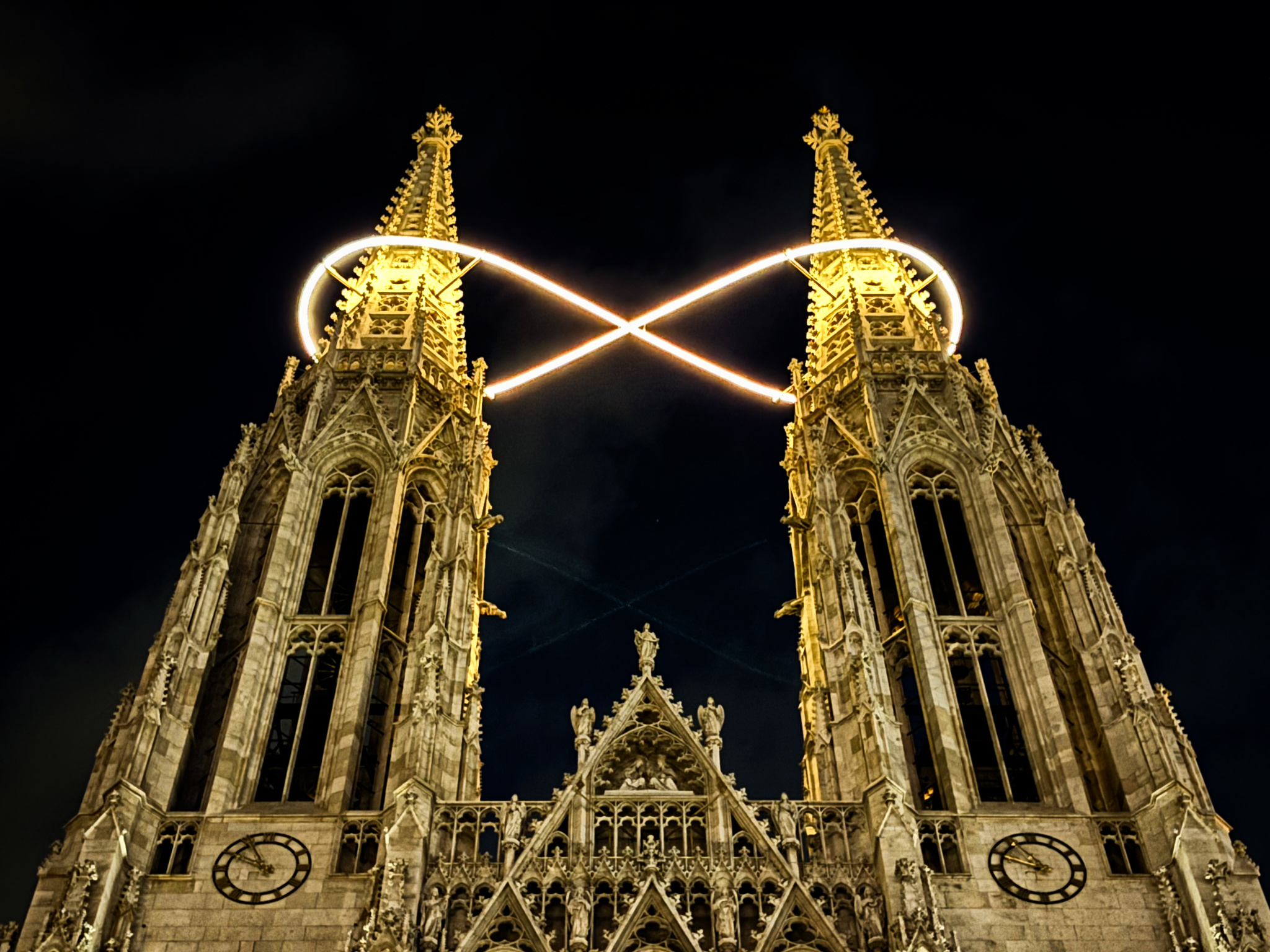
Building: Steinhof church, also St. Leopold Church, 1907 // Kirche am Steinhof, Kirche zum heiligen Leopold.
Address: Baumgartner Höhe 1, in Penzing, the city’s 14th district.

Up on the city’s Baumgartner Heights is an example of Europe’s first modernist church at Steinhof. Dedicated to St. Leopold, the structure is one of the city’s finest examples of turn-of-the-century architecture, and one of the world’s most important churches in the Jugendstil or Art Nouveau architectural style. The church was designed and built by architect Otto Wagner, inaugurated in 1907 for patients and staff within the surrounding hospital complex the Lower Austria state, sanatorium, and nursing home for the mentally ill (Niederösterreichische Landes-, Heil-, und Pflegeanstalt für Geistes- und Nervenkranke) which included over 30 buildings and room for over 2000 beds. The bright, airy, and spacious modern design was met at that time with skepticism and criticism by local church officials. Of utmost importance on Wagner’s mind were the hospital patients: his church design was about gentle solitude, not fire and damnation.

The church was a collaborative effort with other Viennese artists, including mosaics and stained glass by Koloman Moser, angel sculptures by Othmar Schimkowitz, and exterior tower sculptures by Richard Luksch. The church roof is topped with a dome covered in gold-plated copper plates, whose bright yellow appearance in daylight merits the nickname “Limoniberg” (lemon hill) that’s visible in different parts of the city. The Steinhof church is an example of a “Gesamtkunstwerk“, where every detail and fixture contributed to a “total and functional work of art”; an architectural masterpiece of the period; and one of Otto Wagner’s most important creations.

I included this building as part of my description of Otto Wagner’s architectural legacy in Vienna and of the recent centenary celebration in Vienna of the city’s 19th- to 20th-century architectural transition from historicism to modernism.


( Click here for images and more )