Fotoeins Fotografie

location bifurcation, place vs. home

Posts tagged ‘Luther Trail’

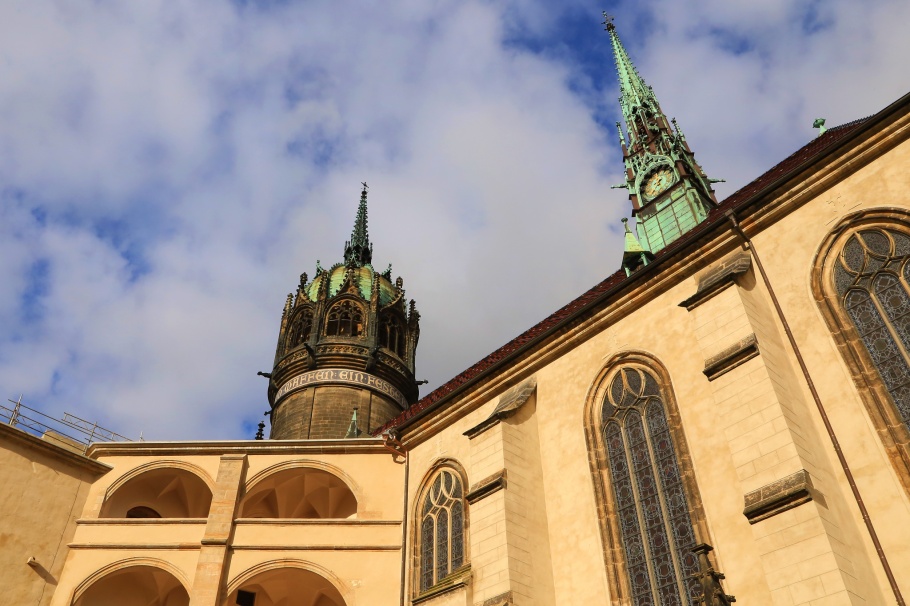
Wittenberg UNESCO WHS: The Castle Church

In the east German town of Wittenberg, the Schlosskirche (Castle- or All Saints’-Church) is one of four sites as part of the town’s status as UNESCO World Heritage Site since 1996.

Elector Frederick III of Ernestine Saxony (1463-1525, also known as Frederick the Wise, Friederich der Weise) became the first patron of the Protestant Reformation with his support and defence of Martin Luther. On the site of the original city castle, Frederick the Wise authorized in 1489-1490 a renaissance palace with the entire north wing occupied by the Castle Church. The church was consecrated and inaugurated in 1503 as the castle and university church “Allerheiligen” (All Saints); Martin Luther taught theology as professor at the neighbouring university. The first Protestant service at the Castle Church was held in 1524-1525.

A significant portion of the church including the original wooden doors was burned and destroyed in 1760 during Europe’s Seven Years’ War (1754-1763). The 1770 replacement church was subsequently destroyed in the conflict against France’s Napoleon which ended with the town under Prussian control in 1815. With support and backing by Emperor Wilhelm II, a full renovation of the church took place between 1885 and 1892 with the west tower taking the form and shape we see today (see also below). The graves for Martin Luther, contemporary colleague and fellow reformer Philipp Melanchthon, and Frederick the Wise are inside the church. After three years of renovation and restoration work in time for the Reformation quincentenary in 2017, the Castle Church was reopened in the autumn of 2016.

Schlosskirche, Castle Church, Wittenberg, Sachsen-Anhalt, Saxony-Anhalt, UNESCO World Heritage Site, Germany, fotoeins.com

( Click here for images and more )

Wittenberger Marktplatz, Rathaus, Lutherdenkmal, Stadtkirche Sankt Marien, Marktplatz, Lutherstadt Wittenberg, Sachsen-Anhalt, Wittenberg, Saxony-Anhalt, Germany, Deutschland, UNESCO, World Heritage Site, Welterbe, Weltkulturerbe, fotoeins.com

The Saxony-Anhalt 5: Luther & Bauhaus

(October 2016.)

As motivation to trace Martin Luther’s footsteps for the 500th anniversary of the Reformation in 2017 and to learn more about the impact of the Bauhaus art and design movement for the centenary in 2019, I embarked on a press-trip in the autumn 2016 to the German federal state of Saxony-Anhalt.

(( The description of this trip would be a continuation of a consecutive annual streak going back to 2001. I’ve set foot inside Germany at least once every year since 2001. I’d already claimed another consecutive year with a short stint at “home” in the HD earlier in the spring, but autumn in-country* solidly confirmed a 16th consecutive year in the country. ))

( Click here for more )

Magdeburger Dom: oldest Gothic cathedral in Germany

As the largest Gothic church in northern Europe, Cologne’s Cathedral gets a lot of love in words and pictures for its size and splendour. But the distinction of oldest Gothic church in Germany goes to Magdeburg. The church is the city’s landmark and the church’s benefactor is part of the city’s nickname as “Ottostadt”. The full name of the church is “Dom zu Magdeburg St. Mauritius und Katharina”, or Magdeburg Cathedral of Saints Catherine and Maurice, reflecting the history at this very location since the 10th-century.

Magdeburg Cathedral is important because:

  • it’s the burial place for Otto the Great, the first German Holy Roman Emperor,
  • it’s the first church constructed in Gothic style on German soil, and
  • it’s the largest consecrated space in east Germany.

( Click here for more )

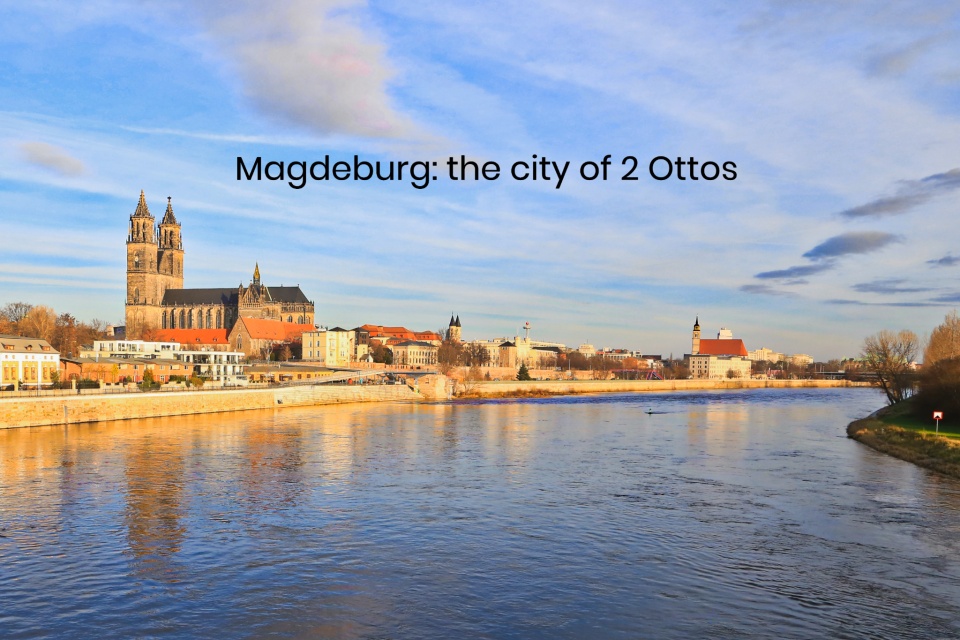
Morning view, Morgenblick, city view, Stadtblick, Hubbruecke, Elbe river, Romanesque Road, Strasse der Romanik, Magdeburg, Sachsen-Anhalt, Saxony Anhalt, Germany, Deutschland, fotoeins.com

Magdeburg: the Otto city where Romanesque meets Luther

Above/featured: From Hubbrücke bridge over the Elbe river, churches left to right are Dom, Kloster Unser Lieben Frauen, and Johanniskirche, respectively. Photo on 3 Dec 2015.

I’ve seen the city on the map, lying halfway between Hannover and Berlin. Over the last 15 years, there’ve been far too many ICE trains along that very same stretch, bypassing the heart of Saxony-Anhalt. Curiosity eventually wins, and I’m on a train to Magdeburg.

Magdeburg is the capital city of the German federal state of Saxony-Anhalt, home to two famous Ottos, a centre for the state’s Romanesque Road, and one of the stations for (Martin) Luther Country. Founded by Charlemagne in 805 AD/CE, the city is one of the oldest German cities, celebrating their 1200th anniversary in 2005. Magdeburg was an important medieval city in the Holy Roman Empire, a member of the Hanseatic League and important trade centre along the Elbe river, a welcome settlement for Jews in the 10th-century, and one of the first places to begin separating church- from civic-rule of law in the 13th-century with the Magdeburger Recht (Magdeburg Rights).


( Click here for more )

Erfurt: 12 stations through the Old Town

Above/featured: Krämerbrücke in shadow, at first light.

Located along the Gera river near the centre of Germany, Erfurt is an historical hub of east-west trade, a stop on the historical road “Via Regia” dating back to the Middle Ages, and is considered a spiritual home for Martin Luther. He left behind plenty of traces throughout the city which is now the capital city for the German state of Thuringia (Landeshauptstadt Thüringens). For its preserved medieval Old Town, half-timbered houses, and churches, Erfurt has the nickname “Thuringian Rome.”

Each of the following locations in addition to the Erfurt’s Hauptbahnhof (Central Station) is indicated with an icon in the map below. All 12 places below can be reached with tram routes 3, 4, or 6 in a common stretch with stops at Anger, Fischmarkt / Rathaus (Fish Market / City Hall), and Domplatz (Cathedral Square).


( Click here for images and more )