Fotoeins Fotografie

location bifurcation, place vs. home

Posts tagged ‘Luther Country’

Green Citadel, Grüne Zitadelle, photo by Andreas Lander, Magdeburg Tourism MMKT, Hundertwasser, Magdeburg, Sachsen-Anhalt, Saxony-Anhalt, Germany, fotoeins.com

Magdeburg’s Hundertwasser landmark: the Green Citadel

“It’s so pink!”

“Yes, but by design, there’s a lot of green foliage integrated within and around the building.”

“But why is the building pink?”

“That colour irritates a few people, particularly some at the big bank next door and even some at state government offices nearby.”

Wouldn’t that be fitting for Hundertwasser, who declared straight lines as “godless” and called his final work “an oasis for humanity and nature in a sea of rational houses”?

In art and in architecture, there’s no mistaking an inevitable clash between what’s “fanciful” and what’s “functional”. Not only has this conflict always been around in some shape or form, it’s a sign there’s change, disruption, or rebellion against the staid of the contemporary. What’s also true is that what’s believed to be “common” has rarely been universal, by place or in time.

( Click here for more )

Magdeburger Dom: oldest Gothic cathedral in Germany

As the largest Gothic church in northern Europe, Cologne’s Cathedral gets a lot of love in words and pictures for its size and splendour. But the distinction of oldest Gothic church in Germany goes to Magdeburg. The church is the city’s landmark and the church’s benefactor is part of the city’s nickname as “Ottostadt”. The full name of the church is “Dom zu Magdeburg St. Mauritius und Katharina”, or Magdeburg Cathedral of Saints Catherine and Maurice, reflecting the history at this very location since the 10th-century.

Magdeburg Cathedral is important because:

  • it’s the burial place for Otto the Great, the first German Holy Roman Emperor,
  • it’s the first church constructed in Gothic style on German soil, and
  • it’s the largest consecrated space in east Germany.

( Click here for more )

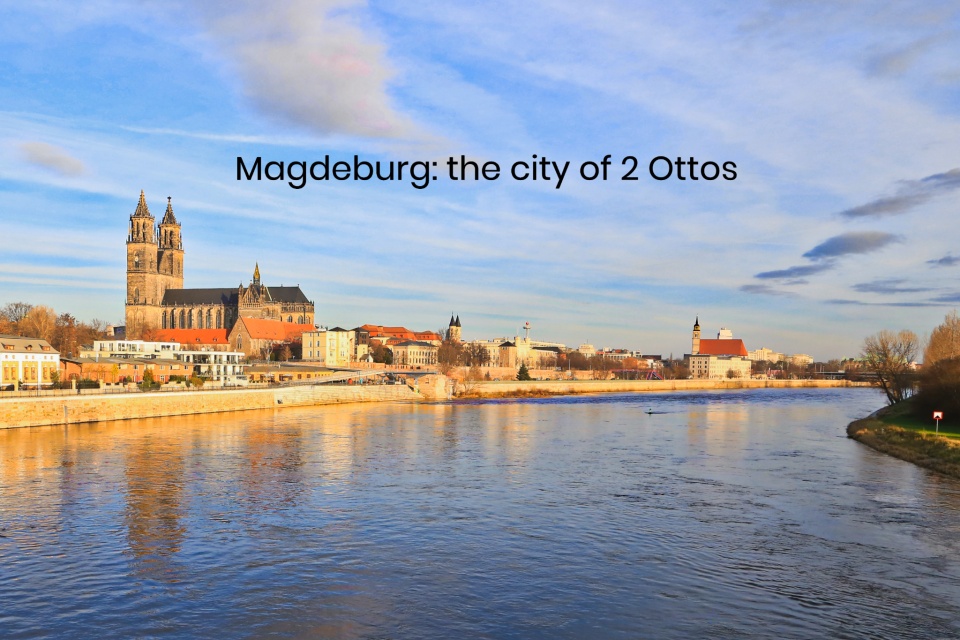
Morning view, Morgenblick, city view, Stadtblick, Hubbruecke, Elbe river, Romanesque Road, Strasse der Romanik, Magdeburg, Sachsen-Anhalt, Saxony Anhalt, Germany, Deutschland, fotoeins.com

Magdeburg: the Otto city where Romanesque meets Luther

Above/featured: From Hubbrücke bridge over the Elbe river, churches left to right are Dom, Kloster Unser Lieben Frauen, and Johanniskirche, respectively. Photo on 3 Dec 2015.

I’ve seen the city on the map, lying halfway between Hannover and Berlin. Over the last 15 years, there’ve been far too many ICE trains along that very same stretch, bypassing the heart of Saxony-Anhalt. Curiosity eventually wins, and I’m on a train to Magdeburg.

Magdeburg is the capital city of the German federal state of Saxony-Anhalt, home to two famous Ottos, a centre for the state’s Romanesque Road, and one of the stations for (Martin) Luther Country. Founded by Charlemagne in 805 AD/CE, the city is one of the oldest German cities, celebrating their 1200th anniversary in 2005. Magdeburg was an important medieval city in the Holy Roman Empire, a member of the Hanseatic League and important trade centre along the Elbe river, a welcome settlement for Jews in the 10th-century, and one of the first places to begin separating church- from civic-rule of law in the 13th-century with the Magdeburger Recht (Magdeburg Rights).

( Click here for more )

Wiki/CC3: https://de.wikipedia.org/wiki/Datei:Bernd_das_Brot_Erfurt_by_Stepro.jpg

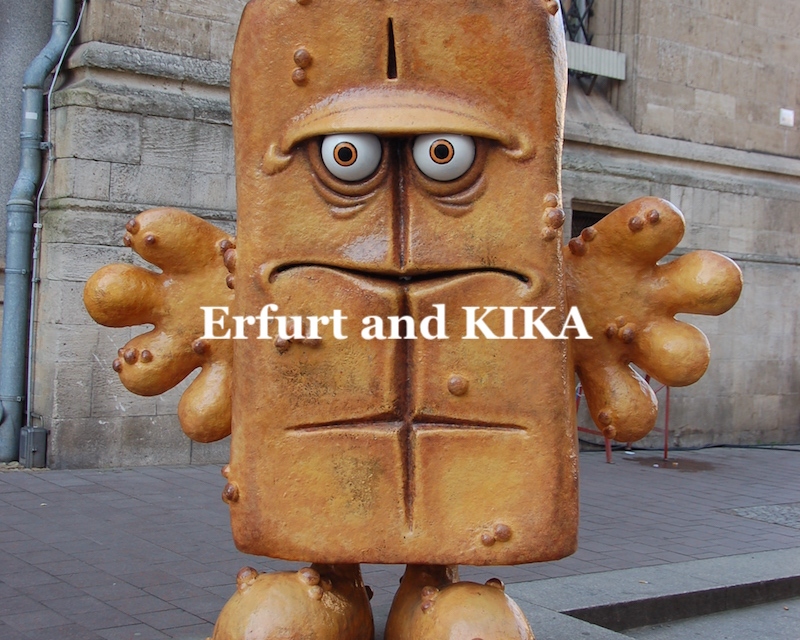
Erfurt: five KiKa character sculptures

Erfurt is the capital city for the state of Thuringia (Landeshauptstadt Thüringen) and is included among many in the Historic Highlights of Germany. As a self-described hub for children’s media, Erfurt is headquarters for the German Children’s Channel, or KInderKAnal, better known in short as KIKA. In commemoration of the channel’s tenth anniversary in 2007, sculptures representing well-loved KIKA characters sprung to “life” around town.

Kids of all ages can now cross the city looking for KIKA characters. My personal favourite is Bernd das Brot (Bernd the bread), a grumpy loaf and reluctant star of late-night tedium … “in the KIKA lounge …” It’s easy to assume I would’ve incorporated a part of the KIKA lineup as part of my early German-language instruction. The truth is there were too many late-nights in my dark one-room apartment with a small television for illumination, and more often than not, crusty Bernd was present (on continuous loop). Like a loaf of bread’s “heel” or end piece that’s undesired and ignored, it’s always there if you need it …

(Click here for images and more )

Erfurt: 12 stations through the Old Town

Above/featured: Krämerbrücke in shadow, at first light.

Located along the Gera river near the centre of Germany, Erfurt is an historical hub of east-west trade, a stop on the historical road “Via Regia” dating back to the Middle Ages, and is considered a spiritual home for Martin Luther. He left behind plenty of traces throughout the city which is now the capital city for the German state of Thuringia (Landeshauptstadt Thüringens). For its preserved medieval Old Town, half-timbered houses, and churches, Erfurt has the nickname “Thuringian Rome.”

Each of the following locations in addition to the Erfurt’s Hauptbahnhof (Central Station) is indicated with an icon in the map below. All 12 places below can be reached with tram routes 3, 4, or 6 in a common stretch with stops at Anger, Fischmarkt / Rathaus (Fish Market / City Hall), and Domplatz (Cathedral Square).


( Click here for images and more )