Fotoeins Fotografie

location bifurcation, place vs. home

Posts tagged ‘Jewish Berlin’

My Berlin: the buried Bibliothek at Bebelplatz

On a clear cool late-autumn morning, a young child is looking through an opening in the cobblestone plaza. She looks up to the man standing next to her.

Daddy, why is there a glass window? What happened here?

The thing to keep in mind is that this square in Berlin is called Bebelplatz (BAY-buhl-platz), and not Babbleplatz. It’s easy to make the mistake. After all, a great repository of books was once created inside the building seen above, in what was once home of the Königliche Bibliothek or Royal Library.

But then came along a large racist blather.

Accompanied by a big ugly fire.

( Click here for images and more )

Berlin Grunewald: no train will ever leave track 17 again

Present in the vicinity of a train station are very distinct and familiar sounds: the racket of heavy locomotives chugging down the rail and the screech of high-friction braking. A breeze sweeps through two columns of trees, creating a low keening sound which escapes into the open space beyond. To stop and listen, the sounds could easily be human: faint shouts and cries. Are they tricks of the mind, or are the dead speaking? The spectre of cruelty, despair, and suffering clings to the abandoned track; seven decades in the past don’t seem very far.

On a cool grey late-autumn afternoon, I’m on an S-Bahn train heading towards Potsdam. Beyond the limits of the “Stadtbahn” and one stop beyond the “Ring” at Westkreuz, the train pulls into the former goods and freight station at Grunewald. Dropping into the underground passage, signage points to the memorial at track 17. I leave the station by the southeast exit, and turn left to ascend the ramp along the side street.

In the Berlin borough of Charlottenburg-Wilmersdorf, Grunewald station lies on the S7 S-Bahn line serving central Berlin city, the city of Potsdam to the southwest, and Ahrensfelde to the northeast in the Berlin borough of Marzahn-Hellersdorf. Grunewald station began operation in 1879 under its original name Hundekehle named after a nature reserve nearby. The station changed its name to “Grunewald” in 1884 when the old Grunewald station began its new life as “Halensee” station. Grunewald station and its tracks were incorporated into Berlin’s S-Bahn train network in 1928.

Many companies including the Deutsche Reichsbahn (German Imperial Rail) were actively complicit in the machinery of mass murder during Nazi rule. After reunification of East and West Germany in 1990, the two separate railways also merged to form Deutsche Bahn in 1994, and calls arose for the new company to acknowledge its dark past. To mark the Reichbahn’s collaboration in deporting people to camps and their deaths, present-day Deutsche Bahn AG established a memorial at track 17. Inaugurated in 1998 the memorial was designed and built by architects Hirsch, Lorch, and Wandel who were very mindful of the 1991 Karol Broniatowski memorial near the station’s entrance.

Along track 17, metal plates have been inserted, one for every transport train which took Berlin’s Jews to their deaths. Each plate includes the transport date, the number of people deported, and the transport’s destination. The first train of record departed Grunewald on 1941 October 18 when 1251 Jews were deported to Łódź. Another plate marks the last train of record (so far) leaving Grunewald on 1945 March 27 when 18 Jews were deported to Theresienstadt; blank plates leave room for additional commemorations with new uncovered information. More than 50-thousand Jews from Berlin were deported from this station alone. The first set of trains went to concentration-camps in eastern Europe, but by the end of 1942, trains were directed to Auschwitz and Theriesenstadt.

The vegetation that’s been left to grow around the track over the years is a visible symbol and an unspoken promise to all: that no train will leave track 17 ever again.

( Click here for images and more )

Berlin: the city’s oldest Jewish Cemetery

Der Jüdische Friedhof (Old Jewish Cemetery), Grosse Hamburger Strasse

In the past, I’ve often felt guilty for taking photographs at a cemetery, as if the act of opening and closing the camera’s shutter somehow “exposes and steals” the essence of people who are laid to rest. Only in the last few years have I overcome these feelings, as I now see cemeteries as beautiful places to visit and to witness frozen snapshots to individual lives over time. On this late-autumn afternoon, I stood in the middle of the garden, transported to a different place and a different time, surrounded by tranquility and living memories.

Große Hamburger Straße (or Greater Hamburg Street) was the key central road in what was once the Spandauer Vorstadt, which was the suburb or town at the foot of the former Berlin city gates. The road allowed for trade and movement from Berlin in the direction towards the nearby town of Spandau.

According to berlin.de, the area developed around the Hackesche Market and Courtyards:

Historically, development of the Höfe went hand in hand with the growth of Berlin as a thriving urban centre. The expansion started around 1700 from an outer suburb known as Spandauer Vorstadt, located outside the Spandau City gate which already had its own church, the Sophienkirche as early as 1712. Friedrich Wilhelm I built a new city wall here and the former suburb became a new urban district belonging to Berlin. Today’s Hackescher Markt takes its name from the market built here by a Spandau city officer, Count von Hacke.

The influx of Jewish migrants and the exiled French Huguenots gave the district the cosmopolitan diversity which it never lost. The first synagogue was built in this area and the first Jewish cemetery established on the Grosse Hamburger Strasse. Another name for the area, the Scheunenviertel (barn district) is associated today with up and coming art galleries and the more bohemian side of Berlin. The largest synagogue in Germany was built in nearby Oranienburger Strasse in 1866.

In use from 1672 to 1827, this is Berlin’s oldest cemetery for the Jewish community. Buried here is Moses Mendelssohn (1729-1786), philosopher, a founding father of the Jewish Enlightenment, and grandfather to the great composer Felix Mendelssohn. During the last stages of fighting in the Second World War, 2425 dead were buried here in 16 mass graves. With no clear boundaries separating those buried in the past from those buried during the war, the new memorial garden was constructed and restored in 2007-08 with all of the buried left undisturbed as they were.

The present location was also the site of the first nursing home in 1844 for the Jewish community in Berlin. The Gestapo transformed the home in 1942 to a collection and staging point for prisoners, and ordered the destruction of the entire site in 1943. 55000 Berlin Jews from infants to the elderly were deported and murdered in the concentration camps at Auschwitz and Theresienstadt.

( Click here for images and more )

My Berlin: Shalekhet (Fallen Leaves), Jewish Museum

Above: Photo, 23 Jun 2025 (X70).

The Jüdisches Museum (Jewish Museum) in Berlin’s Kreuzberg district is one of the most visited museums in the German capital. Millions from around the world have visited the museum since its opening in late-2001. With the unique architectural vision and building design by Daniel Libeskind, the museum does not set aside the history of the Jewish community within Germany as being separate from the history of the country as a whole. Instead, there is conscious effort by Libeskind and the Museum to have visitors consider how the historical, cultural, art, literature, music, intellectual, scientific, and economic contributions from the Jewish community are tied inextricably with the history of Germany over the span of two millennia. These very issues and questions are now also driving discussions about the present state and evolution of the Turkish and other expatriate communities within Germany.

One sculpture in the museum is both poignant and disturbing.


( Click here for images and more )

Stelenfeld, field of stelae, Holocaustdenkmal, Holocaust Memorial, Berlin, Germany, fotoeins.com

My Berlin: in the field of stelae

Above/featured: Reflection – 19 Mar 2011 (450D).

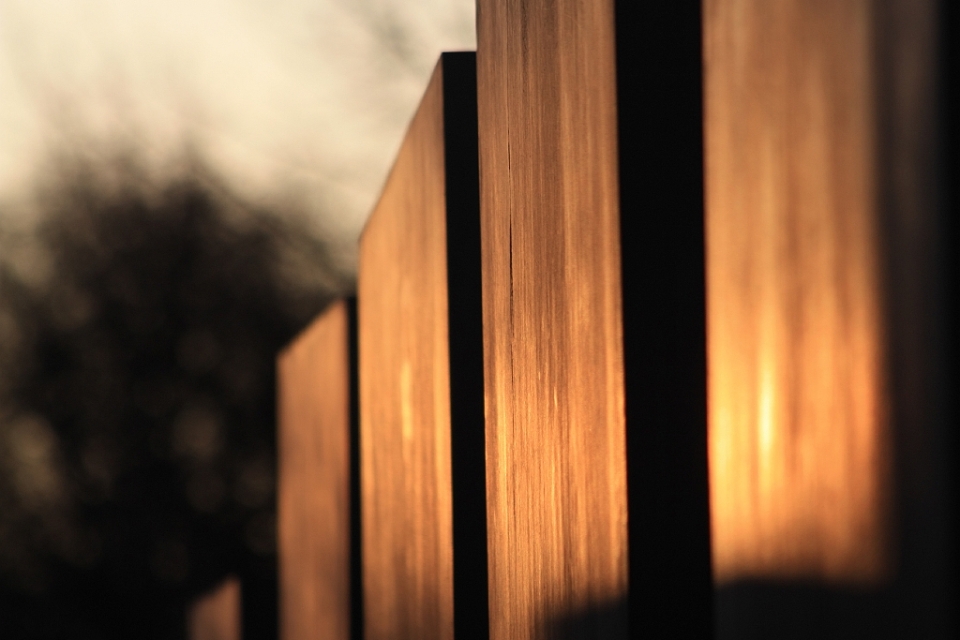
In Berlin’s Mitte district between Brandenburg Gate and Postdamer Platz is a field of standing blocks (Stelefeld).

The slabs of concrete are uniform in colour, composition, length, and width. However, the blocks stand at different heights, the curved ground below undulates, and when the slabs loom suddenly overhead, the spaces in between can be eerie, adding to feelings of confusion and disconnection.


( Click here for more )