Fotoeins Fotografie

location bifurcation, place vs. home

Posts tagged ‘Holocaust memorial’

My Prague: OlÅ¡any cemetery, search for Kafka & Palach

Above/featured: A quiet leafy avenue in Prague’s OlÅ¡any Cemetery.

I can’t spend all this time in the Czech capital city, and leave without paying any respects to two 20th-century personalities of Prague. Franz Kafka was an early 20th-century German-Czech writer (e.g., 1912 Die Verwandlung/Metamorphosis), whose writings became known to the world posthumously, thanks to friend and fellow writer Max Brod. In the 1960s, Jan Palach was an important historical figure of opposition who died in protest against the Communist regime.

I’m in the underground metro, heading east from the city centre towards Vinohrady and beyond to OlÅ¡any. The sun’s out on a crisp mid-autumn day, and while deciduous trees are left wanting for leaves, the latter have piled like carpets of colour on the cemetery grounds. I’m looking for the graves of Palach and Kafka who are buried in OlÅ¡anské hÅ™bitovy (OlÅ¡any Cemetery) and Nový židovský hÅ™bitov (New Jewish Cemetery), respectively.


( Click here for images and more )

Dachau: nie wieder, never again

Where: KZ-Dachau, 20 km northwest from Munich, Germany.
What: The blueprint by which murder became a methodical industrialized process.

I once thought I wasn’t prepared emotionally; perhaps I never would. But I couldn’t go further in my long-term examination of Germany and Jewish-German history without a visit.

It’s an overcast morning in early June, and a couple of rain showers accompany me along with a handful of other people, waiting for the site to open at 9am. A dark heavy cloak descends the moment I step through the main gate and into the site. There is dread, waiting. I promise myself to be open as much as possible, to really look and listen.

This is KZ-Gedenkstätte Dachau, the Dachau Concentration Camp Memorial Site. The abbreviation KZ is “Konzentrationslager für Zivilpersonen” or concentration camp for civilians, although the initial terminology used by the Nazi Schutzstaffel (SS) was KL for “Konzentrationslager.”

There’s a lot to absorb. And maybe, it’s best not to.

Systematic torture and unrestrained cruelty. Forced medical experiments. Arbitrary execution by hanging or gunfire. The destruction of human dignity. The annihilation of hope. This camp as a “model” to broaden the scope and scale of industrial mass-murder. The first commandant of Auschwitz in 1940, Rudolf Höss, honed a career in brutality as SS support staff and block leader at the Dachau camp in late-1934.

I had planned to stay for a few hours at most and leave around noon. I didn’t notice the time. When I finally noticed clear skies and the change in sun-angle, I check my watch. It’s almost 5pm, closing time. Eight hours have flown by outside my bubble, which begins to dissolve.

( Click here for images and more )

Vienna: Holocaust Memorial by Rachel Whiteread

Where: Judenplatz, in Vienna’s Altstadt.
What: Holocaust Memorial, by Rachel Whiteread (2000).

How do you commemorate or memorialize the absent or missing? How should the void be acknowledged, recognized, and remembered? Does the act of constructing a physical monument “draw a line”, creating a physical manifestation of marking an end that gathers and wipes away all subsequent future responsibility for remembering?

In Vienna’s Old Town, what was unjustly and violently removed from the city’s long historical memory and cultural identity comes into shape at Judenplatz. Under the public square are ruins of the medieval synagogue destroyed in the pogrom of 1421 with hundreds of Jews driven out, hundreds killed by burning, and the community erased. Directly above these ruins is the Holocaust Memorial which attempts to generate experiences and memories to address the void left behind after the systematic murder of 65-thousand people.

( Click here for images and more )

My Berlin: Shalekhet (Fallen Leaves), Jewish Museum

Above: Photo, 23 Jun 2025 (X70).

The Jüdisches Museum (Jewish Museum) in Berlin’s Kreuzberg district is one of the most visited museums in the German capital. Millions from around the world have visited the museum since its opening in late-2001. With the unique architectural vision and building design by Daniel Libeskind, the museum does not set aside the history of the Jewish community within Germany as being separate from the history of the country as a whole. Instead, there is conscious effort by Libeskind and the Museum to have visitors consider how the historical, cultural, art, literature, music, intellectual, scientific, and economic contributions from the Jewish community are tied inextricably with the history of Germany over the span of two millennia. These very issues and questions are now also driving discussions about the present state and evolution of the Turkish and other expatriate communities within Germany.

One sculpture in the museum is both poignant and disturbing.


( Click here for images and more )

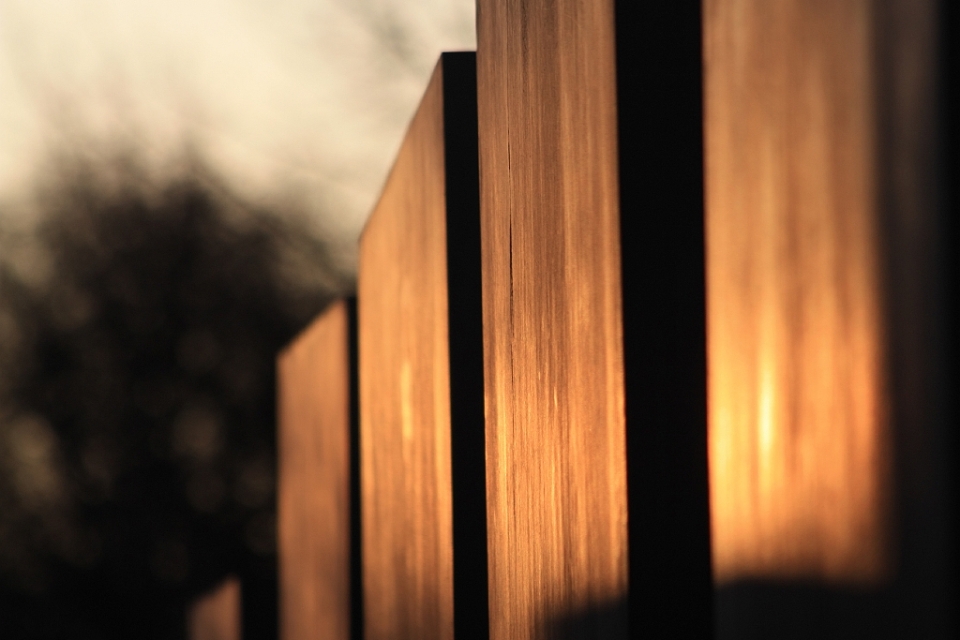
Stelenfeld, field of stelae, Holocaustdenkmal, Holocaust Memorial, Berlin, Germany, fotoeins.com

My Berlin: in the field of stelae

Above/featured: Reflection – 19 Mar 2011 (450D).

In Berlin’s Mitte district between Brandenburg Gate and Postdamer Platz is a field of standing blocks (Stelefeld).

The slabs of concrete are uniform in colour, composition, length, and width. However, the blocks stand at different heights, the curved ground below undulates, and when the slabs loom suddenly overhead, the spaces in between can be eerie, adding to feelings of confusion and disconnection.


( Click here for more )